

Latest Version
October 13, 2024
Rollic Games Oyun Yazilim ve Pazarlama Anonim Sirketi
Puzzle
iOS
0
Report a Problem
More About :game
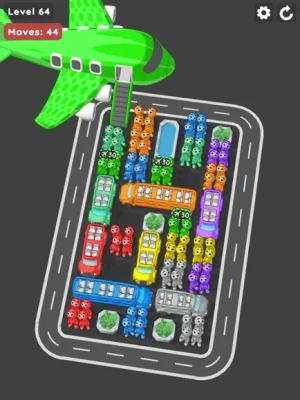
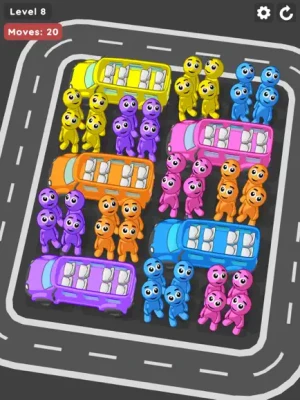
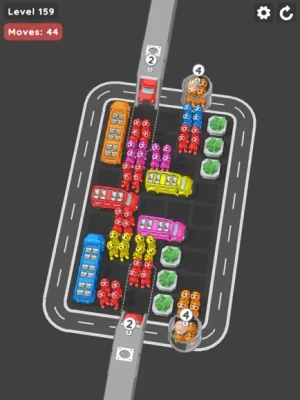
Parking Out is a casual puzzle game developed by Rollic Games. The main objective is simple: help groups of colorful passengers reach their matching transport vehicles and clear the terminal.
The difficulty comes from the limited space and the way vehicles and passenger groups interact. Buses cannot simply be moved wherever you want, so you need to carefully organize the people around the available transport.
The App Store describes the game as a challenge involving colorful people, transport vehicles, obstacles, and buses that need to be filled with eight passengers.
This creates a puzzle experience where every movement can affect what becomes possible next.
Parking Out Gameplay Overview
The gameplay revolves around matching passengers with the correct colored vehicles while keeping the terminal organized.
At first, the concept is easy to understand. As the levels become harder, however, the board can become crowded and the order in which you move groups becomes increasingly important.
A typical puzzle involves:
- Examining the terminal.
- Identifying the available passenger groups.
- Checking which vehicles are available.
- Matching passengers with their transport.
- Moving groups through the available spaces.
- Filling buses with passengers.
- Clearing obstacles.
- Managing the remaining space.
- Completing the level without creating an unsolvable position.
Main Features
Color Matching Puzzle Mechanics
Color matching is at the heart of Parking Out. Passengers need to be coordinated with the appropriate colored transport vehicles.
The mechanic is immediately understandable, but later levels require more planning because multiple groups and vehicles can compete for limited space.
Bus-Filling Gameplay
Buses are a major part of the puzzle. The game's App Store description states that buses need to be filled with eight passengers, making passenger management an important part of each challenge.
Crowded Terminal Challenges
The terminal can quickly become chaotic. Players need to organize movement carefully instead of simply sending passengers toward the first available vehicle.
Strategic Movement
Parking Out rewards players who think several moves ahead. Choosing the wrong passenger group can block access to another group or make the remaining board considerably harder.
Obstacles
Obstacles add another layer to the puzzle. Players need to clear paths and create enough room for passengers to reach their destinations.
Boosters
Later updates introduced new booster mechanics and feature progression, giving players additional tools when dealing with challenging puzzles.
New Game Modes
The game's version history shows that new game modes were introduced during its 2.0.x updates, expanding the gameplay beyond the original puzzle structure.
Advanced Puzzle Levels
Updates also added advanced levels specifically aimed at more experienced puzzle players, accompanied by increased difficulty.
Parking Out Game Theme and Atmosphere
Parking Out has a lighthearted, colorful atmosphere designed around transportation and crowd organization.
Instead of using a complicated story, the game creates its identity through colorful passenger groups, buses, terminals, and increasingly complex movement puzzles.
The bright visual presentation makes it easy to distinguish passengers and vehicles, which is particularly important when multiple colors appear on the same board.
Is There a Story in Parking Out?
Parking Out does not rely on a traditional story campaign.
There are no major characters or narrative chapters to follow. Instead, the player's goal is straightforward: organize the terminal, match passengers with the correct transport, and get everyone out.
This keeps the focus on solving puzzles rather than following a narrative.
How the Passenger System Works
Passengers are grouped according to color and need to be coordinated with the appropriate transport.
The challenge is not simply identifying matching colors. You also have to consider when a group should move.
For example, sending the wrong group first could occupy a valuable area or prevent another group from reaching its destination.
The best solutions therefore involve both:
- Color recognition
- Movement planning
How the Bus System Works
Buses are central to the game's puzzle design.
The App Store specifically notes that buses cannot move freely and must be filled with eight passengers.
That creates an interesting constraint. You are not simply solving a traditional matching puzzle; you are managing passengers around fixed transportation points.
A successful solution requires you to think about the order in which passengers reach the buses.
Beginner's Guide to Parking Out
1. Look at the Entire Board
Don't immediately move the first available passenger group.
Take a moment to understand where the buses, people, obstacles, and open spaces are located.
2. Identify the Obvious Matches
Start by determining which passenger groups have an immediate route to their matching transport.
3. Think About Space
Space is one of your most important resources.
A move that solves one problem can create another if it leaves passengers blocking a critical path.
4. Watch the Passenger Count
Because buses need eight passengers, keep track of how many suitable passengers remain for each vehicle.
5. Avoid Random Moves
If you're unsure about a move, consider what the board will look like immediately afterward.
6. Learn From Failed Levels
A failed attempt can reveal which passenger group should have been moved first.
Instead of repeating the same sequence, change your opening moves and see how the board develops differently.
Advanced Parking Out Strategy
Plan the Order of Movement
The order in which you move passenger groups can determine whether a level is easy or nearly impossible.
Try to identify the sequence that opens the most space.
Prioritize Blocking Positions
If a group is preventing several other movements, consider moving it earlier than a group with an easy route.
Preserve Flexible Spaces
Avoid filling every available area immediately. Keeping some open space can give you additional options later.
Think Beyond Color Matching
Matching colors is only one part of the puzzle. You also need to consider:
- Passenger position
- Bus location
- Available space
- Obstacles
- Movement order
- Remaining routes
Use Boosters at the Right Time
Don't waste boosters on easy levels. Save them for puzzles where they can prevent a difficult situation or open an important route.
Boosters and Progression
Boosters became an important part of Parking Out during its 2.0 update cycle.
Version 2.0 introduced new booster mechanics, while subsequent versions expanded feature progression and improved the user experience.
This gives players additional options when facing complicated boards.
A good strategy is to think of boosters as emergency tools rather than something that should be used immediately.
Game Modes
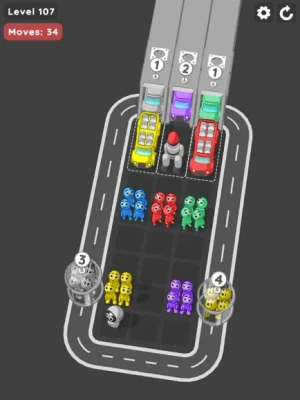
Parking Out's update history shows the addition of new game modes during August 2024.
The game therefore developed beyond its original level-based puzzle system, offering additional ways to challenge players.
Because the exact mode structure may vary by version, players should check the current in-game menu for the modes available in their installed version.
Difficulty
Parking Out begins with an accessible puzzle concept but becomes progressively more demanding.
The developer's update history specifically mentions:
- Increased difficulty
- Advanced puzzle levels
- Updated levels
- Difficulty optimization
- New mechanics
- New game modes
These changes show that the game was designed to become more challenging as players progress.
The difficulty comes primarily from planning rather than fast reflexes.
Parking Out Levels
The game received numerous level additions during its development.
Several updates introduced new levels, while later releases added advanced puzzle stages and revised existing levels. Version 2.2 also introduced new levels alongside new core mechanics and increased overall difficulty.
This means players can expect the challenge to evolve rather than simply repeat the same basic board layout.
Controls and Interface
Parking Out uses touch-based controls designed around moving groups of passengers through the terminal.
Earlier updates specifically improved the game's drag-and-drop input system and later introduced an improved input system.
The interface is intentionally straightforward, allowing players to focus on the puzzle instead of complicated controls.
Game Progression
Progression is primarily level-based.
As you advance, the game introduces more complex layouts, additional mechanics, greater difficulty, and new challenges.
The progression can be summarized as:
Solve → Advance → Learn New Mechanics → Face Harder Boards → Use Better Strategies → Repeat
This structure works well for casual players because each completed puzzle provides a clear sense of progress.
New Mechanics
Parking Out received several gameplay changes throughout its update history.
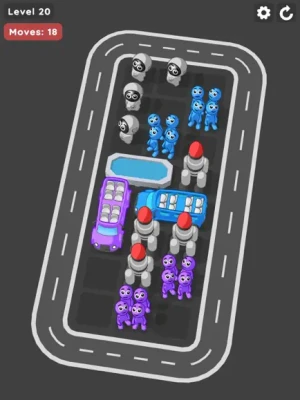
Version 1.3 introduced Space Rockets and Astronauts, while later versions introduced new game modes, boosters, feature progression, and other mechanics.
These additions helped expand the basic passenger-and-vehicle puzzle concept.
Space Rockets and Astronauts
One of the more unusual additions to Parking Out was the introduction of Space Rockets and Astronauts in version 1.3.
This update added a new theme and mechanic to the otherwise transportation-focused puzzle experience.
It is a good example of how the game experimented with additional gameplay concepts during its update cycle.
Updates and Version History
Parking Out received a series of updates throughout 2024.
Important changes included:
- Version 1.3: Space Rockets and Astronauts, new levels, and bug fixes.
- Version 1.4: Sound and visual improvements plus better drag-and-drop input.
- Version 1.6: Improved input system and updated levels.
- Version 1.7: New levels, sounds, colors, and animations.
- Version 1.8.3: Advanced puzzle levels, increased difficulty, economy and interface updates.
- Version 2.0: Difficulty optimization.
- Version 2.0.1: New booster mechanics.
- Version 2.0.2: Additional booster mechanics, progression, and UX improvements.
- Version 2.0.3: Difficulty updates, camera changes, bug fixes, and new levels.
- Version 2.0.6: Difficulty updates, camera improvements, bug fixes, and new levels.
- Version 2.0.7: Fixed buggy airplane levels.
- Versions 2.0.8 and 2.1: New game modes and updated levels.
- Version 2.1.1: New levels, camera updates, optimization, revised levels, difficulty adjustments, and bug fixes.
- Version 2.2: New core mechanics, increased overall difficulty, and new levels.
Apple's current listing displays version 2.2 dated September 24, 2024 as the latest version in the available version history.
Player Experience
Parking Out currently has a 4.5 out of 5 rating from 40 ratings on the U.S. App Store.
Player feedback is mixed in some areas.
Some users describe the game positively and enjoy its puzzle concept, while others have raised concerns about advertising frequency and particular levels that they felt contained problems or lacked a clear solution.
One review specifically complained about frequent advertisements after completing boards, while another reported difficulty with a particular level involving mismatched passenger and vehicle colors.
This feedback is useful because it shows that the game can be entertaining for puzzle fans but may occasionally frustrate players when a level's solution is difficult to identify.
Pros and Cons
Pros
- Easy-to-understand puzzle concept
- Color matching mechanics
- Bus-filling objectives
- Strategic passenger movement
- Crowded terminal challenges
- Obstacles and blockers
- Booster mechanics
- Multiple game modes
- Advanced puzzle levels
- New mechanics added through updates
- Colorful presentation
- Supports iPhone and iPad
- Free to download
Cons
- Some players have complained about frequent advertisements.
- Certain levels can be frustrating.
- Player reviews have reported possible level or progression issues.
- Optional in-app purchases are available.
- The latest displayed update is from September 2024.
Technical Details
| Detail | Information |
|---|---|
| Game | Parking Out |
| Developer | Rollic Games |
| Category | Puzzle |
| Price | Free |
| In-App Purchases | Yes |
| Rating | 4+ |
| Language | English |
| iPhone | Supported |
| iPad | Supported |
| iPod touch | Supported |
| Mac | Apple Silicon Mac compatibility listed |
| Apple Vision | Supported according to listing |
| iOS Requirement | iOS 12.5 or later |
| iPadOS Requirement | iPadOS 12.5 or later |
| App Size | 277.8 MB |
| Current Listed Version | 2.2 |
| Latest Listed Update | September 24, 2024 |
Apple lists Parking Out at approximately 277.8 MB and requires iOS 12.5 or later. It is also listed as designed for iPad.
In-App Purchases
Parking Out is free to download but includes optional purchases.
The App Store currently lists coin packs, starter and bundle options, and a Remove Ads purchase priced at $7.99 in the U.S. storefront.
Available purchases include:
- Mini Coin Pack
- Small Coin Pack
- Starter Pack
- Mini Bundle
- Medium Coin Pack
- Small Bundle
- Remove Ads
- Medium Bundle
- Big Coin Pack
- Large Bundle
Is Parking Out Free?
Yes. Parking Out is free to download, but optional in-app purchases are available.
Players can choose to progress through the game normally or purchase additional resources and other optional items.
Is Parking Out a Good Puzzle Game?
Parking Out is a good option if you enjoy casual puzzle games built around color matching, spatial organization, and movement planning.
Its strongest feature is the way a simple idea becomes increasingly complicated. Matching a passenger to a vehicle is easy; figuring out which passenger should move first is where the real puzzle begins.
The additional mechanics, boosters, advanced levels, and new modes also give the game more variety than a basic color-matching title.
Is Parking Out Difficult?
The early puzzles are relatively accessible, but the difficulty increases considerably as new mechanics and advanced levels appear.
The developer specifically introduced increased difficulty and advanced puzzles in later updates.
If you become stuck, the best approach is usually to restart and change the order of your first few moves rather than repeatedly making the same sequence.
Best Tips for Hard Levels
Study before moving: Look at every passenger group and vehicle first.
Find the bottleneck: Identify the position that is preventing the most movement.
Move strategically: The best first move is not necessarily the easiest match.
Keep space open: Don't fill every available area immediately.
Track bus capacity: Remember that the objective involves filling buses with eight passengers.
Use boosters wisely: Save them for situations where the normal solution becomes difficult.
Think backward: Start with the final transport objective and determine which passenger groups need to move first.
Accessibility
Apple's current listing states that the developer has not indicated which accessibility features Parking Out supports.
Who Should Play Parking Out?
Parking Out is particularly suitable for:
- Casual puzzle fans
- Color matching game players
- Bus puzzle enthusiasts
- Brain-game fans
- Logic puzzle players
- Players who enjoy organizing games
- Fans of spatial puzzles
- Players who like short mobile gaming sessions
- People who enjoy increasingly difficult levels
It may not be ideal for players who prefer action-heavy gameplay, deep storytelling, or competitive multiplayer.
Expert Rating
Gameplay: 8/10
Puzzle Design: 8/10
Controls: 8/10
Progression: 8/10
Visual Presentation: 8/10
Replay Value: 7.5/10
Overall: 7.9/10
Final Verdict
Parking Out takes a straightforward idea—matching passengers with their transportation—and turns it into a strategic spatial puzzle.
The game becomes increasingly interesting as the terminal gets more crowded, buses create fixed objectives, obstacles restrict movement, and new mechanics change how levels must be approached.
Its update history is particularly notable, with new levels, advanced puzzles, boosters, game modes, Space Rockets and Astronauts, camera improvements, and additional mechanics added over time.
The main weaknesses come from player-reported advertising frustration and occasional concerns about particular levels.
Overall, Parking Out is a colorful and accessible puzzle game that rewards careful planning, smart passenger movement, and efficient use of limited space.
Frequently Asked Questions
What is Parking Out?
Parking Out is a mobile puzzle game where you organize colorful passengers and matching transport vehicles to clear a crowded terminal.
Who developed Parking Out?
Parking Out was developed by Rollic Games.
Is Parking Out free?
Yes. Parking Out is free to download with optional in-app purchases.
Can I play Parking Out on iPhone?
Yes. Parking Out supports iPhone and requires iOS 12.5 or later.
Can I play Parking Out on iPad?
Yes. The App Store lists Parking Out as designed for iPad and requires iPadOS 12.5 or later.
How many passengers does each bus need?
The game's App Store description states that buses need to be filled with eight passengers.
Does Parking Out have boosters?
Yes. New booster mechanics were introduced during the game's 2.0 update cycle.
Does Parking Out have different game modes?
Yes. The version history shows that new game modes were introduced in updates 2.0.7 and 2.0.8.
Does Parking Out have advanced levels?
Yes. Updates introduced advanced puzzle levels specifically for experienced puzzle players and increased the difficulty.
Does Parking Out have in-app purchases?
Yes. The App Store lists coin packs, bundles, a starter pack, and a Remove Ads purchase.
Can advertisements be removed?
The U.S. App Store listing includes a Remove Ads in-app purchase.
What is the latest listed version of Parking Out?
The latest version currently displayed in Apple's version history is 2.2, released September 24, 2024.
Rate the Game
User Reviews














Popular Games


















 Android
 iOS
iOS Windows
 Xbox
Xbox