


Latest Version
September 15, 2026
Etermax
Puzzle
iOS
0
Report a Problem
More About :game
The game features 1,000+ hand-picked puzzles, themed collections, daily challenges, gradually increasing difficulty, relaxing music, card-dealing animations, move and time tracking, coins, and collectible content. Puzzles range from easy 3×3 boards to more challenging 5×5 layouts.
What Is Picsaw Solitaire Puzzle Game?
Picsaw Solitaire is a single-player puzzle game developed by Etermax. It takes two familiar ideas—jigsaw puzzles and solitaire-style cards—and combines them into a swipe-based photo puzzle.
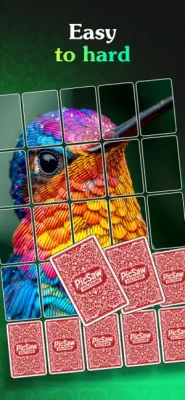
Each puzzle begins with pieces dealt onto the board like playing cards. Your objective is to move the pieces into the correct positions. When neighboring pieces belong together, they lock into place, gradually forming the complete image.
The result is a slower-paced puzzle experience designed for players who enjoy:
- Jigsaw puzzles
- Solitaire-style games
- Photo puzzles
- Relaxing brain games
- Logic puzzles
- Short casual sessions
- Offline games
- Collection-based progression
There are no countdown timers, so the game emphasizes careful thinking rather than rushing.
How Picsaw Solitaire Gameplay Works
The basic concept is simple, but solving larger boards requires more planning.
Pieces are presented as cards on a shuffled puzzle board. You can swap and slide pieces to organize the image.
The important mechanic is that adjacent matching pieces lock together. Once several pieces are connected, you can use the resulting groups as larger sections of the final picture.
This creates a satisfying progression:
Shuffle → identify pieces → move cards → connect neighbors → build sections → complete the photo
The early 3×3 puzzles are designed to be accessible, while later 5×5 puzzles require more observation and spatial reasoning.
Main Features
1. 1,000+ Photo Puzzles
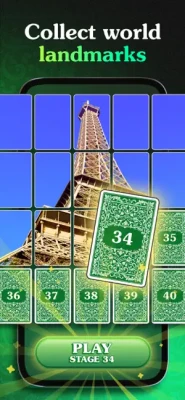
Picsaw Solitaire includes more than 1,000 puzzles across themed collections.
The large puzzle library gives the game a long-term progression system rather than relying on a small number of repeated boards.
2. Daily Challenges
Daily Challenges provide a reason to return regularly.
Instead of simply progressing through the normal puzzle collection, daily puzzles create an additional routine where you can test your skills and earn rewards.
3. 3×3 to 5×5 Puzzle Boards
Difficulty increases as the board expands.
A 3×3 puzzle contains only nine positions, making it easier to recognize patterns and establish the image.
A 5×5 board contains 25 positions, creating substantially more possible arrangements and requiring greater attention to detail.
4. Themed Collections
Completed puzzles contribute to collections that give the game a sense of long-term progression.
Coins can also be earned and used to unlock exclusive collections.
5. Move and Time Tracking
Picsaw Solitaire records your moves and completion time.
This is useful if you want to improve your own performance rather than simply finish each puzzle.
You can try to solve the same level more efficiently by reducing unnecessary movements.
6. Relaxing Presentation
The game includes card-dealing animations, music, and sound effects designed around a calm puzzle experience.
7. Offline Play
The App Store description states that Picsaw Solitaire can be played offline, making it suitable for situations where you don't have an internet connection.
Full Picsaw Solitaire Strategy Guide
Strategy 1: Don't Move Pieces Randomly
The biggest mistake beginners can make is moving cards without a plan.
Before making a move, inspect the board.
Look for:
- Similar colors
- Strong edges
- Recognizable objects
- Lines crossing between pieces
- Matching backgrounds
- Faces or distinctive shapes
- Corners of the image
A few seconds of observation can prevent several unnecessary moves.
Strategy 2: Find Obvious Image Sections First
Some photos contain highly recognizable objects.
For example, you may see:
- A bright sky
- A person's face
- A building
- A tree
- A distinctive pattern
- A large area of one color
Use these visual clues to establish the first connected section.
Once you have a reliable group, build outward from it.
Strategy 3: Pay Attention to Adjacent Pieces
Picsaw's matching mechanic makes neighboring pieces particularly important.
When you find two pieces that clearly belong together, connecting them gives you a stable reference point.
Don't immediately break a confirmed group just to experiment with another area of the board.
Build around pieces you are confident about.
Strategy 4: Solve the Corners Early
Corners are useful reference points because they have fewer possible neighboring positions.
On larger boards, identifying the four corners can help establish the overall structure of the image.
Once a corner is identified, look for pieces that logically continue its edges.
This can make the rest of the puzzle easier to organize.
Strategy 5: Use Straight Lines as Clues
Lines are among the strongest clues in photo puzzles.
Look for:
- Horizons
- Building edges
- Table surfaces
- Roads
- Borders
- Clothing patterns
- Text
- Fences
If a line continues naturally from one card to another, those pieces are strong candidates for connection.
Strategy 6: Separate Similar Colors Carefully
Large areas of similar colors can be deceptive.
A blue sky, green grass, or plain wall may contain several pieces that look almost identical.
Instead of relying only on color, inspect the exact details of the image.
Look for tiny changes in:
- Texture
- Shadows
- Brightness
- Objects
- Lines
- Patterns
This becomes increasingly important on 5×5 puzzles.
How to Solve 3×3 Puzzles
3×3 boards are ideal for learning the game's mechanics.
Because there are only nine positions, begin by identifying the obvious corners.
Then locate pieces containing:
- Major image features
- Straight borders
- Strong color changes
- Easily recognizable objects
Once you have a few pieces connected, use them as your reference structure.
Recommended 3×3 approach:
1. Find corners
2. Identify obvious edge pieces
3. Connect recognizable sections
4. Fill the remaining gaps
5. Check the complete image before making unnecessary moves
The small board means you can usually solve these puzzles through visual recognition without needing extensive planning.
How to Solve 4×4 Puzzles
The 4×4 board introduces more possible arrangements.
Start with the same fundamentals, but become more deliberate.
Focus on:
- Corners
- Long visual lines
- Strongly recognizable objects
- Color transitions
- Groups of two or three pieces
Instead of solving individual cards, start thinking in groups.
For example, if three cards clearly belong together, treat them as one section of the image.
How to Solve 5×5 Puzzles
The 5×5 boards are where careful strategy becomes more valuable.
With 25 positions, guessing can create unnecessary rearrangements.
Recommended method:
Step 1: Identify all four corners.
Step 2: Find obvious edge pieces.
Step 3: Locate the most recognizable section of the image.
Step 4: Build small groups around confirmed matches.
Step 5: Connect those groups.
Step 6: Fill the remaining spaces using color, lines, and image continuity.
Step 7: Review the whole image before making your final adjustments.
The key is to stop thinking about individual cards and start thinking about connected image sections.
How to Improve Your Move Count
If you want better puzzle statistics, focus on reducing unnecessary experimentation.
Before moving a card, ask:
"Do I have a reason for this move?"
If the answer is no, inspect the board again.
A useful improvement routine is:
First attempt: Solve naturally.
Second attempt: Notice where you made unnecessary moves.
Third attempt: Apply what you learned.
Because the game tracks moves and time, you can use your own results as a simple performance benchmark.
How to Improve Completion Time
Picsaw Solitaire doesn't use countdown timers, so you can concentrate on solving efficiently without external pressure.
To improve your time:
Scan before moving
Spend a moment looking at the entire board.
Prioritize strong clues
Don't waste time on pieces with almost identical colors.
Build groups
Connected sections reduce the number of individual pieces you need to reason about.
Avoid repeated rearranging
Constantly moving the same cards slows you down.
Learn common visual patterns
With practice, you'll recognize useful clues faster.
Daily Challenge Strategy
Daily Challenges are an excellent way to maintain a regular puzzle routine.
Instead of treating them as a race, use them to test your current ability.
After finishing a daily puzzle, consider:
- How many moves did I use?
- Which section caused the most trouble?
- Did I identify the corners quickly?
- Did I spend too much time guessing?
- Could I recognize the image faster next time?
The goal is gradual improvement rather than simply finishing as quickly as possible.
Coin and Collection Strategy
Coins are part of the game's progression system and can be used to unlock exclusive collections.
If you're interested in completing collections, avoid treating every puzzle as an isolated level.
Think of the game as having two goals:
Puzzle goal: Complete the current image.
Collection goal: Progress toward additional themed content.
This gives you a reason to keep solving puzzles even after you've become comfortable with the basic mechanics.
Beginner Mistakes to Avoid
Moving Too Quickly
The absence of timers means there is little reason to rush.
Take advantage of the relaxed format.
Ignoring the Image as a Whole
Don't examine only individual cards.
Frequently zoom out mentally and consider how the entire photo should look.
Breaking Confirmed Groups
Once pieces have clearly connected, use that group as an anchor.
Relying Only on Color
Two pieces can share similar colors without being neighbors.
Texture and image continuity are often more useful.
Chasing the Fastest Time Immediately
First learn to solve puzzles consistently.
Speed naturally improves when you stop making unnecessary moves.
Advanced Puzzle Techniques
The Anchor Method
Find one highly recognizable piece or group and treat it as your anchor.
Build neighboring pieces around it.
This is especially effective when the picture contains a distinctive central object.
The Edge Method
Use borders and corners to establish the outside structure first.
Once the perimeter becomes clearer, the center becomes easier to interpret.
The Pattern Method
Look for repeated textures.
A brick wall, wooden surface, tiled floor, or patterned fabric can provide subtle clues about which cards belong together.
The Contrast Method
Strong transitions are easier to recognize than similar colors.
Look for:
- Dark next to light
- Blue next to green
- Sky next to buildings
- Objects against backgrounds
- Text against a contrasting surface
The Group Method
Instead of thinking:
"Where does this card go?"
Think:
"Which cards form this section of the picture?"
This shift becomes increasingly useful on larger boards.
Why Picsaw Solitaire Is Relaxing
The game deliberately removes several sources of pressure found in competitive puzzle games.
There are:
- No countdown timers
- No multiplayer competition
- No need to rush
- Relaxing music
- Satisfying card animations
- Gradual difficulty
- Offline play
The result is a puzzle experience designed around concentration and relaxation rather than constant competition.
Who Should Play Picsaw Solitaire?
Picsaw Solitaire is a good match for players who enjoy:
- Jigsaw puzzles
- Solitaire games
- Photo puzzles
- Casual brain games
- Visual logic challenges
- Relaxing single-player games
- Offline puzzle games
- Collection-based progression
It is especially suitable for short sessions because you can complete a puzzle and stop without having to commit to a long game session.
Picsaw Solitaire Game Information
Game: Picsaw Solitaire Puzzle Game
Developer: Etermax
Genre: Puzzle
Mode: Single-player
Puzzle Types: Photo and card-based puzzles
Puzzle Library: 1,000+ puzzles
Grid Sizes: 3×3 through 5×5
Challenges: Daily Challenges
Progression: Themed collections and rewards
Tracking: Moves and completion time
Play Mode: Offline supported
Price: Free
Platforms: iPhone and iPad
iOS Requirement: iOS 13.0 or later
iPad Requirement: iPadOS 13.0 or later
Languages: English, Portuguese, and Spanish
Age Rating: 13+
Developer: Etermax
App Size: 301.2 MB on the current U.S. App Store listing
Contains: Advertising
Picsaw Solitaire vs Traditional Jigsaw Puzzles
Picsaw Solitaire takes the visual objective of a traditional jigsaw puzzle and changes how the pieces are presented.
Traditional Jigsaw
- Physical pieces
- Pieces are manually placed
- Large variety of physical puzzle sizes
- No card-based presentation
Picsaw Solitaire
- Digital cards
- Swipe and slide controls
- Pieces are dealt onto a board
- Matching neighboring pieces lock together
- Photo collections provide progression
- Daily challenges add recurring content
The card-based presentation is what gives Picsaw Solitaire its distinctive identity.
Frequently Asked Questions
What is Picsaw Solitaire Puzzle Game?
Picsaw Solitaire is a single-player puzzle game that combines card-style mechanics with photo jigsaw puzzles.
How many puzzles are in Picsaw Solitaire?
The App Store listing advertises 1,000+ hand-picked puzzles across themed collections.
What grid sizes are available?
The game includes puzzles ranging from 3×3 to 5×5 grids, with difficulty increasing as the boards become larger.
Does Picsaw Solitaire have daily puzzles?
Yes. The game includes Daily Challenges with new puzzles.
Does Picsaw Solitaire have a timer?
The current App Store description specifically states that there are no timers, allowing players to solve puzzles at their own pace.
Can Picsaw Solitaire be played offline?
Yes. The App Store listing describes it as an offline puzzle game.
How do the puzzle pieces work?
Pieces are dealt like playing cards and shuffled on a board. Players swap and slide them, and adjacent matching pieces lock together.
Does Picsaw Solitaire track performance?
Yes. The game tracks moves and time for each puzzle, allowing players to monitor their performance.
Can I unlock new collections?
Yes. The game includes coins and exclusive collections as part of its progression system.
Is Picsaw Solitaire available on iPhone?
Yes. The App Store listing supports iPhone and iPad, with iOS 13.0 or later required for iPhone.
Picsaw Solitaire Puzzle Game offers a refreshing variation on the traditional jigsaw formula. Its card-based presentation, swipe controls, photo puzzles, and automatic piece-locking mechanic make it easy to understand while leaving room for more careful strategy on larger boards.
The smaller 3×3 puzzles are a good introduction, while 4×4 and 5×5 boards reward players who learn to recognize corners, edges, colors, lines, textures, and connected image sections.
With more than 1,000 puzzles, Daily Challenges, themed collections, performance tracking, offline play, and a no-timer approach, Picsaw Solitaire is built around relaxed puzzle solving rather than competition.
The most effective strategy is simple: observe first, connect obvious pieces, build groups, use strong visual clues, and avoid unnecessary moves. As your pattern recognition improves, both your completion times and move counts should naturally become more efficient.
Rate the Game
User Reviews












Popular Games



















 Android
 iOS
iOS Windows
 Xbox
Xbox