






Latest Version
September 14, 2026
ABI GLOBAL LTD.
Puzzle
iOS
0
Report a Problem
More About :game
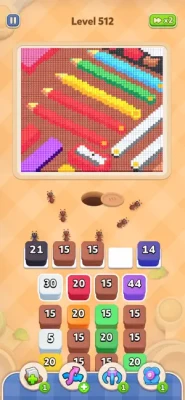
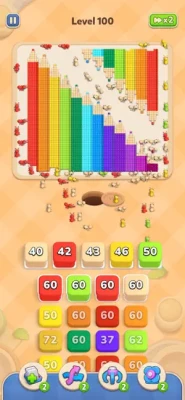
The basic idea is simple: tap a colored box, send its ants toward matching blocks on the pixel-art board, and clear those blocks until the entire picture is uncovered. The challenge comes from the limited number of available slots. Colony Flow! gives you five open slots, so choosing the wrong color at the wrong time can leave your colony stuck.
The game combines color matching, puzzle solving, spatial planning and relaxing idle-style animations. As the levels become more complicated, simply matching colors is no longer enough. You need to think several moves ahead and decide which color should be cleared first.
What Is Colony Flow!?
Colony Flow! is a single-player puzzle game from ABI GLOBAL LTD. The game is available on iPhone and iPad through the App Store and is also available on Android and Windows according to its Google Play listing. The mobile version is free with optional in-app purchases.
Each puzzle presents a colorful pixel-art image covered by blocks. Your ant colony removes matching blocks as you activate the appropriate colored boxes. Completing the puzzle gradually reveals the hidden artwork.
The game's themes include animals, fruit, food, flowers, nature, festivals, toys, rockets, castles and other colorful designs. There are no timers or lives forcing you to rush, which makes the game particularly suitable for short sessions or relaxed puzzle play.
Colony Flow! Gameplay
The controls are intentionally simple. You generally tap a box to place it into an available slot, after which the corresponding ants begin working.
The important part is not the tapping itself. It is the order in which you use the boxes.
Every move should answer one question:
Will this color actually help clear the board right now?
If the answer is no, saving that box for later is often the better decision.
As matching blocks disappear, new areas of the artwork become accessible and previously buried boxes can become available. This creates a satisfying chain reaction where one carefully planned move opens the way for another.
The Five-Slot Rule
The five-slot system is the most important mechanic to understand.
You have only a limited number of spaces for active boxes. If you fill them with colors that cannot currently reach useful blocks, the slots can remain occupied and prevent you from selecting the box you actually need.
That means a good Colony Flow! player does not simply select every box that becomes available.
Instead:
- Check the board before choosing a box.
- Look for matching blocks that the ants can reach.
- Prefer colors with an immediate purpose.
- Keep at least one slot available whenever possible.
- Avoid filling the queue with inactive colors.
- Wait for the current ants to clear a route before committing another move.
The official game description specifically warns that filling all five slots can bring the colony to a halt.
Full Colony Flow! Strategy Guide
1. Study the Board Before Your First Move
Do not start by tapping the first box you see.
Take a few seconds to inspect the artwork.
Look for:
- The colors that are closest to the colony.
- Large groups of the same color.
- Colors blocked behind another layer.
- Narrow routes that could become important later.
- Boxes that are currently exposed.
- Colors that appear to have no reachable destination.
This small pause can save an entire restart.
2. Prioritize Reachable Colors
A matching color is not automatically a useful color.
Suppose you have a blue box available, but the remaining blue blocks are completely blocked by another section of the picture. Activating blue may occupy a slot without producing meaningful progress.
A different color might have an open route and immediately remove several blocks.
Choose the second color.
The general rule is:
Reachability matters more than color availability.
3. Clear the Outer Areas First
Many boards become easier once you remove the outer or exposed sections of the picture.
Outer blocks often act as barriers. Removing them can open routes toward the middle of the artwork and expose additional colors.
When deciding between two useful moves, ask which one opens more of the board.
The move that creates a new route is usually more valuable than the move that simply removes a few isolated blocks.
4. Keep the Colony Moving
A strong sequence often looks like this:
Select → clear → open a route → select the newly useful color → clear again.
Try to maintain this rhythm.
The dangerous situation is:
Select → select → select → select → select → nothing can move.
Once all five slots are occupied by poorly timed choices, the board can become effectively locked.
5. Do Not Waste a Slot
Before activating a box, ask:
- Where are its matching blocks?
- Can the ants reach them now?
- Will another color need that route first?
- Does activating this box help expose another area?
- Am I leaving enough room for the next important move?
If you cannot answer these questions, waiting is usually safer.
6. Watch for Buried Boxes
Some boxes are not immediately accessible because other boxes are positioned above them.
Clearing the correct color can expose the next box you need.
This means the puzzle is partly about planning the queue and partly about unlocking the queue.
Do not judge a level only by the boxes visible at the beginning.
Think about what becomes available after each successful clear.
7. Count Remaining Blocks
Experienced players should start mentally estimating how many blocks of each color remain.
For example:
- Red: large amount remaining
- Yellow: almost finished
- Blue: blocked
- Green: immediately reachable
In this situation, green may be the best move even if red appears to be the dominant color.
The goal is not to use the biggest group first.
The goal is to create the safest sequence.
8. Protect Important Routes
Some paths are more valuable than others.
If one color needs to travel through a narrow opening, avoid filling the board around that opening with unnecessary colors.
Think of important paths as roads through your colony.
Keep the major roads open until the colors that depend on them have finished their work.
9. Finish Small Groups Carefully
Small color groups can be deceptively important.
A color with only a few remaining blocks might be the final piece needed to expose a buried section of the artwork.
Do not automatically ignore small groups because they appear less productive.
Instead, consider whether clearing them changes the board structure.
10. Do Not Rush
Colony Flow! deliberately removes some of the pressure normally found in mobile puzzle games. The App Store description emphasizes that there are no timers or lives, allowing players to take their time and plan their moves.
Use that advantage.
If you are unsure between two moves, stop and inspect the board again.
A few seconds of planning is better than filling your final slot with a useless color.
Advanced Colony Flow! Tips
Think Two or Three Moves Ahead
Do not ask only:
“What can I clear now?”
Ask:
“What will become available after I clear this?”
That second question is what separates casual play from efficient puzzle solving.
Use the Slot System as a Resource
Treat the five slots like limited inventory.
Every occupied slot has a cost.
A useful color that can immediately work is a good investment.
A color that cannot reach anything yet is a liability.
This mindset becomes increasingly valuable on difficult boards.
Look for Chain Reactions
The best move is sometimes the one that does not remove the most blocks immediately.
Instead, it may expose:
- A new box.
- A new route.
- A blocked color.
- A large cluster.
- A previously unreachable part of the picture.
Those chain reactions can turn a difficult position into a simple one.
Avoid Panic Tapping
When several boxes become available, resist the temptation to tap rapidly.
Colony Flow! rewards deliberate decisions rather than speed.
Look at the board, identify the next useful color, then commit.
Restart When Your Position Is Truly Blocked
If every slot is occupied and none of the active colors can make meaningful progress, continuing to tap randomly rarely helps.
A restart can be faster than trying to recover from a bad sequence.
The best walkthrough strategies for the game similarly emphasize scanning the board first, planning the order of moves and avoiding blocked slots.
Colony Flow! Level Strategy
Because individual boards can require different color orders, there is no single sequence that works for every level.
Instead, use this repeatable process:
Step 1 – Identify the open colors
Find the boxes that are currently available.
Step 2 – Find their destinations
Look at the artwork and identify which matching blocks can actually be reached.
Step 3 – Choose the safest first move
Prefer a move that immediately clears blocks and opens another route.
Step 4 – Wait for the route to develop
Let the ants finish enough work to reveal the next useful option.
Step 5 – Reassess the board
Do not blindly follow the original plan if the board has changed.
Step 6 – Preserve an empty slot
Whenever possible, avoid filling all five spaces.
Step 7 – Finish the remaining colors
Once the major routes are open, clear the remaining small groups and complete the pixel-art picture.
How to Beat Difficult Colony Flow! Levels
Hard levels are usually less about fast reactions and more about sequencing.
Try this approach:
Outer area → accessible color → newly exposed route → buried color → center → cleanup
This is not a universal move order, but it is a useful planning framework.
On complicated boards, first determine which color is acting as the physical barrier. Clearing that color may open several other options at once.
What to Do When You Are Stuck
If your Colony Flow! level seems impossible, check these five things:
1. Are all five slots occupied?
If yes, determine whether any active color can actually continue working.
2. Did you activate a color too early?
A color may match the picture but still be unreachable.
3. Is a route blocked by another color?
You may need to clear the blocking color first.
4. Is there a buried box you have not exposed?
Look at what the next successful clear could reveal.
5. Did you stop watching the board?
After every major clear, reassess the entire puzzle.
For exact level solutions, video walkthroughs can be particularly useful because the board layout and box order matter. Current third-party walkthrough libraries publish level-specific video guides and written strategies for many Colony Flow! stages.
Colony Flow! Features
- Relaxing ant colony puzzle gameplay
- Simple one-tap controls
- Color-matching mechanics
- Five-slot management
- Pixel-art pictures to uncover
- Hundreds of colorful puzzle themes
- Animals, food, flowers, nature and other artwork
- No timer
- No lives
- Gradually increasing puzzle difficulty
- Satisfying ant animations
- Relaxing music
- Single-player gameplay
- Offline play is listed on the Google Play version
Colony Flow! Difficulty
The early levels are designed to teach the basic relationship between boxes, ants, colors and the hidden artwork.
Later puzzles require more planning because the available slots become more important and the order of your choices can determine whether the colony continues working.
The difficulty does not come from complicated controls. It comes from making the right decision before you commit a limited slot.
That makes Colony Flow! a good choice for players who enjoy casual puzzle games but still want something that rewards careful thinking.
Colony Flow! Atmosphere
One of the game's biggest strengths is its relaxed presentation.
The tiny ants marching across the colorful artwork give each successful move a satisfying sense of progress. Instead of creating pressure with a countdown clock, Colony Flow! lets players watch the colony work while gradually revealing the completed pixel-art image.
The result is a puzzle experience that feels more like a quiet brain teaser than a stressful challenge.
Colony Flow! Pros and Cons
Pros
- Very easy to learn
- Relaxing presentation
- Satisfying ant animations
- Clever slot-management mechanic
- Colorful pixel-art rewards
- No timers or lives
- Works well for short play sessions
- Later puzzles provide meaningful planning challenges
Cons
- Some boards can become frustrating after a poor move order
- Limited slots make mistakes costly
- Players looking for fast action may find the pace slow
- Optional purchases and advertising are part of the mobile experience
- Some players have reported concerns about ads and changes to reward options in recent reviews.
Is Colony Flow! Worth Playing?
Yes, especially if you enjoy color-matching puzzles, brain teasers, relaxing mobile games and pixel-art challenges.
The game has a simple concept, but the five-slot system gives it more strategic depth than its cute presentation initially suggests. You can understand the controls almost immediately, yet difficult boards can still require careful planning.
It is particularly well suited to players who prefer puzzle games without timers or constant pressure.
Colony Flow! Ratings and Player Feedback
The U.S. App Store listing currently shows 4.7 out of 5 from around 16,000 ratings, while the Google Play listing shows approximately 4.6 stars from more than 35,000 reviews and over 1 million downloads. Ratings can change as new reviews arrive.
Recent player feedback is generally positive about the relaxing puzzle design, although some users have criticized advertising, reward changes and aspects of customer support.
Colony Flow! Frequently Asked Questions
Is Colony Flow! free?
Yes. The App Store lists Colony Flow! as free with optional in-app purchases.
What is the goal of Colony Flow!?
The goal is to use colored ant boxes to remove matching blocks from the pixel-art board until the entire picture is cleared.
How many slots do you get in Colony Flow!?
The core puzzle mechanic provides five open slots. Filling them with poorly timed colors can stop your colony from progressing.
Is Colony Flow! timed?
No. The official description states that there are no timers or lives, so you can take your time planning each puzzle.
Can I play Colony Flow! offline?
The Google Play listing identifies Colony Flow! as an offline puzzle game.
What makes Colony Flow! difficult?
The main challenge is choosing the correct order of colors while managing the five available slots. A color can be useful later but harmful if selected before its route is ready.
Does Colony Flow! have pixel art?
Yes. Completing puzzles reveals colorful pixel-art pictures featuring themes such as animals, fruit, food, flowers, nature, festivals, toys, rockets and castles.
Are there Colony Flow! level walkthroughs?
Yes. Various player-made walkthrough resources provide level-specific written solutions and video guides. Because individual board layouts can differ, use the exact level number and compare the board before following a solution.
Final Verdict
Colony Flow! takes a simple idea—send ants toward matching colors—and turns it into a surprisingly thoughtful puzzle experience.
Its biggest strength is the balance between relaxation and planning. The colorful pixel art and cute ant animations make the game approachable, while the five-slot system forces you to think carefully about every important move.
If you enjoy relaxing puzzle games, color sorting, pixel-art challenges, brain teasers and strategy-based mobile games, Colony Flow! is well worth trying.
The key lesson is simple:
Don't just ask which color you can use. Ask which color keeps the entire colony moving.
Rate the Game
User Reviews















Popular Games



















 Android
 iOS
iOS Windows
 Xbox
Xbox