








Latest Version
September 14, 2026
Cedar Games Studio
Puzzle
iOS
0
Report a Problem
More About :game
The game mixes relaxing merge gameplay with investigation, exploration, town rebuilding, and an evolving story. It features hundreds of levels and more than 500 different objects, while new themed adventures and cases add variety to the experience.
Mystery Town: Merge Games Overview
Mystery Town is built around a simple idea: merge items to create better items, then use those upgraded objects to complete tasks and advance the story.
At first, the board may look straightforward, but the limited space and energy system make planning increasingly important. Instead of blindly merging everything as soon as possible, successful players learn which objects should be combined immediately, which should be saved, and which items are worth keeping for future orders.
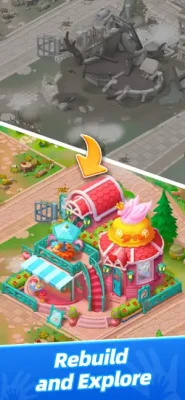
The adventure also extends beyond the merge board. Completing tasks contributes to rebuilding the town, opening new locations, progressing through cases, and revealing more of Aurora's investigation.
Key Features
- Merge matching objects into higher-level items
- Complete orders and story objectives
- Explore hundreds of levels
- Discover more than 500 different objects
- Search for clues connected to the town's mystery
- Unlock new areas and themed adventures
- Restore damaged buildings and locations
- Meet characters connected to the story
- Investigate cases and uncover hidden information
- Manage energy, board space, coins, and valuable resources
- Play a combination of puzzle, mystery, and town-restoration gameplay
The game is currently listed for iPhone and iPad on the App Store, while the Google Play listing also identifies Android and Windows availability. The App Store lists iOS 15.0 or later as the minimum iPhone/iPad requirement.
The Story of Mystery Town
The story follows Aurora, who arrives at her uncle's home expecting answers but instead finds herself pulled into a much stranger situation.
Her uncle has disappeared, and mysterious events surrounding the town suggest that there is more going on than a simple disappearance. Strange clues, suspicious characters, unexplained incidents, and hidden locations gradually become part of the investigation.
Rather than solving the mystery through traditional detective gameplay, you advance by completing merge objectives and discovering items that help move the investigation forward.
The story gives the merging system a purpose: you're not simply combining objects for points. Your work on the board helps Aurora investigate the town and get closer to the truth.
How the Merge System Works
The central mechanic is easy to understand.
Find matching objects, drag them together, and create an upgraded version. Higher-level objects are generally more useful and can satisfy more demanding orders.
The challenge comes from deciding when to merge.
A common mistake is to merge every available item immediately. This can leave the board filled with awkward single items or remove objects that could have been useful for a current order.
A better approach is to look at your active orders first.
Basic Merge Strategy
- Check your current orders.
- Identify which item chains are required.
- Find the objects that generate those items.
- Merge only when the resulting item is useful.
- Keep valuable intermediate items when another order may need them.
- Clear unnecessary objects when the board becomes crowded.
- Use energy carefully rather than spending it all on one objective.
This small change in thinking makes the game much easier to manage.
Full Strategy Guide
1. Check Orders Before Spending Energy
Your orders tell you what the board is actually working toward.
Before tapping generators repeatedly, inspect the requested items. If an order needs a particular object chain, concentrate on that chain instead of producing random items.
This reduces wasted energy and keeps your board under control.
2. Do Not Merge Automatically
Merging feels satisfying, but bigger isn't always better at the exact moment you create the item.
If you merge an item that another order needs at a lower level, you may have to produce the entire chain again.
Before making a large merge, ask:
Will this item help me complete an order now, or am I creating it simply because I can?
That one question can prevent a lot of unnecessary work.
3. Protect Your Board Space
Board management becomes increasingly important as your collection grows.
Try to keep groups of related items together. For example, keep objects from the same production chain in one area rather than scattering them around the board.
A tidy board makes matching easier and lets you recognize useful combinations immediately.
When several spaces become occupied by low-value objects, consider whether they are actually contributing to your current objectives.
4. Plan Around Energy
Energy is one of the most important resources in Mystery Town.
Many actions require energy, so spending everything as soon as the meter fills can create a long waiting period later.
A smarter routine is to:
- Spend energy on the most important active order.
- Avoid unnecessary generator taps.
- Finish objectives efficiently before starting unrelated chains.
- Take advantage of energy rewards when available.
- Return to the game when energy has regenerated.
Recent player feedback also highlights energy requirements as one of the more important progression considerations at higher stages, making efficient energy use increasingly valuable.
5. Think Several Merges Ahead
Don't focus only on the next merge.
If you need a high-level item, mentally follow the chain backward.
For example:
Final Item → Intermediate Item → Lower-Level Item → Starting Material
This helps you estimate how many basic objects you'll need before you start consuming energy.
Planning the chain first is particularly useful when the requested item requires several upgrades.
6. Keep Useful Intermediate Items
A medium-level object may look unimportant compared with a higher-level item, but it can become useful for another order.
Avoid merging every pair simply to make the board look cleaner.
Keep a few strategically useful intermediate objects when you have enough board space.
7. Use the Board as a Workspace
Organize the board rather than treating it like a random storage area.
A practical arrangement is:
- One area for active order items
- One area for newly generated materials
- One area for higher-level objects
- One area for temporary storage
This makes it much easier to spot possible merges.
8. Prioritize Orders That Unlock Progress
Not every task has equal strategic value.
When several objectives are available, prioritize the ones that contribute directly to:
- Story progression
- Building restoration
- New area unlocks
- Important investigations
- Valuable rewards
Completing useful objectives is generally better than spending your limited resources simply to create impressive-looking items.
9. Save Valuable Resources
Coins, diamonds, energy, and special rewards should be treated as progression tools rather than emergency buttons.
Don't spend premium currency simply because an item is taking longer than expected.
Save valuable resources for moments where they provide a meaningful advantage, particularly when you're close to completing an important objective.
10. Pay Attention to Clues
Mystery Town isn't only about producing objects.
Clues are part of the larger investigation, and the story can introduce evidence through the objects and cases you encounter.
When an investigation objective appears, slow down and read what the game is asking you to discover. The clues help connect the merge gameplay with the mystery surrounding Aurora and her uncle.
11. Follow the Story Instead of Ignoring It
It can be tempting to treat Mystery Town as another casual merge game and skip the narrative.
That's a missed opportunity.
Characters, cases, locations, and clues give context to your objectives. Following the story also makes the restoration and exploration systems feel more meaningful.
12. Unlock New Areas Efficiently
New areas provide more than visual changes. They expand the adventure and introduce additional objectives and discoveries.
When a new location becomes available, focus on the requirements needed to unlock it instead of spreading your resources across too many unrelated tasks.
13. Restore Buildings With a Purpose
Town restoration is one of the game's major progression systems.
Use the rewards earned from completed orders to improve damaged parts of the town. Restoring locations also gives the overall adventure a sense of progress: the world gradually changes as Aurora's investigation moves forward.
14. Handle Difficult Orders Carefully
When an order suddenly requires a high-level item, don't panic.
Break it into smaller steps.
Ask:
- What is the final requested item?
- What item produces it?
- What lower-level items are required?
- Which generator provides those materials?
- How much energy will the process probably require?
- Do I already have part of the chain stored?
This turns a difficult order into a manageable checklist.
15. Avoid Wasting the Last Board Spaces
A nearly full board can make even simple merges frustrating.
When you have only a few spaces remaining, stop generating new materials unless you know exactly where they will go.
Merge existing items first, complete an order if possible, and create room before continuing production.
16. Use Events as Opportunities
Mystery Town regularly introduces themed adventures and events. These can provide additional objectives and a change from the main progression.
When an event appears, check its requirements before spending resources. Some event objectives can compete with your normal progression for the same limited resources.
Play them when the rewards justify the investment.
Best Beginner Tips
If you're just starting Mystery Town, these are the most useful habits to develop:
Tip 1: Always check orders before producing items.
Tip 2: Don't merge automatically.
Tip 3: Keep your board organized.
Tip 4: Protect your energy.
Tip 5: Save premium currency whenever possible.
Tip 6: Keep useful intermediate objects.
Tip 7: Prioritize objectives that advance the story or restore the town.
Tip 8: Read clues and character dialogue instead of treating them as decoration.
Tip 9: Think about the complete merge chain before starting a large order.
Tip 10: Don't let your board become completely full before you reorganize it.
Advanced Merge Strategy
Once you understand the basics, the biggest improvement comes from resource forecasting.
Suppose an order requires a high-level object. Rather than immediately tapping every available generator, first estimate how many basic materials you'll need.
Then consider what is already sitting on the board.
If you already possess half of the required chain, your next priority should be generating only the missing pieces.
This approach saves energy and prevents the board from filling with unnecessary items.
The Three-Question Rule
Before spending energy, ask:
What do I need?
Identify the exact requested object.
What produces it?
Find the correct item chain or generator.
What can I finish with what I already have?
Use existing board pieces before generating more.
This simple process is one of the best ways to make steady progress without wasting resources.
How to Manage a Crowded Board
A crowded board is usually a sign that you're producing faster than you're completing objectives.
When this happens:
- Stop generating new items.
- Look for immediate merges.
- Complete any order that is already possible.
- Remove or use low-value objects where appropriate.
- Group similar items together.
- Resume production only after creating enough space.
Don't measure progress by how many objects you create. Measure it by how efficiently those objects become completed objectives.
Energy Management Guide
Energy is effectively your activity budget.
Instead of treating energy as something that should always be spent immediately, treat it as a resource that should produce measurable progress.
Good Energy Spending
- Producing an item required by an active order
- Completing a story objective
- Unlocking meaningful progression
- Working toward an important restoration task
Poor Energy Spending
- Producing random objects without a target
- Repeatedly generating materials you don't currently need
- Chasing a merge simply because it is available
- Filling the board without a clear plan
The most efficient players aren't necessarily the ones who play the longest. They are the ones who get more useful progress from each energy point.
Mystery Investigation Tips
The mystery side of the game rewards patience.
When Aurora encounters a suspicious character or new clue, pay attention to the information presented. Characters can have different relationships with the investigation, and the story is designed around discovering what is actually happening in the town.
Keep track of:
- New characters
- Suspicious behavior
- Newly discovered locations
- Important clues
- Story objectives
- Unusual objects
- Major changes in the town
The investigation becomes easier to follow when you treat these details as pieces of one larger story.
Town Restoration Strategy
Restoring the town is more satisfying when you think of it as long-term progression.
Rather than rushing every available decoration or improvement, concentrate on the restoration objectives connected to your current storyline.
Each completed order should ideally do at least one of three things:
Advance the story → unlock something → improve the town.
If an action doesn't contribute meaningfully to any of those goals, consider saving your resources.
Common Mistakes to Avoid
Merging Without Checking Orders
This can leave you with the wrong items at the wrong time.
Spending Energy on Everything
Energy disappears quickly when you generate materials without a clear objective.
Filling Every Board Slot
A full board reduces your ability to create the combinations you actually need.
Spending Premium Currency Too Quickly
Premium resources are more valuable when saved for genuinely useful situations.
Ignoring Intermediate Items
A medium-level object may become essential for another order.
Focusing Only on the Highest-Level Items
Large merges aren't automatically efficient if they don't help your current objectives.
Ignoring the Story
The mystery and character development are major parts of what separates this game from a basic merge puzzle.
Is Mystery Town: Merge Games Worth Playing?
If you enjoy merge games with a story, Mystery Town has a lot to offer. The combination of object merging, mystery cases, clue hunting, exploration, and town restoration gives the basic merge formula more purpose.
The strongest part of the experience is the way different systems connect. Your merges produce items, items complete orders, orders support restoration, and progression gradually reveals more of Aurora's investigation.
The main consideration is resource management. Player reviews on Google Play show that some players find later energy requirements demanding, so the game is better suited to people who don't mind taking their time or carefully managing limited resources.
Pros and Cons
Pros
- Engaging mystery premise
- Simple but satisfying merge mechanics
- Large variety of objects
- Story-driven progression
- Town restoration system
- Character-focused investigation
- New themed adventures and cases
- Relaxing gameplay style
- Plenty of long-term objectives
Cons
- Energy can become restrictive during longer sessions
- Higher-level orders require more planning
- Board management becomes increasingly important
- Some progression can feel slow if resources are poorly managed
- In-app purchases are available
Mystery Town: Merge Games Game Information
Game: Mystery Town: Merge Games
Developer: Cedar Games Studio
Genre: Puzzle / Merge / Adventure
Main Gameplay: Match, merge, investigate, restore
Mode: Single-player
Platforms: iPhone, iPad, Android and Windows
Age Rating: 13+ on the U.S. App Store
Languages: English, German, Japanese, Korean, Simplified Chinese and Traditional Chinese
App Store Size: Approximately 462 MB
Business Model: Free to play with optional in-app purchases
The App Store currently lists the game under the Puzzle category, while Google Play describes it as a puzzle/merge game and reports more than 5 million downloads.
Frequently Asked Questions
What is Mystery Town: Merge Games?
Mystery Town: Merge Games is a merge puzzle adventure centered around Aurora's investigation into her uncle's disappearance. Players merge objects, complete orders, uncover clues, restore locations, and progress through the story.
How do you play Mystery Town?
You drag matching objects together to create upgraded items. Those items can then be used to complete orders, progress through the story, restore buildings, and investigate new mysteries.
What is the main goal in Mystery Town?
The long-term goal is to help Aurora uncover the truth surrounding her uncle's disappearance while restoring the town and completing the various cases and objectives along the way.
How do you get better at Mystery Town?
The most important skills are energy management, board organization, order prioritization, and planning merge chains before you start producing items.
Should I merge everything immediately?
No. Check your orders first. Sometimes keeping lower-level or intermediate objects is more useful than immediately combining them.
How do you save energy in Mystery Town?
Only generate materials that contribute to a current objective, avoid unnecessary production, and plan your merge chain before spending energy.
Does Mystery Town have a story?
Yes. The game follows Aurora as she investigates her uncle's disappearance and uncovers secrets involving the town and its inhabitants.
Does Mystery Town have different areas?
Yes. Progression includes new areas and themed environments, including locations such as the mansion and harbor.
Can you play Mystery Town offline?
The current Google Play listing identifies the game as a single-player title, but player feedback has reported that an internet connection may be required in practice. If offline play is important to you, check the game's current requirements on your device before relying on it.
Final Verdict
Mystery Town: Merge Games is a good choice for players who want more than a traditional match-and-merge puzzle. Its mystery storyline, clue hunting, character interactions, exploration, and town restoration give each merge a larger purpose.
The best way to play is patiently: study your orders, protect your energy, keep the board organized, and think several merges ahead. Once you stop treating every available merge as something that must be completed immediately, the game becomes much easier to manage.
For players who enjoy merge puzzles, mystery games, relaxing mobile adventures, investigation stories, and town-building mechanics, Mystery Town offers a particularly interesting combination of genres.
Rate the Game
User Reviews













Popular Games


















 Android
 iOS
iOS Windows
 Xbox
Xbox