

Latest Version
September 15, 2026
Etermax
Puzzle
iOS
0
Report a Problem
More About :game
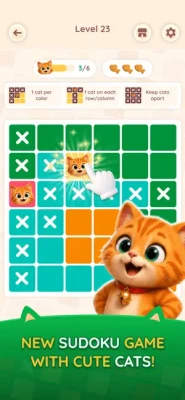
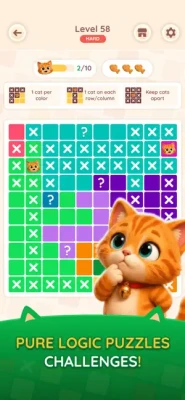
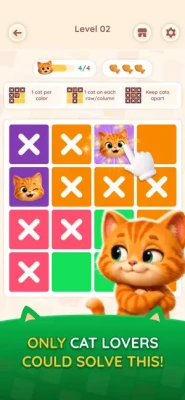
The game is designed around logic rather than guessing. You eliminate impossible positions, narrow down the remaining choices and gradually uncover the unique solution.
Sudocat combines ideas associated with Sudoku-style deduction and Minesweeper-like clue reading while keeping the presentation relaxed and approachable. The current listings advertise hundreds of handcrafted puzzles, offline play and short sessions designed for focused brain training.
What Is Sudocat Brain Logic Puzzle?
Sudocat is a puzzle game developed by Etermax where cats replace the traditional numbers found in many logic-grid games.
The objective is straightforward:
Find the correct position for every cat.
The challenge comes from interpreting the clues surrounding the board.
Instead of guessing which square looks right, you progressively eliminate positions that cannot work. Each deduction gives you more information about the remaining cats until the entire puzzle falls into place.
The developer describes every puzzle as having one solution that can be reached through reasoning alone.
How to Play Sudocat
The basic rules are easy to learn, but the puzzles become more demanding as the layouts become more complex.
Step 1: Study the Board
Don't immediately place a cat.
First, scan the entire puzzle and identify the clues that provide the most information.
Step 2: Read the Clues
Look at the numbers and positions around the cats and determine what they tell you about possible locations.
Step 3: Eliminate Impossible Squares
If a clue makes a particular position impossible, mentally remove it from consideration.
Step 4: Find Forced Positions
Eventually, one cat may have only one possible location.
That is your strongest move.
Step 5: Repeat the Process
Every confirmed position gives you additional information.
Continue eliminating possibilities until all cats have been placed.
Full Sudocat Strategy Guide
1. Never Guess
The most important rule is also the simplest:
Don't guess.
The game is specifically designed so that puzzles can be solved through deduction rather than luck.
If you reach a point where two positions seem equally possible, you probably haven't extracted enough information from the surrounding clues yet.
Go back and look for another deduction.
2. Start With the Strongest Clue
Not every clue is equally useful.
Look for clues that immediately restrict the number of possible positions.
A clue that leaves only one or two realistic possibilities is much more valuable than one that leaves several.
Starting with the strongest information reduces the puzzle quickly.
3. Eliminate Before You Place
A common beginner mistake is trying to determine where every cat is immediately.
A better approach is to determine where cats cannot be.
For example:
- Position A is impossible.
- Position B is impossible.
- Position C is impossible.
- Only Position D remains.
Therefore, D must be correct.
This elimination method is the heart of deduction puzzles.
4. Look for Forced Moves
A forced move occurs when only one location remains possible for a particular cat.
Whenever you find one, take advantage of it immediately.
A forced placement can unlock several new deductions elsewhere on the board.
5. Recheck the Board After Every Placement
Don't continue following the same mental plan after placing a cat.
The board has changed.
That means previously uncertain clues may now become obvious.
After each important deduction:
Stop → scan → eliminate → continue.
This simple habit can make difficult boards much easier.
6. Work From the Most Constrained Area
When a puzzle becomes difficult, don't necessarily work from the top-left corner toward the bottom-right.
Instead, identify the area with the fewest remaining possibilities.
Highly constrained areas contain more useful information.
Solving them can unlock the rest of the board.
7. Use Cross-Checking
If a cat appears to have several possible positions, compare those positions against other clues.
Ask:
- Would this placement conflict with another clue?
- Does another cat already need that area?
- Does placing this cat eliminate a possibility elsewhere?
- Does the clue still make sense after this placement?
Cross-checking prevents premature decisions.
8. Think in Relationships
Sudocat isn't just about individual cats.
Each placement affects the possibilities of other cats.
Think of the puzzle as a network:
Clue → possible positions → elimination → forced placement → new clue information
The more connections you notice, the easier the puzzle becomes.
9. Don't Focus Only on One Cat
A stubborn cat may not be the best place to continue.
If you can't determine its position, move to another part of the board.
Solve something else first.
The new information may eventually make the difficult cat obvious.
10. Use the "One Remaining Option" Rule
Whenever a cat has only one legal position left, you've found a guaranteed deduction.
Likewise, if a particular position can contain only one possible cat, that position is effectively solved.
These two situations are among the most useful patterns to recognize.
Advanced Sudocat Techniques
Candidate Elimination
For more difficult boards, mentally maintain a small list of possible locations for each uncertain cat.
For example:
Cat A: 2 possible positions
Cat B: 3 possible positions
Cat C: 1 possible position
Cat C should be your immediate priority.
Once Cat C is placed, revisit A and B.
Constraint Chains
Sometimes one deduction doesn't immediately solve a cat, but it reduces another cat's possibilities.
You can think of the sequence like this:
A cannot go here → B loses an option → C becomes forced → A becomes solvable
This type of chain is particularly useful on harder puzzles.
Contradiction Checking
When you're unsure about a possibility, examine what would happen if that position were true.
If it would create an impossible arrangement elsewhere, the assumption can be eliminated.
Importantly, this doesn't mean randomly guessing.
You're using the consequences of a possibility to determine whether it is logically valid.
Sudocat Beginner Tips
Tip 1: Scan Before Acting
Spend a few seconds understanding the board before making your first move.
Tip 2: Find the Easiest Deduction
Don't start with the hardest cat.
Look for the most restricted position.
Tip 3: Eliminate Aggressively
Removing impossible choices is often easier than finding the answer directly.
Tip 4: Recheck After Every Solution
A single confirmed cat can change the entire puzzle.
Tip 5: Don't Rush
Sudocat is designed for focus and calm rather than fast reflexes.
Tip 6: Walk Away From a Stubborn Area
If you can't solve one section, work somewhere else.
Tip 7: Trust the Logic
If the puzzle seems to require a blind guess, look for information you haven't used yet.
How to Solve a Difficult Sudocat Puzzle
When a board becomes complicated, use this systematic process.
Phase 1 – Scan
Look over the entire board.
Phase 2 – Identify Constraints
Find cats or positions with the fewest possibilities.
Phase 3 – Eliminate
Remove impossible locations.
Phase 4 – Place
Commit only when the deduction is strong enough.
Phase 5 – Refresh
Recalculate the remaining possibilities.
Phase 6 – Chain
Use the new information to trigger additional deductions.
Phase 7 – Finish
Continue until every cat has a confirmed position.
This approach is much more reliable than repeatedly testing random placements.
Sudoku vs. Sudocat
Sudocat takes inspiration from Sudoku-style deduction but removes the traditional requirement to work with a grid of numbers.
Instead, the game's focus is on cats, clues and spatial deduction.
| Feature | Traditional Sudoku | Sudocat |
|---|---|---|
| Main theme | Numbers | Cats |
| Core skill | Deduction | Deduction |
| Guessing | Not recommended | Not required |
| Visual style | Number grid | Cat-themed puzzle board |
| Main challenge | Number placement | Cat placement |
| Goal | Complete the grid | Find every cat |
Sudocat is therefore better thought of as a logic-placement puzzle inspired by Sudoku, rather than a conventional Sudoku clone. The developer also describes it as suitable for fans of Sudoku-style deduction, Queens puzzles, Nonograms and other grid-based brain teasers.
Sudocat and Minesweeper-Style Logic
Sudocat also shares an important idea with Minesweeper: clues provide information about nearby possibilities.
You aren't simply looking for a matching symbol.
You're interpreting spatial relationships and using them to rule out locations.
That makes the game appealing to players who enjoy deduction puzzles where the answer is hidden in the information already visible on the board.
The Google Play description explicitly presents Sudocat as a combination of Sudoku-style deduction and Minesweeper-like spatial tension.
Brain Training and Puzzle Skills
Sudocat is designed to exercise several useful puzzle-solving skills, including:
- Logical reasoning
- Deduction
- Concentration
- Pattern recognition
- Strategic thinking
- Spatial analysis
- Careful observation
The developer positions the game as a calm way to keep your mind active through short puzzle sessions.
Why the No-Guessing Design Matters
Many logic games eventually become frustrating because the player reaches a position where they appear to have no choice except trial and error.
Sudocat takes a different approach.
According to its current store descriptions, every puzzle has a single solution and is designed to be solved through logic alone.
That changes how you should approach the game.
If you are stuck, don't immediately choose one of two possibilities.
Instead ask:
"What clue have I not fully used yet?"
That question often leads to the next deduction.
How to Improve Your Sudocat Solving Speed
Speed should come after accuracy.
Start by solving puzzles carefully without making mistakes.
Once the deduction patterns become familiar, your solving time will naturally decrease.
Practice These Patterns
Forced position: Only one location remains.
Forced cat: Only one cat can occupy a particular location.
Elimination: Several locations are ruled out by one clue.
Chain deduction: One solved cat creates another forced move.
Cross-check: A potential placement conflicts with another clue.
The faster you recognize these patterns, the faster you will solve difficult boards.
Common Sudocat Mistakes
Guessing Too Early
If two possibilities remain, don't randomly choose one.
Ignoring Previously Solved Cats
Every confirmed cat provides information about the remaining board.
Focusing on One Area
Move around the board when you're stuck.
Missing Simple Eliminations
A complicated-looking puzzle may contain a very simple deduction.
Moving Too Quickly
Rushing can cause you to overlook the clue that makes the answer obvious.
Assuming Every Clue Has Equal Value
Some clues provide far more information than others.
Offline Play
One of Sudocat's useful features is that the puzzles can be played offline.
The current App Store and Google Play descriptions explicitly state that the game is fully playable without an internet connection.
That makes it suitable for:
- Travel
- Waiting rooms
- Commutes
- Short breaks
- Airplane mode
- Quick daily brain-training sessions
Levels and Progression
Sudocat currently advertises hundreds of handcrafted levels.
Because the puzzles are handcrafted, the challenge is based on deliberately designed deduction rather than random board generation.
The progression is intended to start with accessible rules before providing more demanding puzzles for experienced logic fans.
Relaxing Cat-Themed Gameplay
The cat theme gives the game a softer personality than many traditional brain-training apps.
Instead of a clinical-looking logic board, the player works through puzzles featuring curious cats and a cozy presentation.
That makes Sudocat suitable for players who want mental stimulation without an overly competitive atmosphere.
Sudocat Brain Logic Puzzle Features
- Cat-themed logic puzzles
- Sudoku-inspired deduction
- Minesweeper-style spatial reasoning
- No traditional number-grid gameplay
- No guessing required
- No luck-based solutions
- Hundreds of handcrafted levels
- Offline gameplay
- Relaxing presentation
- Short puzzle sessions
- Brain-training challenges
- Pattern recognition
- Logical reasoning
- Focus and concentration
- Strategic thinking
Sudocat Pros and Cons
Pros
- Original cat-themed take on deduction puzzles
- Easy rules with deeper challenges later
- Designed around pure logic
- No guessing required
- Hundreds of handcrafted levels
- Works offline
- Relaxing atmosphere
- Good for short sessions
- Combines ideas from Sudoku and Minesweeper
- Suitable for both beginners and experienced puzzle fans
Cons
- Players who prefer traditional Sudoku may need time to adjust
- The relaxed pace may not appeal to action-oriented players
- Difficulty comes primarily from increasingly complex deduction rather than varied gameplay mechanics
- The current iOS listing contains advertising
Is Sudocat Good for Beginners?
Yes.
The rules are deliberately simple, and the developer describes the game as beginner-friendly while noting that advanced levels can provide a more serious challenge.
New players should concentrate on one principle:
Never place a cat because it "looks right." Place it because the clues prove it belongs there.
Once that mindset becomes natural, the later puzzles become much easier to understand.
Is Sudocat Difficult?
The basic rules are easy, but the difficulty comes from the amount of information you need to process.
Early puzzles can teach the deduction system without overwhelming you. Later boards require you to combine several clues and recognize chains of deductions.
So the game has a gentle learning curve but can still provide a meaningful challenge for experienced puzzle players.
Sudocat Strategy Cheat Sheet
| Situation | Best Approach |
|---|---|
| Starting a puzzle | Scan the entire board |
| One cat has few options | Analyze it first |
| Several positions are impossible | Eliminate them |
| Only one position remains | Place the cat |
| You're stuck | Move to another area |
| Two options look possible | Find another clue |
| A cat is placed | Recheck the whole board |
| Difficult puzzle | Track constraints and chains |
| Tempted to guess | Stop and look for missing information |
Sudocat Brain Logic Puzzle FAQ
What is Sudocat?
Sudocat Brain Logic Puzzle is a cat-themed deduction game where players use clues and logic to determine where every cat belongs.
Is Sudocat like Sudoku?
It is inspired by Sudoku-style deduction, but it does not use traditional Sudoku number placement. Instead, the focus is on placing cats according to logical clues.
Is Sudocat like Minesweeper?
It has Minesweeper-like spatial deduction elements. The Google Play listing describes the game as combining Sudoku-style deduction with Minesweeper logic.
Does Sudocat require guessing?
No. The developer states that every puzzle can be solved through logic without guessing or luck.
Does Sudocat use numbers?
It does not require traditional number-based Sudoku solving. The game's central focus is finding cats using clues and deduction.
How many levels does Sudocat have?
The current store description advertises hundreds of handcrafted levels.
Can I play Sudocat offline?
Yes. The current store listings state that the puzzles are fully playable offline.
Is Sudocat suitable for beginners?
Yes. The developer says the rules are easy to learn while later levels can provide a stronger challenge for experienced players.
Who developed Sudocat?
Sudocat Brain Logic Puzzle was developed by Etermax.
What devices support Sudocat?
The current App Store listing supports iPhone and iPad and requires iOS/iPadOS 13 or later. It also lists compatible Apple Silicon Macs and Apple Vision devices.
Is Sudocat free?
The current store listings make the game available as a free download; the iOS listing indicates advertising, while Google Play lists ads and in-game purchases.
Final Verdict
Sudocat Brain Logic Puzzle is a clever alternative to traditional Sudoku for players who enjoy deduction but want something more visual and playful.
Its strongest idea is the commitment to logic without guessing. Instead of relying on trial and error, you gradually eliminate impossible positions until the correct solution becomes unavoidable.
The combination of cat-themed presentation, Sudoku-inspired deduction and Minesweeper-like spatial reasoning gives the game its own identity. With hundreds of handcrafted puzzles and offline support, it also works well as a quick daily brain-training game.
If you enjoy logic puzzles, Sudoku-style games, Minesweeper, Nonograms, Queens puzzles, brain teasers or relaxing cat games, Sudocat is an easy title to recommend.
Read the clues. Eliminate the impossible. Find every cat.
Rate the Game
User Reviews















Popular Games


















 Android
 iOS
iOS Windows
 Xbox
Xbox