
Latest Version
September 15, 2026
Etermax
Puzzle
iOS
0
Report a Problem
More About :game
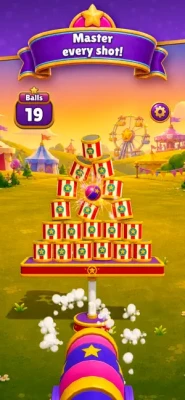
Developed by Etermax, the game combines casual cannon shooting with physics-based destruction. Towers can contain different materials, including wood, ice and stone, and each structure reacts differently when hit. You can also earn coins and unlock powerful boosters to help with tougher layouts.
What Is Smash Fair: Tin Can Fest?
Smash Fair: Tin Can Fest turns the traditional fairground tin-can game into a full 3D demolition puzzle.
Instead of simply shooting at a target, you need to study the entire structure before firing. A well-placed cannonball can knock out a support, send several blocks falling, and trigger a chain reaction that finishes the level with a single shot.
That makes the game less about rapid firing and more about aiming, timing, physics, target selection and efficient destruction.
The game features hundreds of levels, quick gameplay sessions, different tower materials, coin rewards and boosters designed to make difficult structures easier to clear.
Smash Fair Gameplay Features
3D Physics-Based Destruction
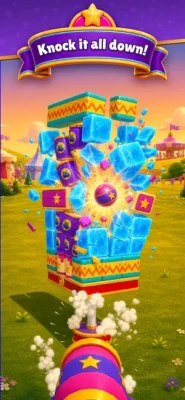
The main attraction is the physical destruction system. Towers collapse dynamically after being hit, creating satisfying chains of falling blocks and debris.
Rather than treating every level as a simple target-shooting challenge, Smash Fair encourages you to think about how one impact can affect the rest of the structure.
Cannon Shooting
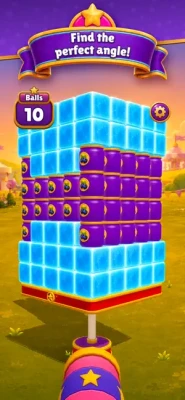
Your cannon is your main tool. Before every shot, look carefully at the tower and decide where the cannonball can cause the most damage.
A direct hit is not always the best option. Sometimes hitting a lower support or a strategically placed block can cause a much larger collapse.
Hundreds of Levels
The game is designed around a large collection of increasingly challenging structures. Early stages help you become comfortable with aiming and destruction, while later levels require more deliberate shots.
Different Materials
Structures can contain materials such as:
- Wood
- Ice
- Stone
- Other structural blocks
Different materials react differently when struck, so learning how each behaves becomes increasingly important.
Boosters
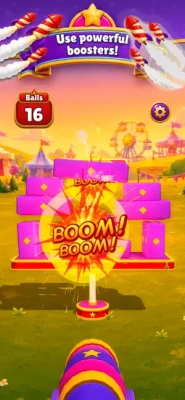
Coins earned through successful play can be used to unlock powerful boosters.
Boosters are particularly useful when a level contains awkward structures that are difficult to collapse with ordinary cannonballs.
Chain Reactions
The best shots are often the ones that create a chain reaction.
One cannonball can hit a key block, which moves another piece, which destabilizes the tower and eventually brings down the entire structure.
Offline Play
The App Store listing currently highlights an Offline Smash event, allowing players to break blocks and complete challenges without Wi-Fi.
Full Smash Fair Strategy Guide
1. Study the Tower Before Shooting
The biggest mistake is firing immediately.
Take a moment to examine the structure from the available angle. Look for:
- Narrow support points
- Blocks holding several pieces together
- Heavy objects sitting on weaker supports
- Gaps between sections
- Blocks positioned near the bottom
- Materials that may react differently to impact
Your first objective should be to understand what keeps the tower standing.
Once you identify that point, you can often solve the level with fewer shots.
2. Aim for the Weakest Point
Don't automatically aim at the largest block.
Large blocks may absorb the impact without causing enough movement. A smaller support can sometimes be much more valuable.
Try to identify the block that connects several parts of the structure.
If removing that piece causes two or more sections to lose their support, one cannonball can accomplish much more than several random shots.
3. Think About the Second Impact
A good shot doesn't necessarily need to destroy everything immediately.
Sometimes the first cannonball should simply start the collapse.
Before firing, ask yourself:
"Where will the pieces go after I hit this block?"
If falling debris can hit another section, you may be able to create a chain reaction.
This is one of the most important skills to develop as levels become more complicated.
4. Use Angles Instead of Straight Shots
The shortest path to a block isn't always the best path.
Changing the angle can allow your cannonball to:
- Hit the underside of a structure
- Reach a protected support
- Strike several pieces
- Bounce into another section
- Start a larger collapse
Experiment with the trajectory when a straightforward shot isn't producing enough destruction.
5. Make Every Cannonball Count
Smash Fair rewards efficient destruction. The fewer cannonballs you use, the more coins you can potentially earn.
Therefore, don't treat extra shots as free attempts.
If your first shot causes only minor damage, stop and reassess the structure rather than immediately repeating the same angle.
Ask what the first shot taught you.
6. Learn the Behavior of Wood
Wooden structures are often useful for practicing basic physics.
Look for wooden supports underneath heavier blocks. Breaking a support can allow the upper section to fall naturally.
When several wooden pieces are connected, try to hit the joint rather than simply attacking the largest visible block.
7. Treat Ice Differently
Ice can behave differently from heavier structural materials, so avoid assuming that the same strategy works for every tower.
When you see an ice section, consider whether breaking it can remove protection or expose another part of the structure.
Use the first shot to test how the surrounding pieces react.
8. Use Stone as a Structural Problem
Heavier-looking sections should generally be approached by thinking about support rather than brute force.
If a stone block is difficult to move directly, look underneath or beside it.
Instead of trying to destroy the strongest object, find the structure keeping it in place.
9. Look for Chain-Reaction Opportunities
Before every shot, scan the tower for a possible sequence:
Cannonball → support → falling block → second section → complete collapse
If you can create that sequence, you have found a high-value shot.
Chain reactions are especially useful when you are trying to conserve ammunition and earn more coins.
10. Don't Waste Boosters on Easy Levels
Boosters can make difficult stages much easier, but using them whenever a level looks slightly inconvenient can leave you without useful resources later.
Save stronger boosters for situations where:
- The tower has several protected sections
- A key support is difficult to reach
- Normal shots are repeatedly failing
- The structure requires a larger impact
- You need help creating a major collapse
Use ordinary cannon shots whenever they are sufficient.
How to Earn More Coins
Coins are important because they can be used to unlock boosters.
The best way to improve your coin efficiency is not simply to play faster. Instead, focus on completing levels with fewer shots.
Coin-Earning Tips
Plan before firing.
A few seconds of observation can save several cannonballs.
Target structural weaknesses.
Don't waste shots on blocks that have little effect on the rest of the tower.
Create chain reactions.
One successful collapse can accomplish the work of several direct hits.
Replay your approach mentally.
If a level takes too many shots, think about which block you could have targeted first.
Save boosters for difficult stages.
Using resources intelligently gives you more flexibility when the structures become complicated.
Beginner Tips for Smash Fair
Tip 1: Don't Rush
The game is built around precision rather than speed. Take time to line up important shots.
Tip 2: Aim Below the Main Target
A lower support can sometimes be more valuable than the most obvious target.
Tip 3: Watch the Entire Structure
Don't focus only on the area where the cannonball lands. Think about what will happen afterward.
Tip 4: Test New Materials
When you encounter a new structural combination, use the early levels to learn how the pieces react.
Tip 5: Learn From Failed Shots
A failed shot isn't necessarily wasted if it reveals how the tower behaves.
Tip 6: Search for One-Shot Solutions
Before using multiple cannonballs, look for a position that can start a complete collapse.
Tip 7: Save Boosters
A booster is most valuable when an ordinary shot cannot solve the structural problem.
Advanced Smash Fair Strategy
Attack the Structure, Not the Target
The biggest difference between a beginner and an experienced player is how they view the tower.
A beginner sees individual blocks.
An experienced player sees relationships between blocks.
Instead of asking:
"Which block should I destroy?"
Ask:
"Which block is responsible for keeping the largest part of this structure standing?"
That change in perspective makes difficult physics puzzles much easier.
Build a Shot Priority System
When approaching a difficult level, consider targets in this order:
- Critical supports
- Blocks connecting multiple sections
- Heavy blocks that can create downward pressure
- Exposed weak materials
- Secondary targets
- Direct damage targets
This isn't an absolute rule for every level, but it is a useful way to analyze a new structure.
Use Controlled Experimentation
If you're unsure about a level, don't randomly fire several shots.
Instead:
- Choose one structural target.
- Fire once.
- Observe the collapse.
- Identify what changed.
- Adjust your next shot.
This turns trial and error into a deliberate puzzle-solving process.
Common Mistakes to Avoid
Firing Without Looking
The most common mistake is shooting before understanding the tower.
Repeating the Same Shot
If an angle doesn't work, changing the angle or target is usually more productive than repeating it.
Ignoring Supports
The block that looks unimportant may actually be holding half the structure together.
Using Boosters Too Early
Save powerful tools for genuinely difficult layouts.
Focusing Only on Direct Hits
Physics-based games reward players who understand what happens after the initial impact.
Chasing Speed
Fast completion is less important than making efficient shots.
Controls and Difficulty
Smash Fair uses simple cannon-based controls designed to be easy to learn. The challenge comes from precision and planning rather than complicated button combinations.
The game is categorized as a puzzle title and has a 4+ age rating on the App Store. It requires iOS 15.0 or later on supported Apple devices.
The current listing also identifies the game as free with optional in-app purchases and advertising.
Smash Fair: Tin Can Fest – Pros and Cons
Pros
- Easy-to-understand cannon gameplay
- Satisfying 3D destruction
- Physics-based puzzle solving
- Hundreds of levels
- Different structural materials
- Chain reactions make successful shots rewarding
- Boosters add another strategic layer
- Short sessions are easy to pick up
- Offline play is available through the listed Offline Smash event
Cons
- Players looking for deep strategy may find the basic shooting mechanics simple
- Progression depends heavily on repeated physics puzzles
- Boosters can become important on harder structures
- Advertising and optional purchases are part of the current mobile version
Who Should Play Smash Fair?
Smash Fair is a good choice if you enjoy casual puzzle games, physics destruction, cannon challenges and games where a carefully planned shot produces a satisfying chain reaction.
It is particularly appealing for players who like watching structures collapse and solving levels through observation rather than complicated controls.
If you enjoy physics puzzle games, destruction games, cannon shooting challenges and casual mobile games, Smash Fair is worth trying.
Smash Fair: Tin Can Fest FAQ
What is Smash Fair: Tin Can Fest?
Smash Fair: Tin Can Fest is a 3D physics puzzle game from Etermax where players fire a cannon at towers and attempt to destroy them using as few shots as possible.
Is Smash Fair a puzzle game?
Yes. The App Store and Google Play classify Smash Fair as a puzzle game.
How does Smash Fair work?
Players aim a cannon, fire cannonballs at tower structures and use physics to create collapses and chain reactions.
Does Smash Fair have boosters?
Yes. Players can earn coins and use them to unlock powerful boosters for difficult structures.
Are there different materials in Smash Fair?
Yes. The game features structures made from materials including wood, ice and stone, each contributing different physical challenges.
Does Smash Fair have many levels?
The game advertises hundreds of challenging levels with increasingly varied structures.
Can Smash Fair be played offline?
The App Store currently lists an Offline Smash event that allows players to break blocks and solve challenges without Wi-Fi.
Is Smash Fair free?
Yes. The game is listed as free to download, with advertising and optional in-app purchases.
What devices support Smash Fair?
The current App Store listing supports iPhone and iPad and requires iOS/iPadOS 15.0 or later. It also lists Mac compatibility for Macs with an Apple M1 chip or later running macOS 12 or later.
Who developed Smash Fair?
Smash Fair: Tin Can Fest was developed by Etermax.
Final Verdict
Smash Fair: Tin Can Fest takes a familiar fairground concept and turns it into a relaxing physics puzzle built around precision shooting and satisfying destruction. The strongest part of the experience is the moment when a carefully chosen cannonball hits the right support and the entire structure starts collapsing.
The game is easy to understand, but getting consistently efficient shots requires observation and a good understanding of how the tower is assembled. If you enjoy casual destruction games, physics puzzles and short mobile gaming sessions, Smash Fair offers a straightforward formula with plenty of room to improve your aim.
Aim carefully. Find the weak point. Fire once. Watch everything fall.
Rate the Game
User Reviews











Popular Games














 Android
 iOS
iOS Windows
 Xbox
Xbox