






Latest Version
September 14, 2026
Hungry Studio
Puzzle
iOS
0
Report a Problem
More About :game
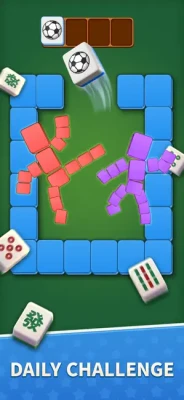
The game combines traditional Mahjong matching, casual puzzle solving, visual recognition and strategic planning with a calm presentation. Its large tiles, high-contrast design and soothing sounds are designed to make longer puzzle sessions comfortable and relaxing.
The latest App Store version lists 10,000+ levels, along with additional themes and performance improvements.
What Is Double Tile!?
Double Tile! is a Mahjong solitaire matching game from Hungry Studio.
Each level presents a layout of tiles. Your job is to remove the board by finding identical pairs that are currently available.
The basic rule is easy:
Find two identical available tiles → tap them → remove them → expose new tiles → repeat.
However, choosing the wrong pair can make later matches harder. A good player therefore looks beyond the immediately available pair and considers which tiles will become accessible after each move.
The App Store describes Double Tile! as a Mahjong solitaire experience designed around relaxation, mindful strategy and quiet focus.
How to Play Double Tile!
1. Find an Available Tile
Not every tile on the board can be selected.
A tile generally needs to have:
- At least one free side
- No tile covering it from above
- A matching partner that can also be selected
Once you identify a legal tile, look for its identical partner.
2. Match Identical Tiles
Tap two matching available tiles to remove them.
The objective is to continue making successful pairs until the entire puzzle is cleared.
3. Watch What You Expose
Every pair you remove changes the board.
A successful match might reveal:
- A new tile underneath
- A previously blocked pair
- A valuable corner tile
- A tile that can unlock several future matches
This is why the best move is not always the easiest pair to see.
Full Double Tile! Strategy Guide
1. Do Not Match Randomly
The biggest mistake beginners make is removing the first obvious pair they notice.
Before tapping, ask:
What will this pair expose?
If removing one pair uncovers several useful tiles, it is usually more valuable than a pair that produces no new opportunities.
Think of every match as an investment in the next move.
2. Prioritize Covered Tiles
A useful general rule is:
Remove tiles that are blocking other tiles.
If two identical tiles are available and one pair is positioned above a large section of the board, clearing that pair can create many more choices.
This helps prevent the board from becoming restricted later.
3. Pay Attention to the Sides
Double Tile! specifically makes tile availability dependent on whether a tile has a free side and whether it is covered.
That means you should constantly scan the left and right sides of the layout.
A tile with one open side can become extremely valuable if its matching partner is also accessible.
4. Think About Both Copies
Finding one useful tile is only half the problem.
You also need to consider its matching tile.
Before removing a pair, check whether either tile is currently helping expose another important tile.
Sometimes leaving a pair untouched for a few moves gives you a much better position.
5. Work From the Outside Toward the Center
When possible, prioritize tiles around the edges of dense formations.
Removing outer tiles can open access to the tiles trapped inside.
This is particularly useful when a level contains several overlapping rows or tightly packed sections.
6. Avoid Creating Dead Ends
A dead end occurs when you reach a position where the remaining tiles cannot be matched effectively because the useful pairs are blocked.
To avoid this:
- Do not remove pairs without considering the resulting layout.
- Keep track of difficult tile types.
- Open blocked areas early.
- Avoid leaving only one accessible copy of an important tile.
- Think several moves ahead.
The official listing also recommends planning ahead to avoid dead ends.
Advanced Double Tile! Tips
Use a “Two-Move Lookahead”
Instead of asking:
“Can I match these?”
ask:
“If I match these, what becomes available next?”
Then ask:
“Can that new option create another match?”
This simple two-step thought process can dramatically improve your success rate on harder boards.
Look for Unlocking Matches
Some pairs are valuable because they unlock other pairs.
Imagine two available tiles:
- Pair A removes two tiles but exposes nothing.
- Pair B removes two tiles and uncovers three additional tiles.
Pair B is normally the better choice.
The goal is not simply to reduce the tile count.
The goal is to increase your future options.
Keep Difficult Tiles in Mind
If a particular symbol appears in a difficult location, remember where its matching tile is.
You may need to clear several surrounding tiles before the pair becomes useful.
This prevents you from accidentally removing supporting tiles in an order that makes the remaining puzzle harder.
Do Not Focus on One Area for Too Long
A common mistake is clearing one corner repeatedly while ignoring the rest of the board.
Instead, periodically scan the entire layout.
You may find that a move on the opposite side opens the exact tile needed to solve the section you were working on.
Save Helpful Pairs
Sometimes an obvious pair is better left untouched.
For example, if both tiles are currently easy to access but removing them does not unlock anything, they can act as a safe future match.
Meanwhile, another pair may be blocking a critical section.
Clear the blocker first.
Double Tile! Hints and Shuffle
Double Tile! includes limited helpful tools such as Hints and Shuffles. Hints can reveal an available match, while Shuffles rearrange the tiles when the current arrangement becomes difficult.
When to Use a Hint
Do not use a hint simply because you cannot immediately see a pair.
First scan the board carefully.
Use a hint when:
- You have searched the board several times.
- The remaining layout is difficult to read.
- You suspect a legal pair is hidden among overlapping tiles.
- You are close to finishing and want to avoid an unnecessary mistake.
When to Use a Shuffle
A shuffle is most valuable when the current arrangement is restricting your options.
Do not automatically use it at the first sign of difficulty.
Try to create a few more openings first.
Save the shuffle for situations where your existing arrangement genuinely lacks useful moves.
How to Beat Difficult Double Tile! Levels
When a level becomes challenging, use this sequence:
Step 1 – Scan the entire board
Do not immediately tap.
Identify every obvious available pair.
Step 2 – Find the blockers
Look for tiles preventing access to larger groups.
Step 3 – Choose an unlocking pair
Prioritize the match that creates the most future possibilities.
Step 4 – Re-scan after every major match
The board changes after each pair disappears.
Your original plan may no longer be optimal.
Step 5 – Preserve useful options
Do not remove every obvious pair immediately.
Some pairs are valuable because they remain available as emergency moves.
Step 6 – Use tools strategically
Use hints and shuffles when they actually improve your position rather than wasting them early.
Double Tile! Level Strategy
With thousands of puzzles available, there is no single move sequence that works for every Double Tile! level.
Instead, use a repeatable strategy.
Early Level Strategy
Early puzzles are ideal for learning the board rules.
Focus on:
- Recognizing available tiles
- Identifying identical pairs
- Understanding which tiles are covered
- Learning how removing a pair changes the layout
Do not worry about speed.
Mid-Level Strategy
As the layouts become more complicated, begin planning several moves ahead.
Prioritize:
- Blocking tiles
- Tiles that unlock large sections
- Pairs with multiple future possibilities
- Difficult or isolated symbols
Hard-Level Strategy
On difficult boards, every move matters.
Before selecting a pair, consider:
What does this remove?
What does this expose?
What does this prevent?
What will my next available match be?
That mental checklist helps prevent dead ends.
Double Tile! Tips for Beginners
Tip 1: Learn the board structure
Spend a few seconds understanding which tiles are stacked or blocked.
Tip 2: Match intelligently
The easiest pair is not always the best pair.
Tip 3: Open the board
Prioritize moves that expose hidden tiles.
Tip 4: Think ahead
Always consider at least your next move.
Tip 5: Do not panic
The game is designed around relaxed puzzle solving rather than fast reactions.
Tip 6: Use hints sparingly
A hint is more valuable when you genuinely cannot find a legal match.
Tip 7: Save the shuffle
A shuffle can rescue a difficult position, so avoid using it unnecessarily.
Double Tile! Features
- Mahjong solitaire puzzle gameplay
- Identical-tile matching
- Large, easy-to-read tiles
- High-contrast visual design
- Relaxing music and nature sounds
- Hint power-up
- Shuffle power-up
- Multiple visual themes
- 10,000+ levels
- Single-player puzzle experience
- iPhone and iPad support
- Free to play with advertising and optional purchases
The current App Store listing identifies the game as free, supports iPhone and iPad, and lists its latest release as version 1.5.3.
Double Tile! Atmosphere
Double Tile! is deliberately more peaceful than many traditional puzzle games.
Large tiles make the board easier to read, while the background presentation and gentle audio create a slower atmosphere. The game includes sounds inspired by environments such as rainfall, rustling leaves and distant streams.
This makes it suitable for players who want a Mahjong puzzle that can be played casually rather than as a high-pressure challenge.
Double Tile! Difficulty
The controls are easy to understand, but the strategic difficulty increases as the board becomes more complicated.
The challenge comes from:
- Limited accessible tiles
- Overlapping layouts
- Multiple possible matches
- Planning ahead
- Avoiding dead ends
- Choosing the right order for removing pairs
The game currently advertises 10,000+ levels, giving players a large amount of puzzle content to work through.
Double Tile! Pros and Cons
Pros
- Simple controls
- Easy-to-read large tiles
- Relaxing presentation
- Strategic Mahjong gameplay
- Huge number of levels
- Helpful hint and shuffle tools
- Suitable for short or long sessions
- Calm audio and visual design
Cons
- Advertising can interrupt gameplay
- Some difficult boards can feel repetitive
- Players looking for fast action may find it too relaxed
- Optional purchases are present
Recent App Store reviews are strongly positive overall, although several players specifically mention advertisements as a drawback.
Is Double Tile! Worth Playing?
Yes, if you enjoy Mahjong solitaire and relaxing matching puzzles.
Double Tile! does not try to reinvent the basic Mahjong formula. Instead, it focuses on making the traditional matching experience comfortable, readable and relaxing.
Its large tiles, calming sounds and enormous level count make it particularly appealing to players who enjoy taking their time with puzzle boards.
The strategic element also keeps it from becoming purely repetitive: the order in which you remove tiles can determine whether you finish a board smoothly or end up with a difficult position.
Double Tile! Ratings and Player Feedback
The U.S. App Store currently shows 4.9 out of 5 from roughly 59,000 ratings.
Player feedback is generally very favorable, with users frequently praising the game's challenge and accessibility. At the same time, advertising is one of the recurring complaints in recent reviews.
Frequently Asked Questions
What is Double Tile!?
Double Tile! is a Mahjong solitaire matching puzzle where you remove identical pairs of available tiles until the board is cleared.
How do you play Double Tile!?
Find two identical tiles that are currently available and tap them to remove them. A tile must have a free side and cannot be covered by another tile.
How many levels does Double Tile! have?
The latest App Store version advertises 10,000+ levels.
Does Double Tile! have hints?
Yes. The game includes limited Hint power-ups that can help reveal an available Mahjong match.
Does Double Tile! have a shuffle?
Yes. Shuffle tools can rearrange the tiles when you need another way to approach the board.
Is Double Tile! relaxing?
Yes. The game is specifically presented as a relaxing Mahjong experience, with gentle melodies and nature-inspired sounds.
Is Double Tile! free?
Yes. The App Store lists Double Tile! as free, with advertising and optional purchases.
Can I play Double Tile! on iPhone and iPad?
Yes. The current App Store listing supports both iPhone and iPad.
Final Verdict
Double Tile! takes the familiar Mahjong solitaire formula and gives it a calm, modern presentation.
The rules are simple enough for anyone to understand, but the increasingly complicated layouts reward players who plan their moves instead of matching tiles randomly.
The most important strategy is to think beyond the pair you are about to remove. Look at what that match will expose, which tiles it will unblock, and what options will remain afterward.
With 10,000+ levels, large tiles, relaxing audio, hints, shuffles and a strong focus on casual puzzle play, Double Tile! is a solid choice for anyone looking for a peaceful Mahjong matching game with plenty of content.
Rate the Game
User Reviews














Popular Games



















 Android
 iOS
iOS Windows
 Xbox
Xbox