

Latest Version
September 14, 2026
Al Games FZ
Puzzle
iOS
0
Report a Problem
More About :game
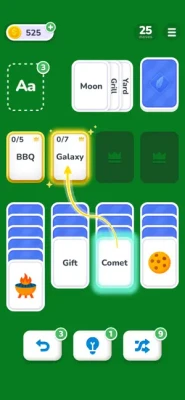
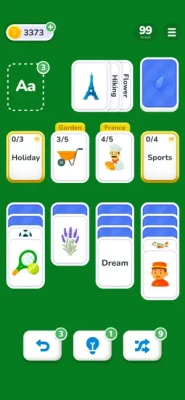
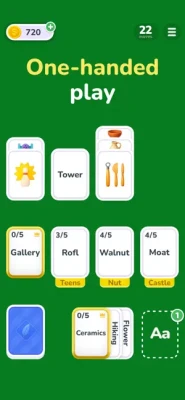
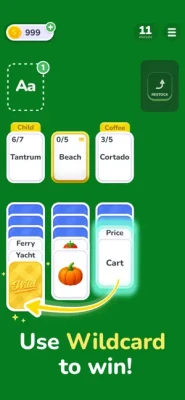
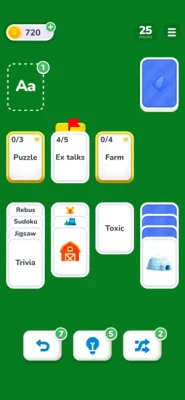
The basic idea is simple: begin with a crown-marked category card and place the matching word or image cards onto it. The challenge becomes more interesting as levels introduce less obvious relationships and layered associations. There is no traditional countdown timer, so the focus is on finding the correct sequence while managing your available moves.
The game is available on iPhone and iPad, requires iOS/iPadOS 13 or later, and includes advertising and optional in-app purchases. The US App Store currently shows a 4.7/5 rating from 596 ratings.
How Word Solitaire: Categories Works
Each puzzle contains category cards and matching word or picture cards.
Your objective is to:
- Find a category card.
- Identify cards that belong to that category.
- Place the correct cards together.
- Continue exposing and sorting cards.
- Complete every stack to finish the level.
For example, a category such as Jewellery can be associated with Necklace. The game also separates word-based matching from image-based matching, so you need to pay attention to the type of card you are handling.
As the levels become harder, the challenge shifts from obvious vocabulary recognition toward understanding relationships between words and categories.
The Most Important Strategy: Think Before Moving
The biggest mistake in Word Solitaire: Categories is making a move simply because it appears correct.
A card can sometimes seem related to more than one possible idea. Before placing it, look at the available category cards and ask:
Which category has the strongest and most specific connection?
This becomes increasingly important when the puzzle contains related concepts.
Instead of asking:
"Could this card fit here?"
ask:
"Is this the most logical place for this card?"
That small change in thinking can save valuable moves.
Full Strategy Guide
1. Start With the Crown-Marked Category
The game specifically instructs players to begin with the crown-marked category card.
Use that card as your starting point rather than randomly experimenting with the available cards.
Once you identify the category, scan the board for its strongest matches.
2. Look for the Obvious Matches First
Early levels often contain direct associations.
If the category is something familiar, look for the card that clearly belongs to it before considering more complicated interpretations.
Obvious matches help reveal the structure of the puzzle.
3. Separate Words From Images
One of the game's important rules is that word cards match with word cards, while image cards match with image cards.
Do not let the meaning of a picture distract you from the card type.
If you are working through a word category, concentrate on the available word cards first.
4. Don't Use a Move Just to Test an Idea
Experimenting can be expensive when moves are limited.
Before moving a card, check:
- The category name
- Other cards already placed
- The remaining unopened cards
- Whether another card has a stronger association
- Whether the move could block a useful sequence
A few seconds of observation can save several unnecessary moves.
5. Think About What the Move Reveals
Some moves are valuable because they help expose new information.
When choosing between two apparently reasonable moves, prefer the one that gives you more information about the remaining board.
This is especially useful on difficult levels.
How to Manage Your Moves
The Google Play description explains that levels must be completed before you run out of moves.
That makes move management one of the most important parts of the game.
Use This Priority System
First: Make completely certain matches.
Second: Make moves that expose useful cards.
Third: Make reasonable associations when the board gives you limited alternatives.
Last: Use a booster or special tool when normal play cannot efficiently solve the position.
Avoid spending moves on guesses.
How to Use the Hint
The Hint feature suggests a valid move when you become stuck.
Do not treat Hint as your first option.
A better approach is:
- Scan every category.
- Check obvious matches.
- Look for cards that have only one logical destination.
- Reconsider ambiguous cards.
- Use Hint only after your own deduction fails.
This makes the game more rewarding and helps you learn the association patterns.
When to Use Undo
Undo allows you to reverse a previous move.
It is especially useful when:
- You notice a better placement immediately afterward.
- A move creates an unexpected problem.
- You accidentally place a card incorrectly.
- You discover that another category should have been completed first.
Use Undo as a tactical tool rather than constantly changing moves.
Wildcard Strategy
The Wildcard can be placed on a stack regardless of the normal matching requirement.
Because it is flexible, do not waste it on an easy situation.
Save it for:
- A blocked sequence
- A difficult association
- A situation where one missing card prevents progress
- A late-game position with limited options
A Wildcard is most valuable when the board has become restrictive.
Shuffle Strategy
The Shuffle feature rearranges the closed cards, rather than randomly changing everything on the board.
This distinction matters.
Use Shuffle when:
- The useful cards are buried.
- You have exhausted obvious moves.
- The current arrangement is preventing progress.
- You believe the solution is available but inaccessible.
Don't use it simply because the puzzle looks complicated.
A difficult-looking board can still contain a straightforward solution.
Dictionary Strategy
The built-in Dictionary can help when an unfamiliar word prevents you from recognizing an association.
If you encounter an unfamiliar term:
- Read the category.
- Consider the surrounding cards.
- Try to infer the relationship.
- Check the Dictionary if necessary.
- Return to the board with the new information.
This makes the Dictionary more than a convenience—it can directly improve your ability to solve vocabulary-based levels.
Combo Streak Strategy
A recent update added Combo Streaks, rewarding several correct moves in a row with bonus moves. Daily Tasks were also added as another progression and reward system.
This changes how you should approach easy sections.
When you recognize several obvious matches, try to maintain the streak instead of making a speculative move between them.
A good sequence is:
Certain match → certain match → certain match → bonus
rather than:
Certain match → guess → mistake → recovery
Accuracy is more valuable than speed.
Daily Tasks and Rewards
Daily Tasks provide another reason to return regularly, while the game has also introduced daily rewards and bonus systems through its updates.
If you play regularly, make daily objectives part of your normal routine rather than treating them as a separate grind.
A practical routine is:
- Collect available daily rewards.
- Complete the easiest daily objectives.
- Play several normal levels.
- Save stronger boosters for harder puzzles.
- Return later if you become mentally stuck.
Advanced Association Strategy
The later levels become more challenging because associations are not always completely obvious. The App Store describes progression from simple pairs toward more layered associations.
Direct Association
This is the easiest type.
Category → obvious matching word
Example:
Jewellery → Necklace
Functional Association
The relationship may depend on what an object does or how it is used.
Instead of looking only for identical meanings, consider:
- What is it used for?
- Where is it found?
- What normally goes with it?
- What group does it belong to?
Thematic Association
Some cards can belong to a broader theme.
When several possibilities exist, identify the category's intended theme before committing to a move.
Layered Association
The hardest situations require more than simple vocabulary recognition.
A card may appear related to several concepts, but only one relationship fits the category structure.
When this happens, examine the other cards before deciding.
Best Way to Solve Difficult Levels
When a level seems impossible, stop moving cards for a moment.
Use this process:
Step 1: Identify Every Category
Read every visible category card carefully.
Step 2: Mark Certain Matches Mentally
Find cards whose relationships are unquestionable.
Step 3: Find Ambiguous Cards
Separate cards that could potentially fit several categories.
Step 4: Solve the Certain Groups
Clear the strongest relationships first.
Step 5: Reevaluate the Ambiguous Cards
With fewer possibilities remaining, their correct category often becomes obvious.
Step 6: Consider Move Efficiency
If two solutions are possible, choose the one requiring fewer unnecessary moves.
Step 7: Use a Booster Only When Necessary
Save Hint, Wildcard and Shuffle for positions where normal deduction has stalled.
A Simple Two-Pass Method
For difficult puzzles, use two mental passes.
Pass One: Recognition
Look only for cards that are clearly connected.
Pass Two: Elimination
For everything remaining, eliminate categories that clearly do not fit.
This is much more reliable than trying to solve every card individually.
Word Mode Strategy
When playing with word cards, pay close attention to exact meaning.
Do not rely only on visual similarity between words.
Consider:
- Synonyms
- Object relationships
- Categories
- Places
- Activities
- Professions
- Materials
- Everyday associations
A word that looks unrelated at first may become obvious once you understand the category.
Image Mode Strategy
Image-based levels require a slightly different approach.
Look at the actual object represented by the picture rather than its artistic style.
Ask:
What is this?
Then:
Which category would naturally contain it?
Do not overthink obvious images.
The image mode is designed to create stronger visual associations, so trust straightforward recognition when the category is clear.
How to Avoid Wasting Moves
The most common inefficient habits are:
Random Placement
Moving cards simply to see what happens.
Better: identify the intended relationship first.
Repeated Guessing
Trying several categories for the same card.
Better: solve the surrounding categories and return to the ambiguous card later.
Early Booster Use
Using Wildcard or Shuffle before understanding the board.
Better: reserve special tools for genuine obstacles.
Ignoring the Move Count
Playing as though the game has unlimited attempts.
Better: always know how many moves remain.
Solving Too Quickly
There is no traditional countdown timer, so rushing is unnecessary.
Take advantage of the relaxed pacing and think through the board.
Best Beginner Routine
For new players, this is a strong routine:
1. Find the crown category.
2. Read all visible cards.
3. Make only obvious matches.
4. Watch what becomes available.
5. Recheck ambiguous cards.
6. Protect your remaining moves.
7. Use Hint when deduction fails.
8. Save Wildcard and Shuffle for difficult situations.
This approach becomes increasingly effective as the categories become more complicated.
Features
Word Solitaire: Categories combines several mechanics into one puzzle format:
- Word association puzzles
- Picture association puzzles
- Solitaire-style card placement
- Hundreds of levels
- Category-based sorting
- Hint system
- Undo
- Wildcard
- Shuffle
- Dictionary
- Daily Tasks
- Combo Streaks
- Daily rewards
- Multiple languages
- No traditional countdown timer
Graphics and Atmosphere
The presentation is deliberately calm rather than action-focused. The game's description emphasizes a mindful, stress-free experience, with word and picture cards forming the central visual language.
That makes it a good fit for short puzzle sessions where the goal is concentration rather than fast reflexes.
Updates and New Content
The game has continued receiving content and feature updates.
Recent App Store notes mention new categories featuring images, additional languages, Play Pass support, Daily Tasks and Combo Streaks. Earlier updates also introduced a Shuffle Booster.
The current App Store listing shows version 1.3.1 dated September 2, while regional listings can display different update histories.
Ratings and Player Feedback
The US App Store currently shows 4.7 out of 5 from 596 ratings.
Player feedback is generally positive about the puzzle concept, although some reviews criticize advertising frequency and others question the difficulty or move requirements of particular levels.
That is useful to know before playing: the core puzzle is relaxing, but some later challenges can become considerably more demanding.
Pros and Cons
Pros
- Relaxed word-puzzle format
- Solitaire-inspired gameplay
- Word and image categories
- No traditional countdown timer
- Hundreds of levels
- Hint and Undo tools
- Wildcard and Shuffle options
- Dictionary support
- Daily Tasks
- Combo Streaks
- Suitable for short or longer sessions
- Available on iPhone and iPad
Cons
- Advertising can interrupt the experience
- Some levels can feel restrictive when moves are limited
- Optional purchases are available
- The difficulty can rise significantly once associations become less obvious
Is Word Solitaire: Categories Worth Playing?
Yes, especially if you enjoy word association games but want something more structured than a conventional crossword or word search.
The solitaire format gives the game an additional layer because solving a puzzle is not simply about recognizing the correct word—you also need to think about move order, card access and the consequences of each placement.
Its strongest quality is the relaxed pacing. Because there is no conventional countdown timer, you can concentrate on the relationships between the cards instead of rushing.
Frequently Asked Questions
What is Word Solitaire: Categories?
It is a word association puzzle that combines category matching with solitaire-style card gameplay. Players sort word and image cards into their appropriate categories.
Is Word Solitaire: Categories a traditional solitaire game?
Not exactly. It uses solitaire-inspired card placement, but the objective is based on word and category associations rather than traditional solitaire rules.
Is there a time limit?
The App Store describes the game as having no timers or time pressure. However, levels can require you to finish before running out of moves.
What does the Hint button do?
Hint suggests a valid move when you are stuck.
What does the Wildcard do?
A Wildcard can be placed on a stack without following the normal matching requirement, making it useful for difficult positions.
What does Shuffle do?
Shuffle rearranges the closed cards to help reveal different possibilities.
Is there a Dictionary?
Yes. A Dictionary feature is available to help players understand unfamiliar words.
Does the game have picture puzzles?
Yes. The game includes both word and image-based associations.
Does Word Solitaire: Categories have daily challenges?
The game added Daily Tasks and Combo Streaks in a recent update, along with associated rewards.
Is Word Solitaire: Categories free?
It is free to download, but contains advertising and optional in-app purchases such as moves, coins and ad-removal options.
What devices support the game?
The App Store lists iPhone and iPad compatibility and requires iOS/iPadOS 13 or later.
Final Verdict
Word Solitaire: Categories is a clever combination of word association and solitaire-style puzzle mechanics. Its rules are easy to understand, but the increasing complexity of the categories gives the game enough depth to reward careful thinking.
The best strategy is not to rush. Identify obvious relationships, protect your moves, solve certain groups before ambiguous ones, and use Hint, Undo, Wildcard and Shuffle strategically.
For players who enjoy word puzzles, association games, brain teasers and relaxing solitaire games, this is a particularly accessible combination. The addition of picture categories, Daily Tasks and Combo Streaks also gives the core matching system more variety as you progress.
Rate the Game
User Reviews










Popular Games



















 Android
 iOS
iOS Windows
 Xbox
Xbox