



Latest Version
September 15, 2026
UniRise Studio
Puzzle
iOS
0
Report a Problem
More About :game
Unlike fast-paced puzzle games that pressure you with a countdown, Fluffy Drop lets you think through your moves at your own pace. Its combination of cute visuals, soft animations, strategic positioning, and progressively harder levels makes it suitable for short sessions or longer puzzle-solving runs.
The game is available for iPhone and iPad and is developed by UniRise Studio. The App Store currently lists it as a free game with in-app purchases and an age rating of 4+.
What Is Fluffy Drop - No Timer?
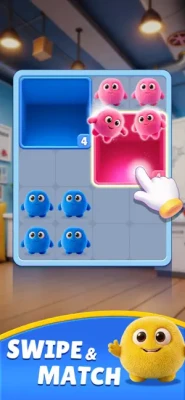
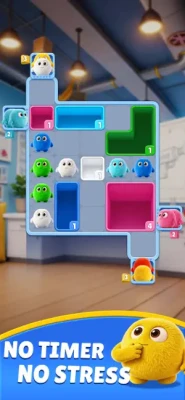
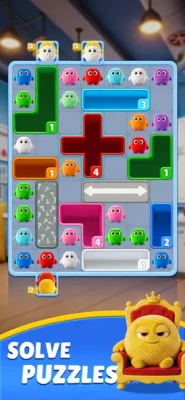
Fluffy Drop is a casual puzzle experience centered on color matching, movement planning, and drag-and-drop mechanics. Each level gives you a board filled with fluffy balls, matching destinations, and various obstacles or gameplay elements.
Your objective is not simply to move everything as quickly as possible. The real challenge is figuring out which ball should move first, where it should go, and how one move can affect the rest of the board.
The official description highlights hundreds of cozy levels, strategic planning, chain reactions, colorful visuals, and offline play.
Fluffy Drop Gameplay
The basic gameplay is easy to understand:
- Look at the entire puzzle before making a move.
- Identify each fluffy ball and its matching destination.
- Check whether obstacles are blocking the obvious route.
- Drag a ball toward its appropriate color area.
- Watch how the move changes the remaining board.
- Continue clearing the puzzle until the level is complete.
The controls are intentionally simple, but later puzzles require considerably more thought. The absence of a timer gives you the opportunity to experiment and reconsider your next move.
How Color Matching Works
Color recognition is one of the most important skills in Fluffy Drop.
A common mistake is to immediately move the easiest-looking ball. Instead, first identify all of the matching colors on the board.
Try to answer these questions:
- Which ball has the clearest route?
- Which destination is currently blocked?
- Which ball is occupying an important position?
- Will moving one object open a route for another?
- Could placing a ball too early prevent another move?
Some players have also noted that certain colors can look quite similar, particularly on smaller screens. When that happens, concentrate on the exact destination rather than relying only on a quick visual impression.
Full Strategy Guide
1. Study the Board Before Moving Anything
Because there is no countdown forcing you to rush, take advantage of it.
Before your first move, scan the complete board. Locate:
- Every fluffy ball
- Every matching color zone
- Narrow passages
- Obstacles
- Potential dead ends
- Areas that may become accessible after another move
This simple habit can prevent unnecessary mistakes later in the level.
2. Don't Always Move the Closest Ball
The closest match is not necessarily the correct first move.
A ball may appear ready to drop into its destination, but moving it could block another route. Conversely, a ball that seems difficult to place might need to move first because it is preventing access to another section.
Think about the order of moves, not just individual matches.
3. Look for Unlocking Moves
Some moves are valuable because they change the board rather than immediately completing a match.
If a ball is blocking a passage, consider whether moving it can open several possibilities.
A useful question is:
"What does this move allow me to do next?"
This way of thinking becomes increasingly important as levels become more complicated.
4. Plan Two or Three Moves Ahead
Try not to treat every move as an isolated action.
For example:
Move A → opens a route → Move B → clears a blocker → Move C → completes a color match
Planning short sequences like this is more reliable than dragging objects randomly and hoping the puzzle works out.
5. Use Chain Reactions Carefully
The game specifically emphasizes planning moves and creating chain reactions.
When one successful placement causes another useful opportunity, take advantage of it.
However, don't force a chain reaction simply because it looks satisfying. The important question is whether the resulting board remains solvable.
6. Protect Important Spaces
An open area can be more valuable than an immediate match.
If a particular space is needed to maneuver another ball, avoid filling it too early unless doing so clearly improves the position.
This is especially useful on crowded boards where movement options are limited.
7. Work From the Outside When Appropriate
When several objects are clustered together, clearing the outside or least-restricted pieces can sometimes expose the objects underneath or behind them.
There isn't one universal order for every level, so compare several possible sequences before committing.
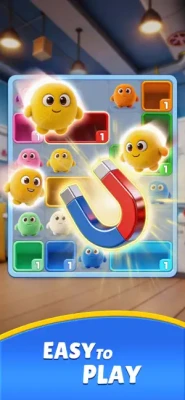
8. Don't Waste Power-Ups
If a level provides a special helper or power-up, don't automatically use it at the first sign of difficulty.
First try:
- Changing your move order
- Clearing another ball
- Opening a different route
- Rechecking color destinations
- Undoing a questionable move, when the game allows it
Save powerful assistance for situations where the board genuinely becomes difficult to solve.
9. Reconsider Failed Attempts
A failed attempt is useful information.
Instead of repeating the exact same sequence, identify the first move where the board became restrictive.
Ask:
- Did I move something too early?
- Did I block a useful space?
- Did I overlook another color?
- Should another ball have moved first?
Then restart with a different opening sequence.
10. Slow Down on Difficult Levels
The "No Timer" design is one of the game's defining features. The App Store specifically promotes the game as a relaxing puzzle experience without time pressure.
Use that advantage.
When a level looks complicated, don't make faster moves. Make more deliberate moves.
How to Solve Hard Fluffy Drop Levels
When a level becomes difficult, use this five-step method:
Step 1 — Map the board
Identify every ball, target, obstacle, and available route.
Step 2 — Find restrictions
Determine which pieces have the fewest possible destinations or movement options.
Step 3 — Find the unlocking move
Look for the move that opens the greatest number of possibilities.
Step 4 — Plan a short sequence
Think two or three moves ahead before acting.
Step 5 — Check the final spaces
Make sure your planned sequence doesn't leave a ball trapped or a required destination inaccessible.
This approach turns a confusing puzzle into a series of smaller decisions.
Tips for Beginners
- Don't rush just because the board looks simple.
- Study the whole level before your first move.
- Match colors carefully.
- Think about movement order.
- Keep important spaces open.
- Look for moves that unlock other moves.
- Avoid using power-ups unnecessarily.
- If you get stuck, change the opening sequence.
- Use the no-timer format to your advantage.
- On small screens, double-check similar-looking colors.
Advanced Tips
Think in Terms of Space
Experienced players should pay attention not only to colors but also to available movement space.
A technically correct match can still be a poor move if it removes the space needed for another ball.
Prioritize Restricted Pieces
If one ball has only one realistic route while another has several possible routes, consider solving the restricted ball first.
This reduces the chance of creating a future dead end.
Preserve Flexibility
A strong position is one where you still have several possible moves.
If a move leaves you with only one option, make sure that option is actually safe before committing.
Use Reverse Planning
If you're stuck, work backward.
Imagine the completed board and ask:
Which ball must reach its destination last?
Then determine what needs to happen immediately before that placement.
Backward planning can reveal the correct order when normal trial-and-error becomes confusing.
Obstacles and Increasing Difficulty
Fluffy Drop gradually introduces additional complexity as players progress. Player feedback also mentions new obstacles being introduced over time, making later levels more demanding while retaining the basic puzzle concept.
The important lesson is that new obstacles shouldn't automatically change your overall strategy.
Instead, incorporate them into the same process:
Observe → Plan → Move → Reassess → Continue
Two Important Mindsets
The Fast Player
The fast player sees an obvious match and immediately makes it.
The Efficient Player
The efficient player asks whether that match is safe, whether it opens another route, and whether it preserves enough space for the remaining pieces.
In Fluffy Drop, the second approach is generally more useful on challenging boards because the game rewards planning rather than reaction speed.
Fluffy Drop Levels and Progression
The developer describes the game as having hundreds of cozy levels, with the difficulty progressing from introductory puzzles toward more demanding challenges.
Recent player reviews indicate that some players have progressed well beyond hundreds of levels, with individual reviews mentioning progress past level 800 and even level 1,400. Those player reports should not be interpreted as an official statement of the total number of levels.
The safest way to think about progression is that the game is designed around a large and continually updated collection of puzzles.
Game Modes and Challenges
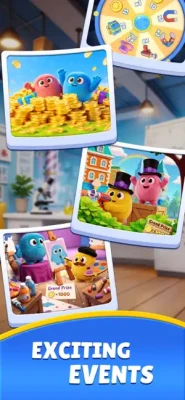
The App Store listing currently shows several limited-time challenge events, including Brain Back to School, Fluffy Fall, and Fluffy Fest.
These events can give the game a different rhythm from the standard level progression and provide additional reasons to return after completing regular puzzles.
Offline Play
Fluffy Drop is advertised as playable offline, which makes it suitable for situations where you don't have a reliable internet connection.
That makes the game particularly convenient for short puzzle sessions while traveling or when you simply want something casual to play without relying on an online connection.
Graphics and Atmosphere
The visual style is deliberately soft and cheerful. Fluffy characters, bright colors, smooth animations, and simple board layouts give the game a cozy personality rather than an intense competitive atmosphere.
The presentation works particularly well with the game's no-timer philosophy: the visual design encourages players to concentrate on solving the puzzle rather than racing against a clock.
Controls
Fluffy Drop uses straightforward drag-and-drop controls.
The simplicity is one of the game's strengths because there is very little control complexity to learn. Most of the challenge comes from deciding where and when to move each piece rather than mastering complicated inputs.
Ads and In-App Purchases
The App Store lists Fluffy Drop as a free game with in-app purchases.
Player reviews frequently discuss advertising, with some players praising the core gameplay while criticizing the frequency or behavior of advertisements. Other reviews mention an option to remove ads through an in-app purchase. These are user reports and may vary by version, platform, region, and current monetization settings.
Recent Updates
The App Store currently lists version 1.16.0, released in September 2026, with bug fixes, performance improvements, and user-experience optimization. The version history also shows frequent updates throughout 2026.
This frequent update history means individual gameplay details can change over time, so players should rely on the current version of the game when checking specific mechanics.
Fluffy Drop on iPhone and iPad
Fluffy Drop - No Timer is available on iPhone and iPad through the App Store. The current listing identifies UniRise Studio as the developer and gives the game an age rating of 4+.
The US App Store listing currently shows a 4.9/5 rating from more than 33,000 ratings, although ratings and review counts can change.
Pros and Cons
Pros
- No countdown timer
- Simple drag-and-drop controls
- Easy to learn
- Increasing puzzle difficulty
- Cute fluffy characters
- Colorful presentation
- Strategic rather than reaction-based gameplay
- Large collection of levels
- Offline play is advertised
- Regular updates
Cons
- Some color combinations may be difficult to distinguish
- Advertising is a recurring complaint in player reviews
- More complicated boards can become surprisingly challenging
- Monetization and ad experiences may vary by platform and version
Who Should Play Fluffy Drop?
Fluffy Drop is a good fit for players who enjoy:
- Relaxing puzzle games
- Color-matching games
- Drag-and-drop puzzles
- Logic challenges
- Casual mobile games
- Offline puzzle games
- No-timer gameplay
- Short gaming sessions
- Gradually increasing difficulty
It is less about fast reflexes and more about planning, positioning, and recognizing the correct sequence of moves.
Frequently Asked Questions
Is Fluffy Drop - No Timer free?
Yes. The App Store lists the game as free with in-app purchases.
Does Fluffy Drop have a timer?
The game is specifically designed around a no-timer puzzle experience, allowing players to solve levels without traditional countdown pressure.
Can Fluffy Drop be played offline?
Yes. Offline play is advertised in the game's store description.
What is the main objective?
The main objective is to guide fluffy balls into matching color zones while clearing the puzzle board through carefully planned drag-and-drop moves.
Is Fluffy Drop difficult?
The early gameplay is designed to be approachable, while later levels introduce more complicated layouts and obstacles. Player feedback indicates that the difficulty increases progressively.
Is Fluffy Drop available for iPad?
Yes. The App Store lists Fluffy Drop for both iPhone and iPad.
Who developed Fluffy Drop?
The game is developed by UniRise Studio.
Does Fluffy Drop contain ads?
The game is free with in-app purchases, and player reviews report advertisements during gameplay. The exact experience can change between versions and platforms.
How can I get better at Fluffy Drop?
The most important improvement is learning to plan the order of moves. Study the board first, identify restricted pieces, preserve open spaces, and look for moves that unlock several possibilities.
Final Strategy Summary
The secret to progressing through Fluffy Drop isn't speed. It is move order.
Before every difficult puzzle, scan the board, identify the most restricted pieces, preserve useful spaces, and look for the move that unlocks the next part of the puzzle. When a level doesn't work, don't simply repeat the same sequence. Find the first decision that caused the board to become restrictive and change it.
With its no-timer format, Fluffy Drop gives you something many mobile puzzle games don't: enough breathing room to actually think. Use that space, plan several moves ahead, and let each placement make the next one easier.
Rate the Game
User Reviews










Popular Games


















 Android
 iOS
iOS Windows
 Xbox
Xbox