

Latest Version
October 23, 2026
Agave Games
Word
iOS
0
Report a Problem
More About :game
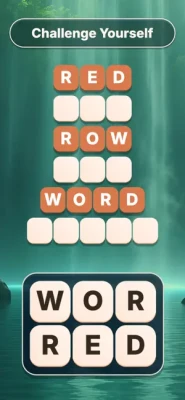
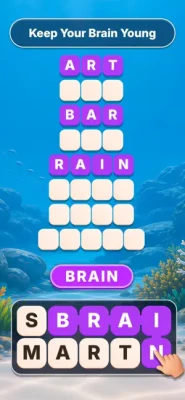
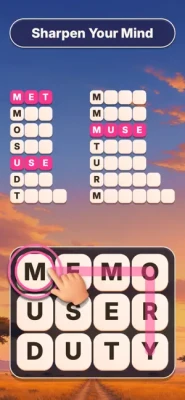
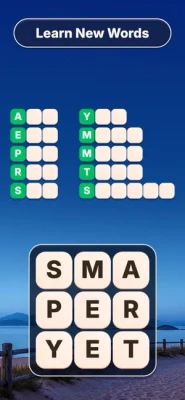
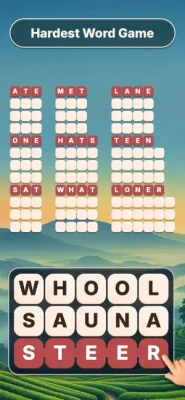
Word Tiles – Relaxing Puzzle offers a refreshing take on traditional word games. Instead of simply searching for words in a grid, players must study the available letters, recognize possible combinations, and work out how each word fits into the overall puzzle. Every level encourages careful observation and a little experimentation.
Developed by Agave Games, the game is designed for players who enjoy vocabulary challenges without the pressure of timed competitions. Its peaceful backgrounds and straightforward controls make it suitable for short breaks or longer puzzle-solving sessions.
The central objective is to find the correct words and fill all the empty spaces on the board. Small numbers displayed on letter tiles provide an important clue: they indicate how many times a particular letter needs to be used. Understanding these numbers is essential because a word that looks correct may not help complete the puzzle if it leaves the board's letter requirements unbalanced.
Early levels introduce the basic mechanics, allowing players to become familiar with connecting letters and completing words. Later stages demand more careful planning, as familiar letter combinations become harder to recognize and the available choices require greater attention.
What Makes Word Tiles – Relaxing Puzzle Different?
The main attraction of Word Tiles is its combination of simple word formation and logical deduction. Players do not need complicated controls or advanced gaming experience. Instead, success comes from looking closely at the board and identifying the words hidden among the available letters.
The letter-count system adds an extra layer of strategy. Players must consider not only whether a word can be formed but also how using its letters affects the remaining puzzle. This makes each decision more meaningful than simply finding as many words as possible.
The absence of a countdown timer allows players to approach difficult levels at their own pace. There is room to pause, reconsider a possibility, and inspect the board before committing to a solution.
The game also includes hundreds of levels with increasing difficulty and calming visual backgrounds. New levels and backgrounds have appeared in updates, giving players additional puzzles to explore as the game develops.
How to Play Word Tiles – Relaxing Puzzle
The gameplay is easy to understand once you become familiar with the letter tiles and their numerical clues. Each level presents a board that must be completed by discovering the words hidden within the available letters.
Understand the Letter Tiles
Start by examining the letters displayed on the board. Look for familiar combinations, common prefixes, recognizable endings, and groups of letters that could form everyday words.
Pay close attention to the small numbers on the tiles. These numbers indicate how many times the corresponding letter must be used. A letter with a higher count may be needed in several words, while another letter may be required only once.
Do not focus exclusively on finding the longest possible word. A short word can be just as important if it uses a letter that is difficult to place elsewhere.
Find Words by Connecting Letters
Look for combinations that form recognizable words and connect the appropriate letters according to the game's controls. If your first idea does not fit the board's requirements, examine the surrounding letters and try a different combination.
It helps to think about words in several categories, including objects, actions, places, descriptive words, and familiar everyday expressions. You may recognize a word more quickly when you consider how its letters could be arranged into different patterns.
Complete Every Empty Space
Finding individual words is only part of the challenge. The ultimate objective is to complete the board while satisfying the required letter counts.
After identifying a possible word, check whether using it leaves enough suitable letters to finish the remaining spaces. If the remaining tiles become difficult to use, reconsider your choices and look for an alternative arrangement.
Progress Through Increasing Difficulty
The early stages help you learn the rules and become comfortable with the puzzle format. As you advance, you will need to pay closer attention to letter combinations, repeated letters, and the consequences of each word choice.
Treat difficult levels as exercises in deduction rather than tests of speed. Since there is no countdown timer, you can take your time and work through each puzzle methodically.
Complete Word Tiles Strategy Guide
Study the Entire Board Before Making a Move
One of the most effective strategies is to inspect the whole board before attempting to solve it. Instead of immediately selecting the first recognizable word, spend a few moments examining the available letters and their numbers.
Look for unusual letters, repeated characters, and combinations that could belong to several different words. These details can reveal which letters are likely to be important later.
A quick overview also helps you avoid committing to an obvious word that creates difficulties elsewhere. The more information you gather before making a move, the easier it becomes to develop a sensible solving strategy.
Use Number Clues to Control Your Choices
The numerical indicators are among the most important elements in Word Tiles. They provide information about how often each letter needs to be used, helping you understand the board's overall requirements.
Check the number attached to a letter whenever you consider using it. If the letter must appear multiple times, avoid treating it as an ordinary single-use resource.
As you complete words, keep track of the remaining requirements. If a particular letter is becoming difficult to account for, consider whether an earlier choice could have used it more effectively.
This approach transforms the puzzle into a process of elimination. Rather than guessing randomly, you can use the available counts to determine which combinations remain possible.
Start With Words You Recognize Immediately
Familiar words can provide a useful starting point. Look for common combinations such as TH, SH, CH, ST, and other letter pairs that frequently appear in English words.
Short, familiar words are often easier to identify than complicated combinations. However, do not assume that every obvious word must be selected first. Check whether it fits the letter requirements and leaves reasonable options for the rest of the board.
A good opening move should help you understand the puzzle, not simply remove letters as quickly as possible.
Look for Rare Letters and Unusual Combinations
Letters such as Q, X, Z, and J can be harder to place than common vowels and consonants. When one of these letters appears, examine the surrounding possibilities carefully.
For example, Q frequently appears with U in English words, while X can occur in words such as BOX, NEXT, or MIX. These examples can help you recognize potential combinations when the appropriate letters are available.
Rare letters may narrow the number of possible solutions, making them useful clues. Identify their likely uses before exhausting the more flexible letters on the board.
Balance Vowels and Consonants
Vowels are essential for building many English words, but a board with several vowels can still be difficult if the consonants do not fit naturally around them.
Look at the relationship between vowels and consonants rather than studying each letter independently. Combinations such as CAT, TRAIN, HOUSE, and PLANT illustrate how different letter structures can form familiar words.
When you are stuck, try building a word around a distinctive consonant and then testing which available vowels fit. Alternatively, begin with a vowel combination and search for consonants that create a valid word.
Think About Word Length
Do not assume that the longest word is automatically the best solution. Longer words may use several letters efficiently, but they can also consume letters needed to complete other words.
Short words may offer greater flexibility, especially when the board contains several overlapping possibilities. The right choice depends on the available letters, the number indicators, and the remaining spaces.
A useful habit is to consider both short and long possibilities before making a decision. Compare how each option affects the rest of the puzzle, then choose the one that produces the most manageable remaining board.
Avoid Random Guessing
Random experimentation can sometimes reveal a word, but it is not a reliable long-term strategy. Repeatedly trying unrelated combinations makes it harder to understand the board's structure.
Instead, follow a simple reasoning process. Identify a possible word, check its letters, review the relevant number indicators, and consider what will remain afterward.
If the choice does not appear promising, return to the board and explore another possibility. A deliberate approach helps you learn from each attempt and reduces unnecessary frustration.
Reconsider Difficult Words From Different Angles
When a familiar word does not fit, avoid repeating the same idea. Look at the available letters from another perspective.
Try changing the first letter, reversing the order in which you inspect a combination, or focusing on a different vowel. Sometimes the solution becomes obvious once you stop concentrating on a single arrangement.
It can also help to mentally separate the letters into smaller groups. Instead of trying to solve the entire board at once, focus on a few promising combinations and expand from there.
Review the Board After Every Successful Word
Completing one word changes the remaining puzzle. Letters become more limited, numerical requirements change, and some possible combinations become easier to recognize.
Take a moment to inspect the board after each successful selection. Check which letters still need to be used and whether your previous assumptions remain valid.
This small habit is particularly useful in later levels, where one decision can influence several remaining possibilities.
Advanced Tips for Challenging Levels
Identify the Most Restrictive Letters First
Some letters can form many different words, while others have only a handful of realistic uses. The more restrictive letters deserve extra attention because they offer fewer alternatives.
Consider a letter with an unusual combination or a high remaining count. Search for words that can accommodate it before concentrating on more flexible letters.
This strategy helps prevent situations in which most of the board is complete but one difficult letter remains without an obvious place.
Use Process of Elimination
When several words seem possible, eliminate options that conflict with the remaining letter requirements.
If one combination would leave a necessary letter with no realistic use, reconsider that combination. If another choice preserves multiple useful possibilities, it may be safer.
You do not need to know the entire solution immediately. Often, the easiest way forward is to identify what cannot work and narrow the available choices until a stronger possibility emerges.
Watch for Repeated Letters
Repeated letters can make a puzzle more complicated because a word may require a letter that also appears elsewhere.
Check the number indicators carefully before assuming that a letter has been fully accounted for. A word containing two instances of the same letter may affect the remaining requirements differently from a word containing it only once.
Paying attention to repeated letters can prevent avoidable mistakes and help you understand why an apparently correct combination may not complete the board.
Develop a Flexible Solving Order
There is no universal order that works for every puzzle. Some boards are easier when you start with an unusual letter, while others become clearer after you identify several short, familiar words.
Adapt your strategy to the board in front of you. Begin with the strongest clues, assess the consequences, and change direction whenever new information suggests a better approach.
Flexibility is especially valuable as the difficulty increases. A strategy that works well in an early level may not be the most efficient choice for a more complicated board.
Take Advantage of the Untimed Format
Because Word Tiles does not impose a countdown timer, there is little reason to rush. Give yourself time to study the board, consider alternative words, and check your reasoning.
If you become stuck, briefly shift your attention away from the puzzle. Returning with a fresh perspective may help you notice combinations that were difficult to recognize before.
The goal is to solve the puzzle accurately and enjoy the process rather than finish every level as quickly as possible.
Common Mistakes to Avoid in Word Tiles
Choosing Words Without Checking the Counts
A recognizable word is not necessarily the best move. If you ignore the numerical indicators, you may use a letter in a way that makes the remaining puzzle harder to complete.
Always consider the required number of uses before committing to a combination.
Focusing Only on Long Words
Long words can be satisfying to find, but they are not automatically more useful. A shorter word may preserve important letters or provide a better route toward completing the board.
Compare possible choices instead of judging them by length alone.
Ignoring Unusual Letters
Leaving rare letters until the very end can create unnecessary difficulties. Consider their likely uses early, especially when the board offers only a few combinations that accommodate them.
You do not always need to use them first, but you should understand their potential role.
Repeating the Same Failed Approach
If a combination does not appear to work, repeatedly examining it without changing your perspective is unlikely to help.
Try a different starting letter, look for another word length, or focus on an entirely different part of the board. Changing your approach often reveals new possibilities.
Trying to Solve Everything at Once
A complicated board can feel overwhelming when you attempt to understand every possible word simultaneously.
Break the puzzle into smaller decisions. Identify a promising combination, assess its impact, and then move on to the next part of the board. A series of manageable decisions is often easier than searching for a complete solution immediately.
Rushing Through Familiar Levels
Even simple levels can contain useful clues about the game's mechanics. Taking a moment to understand why a word fits can help you recognize similar patterns in later puzzles.
Use easier stages to develop habits that will remain useful when the board becomes more demanding.
How to Improve Your Word-Finding Skills
Expand Your Everyday Vocabulary
A broader vocabulary gives you more options when searching for words. Pay attention to unfamiliar words you encounter in reading, conversation, and other word games.
You do not need to memorize long lists. Learning common prefixes, suffixes, and word families can make it easier to recognize unfamiliar combinations.
Practice Recognizing Letter Patterns
English contains many recurring patterns. Common beginnings include RE, UN, and PRE, while frequent endings include ING, ED, ER, and LY.
These patterns are not guaranteed to appear in every puzzle, but recognizing them can help you generate possible words more quickly.
Learn From Each Completed Level
After finishing a challenging board, consider which clues helped you solve it. Perhaps an unusual letter revealed the correct word, or a numerical indicator ruled out several possibilities.
Recognizing these patterns helps you approach future puzzles with greater confidence.
Improve Your Patience and Attention
Word puzzles reward careful observation. Small details that seem unimportant at first can become decisive when only a few letters remain.
Build a habit of checking the entire board, reviewing the numbers, and reconsidering possibilities before giving up on a level.
A Practical Routine for Solving Each Level
Begin With a Visual Scan
Look over the entire board and identify the letters that stand out. Pay attention to unusual characters, repeated letters, and familiar combinations.
Identify Promising Words
Search for short, recognizable words and possible longer combinations. Keep several options in mind rather than committing immediately to the first word you see.
Check the Number Indicators
Compare your proposed words with the number of times each letter must be used. Consider whether your choice will leave the remaining board in a manageable state.
Make a Reasoned Move
Select a word that fits the available letters and supports your overall progress. Avoid choosing a word simply because it is easy to recognize.
Reassess the Remaining Board
Once the word is completed, examine the updated requirements. Look for new combinations and adjust your approach as necessary.
Repeat Until the Board Is Complete
Continue identifying words, checking counts, and evaluating the remaining possibilities until every required space has been filled.
Is Word Tiles – Relaxing Puzzle Suitable for Beginners?
Yes. The game is designed to be accessible to a broad audience, including people who do not regularly play word puzzles.
The basic objective is straightforward: connect letters to make words and complete the board. The numerical clues add complexity gradually as players encounter more challenging combinations.
Beginners can start by identifying familiar words and learning how the letter counts work. With practice, they can begin to evaluate several possibilities at once and plan moves more carefully.
The untimed format is another advantage because players can think through a puzzle without the pressure of a ticking clock. The game is suitable for casual play, although later levels may require considerable patience and attention.
Can Word Tiles Help Keep Your Mind Active?
Word Tiles encourages several forms of mental engagement. Players practice recognizing letter patterns, recalling vocabulary, comparing possible words, and evaluating how individual choices affect a larger problem.
The number indicators also introduce a basic reasoning challenge. Players must consider how frequently each letter needs to be used rather than relying entirely on word recognition.
These activities can make the game an enjoyable way to exercise everyday problem-solving skills. However, playing a word game should not be considered a guaranteed method of improving memory or preventing cognitive decline.
Graphics, Atmosphere, and Overall Experience
Word Tiles – Relaxing Puzzle combines its word challenges with calm visual backgrounds. The presentation supports a slower style of gameplay, allowing players to concentrate on the puzzle rather than reacting to constant time pressure.
The simple premise makes it easy to start playing, while the increasing difficulty provides a reason to continue. Players who enjoy vocabulary games, crossword-style challenges, and logic puzzles may appreciate the combination of familiar words and numerical clues.
The game is free to download on supported Apple devices, with in-app purchases available. The listing also indicates that the game contains advertising, so players should not assume that every part of the experience is completely ad-free.
Platforms and Availability
Word Tiles – Relaxing Puzzle is developed by Agave Games and is available for iPhone and iPad through Apple's App Store. The listing specifies iOS 13.0 or later for iPhone and iPadOS 13.0 or later for iPad, although compatibility requirements may change with future updates.
The game is listed as free to download with optional in-app purchases. Available purchases include bundles, currency packs, and an option marketed as an ad-free purchase. Prices and purchase options can vary by storefront and may change over time.
The game is presented in English, making familiarity with English vocabulary important for solving its word puzzles.
Frequently Asked Questions
What is Word Tiles – Relaxing Puzzle?
Word Tiles – Relaxing Puzzle is a casual word game in which players connect letter tiles to form words and fill every required space on the board. Numerical indicators show how many times each letter needs to be used.
How do you win a level in Word Tiles?
To complete a level, discover the required words and satisfy the board's letter-use requirements. Examine the letters and their numerical indicators, then choose combinations that help you fill all the empty spaces.
What do the numbers on the letter tiles mean?
The small numbers indicate how many times a particular letter must be used. Tracking these requirements helps you determine which words fit the puzzle and avoid choices that leave difficult letter combinations behind.
Does Word Tiles have a time limit?
The game's published description states that there is no timer. Players can solve puzzles at their own pace without the pressure of a countdown.
Is Word Tiles free to play?
Yes. The game is available as a free download, but it includes advertising and optional in-app purchases. Certain paid options are offered for players who want additional items or an ad-free experience.
Does Word Tiles get harder as you progress?
Yes. The game features hundreds of levels, and the puzzles become more challenging as you advance. Later stages require more careful observation, vocabulary knowledge, and planning.
What is the best strategy for difficult levels?
Start by examining the entire board, paying special attention to rare letters and numerical indicators. Identify possible words, evaluate how each choice affects the remaining letters, and reconsider your approach whenever a combination appears unhelpful.
What should I do when I cannot find a word?
Try looking at the letters from a different perspective. Search for common prefixes, endings, short words, and unusual combinations. You can also focus on a restrictive letter or review the remaining number requirements to narrow your options.
Is Word Tiles suitable for children and adults?
The game is presented for a broad audience and carries an age rating of four and older on the Apple App Store. Its simple controls make it accessible, although some later puzzles may challenge experienced word-game players.
Can I play Word Tiles at my own pace?
Yes. The game does not use a countdown timer, so you can pause to think, explore different word combinations, and return to a challenging puzzle without having to race against the clock.
Final Thoughts on Word Tiles – Relaxing Puzzle
Word Tiles – Relaxing Puzzle offers an enjoyable combination of word discovery, letter management, and logical reasoning. Its simple mechanics make it easy to begin, while the numerical clues and increasingly challenging levels provide plenty of opportunities to develop a more thoughtful approach.
The most effective strategy is to study the board before making a move, pay attention to how often each letter must be used, and consider how each word affects the remaining puzzle. By avoiding random guesses, recognizing common letter patterns, and staying flexible when a solution is not immediately obvious, players can approach even difficult levels with greater confidence.
Whether you enjoy casual vocabulary games or prefer puzzles that require careful planning, Word Tiles provides a relaxed way to challenge yourself one board at a time.
Rate the Game
User Reviews



Popular Games



















 Android
 iOS
 Windows
 Xbox