
Latest Version
September 28, 2026
UNICO STUDIO
Word
iOS
0
Report a Problem
More About :game
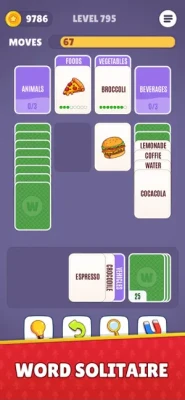
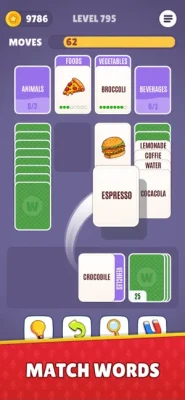
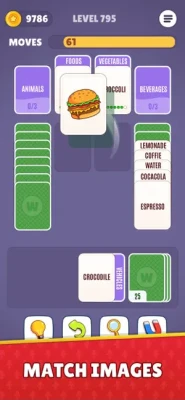
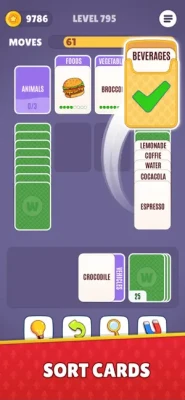
The concept is easy to understand: choose a category, study the available words, and drag the words that belong to that category into place. The challenge comes from the fact that many words can appear related to more than one category, so simply recognizing a connection isn't always enough. You need to determine the most appropriate relationship while carefully managing your limited moves.
The game features hundreds of handcrafted levels, gradually increasing difficulty, offline play, calming visuals, and strategic limited-move gameplay. It is available as a free download with advertising and optional in-app purchases.
How to Play Word Solitaire: Match & Play
Each puzzle presents a collection of word cards and category cards.
Your basic objective is:
Place the category card → study the available words → identify related words → move them into the category → clear the puzzle.
The important part is choosing the correct relationship.
A word may appear to fit several categories at first glance. The strongest solution is usually based on the most specific or intentional relationship represented by the puzzle rather than the first association that comes to mind.
The number of moves is limited, so every placement matters. Running out of moves or reaching a dead end means you need to rethink your sequence.
Main Gameplay Features
Word Category Sorting
The central mechanic is sorting words into their appropriate categories. This combines vocabulary knowledge with association and deduction.
Solitaire-Inspired Gameplay
The game uses the structure and feel of solitaire-style card play while replacing conventional card values and suits with words and categories.
Hundreds of Handcrafted Levels
The developer describes the game as having hundreds of handcrafted puzzles, with the difficulty increasing as you progress.
Limited-Move Challenges
You cannot make unlimited guesses. Moves are limited, which means successful play requires planning rather than randomly testing word combinations.
Offline Play
Word Solitaire: Match & Play can be played without an internet connection, making it suitable for short breaks, travel, and other offline situations.
Relaxing Presentation
The game uses calming visuals and a smooth interface, giving the word puzzles a more relaxed presentation than a fast-paced competitive word game.
Game Center
The App Store listing confirms Game Center support and achievements.
Full Word Solitaire: Match & Play Strategy Guide
The biggest mistake is treating the game as a simple vocabulary test.
It is actually a combination of word recognition, categorization, deduction, and move management.
Knowing that two words are related doesn't automatically mean they belong together in the current puzzle.
1. Read the Categories Before Moving Words
Don't immediately grab the first word that looks obvious.
Start by examining all visible category cards.
Ask:
- What does each category represent?
- Which categories appear highly specific?
- Which categories could have several interpretations?
- Which words clearly belong somewhere?
- Which words could potentially fit multiple groups?
This gives you a mental map before you start spending moves.
2. Find the Most Obvious Matches First
Start with words whose category relationship is extremely clear.
For example, if several words obviously belong to a specific subject, group, object type, profession, activity, or concept, those are usually safer starting points.
Clear matches help reduce the number of uncertain cards remaining on the board.
3. Don't Trust the First Association
This is one of the most important Word Solitaire strategies.
Suppose a word appears to fit Category A.
Before moving it, ask:
Could this word have a more specific relationship with Category B?
The puzzle may deliberately include words that create tempting but incorrect associations.
This is where the game becomes more about logic than simply knowing definitions.
4. Use the Process of Elimination
When a word doesn't have an obvious category, don't guess immediately.
Instead, eliminate the categories where it clearly doesn't belong.
If only two categories remain possible, compare the other words in those groups.
Often, the surrounding cards reveal the intended answer.
5. Look for Category Clusters
Sometimes several words strongly point toward the same category.
When you notice a cluster, use it as an anchor.
For example:
Word A + Word B + Word C
may strongly suggest one particular category.
Once that category becomes clear, the remaining words become easier to interpret.
6. Watch for Overlapping Categories
More difficult levels can contain categories where several words appear related.
This is where many failed attempts happen.
Don't ask:
“Can this word fit here?”
Ask:
“Does this word fit here better than the other available options?”
That small change in thinking can dramatically improve your success rate.
7. Protect Your Limited Moves
Moves are one of your most important resources.
Before placing a questionable card, ask:
“How much information will this move give me?”
A confident placement that confirms a category is valuable.
A random placement based on a weak association may simply consume a move.
Because the game specifically uses limited-move gameplay, inefficient guesses can quickly create difficult positions.
8. Solve the Most Certain Category First
If one category has several unmistakable words while another category is ambiguous, begin with the certain group.
This reduces uncertainty.
After clearing the obvious group, reassess the remaining words.
The relationships that were unclear at the beginning may become much easier once several competing possibilities disappear.
9. Don't Assume Every Word Has an Obvious Meaning
Some cards may be designed around a particular interpretation rather than the most common meaning of the word.
Consider:
- Alternative meanings
- Related objects
- Common phrases
- Groups of things
- Activities
- Places
- Names
- Descriptive relationships
If a word seems strange in one category, look for another legitimate connection.
10. Reevaluate the Board After Every Important Move
Don't continue playing according to an old plan after the board changes.
After clearing a category, pause.
Look again at:
- Remaining categories
- Remaining words
- Possible overlaps
- New obvious relationships
- Words that have become more constrained
A good solution is often built in stages rather than following one rigid plan from the beginning.
Advanced Word Solitaire Strategies
Use a Confidence System
You can mentally divide possible moves into three groups:
High confidence:
The relationship is obvious.
Medium confidence:
The relationship is plausible but another category may also fit.
Low confidence:
You're essentially guessing.
Use high-confidence moves first.
Save medium-confidence decisions until more information becomes available.
Avoid low-confidence moves unless there are no better options.
Solve the Most Specific Category First
Specific categories usually provide more information than broad categories.
For example, a narrow group can immediately eliminate several possible destinations for the remaining cards.
Broad categories can be left until the board contains fewer competing possibilities.
Use Remaining Words as Evidence
A category isn't defined only by the words you put into it.
The words left behind also provide information.
If putting a particular word into Category A leaves another word that suddenly has no logical home, your previous assumption may have been wrong.
Always consider the consequences of a placement.
How to Handle a Dead End
Sometimes you reach a point where no useful move seems available.
Don't immediately repeat the same sequence.
Instead:
Step 1: Find the first uncertain move
Look backward and identify where you made your first low-confidence placement.
Step 2: Undo the assumption mentally
Consider what would happen if that word belonged somewhere else.
Step 3: Rebuild the category
Look for stronger relationships among the remaining words.
Step 4: Protect your remaining moves
Don't start guessing randomly.
Step 5: Restart only when necessary
If the board is genuinely compromised, a fresh attempt with a different opening sequence can be more productive.
Player feedback on the App Store has included reports of situations where users reached a state with no apparent moves or where hints did not resolve the position. The developer has acknowledged these reports and said the team was working on stability.
Word Solitaire Hint Strategy
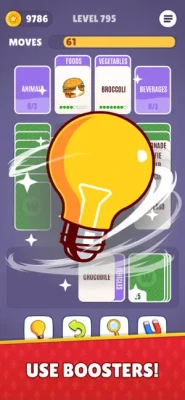
Hints can be useful, but don't use them immediately whenever you feel uncertain.
First try:
- Identify obvious categories.
- Eliminate impossible relationships.
- Compare ambiguous words.
- Reassess the remaining board.
- Use a hint only if the uncertainty remains.
This approach lets you use assistance as a learning tool rather than relying on it for every difficult decision.
How to Improve at Word Association Puzzles
Build Category Awareness
As you play, you'll encounter recurring types of relationships.
Pay attention to categories involving:
- Objects
- Animals
- Places
- Activities
- Professions
- Food
- Entertainment
- Nature
- Technology
- Everyday items
- Descriptive terms
Recognizing the type of relationship is often faster than analyzing each word individually.
Think in Groups, Not Individual Words
Instead of asking:
“Where does this word go?”
ask:
“What group of four or more words is the puzzle trying to create?”
This changes your approach from guessing destinations to discovering patterns.
Common Mistakes to Avoid
Guessing Because a Word “Feels Right”
A vague association can consume a valuable move.
Ignoring Other Categories
Always compare at least two possible destinations when a word is ambiguous.
Using Moves to Experiment Randomly
Limited moves make careless experimentation expensive.
Solving Only One Word at a Time
Look for relationships among groups of words.
Forgetting Previously Learned Patterns
If you recognize a category structure from earlier levels, use that knowledge—but don't assume every similar-looking puzzle has exactly the same solution.
Continuing After the Board Changes
Reevaluate after clearing an important category.
Rushing
The game is built around logic and planning, not speed.
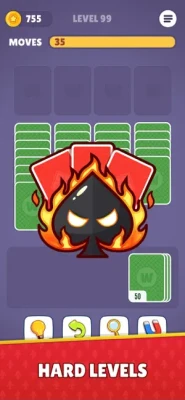
Difficulty and Progression
Word Solitaire: Match & Play begins with straightforward word-category relationships and becomes more demanding as the number and ambiguity of possible associations increase.
The difficulty comes from several factors:
- More words
- More categories
- Overlapping associations
- Limited moves
- Less obvious relationships
- More opportunities for incorrect assumptions
The developer describes the game as having increasing difficulty that grows with the player's progress.
One App Store reviewer also described later puzzles as becoming difficult after the early levels, while another noted that some puzzles contain many possible category relationships. These are individual player experiences rather than a universal measure of difficulty.
Relaxing Gameplay and Atmosphere
Despite its strategic difficulty, Word Solitaire: Match & Play is presented as a calm brain game.
Its visual design and smooth interface are intended to create a relaxing environment while the player works through word associations. The developer specifically positions it as suitable for short two-minute sessions as well as longer play sessions.
That makes it a good fit for players who enjoy word puzzles but prefer a slower, solitaire-inspired format.
Offline Gameplay
One of the useful features of Word Solitaire: Match & Play is its offline support.
The App Store listing states that the game does not require Wi-Fi, allowing players to work through puzzles without an active internet connection.
This makes it convenient for:
- Travel
- Flights
- Waiting rooms
- Commuting
- Breaks
- Quiet evening sessions
Is Word Solitaire Educational?
Word Solitaire: Match & Play is primarily a puzzle game rather than a formal educational application.
However, its mechanics naturally involve:
- Vocabulary
- Word recognition
- Memory
- Categorization
- Logical thinking
- Decision-making
The developer specifically describes these as skills that the game can exercise through its puzzles.
It is therefore best described as a word-based brain puzzle game with vocabulary and logic elements, rather than a structured language-learning course.
Word Solitaire: Match & Play Pros and Cons
Pros
- Original combination of solitaire and word puzzles
- Easy basic controls
- Strong focus on word association
- Hundreds of handcrafted levels
- Increasing difficulty
- Limited-move strategic gameplay
- Offline support
- Calming presentation
- Game Center achievements
- Suitable for short or longer sessions
Cons
- Some categories can have several plausible word associations
- Limited moves can make difficult puzzles frustrating
- Some players have reported freezes or situations with no apparent moves
- Some recent player feedback has criticized changes to continuation/reward mechanics
- Advertising and optional purchases are part of the free-to-play model
The current US App Store listing shows a 4.8/5 rating from about 2.8K ratings. Player reviews are generally positive, but some reviews also report issues involving freezes, dead ends, repeated puzzles, and changes to the way players can continue after failing a level.
Ads and In-App Purchases
Word Solitaire: Match & Play is free to download and contains advertising and optional in-app purchases.
The current App Store listing includes coin packs, starter and advantage packs, fail offers, and options to remove advertisements.
Player feedback also indicates that the game's continuation mechanics have changed across updates, with some players preferring earlier options for continuing after a failed attempt. These comments represent individual experiences and may vary by version or account.
Latest Update
The current App Store listing shows version 1.1.3, released very recently, with bug fixes and performance improvements aimed at providing a smoother gameplay experience.
Previous updates have also included new levels, performance improvements, and additional language support.
Word Solitaire Rating and Game Information
Game: Word Solitaire: Match & Play
Developer: UNICO STUDIO
Category: Word
Current US App Store Rating: 4.8/5
Ratings: About 2.8K
Age Rating: 4+
Size: About 326 MB on the current listing
Languages: English plus 18 additional languages
Advertising: Yes
In-App Purchases: Yes
Game Center: Supported
Platforms and Requirements
Word Solitaire: Match & Play supports:
- iPhone
- iPad
- iPod touch
- Apple Vision
- Compatible Apple silicon Mac
The current App Store listing requires iOS 15.0 or later for iPhone, iPadOS 15.0 or later for iPad, and macOS 12.0 or later with an Apple M1 chip or later for Mac.
Frequently Asked Questions
What is Word Solitaire: Match & Play?
It is a word puzzle that combines solitaire-inspired gameplay with word association and category sorting. Players organize word cards under the correct category cards.
How do you play Word Solitaire?
Choose a category, analyze the available word cards, and place the words that belong to that category. You must complete the puzzle while managing a limited number of moves.
Is Word Solitaire free?
Yes. The game is free to download, but it contains advertising and optional in-app purchases.
Can you play Word Solitaire offline?
Yes. The App Store listing states that the game works offline without requiring Wi-Fi.
Does Word Solitaire have many levels?
Yes. The developer describes the game as having hundreds of handcrafted levels with increasing difficulty.
What makes Word Solitaire difficult?
The main challenge comes from ambiguous word relationships and limited moves. Several words may appear to fit a category, so you need to determine which association is intended.
What is the best strategy for Word Solitaire?
Start with high-confidence matches, identify the most specific categories, avoid random guesses, and consider how every placement affects the remaining words.
Are there hints?
The game includes hint functionality, and player reviews discuss situations where hints can be useful or, in some reported cases, have failed to provide a useful move.
Does Word Solitaire have achievements?
Yes. The App Store lists Game Center support and achievements.
Is Word Solitaire suitable for casual players?
Yes. Its simple controls, calm presentation, offline support, and short-session format make it accessible, while the limited-move puzzles provide additional depth for players who want a challenge.
Final Word Solitaire Strategy Tip
Don't ask only whether a word belongs in a category—ask whether it belongs there better than every other available option.
That is the key to progressing through the harder Word Solitaire: Match & Play puzzles. Start with obvious relationships, use elimination for ambiguous cards, protect your limited moves, and constantly reconsider the remaining board after each important category is cleared.
The game is ultimately a blend of vocabulary, word association, solitaire-style card management, and logical planning. Once you start looking for complete category patterns instead of solving one word at a time, difficult levels become much easier to approach.
Rate the Game
User Reviews






Popular Games



















 Android
 iOS
iOS Windows
 Xbox
Xbox