




Latest Version
September 15, 2026
Etermax
Word
iOS
0
Report a Problem
More About :game
The challenge is simple but unpredictable. Players take turns giving clues connected to the secret word without making the answer too obvious. The impostor has to listen carefully, improvise, and pretend to know the word. Everyone else has to study the clues and figure out who does not really know what the group is talking about.
The game supports three or more players and includes a Live Mode that allows friends to play together remotely.
What Is Imposter Live Party Game?
Imposter Live is a social deduction party game from Etermax. It is designed for groups rather than traditional single-player play, making it suitable for game nights, parties, family gatherings, trips, school breaks, and remote sessions with friends.
The basic concept combines a secret-word game with an impostor mechanic. Everyone has to communicate, but nobody wants to reveal too much information.
The result is a game where a single clue can completely change the direction of a round.
How to Play Imposter Live
The basic rules are easy to learn.
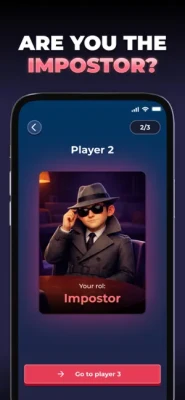
At the beginning of a round, players receive their roles privately. Most players see a secret word, while the impostor does not know it.
Players then take turns giving clues related to that word.
The players who know the word need to prove that they belong without making the secret answer obvious.
The impostor has the opposite problem. They need to figure out what everyone is describing while pretending that they already know the answer.
After the clue phase, players analyze the responses and vote for the person they believe is the impostor.
If the group identifies the impostor, the impostor may still have another opportunity depending on the game mode and rules. The current version also lists additional ways to play, including multiple impostors, clues, and guessing the word to survive.
Main Features
Secret Word Gameplay
The secret word is the foundation of every round.
Most players know the word, but the impostor does not. This creates an information gap that players must exploit without giving the answer away.
Impostor Role
Being the impostor requires quick thinking.
You need to listen to everyone else's clues, identify the possible topic, and produce answers that sound believable.
A good impostor does not necessarily give the most impressive clue. The goal is to sound like someone who genuinely knows the word.
Clue-Based Rounds
Every clue provides information.
Players can use clues to demonstrate that they know the secret word, while simultaneously watching for answers that appear too vague, too specific, or disconnected from the discussion.
Voting
The final decision comes down to the group.
Players need to consider the entire round rather than accusing someone because of one unusual clue.
Multiple Impostors
The current version history specifically mentions multiple-impostor gameplay. When there is more than one impostor, identifying suspicious behavior becomes more difficult because several players may deliberately avoid revealing information.
Live Mode
Live Mode allows players to interact through video and play from different locations. The feature is designed to let friends see one another, exchange clues, and identify the impostor in real time.
Full Imposter Live Strategy Guide
Winning consistently requires more than simply guessing who looks suspicious. The best approach changes depending on whether you know the secret word or are playing as the impostor.
Strategy for Regular Players
1. Give a Specific but Safe Clue
Your clue should demonstrate that you know the word without revealing it directly.
For example, if the secret word is "beach," saying "sand" may be useful, but saying "ocean" could still be too broad depending on the group.
Try to choose clues that genuine players will understand while keeping enough uncertainty for the impostor.
2. Avoid Extremely Obvious Clues
Giving away the secret word defeats the purpose of the round.
If everyone immediately understands the answer from your clue, the impostor can also identify it.
A better clue points toward the answer without naming its most obvious association.
3. Listen to the Order of Clues
The first few clues can establish the general topic.
Later players have more information available, which means they can sometimes produce safer clues.
Pay attention to whether someone's answer sounds naturally connected to the earlier clues or whether they appear to be copying the direction of the conversation.
4. Watch for Overly General Answers
An impostor may try to survive by giving clues that could apply to many different words.
For example, words such as "good," "big," "fun," or "interesting" can sometimes reveal very little.
One vague answer is not proof of anything, but repeated vagueness can become suspicious.
5. Look for Clues That Are Too Convenient
The opposite problem can also happen.
A player may give a highly specific clue immediately after hearing everyone else.
That can mean they genuinely know the answer, but it can also be an attempt to appear confident after collecting information.
Judge the clue in context rather than automatically trusting confidence.
6. Remember Everyone's Answers
Do not focus only on the most suspicious player.
Compare the clues from the entire group.
Ask yourself:
- Who sounded natural?
- Who avoided committing to a meaningful clue?
- Who changed direction suddenly?
- Who seemed to learn the word from other players?
- Who gave an answer that could fit almost anything?
This makes voting more reliable.
Strategy for the Impostor
Playing as the impostor is completely different.
You do not have the secret word, so your first priority is to gather information without exposing yourself.
1. Listen Before Speaking
Do not rush to give your clue.
Listen to the first players carefully and look for connections between their answers.
Several apparently unrelated clues can reveal the category or object.
2. Identify the Common Connection
Suppose three players give clues involving:
- travel
- luggage
- airport
You can start building a mental picture of the secret word.
The objective is not necessarily to identify the exact word immediately. First identify its general category.
3. Avoid Extremely Specific Guesses
If you are only 50% certain about the word, do not give a clue that depends on a very specific interpretation.
A safer clue can keep you in the game while you collect more information.
4. Mirror the Group's Level of Specificity
If everyone is giving broad clues, give a broad clue.
If everyone is being highly specific, an extremely vague response may stand out.
Try to match the communication style of the group.
5. Never Panic After a Suspicious Clue
Someone may accuse you even when you are not the impostor.
Stay calm.
Explain why your clue made sense without revealing information that could help the real impostor.
6. Use Other Players' Mistakes
A strong impostor does not need to dominate the conversation.
If another player gives a clue that reveals too much, use that information to identify the secret word.
The more information the group gives away, the easier the impostor's job becomes.
How to Detect the Impostor
There is no guaranteed behavioral signal that identifies an impostor, so focus on what players actually say.
Suspicious Pattern 1: Extremely Vague Clues
A player repeatedly uses clues that could apply to dozens of words.
Suspicious Pattern 2: Copying Previous Ideas
The player waits for several answers and then gives a clue that closely follows the established direction without adding much new information.
Suspicious Pattern 3: Sudden Confidence
Someone who initially appears uncertain suddenly becomes very specific after hearing multiple clues.
Suspicious Pattern 4: Contradictory Clues
Their answer does not fit the other clues or seems to describe a completely different concept.
Suspicious Pattern 5: Overexplaining
An impostor may sometimes try too hard to justify an answer after being questioned.
However, none of these behaviors should be treated as automatic proof. The strongest deduction comes from comparing the entire round.
Best Clue Strategy
The ideal clue sits between two extremes.
Too obvious: The impostor discovers the word.
Too vague: Other players think you may be the impostor.
Balanced: Genuine players understand the connection, but the impostor still has to work for it.
This balance is one of the most important skills in Imposter Live.
How to Survive as an Impostor
If you receive the impostor role, use this sequence:
Listen → Identify the category → Narrow the possibilities → Give a flexible clue → Watch reactions → Adjust your theory.
Do not try to solve the entire word immediately.
Instead, gradually reduce the possibilities as players provide information.
How to Survive the Voting Phase
If you are accused, avoid becoming defensive too quickly.
Explain your clue briefly and point out why it fits the secret word without asking other players to reveal more information.
If you are a regular player, avoid voting simply because someone sounds nervous. A nervous player may simply be under pressure.
Look for contradictions between clues.
Multiplayer Tips
Imposter Live is designed around group interaction, so communication style matters.
When playing with friends:
- Pay attention to recurring bluffing habits.
- Do not assume the quietest player is suspicious.
- Do not automatically trust the most confident player.
- Compare clues instead of personalities.
- Avoid revealing the secret word accidentally.
- Keep accusations focused on the actual clues.
The game becomes more interesting when players develop different bluffing styles.
Multiple Impostors Strategy
Multiple impostors change the deduction process.
With only one impostor, the group is looking for one person who appears disconnected from the secret word.
With multiple impostors, several players may intentionally give uncertain clues.
For regular players, this means you should avoid stopping after identifying one suspicious person. Continue examining the rest of the group.
For impostors, multiple roles can provide additional opportunities to hide because uncertainty becomes more widespread.
Live Mode Strategy
Live Mode adds another layer to the game because players can interact through video. The current App Store description says players can play over video, see each other, give clues, and catch the impostor in real time.
When playing remotely:
- Keep your camera and communication setup ready before the round.
- Listen carefully rather than talking over other players.
- Watch the timing of responses.
- Pay attention to changes in confidence.
- Avoid giving away reactions to your own secret information.
The social element is especially important when everyone can see one another.
Best Settings for a Party
For a casual group, start with the standard rules.
Once everyone understands the basic gameplay, experiment with additional options such as multiple impostors.
A larger group can create more uncertainty because there are more clues and more players to analyze.
A smaller group makes each clue more important because every player's contribution represents a larger portion of the available information.
Imposter Live for Friends and Family
The App Store listing describes the game as suitable for friends, families, children, adults, parties, trips, school breaks, and group gatherings. It is rated 4+ on the current U.S. App Store listing.
The rules are simple enough to learn quickly, which makes it useful as a party game where players do not want to spend a long time explaining complicated mechanics.
Imposter Live Platforms and Requirements
The current App Store listing supports iPhone and iPad and requires iOS/iPadOS 12.0 or later. It lists English, German, Portuguese, and Spanish among the supported languages.
The game is also available on Google Play as Imposter Live Party Game, where the listing identifies Etermax as the developer and currently shows 10K+ downloads.
Game Information
Game: Imposter Live: Party Game
Developer: Etermax
Genre: Word / Party / Social Deduction
Players: 3 or more
Main mechanic: Secret words and hidden impostor
Modes: Standard play and Live Mode
Multiplayer: Yes
Platform: iPhone and iPad, with Android availability
App Store age rating: 4+
Languages: English, German, Portuguese and Spanish
App Store requirement: iOS/iPadOS 12.0 or later
Pros and Cons
Pros
- Easy rules
- Designed for groups of 3 or more
- Quick rounds
- Secret-word deduction gameplay
- Bluffing and social strategy
- Multiple impostor option
- Live video mode
- Works for face-to-face or remote sessions
- Suitable for parties and game nights
Cons
- Requires a group for the main experience
- The quality of a round depends heavily on player interaction
- Very small groups may provide less information to analyze
- The game is less suitable for players looking for a traditional single-player experience
Frequently Asked Questions
How many people can play Imposter Live?
The game is designed for 3 or more players.
What does the impostor do?
The impostor does not receive the secret word. They must listen to the other players' clues, figure out what the group is describing, and bluff convincingly enough to avoid being identified.
How do you win as a regular player?
Your goal is to understand the clues, identify the player who appears not to know the secret word, and vote for the impostor.
How do you win as the impostor?
You need to blend into the group, gather enough information from the clues to understand the secret word, and avoid being identified during the voting phase.
Does Imposter Live have multiplayer?
Yes. Multiplayer group play is the central concept of the game, with support for three or more players.
Does Imposter Live have online play?
The game includes Live Mode, which allows players to play over video from different locations.
Does Imposter Live have multiple impostors?
Yes. The current App Store version history lists multiple-impostor gameplay as one of the available ways to play.
Is Imposter Live available on Android?
Yes. Google Play lists Imposter Live Party Game under the package com.etermax.imposter.
Who made Imposter Live?
Imposter Live: Party Game was developed by Etermax.
Final Thoughts
Imposter Live: Party Game keeps its rules simple while creating plenty of room for bluffing and deduction. The secret-word system means every player has to communicate carefully, while the impostor has to learn from the conversation without making it obvious that they are missing the key information.
The most important skill is balance. If you know the word, give enough information to prove that you belong without handing the answer to the impostor. If you are the impostor, listen carefully, collect information gradually, and avoid trying to sound too certain too early.
With support for three or more players, multiple impostors, clue-based rounds, voting, and Live Mode, the game is built around social interaction rather than complicated controls.
Rate the Game
User Reviews















Popular Games



















 Android
 iOS
iOS Windows
 Xbox
Xbox