

Latest Version
September 14, 2026
Al Games FZ
Word
iOS
0
Report a Problem
More About :game
The challenge comes from finding the right combination. Several words may appear to fit at first, but the letters created by intersecting words gradually reveal which placement is correct. That makes every puzzle a mixture of vocabulary, deduction, pattern recognition, and forward planning.
Players can begin with easier puzzles and gradually work toward more difficult challenges. The game also includes themed categories, daily challenges, mini crosswords, larger puzzles, hints, number-based Kriss Kross puzzles, and offline play.
What Makes Fill-in Word Different?
Traditional crosswords usually give you clues that you need to interpret. Fill-in Word takes a different approach: the words are already provided, but where they belong is the puzzle.
This creates an interesting logic loop:
- Look at the available words.
- Check their lengths.
- Find spaces that match.
- Use starting letters and intersections as clues.
- Test possible placements.
- Let newly placed letters eliminate incorrect choices.
- Complete the grid through deduction.
It is easy to understand but becomes considerably more demanding as the grids grow and fewer obvious placements remain.
Main Gameplay Features
Word-Fill Crossword Puzzles
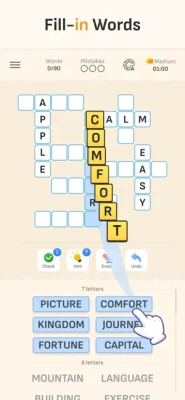
The core mode gives you a list of words and a crossword-style grid. Your objective is to place every word correctly without relying on conventional crossword clues.
Daily Crossword Challenge
Daily challenges provide a reason to return regularly. The game also includes daily words and additional activities designed around vocabulary and puzzle solving.
Multiple Difficulty Levels
You can progress from easier puzzles toward harder and more demanding grids. Higher difficulty requires greater attention because several words may initially appear capable of fitting the same location.
Mini and Large Puzzles
Short mini puzzles are useful when you only have a few minutes, while larger grids provide a longer logic challenge.
Category-Based Puzzles
Different categories introduce vocabulary from a variety of subjects. This gives the game more variety than repeatedly solving identical word lists.
Number Kriss Kross
Number puzzles change the usual word-based formula. Because numbers can sometimes fit several positions, these puzzles place additional emphasis on careful deduction.
Hints
When you reach a difficult position, hints can help you continue rather than abandoning the puzzle. However, using them sparingly makes the solving process much more rewarding.
Offline Play
The game supports offline play, making it suitable for playing when you do not have a reliable internet connection.
Dark and Light Modes
You can switch between dark and light presentation depending on your preference and playing environment.
How to Play Fill-in Word Crossword Puzzle
The basic rules are straightforward.
You receive a crossword-style grid containing spaces and a collection of words. Every word must be placed into a matching horizontal or vertical position.
The important part is that the words intersect. A letter placed in one word affects the possible positions of another word.
For example, if a four-letter word must cross another word at its second position, the letter already occupying that square immediately eliminates many possibilities.
Keep repeating this process until every word has a valid position.
Full Strategy Guide
1. Start With the Longest Words
Long words are usually easier to place because there are fewer spaces with exactly the same length.
Look through the word bank before making your first move. Identify unusually long words and compare them with the longest open spaces on the board.
These placements can provide several letters that help solve shorter words.
2. Use Starting Letters Carefully
Some puzzles provide starting letters that act as built-in clues.
Do not simply search for a word with the correct length. Look for a word whose letters can actually match the known positions on the grid.
A starting letter combined with word length can reduce several possibilities immediately.
3. Count the Spaces
Word length is one of your strongest tools.
If you have a seven-letter word, immediately search for seven-cell spaces. Do the same for four-, five-, six-, and longer words.
Avoid placing a word simply because it looks visually appropriate. Count every square.
4. Look for Rare Letters
Letters such as Q, X, Z, J, and V can be extremely useful.
If one of these letters appears in a word, look for grid positions where that letter could logically intersect another word.
Rare letters often provide stronger evidence than common letters such as E, A, or S.
5. Find Forced Moves
A forced move is a placement where only one word can logically fit.
For example, suppose a six-letter space already contains the pattern:
_ A _ E _ T
If only one available word matches that pattern, you have found a strong placement.
Prioritize these moves instead of guessing.
6. Work From Confirmed Letters
Once several words are placed, the board becomes much easier to read.
Use confirmed letters to create patterns in unfinished spaces.
Instead of asking:
Which word might fit here?
ask:
Which available word matches this exact pattern?
That change in approach makes difficult puzzles much more manageable.
7. Do Not Commit Too Early
One of the biggest mistakes in fill-in puzzles is treating a possible placement as a confirmed placement.
A word can sometimes fit more than one location at the beginning.
If two positions appear possible, leave the decision open until another intersection provides additional information.
8. Use Intersections as Evidence
The intersections are the heart of the game.
Suppose a word seems to fit horizontally, but placing it would force an impossible letter in a vertical word. That horizontal placement is probably wrong.
Always evaluate a word against the words it crosses.
9. Solve Short Words After the Board Opens Up
Three- and four-letter words can be deceptively difficult at the beginning because there are many possible positions.
After several longer words are placed, however, short words often become obvious.
Do not waste too much time forcing short words into an empty grid.
10. Keep Track of Unused Words
When you become stuck, stop looking only at the grid.
Look at the remaining word list.
Ask yourself:
- Which word has the fewest possible positions?
- Which word contains unusual letters?
- Which word has a pattern matching a partially completed space?
- Which remaining word could unlock several intersections?
The answer often points toward your next move.
11. Recheck Your Assumptions
If the final few words refuse to fit, do not automatically assume you need a hint.
Go back and inspect your earlier placements.
A single incorrect assumption near the beginning can create several apparently impossible spaces later.
Remove the questionable placement and see whether the rest of the puzzle becomes clearer.
12. Save Hints for Genuine Roadblocks
Hints are most useful when the board has stopped producing meaningful deductions.
Using a hint every time you hesitate can prevent you from learning the game's logic.
Try at least two or three different deductions first:
- Check word length.
- Check known letters.
- Compare intersections.
- Review remaining words.
- Reconsider an earlier placement.
If none works, then a hint can be worthwhile.
Advanced Fill-in Word Tips
Think Several Moves Ahead
The best placement is not always the word that fits immediately.
Consider what letters that placement will create for other words.
A word that produces two or three useful intersections may be more valuable than one that simply fills an empty space.
Use Contradictions
You do not always have to prove that a word belongs somewhere.
Sometimes it is easier to prove where it cannot go.
If a placement creates an impossible combination with another word, eliminate it.
This is particularly useful on harder puzzles.
Prioritize Highly Connected Spaces
Some spaces intersect several other words.
Solving one of these can reveal a large portion of the grid.
When choosing between two possible moves, favor the one that provides more new letters.
Don't Confuse Familiarity With Correctness
A familiar word may feel like the obvious answer, but the grid determines whether it is correct.
Always let the crossing letters and available spaces make the final decision.
Tips for Number Kriss Kross
Number puzzles require a slightly different mindset.
Because numbers can repeat more easily than unusual letters, several placements may initially look possible.
Use:
- The exact number of cells.
- Existing numbers at intersections.
- Repeated sequences.
- Unique combinations.
- The remaining unused numbers.
Avoid guessing early. Number puzzles reward systematic elimination.
Daily Challenge Strategy
If you want to make daily puzzles part of your routine, start with the easiest available challenge and gradually increase the difficulty.
A good routine is:
First: scan the entire word list.
Second: identify the longest and most unusual words.
Third: place obvious matches.
Fourth: use the new crossing letters.
Fifth: finish the remaining short words.
Finally: check every intersection before submitting the completed puzzle.
The game also incorporates daily goals and word-related activities, giving regular players additional reasons to return.
Common Mistakes to Avoid
Guessing Based Only on Word Length
Several words can have the same number of letters. Length alone is not enough.
Ignoring the Remaining Word List
The unused words contain valuable information. Always reconsider them when stuck.
Filling Every Possible Space Immediately
Some early placements are only possibilities, not certainties.
Forgetting About Intersections
A word can look perfect by itself and still be wrong once its crossing letters are considered.
Using Hints Too Quickly
Hints are helpful, but solving a difficult section yourself improves your understanding of the puzzle's logic.
Is Fill-in Word Good for Relaxing?
Yes. The game is designed around relatively calm, methodical puzzle solving rather than fast reflexes.
The combination of word placement, logical deduction, different puzzle sizes, categories, and adjustable difficulty makes it suitable for short sessions or longer puzzle-solving sessions.
The App Store listing also describes it as a game for teens, adults, and seniors who want to test their vocabulary and logic skills.
Difficulty and Progression
The game ranges from easier puzzles to much more demanding challenges. As the grids become harder, the main challenge is no longer understanding the rules—it is recognizing which placement is logically strongest.
Recent updates have continued adding puzzles and categories while rebalancing levels and improving the overall experience. The App Store version history lists multiple updates introducing fresh puzzles, new categories, additional rewards, and gameplay improvements.
Pros and Cons
Pros
- Easy rules with surprisingly deep logic
- Large variety of word-fill puzzles
- Daily challenges
- Category-based puzzles
- Mini and large crossword grids
- Multiple difficulty levels
- Number Kriss Kross puzzles
- Hint system
- Dark and light modes
- Offline play
- Regular additions and updates
Cons
- Some puzzles can have several possible-looking placements early on
- Short words may be difficult to identify before enough letters are revealed
- Players can become frustrated if an incorrect early placement is not noticed
- Some players may prefer traditional clue-based crosswords
Game Information
Game: Fill-in Word: Crossword Puzzle
Genre: Word / Puzzle / Logic
Developer: AI Games FZ, according to the current App Store listing
Platform: iPhone and iPad
Age Rating: 4+
Price: Free with in-app purchases
Languages: English plus additional supported languages
Game Style: Word fill-in, Kriss Kross, crossword logic
Offline Mode: Yes
Daily Challenges: Yes
Difficulty: Easy through extreme
Modes: Word puzzles, categories, mini puzzles, large puzzles and number Kriss Kross
Latest App Store Version Shown: 6.2.4
Latest Version Update: August 29, 2026
Who Should Play Fill-in Word?
Fill-in Word is a good choice for players who enjoy:
- Crossword puzzles without traditional clues
- Word games
- Logic puzzles
- Brain teasers
- Vocabulary games
- Daily puzzle challenges
- Relaxing offline games
- Kriss Kross and Word-Fit puzzles
- Short casual gaming sessions
It is especially appealing if you enjoy puzzles where the solution comes from deduction rather than speed.
Fill-in Word Crossword Puzzle Review
Fill-in Word: Crossword Puzzle takes a familiar crossword concept and turns it into a pure placement and logic challenge. The word list gives you the pieces, while the grid forces you to determine how those pieces fit together.
The strongest part of the game is the way one correct placement can unlock several others. A puzzle may appear confusing at first, then suddenly become much clearer after one well-chosen word.
Its combination of daily challenges, categories, different puzzle sizes, increasing difficulty, and number puzzles gives the experience more variety than a basic word-fill game.
For players who enjoy thoughtful word puzzles and prefer deduction over fast-paced gameplay, it is an easy game to pick up but difficult to completely master.
Final Tips
The most important rule is simple: do not guess when you can deduce.
Start with long words, use the starting letters, pay attention to unusual letter combinations, and let intersections confirm your decisions. When a puzzle becomes difficult, look at the remaining words instead of repeatedly trying the same position.
Once you begin thinking several placements ahead, even the harder Fill-in Word crossword puzzles become much more manageable.
Rate the Game
User Reviews



Popular Games











 Android
 iOS
iOS Windows
 Xbox
Xbox