
Latest Version
October 05, 2026
Gamehouse LLC
Word
iOS
0
Report a Problem
More About :game
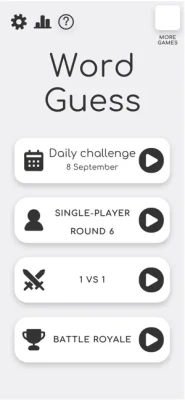
The game is designed around short guessing rounds that are easy to understand but increasingly challenging as you try to identify the correct word using limited information. The App Store describes four main modes: Daily Puzzle, Solo, 1v1, and Battle Royale.
What Is Word Guess: Classic Games?
Word Guess: Classic Games is a vocabulary and deduction game from Gamehouse LLC that combines traditional word-guessing mechanics with several different ways to play.
Rather than forcing every player into the same experience, the game lets you choose between relaxed solo puzzles and competitive modes.
You can:
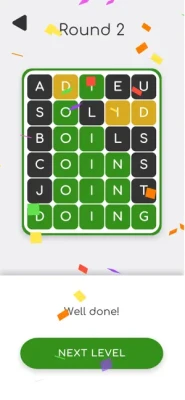
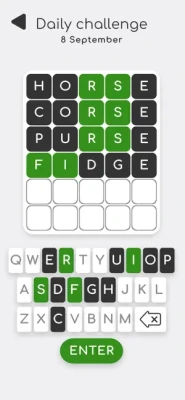
Solve the Daily Puzzle.
Practice vocabulary in Solo mode.
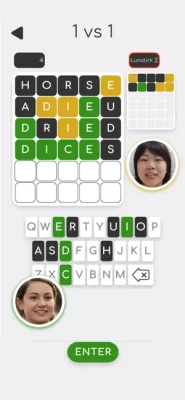
Compete directly against another player in 1v1.
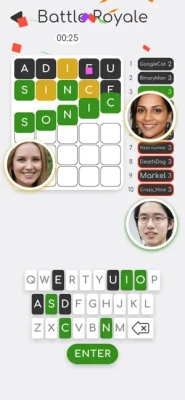
Enter Battle Royale rounds.
Play at your own pace.
Test your word knowledge against real players.
The current App Store listing describes the game as a casual brain-training experience designed to sharpen word skills and encourage faster thinking.
How Word Guess Gameplay Works
The basic objective is straightforward:
Use the information available to identify the hidden word.
The challenge comes from choosing letters intelligently rather than simply guessing random words.
A strong player doesn't only ask:
"What word could this be?"
They also ask:
"Which guess will give me the most useful information?"
That distinction is extremely important.
A good guess can eliminate several possibilities at once, while a poor guess may reveal almost nothing.
The Most Important Word Guess Strategy
Think About Information, Not Just Correct Letters
When you're uncertain, choose a word that tests several useful letters.
For example, suppose you have identified one or two letters but still have many possible answers.
Instead of immediately guessing the word you think is most likely, consider whether another word could test several unconfirmed letters.
This creates a better information base for the following round.
The objective isn't always to solve the puzzle immediately.
Sometimes the best move is the one that makes the next guess much easier.
Start With Strong Letter Coverage
When you have little information, avoid repeatedly using the same common letters.
A strong opening guess should ideally contain several frequently occurring letters.
Commonly useful letters include:
E, A, R, O, T, L, I, S, N
You don't need to use the same opening word every time.
Instead, develop a few reliable starting patterns.
The important principle is:
Cover different letters early.
Don't Waste Guesses
A guess is valuable when it teaches you something.
If you already know that certain letters are absent, don't keep building guesses around them unless the game requires it.
Likewise, if a particular letter has already been confirmed in a position, use that information to narrow your possibilities.
Every round should reduce uncertainty.
Pay Attention to Letter Position
Finding the correct letter isn't always enough.
Its position can be just as important.
Suppose you know that a word contains R, but you don't know where it belongs.
Don't simply keep guessing words containing R.
Try to place it in different positions while simultaneously testing new letters.
This turns each guess into a small experiment.
Use Word Patterns
As clues accumulate, start looking for recognizable patterns.
For example:
_ A _ E R
could represent several possible words.
Instead of thinking about individual letters separately, think about the entire pattern.
Ask:
What common endings fit?
What common beginnings fit?
Is there a familiar word family?
Could the missing letter create a common combination?
Does the pattern suggest a noun, verb, or adjective?
Pattern recognition becomes increasingly valuable as the puzzle becomes more difficult.
Think About Common Letter Combinations
English words contain many recurring combinations.
Examples include:
TH
CH
SH
ST
TR
PR
CR
PL
ING
ER
ED
LY
When you have several confirmed letters, consider whether one of these combinations could complete the pattern.
This is especially useful when the puzzle has narrowed down to several similar possibilities.
Don't Overthink Rare Words
One common mistake in word games is assuming the answer must be an unusual word.
Start with common vocabulary.
If your known pattern can form several ordinary words, consider those before searching mentally for obscure alternatives.
Rare-word guessing can waste valuable attempts.
Use Word Families
If you discover a structure such as:
_IGHT
immediately consider related possibilities such as:
RIGHT
LIGHT
NIGHT
MIGHT
SIGHT
TIGHT
The exact available answer depends on the puzzle, but recognizing word families dramatically reduces the search space.
This is one of the most useful skills for improving consistency.
Daily Puzzle Strategy
The Daily Puzzle is ideal for players who want a regular word challenge rather than continuous competitive play. The App Store specifically lists it as one of the game's four main modes.
Don't rush your Daily Puzzle.
Take time to examine every clue.
A good routine is:
Start with broad letter coverage.
Record confirmed letters mentally.
Eliminate impossible patterns.
Look for common word families.
Use later guesses to confirm uncertain positions.
Make the final guess only when the pattern is strong.
Because the Daily Puzzle is a recurring challenge, it is also a useful way to improve your vocabulary habits.
Solo Mode Strategy
Solo mode is the best place to practice without competitive pressure.
Use it to experiment.
Try different opening words and observe which approaches give you the most useful information.
You can also use Solo mode to practice:
Pattern recognition
Common endings
Letter frequency
Word families
Rare letter combinations
Fast decision-making
Don't measure success only by whether you win.
Measure whether your guesses are becoming more informative.
1v1 Word Guess Strategy
The 1v1 mode changes the psychology of the game because you're competing directly against another player.
Here, speed becomes more important.
However, speed without accuracy can be dangerous.
A strong 1v1 approach balances:
Information + accuracy + pace
Don't spend too long searching for the perfect word if you already have enough information to make a strong guess.
At the same time, don't rush into a guess simply because your opponent may be moving quickly.
How to Improve in 1v1 Matches
Start efficiently
Use a strong opening guess rather than experimenting randomly.
Avoid unnecessary hesitation
Once the pattern becomes clear, commit.
Learn from mistakes immediately
If you lose because you overlooked a common pattern, remember it.
Stay calm
Your opponent's progress should not determine your decision-making.
Use information efficiently
Every guess should help narrow the possibilities.
Battle Royale Strategy
Battle Royale adds another competitive layer to Word Guess: Classic Games. The App Store describes it as an intense mode in which players compete against others.
This mode rewards players who can maintain good decision-making under pressure.
The most important rule is:
Don't let the competitive environment make your guesses worse.
When pressure increases, players often make obvious mistakes:
Guessing before reading the pattern
Repeating letters unnecessarily
Ignoring confirmed positions
Choosing obscure words
Changing a strong strategy simply because another player is ahead
Stay focused on the puzzle.
Battle Royale: Speed vs Accuracy
There is a natural temptation to guess as quickly as possible.
But speed is only useful if your guesses remain intelligent.
A better approach is:
Fast analysis → deliberate guess → immediate next move
Avoid long periods of hesitation, but don't replace thinking with random tapping.
Vocabulary Training Tips
If you want to become consistently better at Word Guess, improve your vocabulary outside individual rounds.
Pay attention to:
Prefixes
Examples:
RE-
UN-
PRE-
DIS-
Suffixes
Examples:
-ING
-ED
-ER
-LY
-TION
Common roots
Recognizing word roots helps you predict possible endings and beginnings.
Word families
Learning related words allows you to generate possibilities quickly.
Improve Your Letter Recognition
A useful training exercise is to look at a word and mentally identify:
Most common letters
Vowels
Consonant combinations
Prefix
Suffix
Possible related words
This gradually makes word patterns easier to recognize during a timed or competitive round.
Vowels Are Extremely Important
When you know very little about a word, identifying its vowel structure can dramatically reduce the possibilities.
English words generally need vowels, although some words use them in unusual ways.
If you don't know whether the answer contains:
A, E, I, O, or U
a strategically chosen guess can help establish the vowel structure early.
Once the vowels are clearer, the remaining consonants become much easier to arrange.
Avoid Repeating Known Information
Imagine you have already established that:
A is present.
E is absent.
R is in the word.
T is not in the final position.
Your next guess should exploit those facts.
Don't make a guess that simply confirms information you already know.
Try to uncover something new.
This is one of the easiest ways to improve your efficiency.
Use the Process of Elimination
Word Guess is fundamentally a deduction game.
Every incorrect possibility can be useful.
Instead of thinking:
"I got the word wrong."
Think:
"That guess eliminated several possibilities."
Then use the remaining possibilities to construct the next guess.
This mindset makes difficult rounds much less frustrating.
How to Handle Multiple Possible Answers
Sometimes you may reach a pattern where several words seem possible.
For example, suppose your clues produce a structure similar to:
C _ A _ E
There may be several reasonable possibilities.
Don't choose randomly.
Instead, ask:
Which letters haven't been tested?
Which word is more common?
Can one guess eliminate several alternatives?
Which possibility fits the known positions exactly?
Is there a common suffix or prefix?
When the game allows strategic information gathering, an information-rich guess can be better than immediately choosing one possible answer.
Common Mistakes to Avoid
Guessing Randomly
Random guesses provide little useful information.
Using the Same Opening Every Time
A familiar opener is useful, but adapting to the clues is more important.
Ignoring Vowels
Vowel structure can dramatically narrow the possibilities.
Forgetting Confirmed Positions
Once a letter's position is established, use it.
Searching for Impossible Words
Stay with plausible vocabulary unless the clues clearly point elsewhere.
Panicking in Competitive Modes
Your opponent's speed shouldn't destroy your own strategy.
Taking Too Long When the Answer Is Obvious
Once the pattern is clear, make the decision.
A Reliable Word Guess Method
Use this five-step system:
Step 1: Establish the Letter Pool
Find useful vowels and common consonants.
Step 2: Record Confirmed Letters
Know which letters are present and where they belong.
Step 3: Remove Impossible Letters
Eliminate letters that the clues have ruled out.
Step 4: Build Word Patterns
Look for familiar endings, prefixes, and word families.
Step 5: Choose the Highest-Confidence Answer
When enough information is available, stop experimenting and commit.
Advanced Strategy: Information Value
Not all guesses are equally useful.
Imagine two possible guesses:
Guess A: likely to be correct but tests only one unknown letter.
Guess B: less likely to be the final answer but tests several unknown letters.
If you still have many attempts available, Guess B may be strategically stronger.
This is because it increases the amount of information available for your next decision.
This concept is especially useful when you are stuck between several possible answers.
Advanced Strategy: Vowel Mapping
When you have limited information, consider deliberately testing the vowel structure.
A word containing several different vowels can reveal whether your target word is likely to use:
One vowel repeatedly
Several different vowels
A common vowel pair
A vowel-consonant pattern
Once the vowel structure is known, the remaining possibilities can shrink quickly.
Advanced Strategy: Pattern Compression
As the puzzle progresses, stop thinking about individual letters.
Convert the information into a visual pattern.
For example:
_ R _ _ N
is easier to reason about than:
"There is an R somewhere and an N somewhere."
Pattern compression allows your brain to compare potential words much faster.
How to Become Faster Without Losing Accuracy
Speed should come from recognition, not rushing.
The more common word structures you recognize, the less time you need to consciously construct each answer.
To improve:
Learn common suffixes.
Learn common prefixes.
Practice word families.
Pay attention to vowel patterns.
Play regularly.
Review difficult words.
Avoid random guesses.
Eventually, many patterns become automatic.
Four Ways to Play
Word Guess: Classic Games currently offers four main modes:
Daily Puzzle
A recurring puzzle for players who enjoy a regular challenge.
Solo
A relaxed individual mode where you can practice at your own pace.
1v1
A direct head-to-head competition against another player.
Battle Royale
A more intense competitive mode involving multiple players.
These four modes give the game a useful balance between casual vocabulary practice and competitive wordplay.
Relaxed Play vs Competitive Play
One of the game's advantages is that it can serve two very different types of players.
If you want to relax, use:
Daily Puzzle + Solo
If you want competition, use:
1v1 + Battle Royale
The underlying word skills remain similar, but your priorities change.
Relaxed play emphasizes thoughtful deduction.
Competitive play adds speed and pressure.
Game Features
Daily Puzzle mode
Solo word puzzles
Head-to-head 1v1 matches
Battle Royale competition
Fast word-guessing rounds
Vocabulary challenges
Deduction-based gameplay
Competitive multiplayer
Casual brain-training experience
Play at your own pace
GameHouse+ support
Free play with advertising
Difficulty and Learning Curve
The controls and basic concept are easy to understand, but becoming consistently good requires more than knowing lots of words.
You need to combine:
Vocabulary + deduction + pattern recognition + decision-making
Beginners often focus too heavily on finding the answer immediately.
Experienced players focus on reducing uncertainty.
That difference is what makes the game increasingly interesting as your skills improve.
Atmosphere and Presentation
Word Guess: Classic Games is designed around a relaxed, approachable word-puzzle experience rather than a heavy narrative.
The App Store describes it as suitable for starting the day with a brain boost or winding down with a little wordplay.
The result is a flexible experience that can work as a quick casual game or as a more competitive vocabulary challenge.
GameHouse+ and Free Play
The game is listed as free with advertising and in-app purchases.
The GameHouse+ system provides a free option with ads, while GH+ VIP offers benefits including ad-free access, offline play, and additional in-game perks. The U.S. App Store listing currently shows GH+ VIP at $9.99 per month or $89.99 per year.
Pricing and availability can vary by storefront and region.
Technical Information
Game: Word Guess: Classic Games
Developer: Gamehouse LLC
Genre: Word / Puzzle
Modes: Daily Puzzle, Solo, 1v1, Battle Royale
Platforms: iPhone and iPad
iOS Requirement: iOS 13.0 or later
iPad Requirement: iPadOS 13.0 or later
Mac Compatibility: macOS 11.0+ with Apple M1 chip or later
Apple Vision: Supported according to the App Store listing
Size: Approximately 106.1 MB
Languages: English, French, German, Italian, Portuguese, Spanish
Age Rating: 4+
Monetization: Free with advertising and in-app purchases
Current App Store Rating
The U.S. App Store listing currently shows 4.3 out of 5 from 8 ratings. Because the number of ratings is still small, it would be misleading to treat this as a broad measure of overall player satisfaction.
Pros and Cons
Pros
Four distinct ways to play
Easy-to-understand word gameplay
Good for short sessions
Useful vocabulary practice
Solo mode provides relaxed play
1v1 adds direct competition
Battle Royale adds extra pressure
Daily Puzzle encourages regular play
Simple concept with room for strategic improvement
Cons
Players who dislike competitive word games may prefer Solo mode
Competitive rounds can feel stressful
Vocabulary difficulty can vary significantly between puzzles
Free play includes advertising
The current U.S. App Store rating is based on only eight ratings, so there isn't enough review data for a strong consensus.
Is Word Guess: Classic Games Worth Playing?
Yes, particularly if you enjoy word puzzles that can be played either casually or competitively.
The strongest part of Word Guess: Classic Games is its variety of modes.
A player who wants a quiet brain-training session can choose Solo or Daily Puzzle, while someone looking for competition can move into 1v1 or Battle Royale.
The game is also easy to pick up. The deeper challenge comes from learning how to make every guess useful.
Rather than guessing words randomly, you gradually learn to:
Test high-value letters.
Recognize word patterns.
Use vowel information.
Eliminate impossible answers.
Recognize word families.
Make faster decisions under pressure.
That makes Word Guess more than a simple vocabulary test. It becomes a game of deduction.
Frequently Asked Questions
What is Word Guess: Classic Games?
It is a word puzzle game focused on guessing hidden words through vocabulary, deduction, and pattern recognition.
What game modes are available?
The App Store lists Daily Puzzle, Solo, 1v1, and Battle Royale.
Can I play Word Guess by myself?
Yes. Solo mode lets you play at your own pace.
Does Word Guess have multiplayer?
Yes. The game includes head-to-head 1v1 play and Battle Royale competition.
Is there a Daily Puzzle?
Yes. Daily Puzzle is one of the four featured game modes.
What is the best first guess?
There isn't one universally perfect opening word. A strong first guess should cover several common letters and ideally test useful vowels.
How can I improve at Word Guess?
Focus on information rather than random guessing. Test useful letters, recognize patterns, remember confirmed positions, eliminate impossible letters, and learn common word families.
Is Word Guess free?
Yes. The App Store lists it as free with advertising and in-app purchases.
Does Word Guess work on iPad?
Yes. The App Store lists iPad compatibility and requires iPadOS 13.0 or later.
What languages does the game support?
The current listing includes English, French, German, Italian, Portuguese, and Spanish.
Final Verdict
Word Guess: Classic Games is a straightforward but surprisingly strategic vocabulary game.
Its biggest advantage is flexibility. You can solve a Daily Puzzle during a short break, practice alone in Solo mode, challenge another player in 1v1, or test your speed in Battle Royale.
The best way to improve is to stop treating every guess as a shot in the dark.
Think about information.
Test useful letters, recognize common patterns, use vowel structure, eliminate impossible words, and learn when to stop experimenting and commit to an answer.
For players looking for a relaxing word game with an optional competitive side, Word Guess: Classic Games offers a simple formula with enough strategic depth to keep the guessing interesting.
Rate the Game
User Reviews





Popular Games


















 Android
 iOS
iOS Windows
 Xbox
Xbox