
Latest Version
October 21, 2026
SayGames Ltd
Word
0
com.playstrom.word.jam
Report a Problem
More About :game
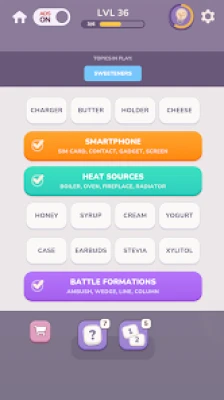
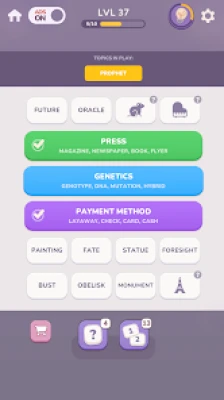
Each level presents a collection of mixed words or items. Your task is to identify which four belong to the same category, arrange them into a correct group, and use the resulting icons to discover more advanced connections. As you progress, the puzzles become more complex, encouraging you to think beyond obvious meanings and recognize relationships between seemingly unrelated concepts.
Whether you enjoy word association games, vocabulary challenges, logic puzzles, or brain-training activities, Word Jam offers a rewarding experience that encourages curiosity and careful thinking.
What Is Word Jam – Association Puzzle?
Word Jam is a word-association puzzle game built around the idea that words can be connected through shared meanings, categories, characteristics, or relationships.
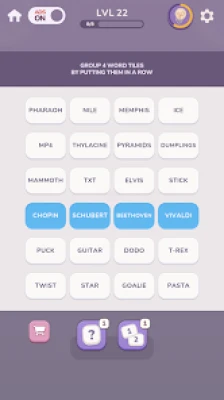
Instead of simply finding hidden words or spelling answers from individual letters, you must work out how different words belong together. Each level contains groups of four related items, and your job is to identify the category that connects them.
For example, a puzzle might contain words related to fruit, musical instruments, countries, or parts of a tree. Other levels may require more abstract thinking, with connections involving activities, professions, objects, or ideas.
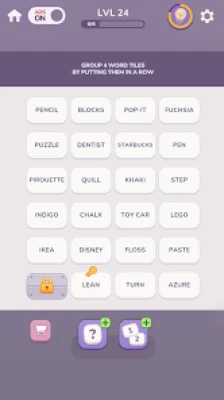
The challenge increases when several words appear to fit more than one possible category. You must identify the intended relationship rather than grouping words based on the first similarity you notice.
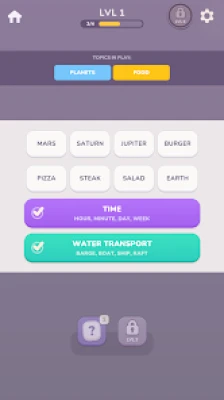
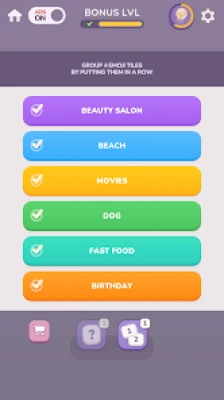
Once you solve a group, its words can merge into an icon representing the category. These icons become part of the next stage of the puzzle, creating additional layers of association and making later levels more challenging.
The result is a casual brain game that combines vocabulary knowledge with deduction, observation, and creative reasoning.
Main Features of Word Jam
Word Association Puzzles
The central feature of Word Jam is its collection of word-association challenges. Each level asks you to identify sets of four words or items that share a meaningful connection.
The categories can involve familiar subjects as well as less obvious relationships, so both general knowledge and logical reasoning are useful.
Four-Word Category Matching
Players must identify groups of four related words. Finding one promising connection is only the beginning; you must determine whether all four items belong to the same category.
Careful comparison is essential when multiple words appear to fit several groups.
Word Merging and Icon Creation
After you complete a valid group, the related words merge into an icon representing their shared concept. These icons help create new layers of associations.
This mechanic gives the game a sense of progression beyond ordinary word sorting. A completed category can become the starting point for a more advanced puzzle.
Increasingly Complex Levels
As you advance, the game introduces more complicated combinations and requires deeper reasoning. Some categories are straightforward, while others depend on indirect connections or specific knowledge.
Learning to recognize these patterns is one of the most useful skills for long-term progress.
Vocabulary and Logical Thinking
Word Jam encourages players to think about meanings, synonyms, common characteristics, and relationships between ideas.
You may encounter familiar words in unexpected combinations, which makes the game useful for practicing flexible thinking and expanding your understanding of language.
Relaxed Puzzle Gameplay
The game is designed around thoughtful decisions rather than fast reactions. You can study the words, compare possible categories, and work through the puzzle at your own pace.
This makes Word Jam suitable for short breaks as well as longer sessions devoted to solving challenging levels.
How to Play Word Jam
Understanding the basic gameplay loop will help you approach each puzzle with greater confidence.
Step 1: Read Every Word Carefully
Begin by reviewing all the words and items visible in the current level. Avoid immediately selecting the first four that appear related.
Look for obvious categories, repeated themes, shared characteristics, and words that might belong to a particular subject.
A complete overview of the board can reveal relationships that are not apparent when you focus on individual words.
Step 2: Identify Possible Categories
Try to organize the words mentally into broad groups. Some may relate to nature, food, geography, entertainment, everyday objects, or other familiar subjects.
These initial categories are only possibilities. Before confirming a group, make sure every word fits the same explanation.
Step 3: Compare Four Potential Matches
Select four words that appear to share a clear connection, using the game's controls.
The strongest group is usually one in which every word fits the same category without requiring an unusual explanation.
If a word seems to fit only loosely, reconsider the group before committing.
Step 4: Complete the Category
When you identify a correct set, the game combines the related items into an icon representing their shared theme.
This is an important step because the resulting icon may be used in a later association puzzle.
Step 5: Study the New Icons
After completing groups, examine the remaining words and any newly created icons. Consider how these items may connect at a broader conceptual level.
For example, several completed categories might relate to a shared activity, place, or general subject. Recognizing that broader connection is often the key to progressing.
Step 6: Solve the Next Layer
Continue grouping related items until you complete the required associations for the level.
If the remaining words seem difficult to connect, revisit your assumptions and consider whether a more specific category explains the available items.
Complete Word Jam Strategy Guide
1. Scan the Entire Board Before Making a Guess
One of the most effective Word Jam tips is to read the full set of words before selecting anything.
A word that appears to belong to one category may also have a relationship with another. If you immediately commit to the first possible grouping, you might use a word that is needed for a more obvious category elsewhere.
Start by identifying the clearest themes and the words that appear to have several possible meanings.
For example, a word might describe a physical object, a profession, or an activity. Its role in the puzzle depends on the relationship the other words establish.
A complete scan gives you more context and helps you avoid premature decisions.
2. Find the Strongest Category First
When several groups seem possible, begin by identifying the one with the clearest shared meaning.
A strong category should explain all four words naturally. You should not need to stretch a definition or invent an unusual connection to make the group work.
Solving a clear category can also simplify the rest of the board by removing four items and reducing the number of competing possibilities.
However, do not assume that the easiest-looking group must always be selected first. If one word could belong to two different categories, compare the alternatives before committing.
3. Make Sure All Four Words Fit
A common mistake is finding three words that belong together and choosing a fourth simply because it seems vaguely related.
In Word Jam, the complete group matters. Every item should fit the same category, not just share a general theme with the others.
Before confirming a set, explain the connection to yourself in a short phrase.
For example, if your proposed group contains four musical instruments, the category is easy to state and every word should fit it directly.
If you cannot describe the relationship clearly, the group may need another look.
4. Watch for Words With Multiple Meanings
Some words can belong to more than one category depending on how they are used.
A word may describe an object in one context and an activity in another. It might also be part of a familiar expression or associated with a particular profession.
These overlapping meanings are often what make word-association puzzles challenging.
When a word seems to fit two groups, do not immediately assign it to either one. Examine the surrounding words and determine which interpretation creates the strongest complete category.
This technique helps prevent one ambiguous word from disrupting several otherwise correct groups.
5. Use Elimination to Narrow the Options
You do not need to solve every category at once. Eliminating clear groups can make the remaining puzzle easier.
Once you identify a strong set of four, completing it reduces the number of words you must consider. This can reveal relationships that were previously hidden by the larger collection.
If you are uncertain about a particular group, temporarily set it aside and search for another category with stronger evidence.
As the board becomes smaller, the remaining words may form more recognizable combinations.
6. Think Beyond Synonyms
Not every category is based on words with similar meanings.
Some groups connect items because they belong to the same place, activity, system, profession, or broader subject. Others may represent different examples of a shared concept.
For example, four words might all be associated with a particular sport without being synonyms. Another group might contain different objects commonly found in the same environment.
If you cannot find a direct meaning-based connection, consider how the words relate in everyday life.
This broader approach is essential for solving more complex Word Jam levels.
7. Use the Icons to Understand the Next Layer
The merging mechanic adds another dimension to the puzzle. Completed word groups can turn into icons representing their shared categories.
Do not treat these icons as unrelated decorations. Think about the concept each icon represents and how that concept might connect to other items.
For example, categories involving cooking, ingredients, and kitchen tools might all connect to a broader theme involving food preparation.
The exact relationships depend on the level, but the principle remains the same: identify the meaning behind each completed group, then look for a broader connection.
8. Look for Hierarchical Relationships
Some associations are easier to understand when you think in levels.
A group of words may represent specific examples of a category, while a resulting icon represents the category itself. Several category icons may then connect to a more general idea.
This creates a progression from individual items to broader concepts.
When the puzzle becomes difficult, ask yourself whether the remaining words belong to a narrower category or whether the game is asking for a more general relationship.
Understanding this distinction can make multi-stage puzzles much easier to solve.
9. Be Careful With Broad Categories
A category can sometimes be so broad that it appears to explain almost anything.
For example, many unrelated words could be described as objects, things people use, or parts of everyday life. Such broad descriptions are rarely helpful when you need to identify the intended group.
Instead, search for the most specific category that naturally includes all four words.
A precise explanation makes it easier to distinguish the correct group from other plausible combinations.
10. Use Failed Guesses as Information
If a group does not work, avoid repeating the same combination without reconsidering it.
Look at the words again and identify which connection was weakest. Perhaps three items belong to one category while the fourth fits another theme.
You can also consider whether one word has an alternative meaning that changes the possible grouping.
Each unsuccessful attempt should help narrow your thinking. Treat it as feedback about the relationship you need to discover.
11. Keep Track of Uncertain Words
Some words will be easy to categorize immediately, while others may remain ambiguous.
Mentally separate these two groups. Focus first on words with strong, direct relationships, and leave the uncertain ones for later.
Once the clear groups have been completed, the remaining items may provide enough context to resolve the ambiguity.
This approach is more reliable than trying to force every word into a category at the beginning.
12. Adapt Your Thinking When the Puzzle Changes
The association strategy that works for one level may not be sufficient for the next. A new puzzle may rely on general knowledge, word meanings, shared functions, or more abstract connections.
If your usual approach stops working, change the type of relationship you are looking for.
Try considering synonyms, opposites, common locations, related activities, category membership, or familiar expressions.
Flexible thinking is one of the most important skills for progressing through a word-association game.
Best Beginner Tips for Word Jam
New players can improve their results by developing a few simple habits.
Read every word first. Understanding the complete board helps you notice relationships between items.
Start with obvious groups. Clear categories reduce the number of remaining possibilities.
Check all four words. A group is stronger when every item fits the same specific explanation.
Avoid forcing a connection. If one word feels out of place, reconsider the group.
Look beyond direct meanings. Words may share a location, activity, function, or broader concept.
Save ambiguous words for later. Completing easier categories can make difficult relationships clearer.
Study the merged icons. Think about what each icon represents and how it might connect to other categories.
Learn from incorrect guesses. Use mistakes to identify weak assumptions and test a different explanation.
Stay patient. Some associations are not immediately obvious, and careful reasoning is often more effective than rushing.
Advanced Word Jam Techniques
Build a Mental Category Map
As you read the board, organize related words into broad themes in your mind.
You might identify a possible group related to nature, another involving food, and another connected to work or entertainment. These themes do not need to be final answers; they simply help you organize the possibilities.
Once you see a likely category, check whether exactly four words fit it naturally.
This mental organization reduces the effort required to compare every word with every other word.
Identify the Most Ambiguous Word
Sometimes one word appears to fit several plausible groups. Rather than repeatedly moving it between imagined categories, identify the source of the ambiguity.
Ask which meaning is most relevant to the surrounding words. If one interpretation creates a clear group of four and another leaves an awkward combination, the stronger explanation is usually the better choice.
This method helps you avoid decisions based only on the first association that comes to mind.
Compare Competing Categories
When two possible groups overlap, evaluate both as complete sets.
Do not judge a category by how well it explains only one or two words. Consider whether it accounts for all four items and whether the remaining words still form sensible groups.
A strong solution should make the entire puzzle more coherent, not simply solve one small part.
Move From Concrete to Abstract Thinking
When the words describe recognizable objects, start with their direct meanings. If that approach does not reveal the category, consider their broader functions or associations.
For example, several objects may belong to the same activity even though they look very different. Similarly, a group of category icons may represent concepts connected through a larger theme.
Moving from concrete details to broader ideas helps you tackle increasingly complex levels.
Explain Each Group in One Sentence
Before confirming a group, describe the connection in a short sentence.
Examples include:
These are all types of musical instruments.
These are all parts of a tree.
These are all countries.
These are all items used in a particular activity.
If the explanation sounds natural and includes all four words, you have a strong candidate. If you need several unrelated explanations to justify the group, reconsider it.
Treat Every Merge as a New Clue
A completed category provides information about the game's intended logic.
Use the resulting icon to identify the level of abstraction required for the next puzzle. If the icon represents a broad concept, consider what other categories could naturally belong with it.
This is especially helpful when the remaining associations are less obvious than the original word groups.
Common Word Jam Mistakes to Avoid
Guessing Too Quickly
The first apparent connection is not always the intended category.
Better approach: Read the full board and compare possible groups before confirming your choice.
Choosing a Fourth Word That Barely Fits
Three related words do not automatically make a correct group if the fourth item has no clear connection.
Better approach: Require a specific explanation that naturally includes all four words.
Ignoring Alternative Meanings
A word may have a different interpretation from the one you first considered.
Better approach: Revisit ambiguous words and compare their possible meanings with the other items.
Looking Only for Synonyms
Many categories connect words through shared uses, locations, activities, or characteristics rather than similar definitions.
Better approach: Expand your thinking beyond vocabulary similarities.
Overlooking the Remaining Board
A proposed category may seem reasonable on its own but leave the remaining words difficult to group.
Better approach: Consider how each choice affects the whole puzzle.
Forgetting the Meaning of Icons
Merged icons represent completed categories and can help you discover more advanced associations.
Better approach: Think about the concept behind each icon and its relationship to the remaining items.
Repeating Failed Guesses
Trying the same combination again without new evidence wastes time and does not improve your understanding.
Better approach: Identify the weakest connection and test a different category.
Assuming Every Category Is Obvious
Some levels rely on indirect relationships that require broader thinking.
Better approach: Consider specific examples, shared functions, familiar expressions, and higher-level concepts.
How to Improve Vocabulary and Logical Thinking With Word Jam
Word Jam encourages you to think about language in a flexible way. Rather than memorizing definitions, you practice identifying relationships between words and concepts.
One useful technique is to consider several possible meanings for an unfamiliar or ambiguous word. Think about its common uses, the objects associated with it, and the activities in which it might appear.
Another technique is to explain the connection between a group of words aloud or in your mind. This helps you distinguish a clear category from a loose association.
You can also improve your reasoning by comparing competing solutions. When two categories seem possible, evaluate which one explains the words most naturally and leaves the remaining board in a more coherent state.
Over time, these habits can improve your ability to recognize patterns, reason through unfamiliar combinations, and approach language puzzles with greater confidence.
How to Progress Through Difficult Word Jam Levels
As the puzzles become more complex, focus on methodical reasoning instead of trying to solve every group immediately.
Start by finding the strongest category on the board. Once you complete it, examine the remaining words and see whether the new arrangement reveals a clearer pattern.
If you become stuck, identify the words that have multiple possible meanings. Consider whether the game is asking for a direct category, a shared function, a common setting, or a more abstract association.
When icons appear, interpret them as meaningful clues rather than isolated objects. The concept represented by an icon may be more important than its visual appearance.
Finally, avoid committing to a weak solution simply because you want to make progress. Taking an extra moment to evaluate the relationship can save repeated guesses and help you understand the puzzle's underlying logic.
Is Word Jam Good for Casual Players?
Word Jam is well suited to players who enjoy word games but prefer more variety than traditional spelling puzzles.
Its main challenge is discovering relationships between words rather than simply finding or forming them. This makes the game approachable for casual players while still providing opportunities for deeper reasoning.
The relaxed format allows you to study the board and work through each category at your own pace. There is no need to rely on quick reflexes; observation, vocabulary, and flexible thinking are more important.
Players who enjoy trivia, association games, categorization puzzles, and brain teasers may find the combination particularly appealing.
Is Word Jam Free to Play?
Word Jam – Association Puzzle is available as a mobile game through Google Play. Availability, optional purchases, and other features may vary depending on the current version and region.
You can focus on learning the category-matching and merging mechanics while exploring the progression system. If optional hints or other assistance are available in your version, consider using them when a puzzle remains difficult after careful analysis.
For the most accurate information about current pricing and in-game options, check the game's listing and the options shown inside the app.
Frequently Asked Questions About Word Jam
What is Word Jam – Association Puzzle?
Word Jam is a mobile word-association game in which players group four related words or items into categories. Completed groups merge into icons that can be used to discover further associations.
How do you play Word Jam?
Read the words on the board, identify four items that share a meaningful connection, and select them as a group. Continue solving categories and using the resulting icons until the level is complete.
What is the main goal of Word Jam?
The main goal is to discover the intended relationships between words and items, complete groups of four, and solve increasingly complex association puzzles.
What is the best strategy for Word Jam?
Study the entire board, solve the clearest category first, and make sure every word fits the same specific explanation. Use completed groups to narrow the remaining possibilities.
How do you solve difficult word-association puzzles?
Look beyond synonyms and consider shared functions, locations, activities, characteristics, or broader concepts. Compare competing categories and leave ambiguous words until more information becomes available.
Why do some words fit multiple categories?
Many words have several meanings or can be associated with different subjects. The challenge is identifying which interpretation best fits the other words and creates the most coherent group.
What happens when you merge a group of words?
A completed group can merge into an icon representing its shared category. That icon may then participate in a more advanced association puzzle.
Is Word Jam a vocabulary game?
Yes, but it also emphasizes logical reasoning and categorization. Knowing word meanings is helpful, while recognizing relationships between concepts is equally important.
Can Word Jam help improve logical thinking?
The game encourages players to compare possibilities, identify patterns, evaluate assumptions, and recognize relationships between different ideas. These activities provide practice in logical and flexible thinking.
What should you do when you get stuck?
Re-read the remaining words, consider alternative meanings, and search for relationships beyond synonyms. If possible, complete a clearer category first so the remaining puzzle becomes easier to analyze.
Is Word Jam suitable for beginners?
The basic rules are straightforward, so beginners can start by finding obvious groups. More complex levels provide additional challenges as players become familiar with the association and merging mechanics.
Does Word Jam require fast reactions?
The game emphasizes careful thinking and word recognition rather than quick physical reactions. Taking time to compare possible categories can help you make better decisions.
Final Verdict
Word Jam – Association Puzzle offers a fresh take on mobile word games by combining four-word category matching with a layered merging system. Instead of relying only on spelling or memorizing definitions, players must discover how words and concepts relate to one another.
The best strategy is to study the entire board, solve the clearest groups first, examine ambiguous words carefully, and use completed icons to understand the next layer of associations. When a category is difficult to identify, broadening your thinking beyond synonyms can reveal connections that are easy to miss.
Whether you enjoy casual brain games, vocabulary challenges, or logic puzzles, Word Jam provides an engaging way to practice observation and creative reasoning. Approach each level methodically, look for meaningful relationships, and enjoy the satisfaction of discovering how seemingly unrelated words fit together.
Rate the Game
User Reviews



Popular Games



















 Android
 iOS
 Windows
 Xbox