
Latest Version
October 02, 2026
MeeGame Studio
Word
0
com.context.toword.similarword
Report a Problem
More About :game
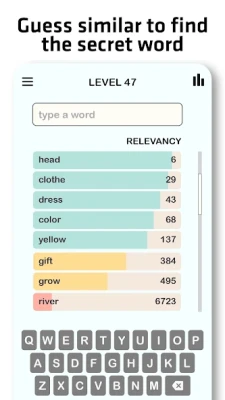
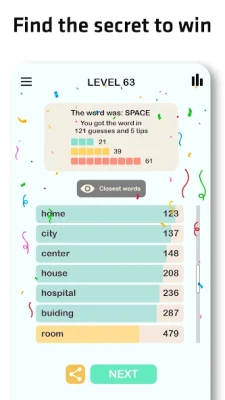
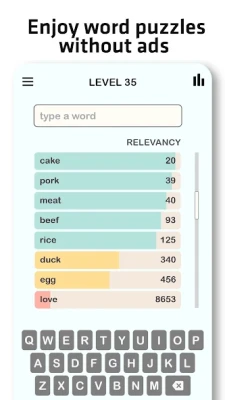
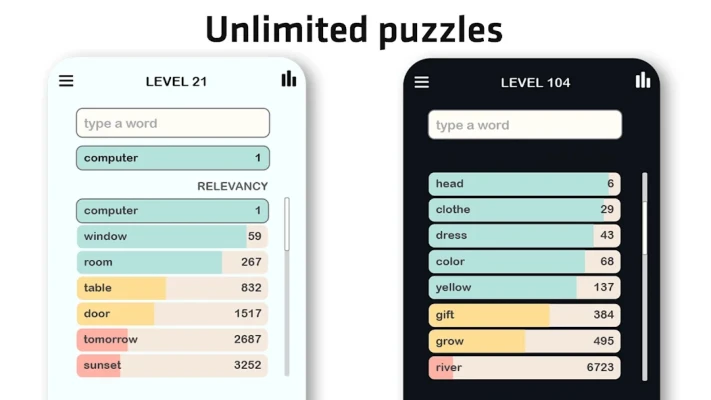
Instead of giving you a traditional crossword grid or a list of letter clues, Cotexto provides a similarity position after each guess. The closer your guess is to the secret word in contextual meaning, the better its position. The objective is to keep exploring related words until you reach number 1, which represents the secret word.
The game offers unlimited guesses and continuously updated puzzles, making it suitable for players who enjoy vocabulary games, daily word challenges, brain teasers, and word association puzzles.
Game Information
Game Title: Cotexto - Similar Word
Developer: MeeGame Studio
Genre: Word / Puzzle
Platform: Android and Windows
Game Mode: Single-player
Downloads: 500K+ on Google Play
Current Google Play Rating: 3.9 stars
Reviews: 2.6K
Age Rating: 3+
Contains: Ads and in-app purchases
Latest Listed Update: March 3, 2026
What Is Cotexto - Similar Word?
Cotexto is a secret-word guessing game that focuses on contextual relationships instead of spelling alone.
You begin by entering a word. The game then tells you where that word ranks in relation to the hidden answer.
The closer your guess is in meaning and usage, the closer its ranking should generally move toward #1.
The system is based on an algorithm that analyzes how words are used in large amounts of text and uses their context to determine similarity.
This creates a different type of word puzzle because knowing the correct letters isn't necessarily enough. You need to think about concepts, associations, categories, actions, objects, and the ways words are commonly used together.
How to Play Cotexto
The basic gameplay loop is straightforward.
Step 1: Enter a Word
Start with any reasonable word that comes to mind.
Your first guess does not need to be close to the answer.
Its purpose is to give you information about the hidden word.
Step 2: Check the Position
After submitting your guess, Cotexto gives you a position.
The secret word occupies position #1.
A relatively close position means you have probably entered the right general area of the word's meaning.
Step 3: Think of Related Words
Use the result to generate another guess.
Don't simply change one letter.
Instead, think about other words that could be related by meaning or context.
Step 4: Follow the Strongest Direction
If several guesses are moving closer to #1, identify what they have in common.
That shared concept can point toward the secret word.
Step 5: Narrow the Meaning
Once you get into a strong position, stop making broad guesses.
Start testing more specific words associated with the concept.
Step 6: Find #1
The objective is to discover the hidden word and reach the top position.
Full Strategy Guide
Cotexto rewards a different type of thinking from conventional word games.
You aren't simply searching for letters. You're searching through a network of related ideas.
Strategy 1: Start With Broad Words
Your first few guesses can be exploratory.
Choose common words that can connect to many different concepts.
For example, if you're completely unsure about the topic, a broad noun or action can help reveal the general direction.
The purpose isn't necessarily to solve the puzzle immediately.
You are collecting information.
Strategy 2: Study Your Best Guess
Your closest guess is one of your most valuable clues.
Ask yourself:
Why might this word be close to the answer?
Then identify its related concepts.
If your closest guess is a type of food, for example, consider:
Other foods
Ingredients
Cooking
Restaurants
Eating
Flavors
Meals
Kitchen objects
This can help you explore the semantic neighborhood surrounding the answer.
Strategy 3: Build a Word Family
When you find a promising area, generate several words connected to it.
Don't immediately jump to an unrelated concept.
Build a small mental family around your strongest guess.
For example:
Travel → airport → flight → passenger → luggage → destination
One of these conceptual paths may lead you closer to the hidden word.
Strategy 4: Compare Your Guesses
Don't look at each ranking independently.
Compare your strongest guesses.
Suppose one group of words consistently performs better than another group. That difference tells you something about the hidden word's context.
Use your results as a map.
Strategy 5: Think in Associations
The answer may not be a direct synonym of your guess.
Contextual similarity can connect words that are commonly used in similar situations.
Therefore, ask:
"What words commonly appear around this idea?"
rather than only:
"What is another word with exactly the same meaning?"
This distinction is essential.
Strategy 6: Move From General to Specific
Early guesses should explore.
Later guesses should narrow.
A useful progression is:
Broad concept → related category → specific concept → likely answer
For example:
Animal → domestic animal → pet → dog → specific related term
The exact path depends on the puzzle.
Strategy 7: Don't Obsess Over Synonyms
A common mistake is repeatedly entering synonyms of your closest word.
Sometimes the answer belongs to the same context without being a direct synonym.
If synonyms stop improving your position, explore related actions, objects, locations, professions, or situations.
Strategy 8: Use the Coldest Guesses as Information
A poor guess is not necessarily useless.
It tells you which direction may be less relevant.
If several words from one category rank poorly, temporarily move away from that category.
Strategy 9: Look for the Hidden Category
When several strong guesses seem unrelated, search for the category connecting them.
For example, if several guesses involve:
A person
A place
An activity
An object
Ask what broader situation connects all four.
The secret word may represent that shared context.
Strategy 10: Change Perspective When Stuck
If your guesses stop improving, don't simply enter more words from the same category.
Change your perspective.
Think about:
Where the word is used
Who uses it
What happens before it
What happens after it
What objects are associated with it
What actions are connected to it
What broader topic contains it
This often opens a new route toward the answer.
How to Improve Your Vocabulary While Playing
Cotexto can naturally encourage vocabulary exploration because the game asks you to think about relationships between words.
When you encounter an unfamiliar word, don't simply memorize it.
Try to connect it to:
Synonyms
Opposites
Related objects
Common phrases
Situations where it is used
Related professions
Related actions
Over time, this builds a broader mental vocabulary.
The Google Play listing specifically presents the game as a way to train the brain and improve vocabulary.
Best Opening Strategy
There is no single guaranteed opening word because the secret word changes.
A better approach is to use the opening guesses as diagnostic tools.
Start with familiar words that can belong to several different contexts.
Then use the ranking to decide which direction to explore.
This is more efficient than trying obscure words randomly.
What to Do When Your Score Improves
When you discover a guess that is significantly closer to #1:
Stop and investigate it.
Ask:
What does this word mean?
What words are commonly associated with it?
What category does it belong to?
What related actions exist?
What related objects exist?
What situations commonly use this word?
Then test the most promising connections.
What to Do When Your Guesses Are Far Away
If several guesses produce weak positions, avoid randomly cycling through unrelated words.
Instead, select a completely different broad concept.
For example:
People → objects → places → activities → nature → food → emotions
You are effectively testing different regions of the vocabulary.
Once one region starts producing stronger results, concentrate your guesses there.
Advanced Context Strategy
The game's similarity system is based on the context in which words are used, rather than simply matching dictionary definitions.
That means you should think like a language model—or, more simply, like someone completing a sentence.
Ask:
What words would naturally appear in the same conversation, article, sentence, or situation?
For example, a word related to "doctor" could be connected to:
Patient
Hospital
Medicine
Treatment
Nurse
Appointment
Diagnosis
Not all of these are synonyms, but they can share strong contextual relationships.
This is one of the most important concepts for understanding how to play effectively.
Unlimited Puzzles
Cotexto is designed around unlimited word puzzles rather than a single finite campaign.
Google Play describes the puzzles as continually updated and unlimited.
This gives the game a repeatable structure:
Guess → Check ranking → Explore context → Improve → Find #1 → Start another puzzle
The format works well for short sessions as well as longer vocabulary challenges.
Daily Word Puzzle Experience
The game is also presented as a daily word puzzle experience.
Daily play gives you a reason to return and test your vocabulary and reasoning skills regularly.
Instead of relying entirely on memory, each puzzle encourages you to build a fresh chain of associations.
Tips for New Players
Don't worry if your first guess is far from #1.
Use early guesses to identify the general topic.
Pay close attention to your best-ranking words.
Think about context, not just synonyms.
Build groups of related words.
Compare several successful guesses.
Move from broad ideas to specific possibilities.
Change direction if your rankings stop improving.
Think about where and how a word is normally used.
Use unfamiliar words as vocabulary-learning opportunities.
Don't be afraid to make exploratory guesses.
Common Mistakes
Guessing Random Words
Random guessing produces little useful information.
Try to make each new guess connected to what you've already learned.
Looking Only for Synonyms
The hidden word may be contextually related without being a direct synonym.
Ignoring Ranking Changes
A ranking improvement is valuable information.
Use it to guide your next guesses.
Staying in One Category Too Long
If your guesses aren't improving, change direction.
Using Very Narrow Words Too Early
Early in the puzzle, broad concepts can help establish the correct area more effectively.
Forgetting Context
The game is built around contextual similarity, so think about how words are used together rather than only how they are defined.
Difficulty
Difficulty: Easy to learn, challenging to master.
The controls and rules are simple, but solving difficult puzzles can require substantial vocabulary knowledge and lateral thinking.
The challenge comes from determining the relationship between your guesses and the secret word.
Graphics and Presentation
Cotexto focuses on the puzzle itself rather than complex graphics.
The presentation is designed to keep attention on:
Your guesses
Their rankings
The hidden word
Your progress toward #1
This minimalist structure fits the game's word-puzzle format.
Controls
Controls are simple.
Type a word, submit it, examine the resulting position, and decide what to try next.
There are no complicated movement controls or timing mechanics.
The challenge is entirely based on language and reasoning.
Pros and Cons
Pros
Simple concept
Unlimited guesses
Unlimited word puzzles
Context-based gameplay
Encourages vocabulary exploration
Easy to learn
Suitable for short sessions
Continuously updated puzzles
Available on Android and Windows
Google Play currently confirms unlimited guesses, contextual similarity ranking, continually updated puzzles, and Android/Windows availability.
Cons
Players who prefer traditional crossword puzzles may need time to adjust to contextual guessing.
The game contains ads and in-app purchases.
Some puzzles can require a broad vocabulary and considerable experimentation.
The similarity ranking can require players to think beyond direct synonyms.
Who Should Play Cotexto - Similar Word?
Cotexto is particularly suited to players who enjoy:
Word guessing games
Daily word puzzles
Vocabulary games
Brain teasers
Word association games
Context-based puzzles
Language challenges
Secret-word games
Logic and reasoning games
Casual puzzle games
It can also appeal to players who enjoy experimenting with language and discovering unexpected relationships between words.
Frequently Asked Questions
What is Cotexto - Similar Word?
Cotexto is a word puzzle game where you try to discover a secret word by submitting guesses and using their contextual similarity rankings as clues.
How do you play Cotexto?
Enter a word, submit it, check its position, and use that information to choose another related word. The objective is to reach the secret word at position #1.
Is the secret word always number 1?
Yes. The game's instructions state that the secret word is position #1.
Can you make unlimited guesses?
Yes. The Google Play listing says players have unlimited guesses.
How does Cotexto determine similar words?
The game's description says an algorithm analyzes thousands of texts and uses the context in which words are used to calculate their similarity.
Is Cotexto a daily word game?
Yes. It is presented as a daily word puzzle game, while also offering unlimited puzzles.
Does Cotexto help improve vocabulary?
The developer presents vocabulary improvement as one of the game's benefits.
Is Cotexto free?
Google Play currently lists the game with ads and in-app purchases.
What devices support Cotexto?
The current Google Play listing shows Cotexto as available on Android and Windows.
What is the age rating?
Google Play currently lists Cotexto with a 3+ rating.
Final Thoughts
Cotexto - Similar Word takes the familiar idea of guessing a hidden word and turns it into a contextual reasoning challenge.
The important thing isn't simply finding a synonym. You need to understand how words relate to each other through meaning, situations, and usage.
The most effective approach is to treat every guess as information. Find your strongest result, explore the concepts surrounding it, compare your rankings, and gradually narrow the search until you reach position #1.
For players who enjoy daily word puzzles, vocabulary games, brain teasers, word association, and secret-word challenges, Cotexto offers a simple format with plenty of room for experimentation.
Rate the Game
User Reviews










Popular Games



















 Android
 iOS
iOS Windows
 Xbox
Xbox