


Latest Version
October 01, 2026
Edujoy Games Sociedad Limitada
Word
iOS
0
Report a Problem
More About :game
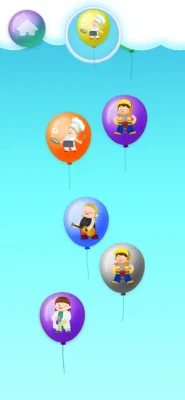
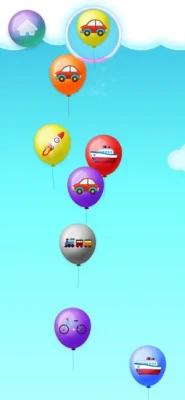
The game covers familiar subjects such as food, transportation, musical instruments, professions, and toys. A friendly bear helps introduce the activity and tells players which balloon they should find and pop, creating a simple connection between an image and its corresponding word.
With bright designs, playful animations, gentle sounds, and straightforward touch controls, the game is built around short, accessible learning sessions. It also supports five languages, giving children an opportunity to become familiar with vocabulary in English, Spanish, French, Portuguese, and Italian.
Game Information
Game: Balloons pop - Toys
App Store ID: 6470016257
Developer: Edujoy Games S.L.
Category: Word / Educational
Platform: iPhone and iPad
Age Rating: 4+
Size: 91.7 MB
Languages: English, Spanish, French, Portuguese, Italian
Latest listed version: 1.5.6
Latest listed update: February 14, 2025
Price: Free with in-app purchases
Compatibility: iOS 14.0 or later / iPadOS 14.0 or later
How to Play Balloons Pop - Toys
The gameplay is intentionally simple.
A child enters a category and sees balloons containing different images. The friendly bear provides guidance about which object to find. The player then looks at the balloons and taps the one that matches the requested word or image.
The basic gameplay loop is:
Listen to the instruction.
Look at the available balloons.
Identify the requested object.
Tap the correct balloon.
Pop the balloon and see the animation.
Continue learning new words.
This combination of visual recognition and interaction makes the game easy for young children to understand.
Vocabulary Categories
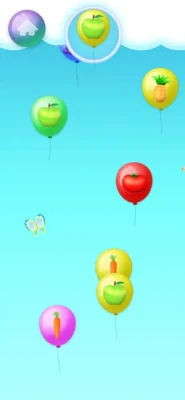
Food
The food category introduces children to the names of familiar foods. Players can recognize food-related images while practicing the associated vocabulary.
This is a useful starting point because children can connect the words with objects they may already encounter at home or in everyday life.
Transportation
The transportation section introduces vocabulary connected with vehicles such as cars, airplanes, and boats.
Children can practice recognizing different forms of transportation while associating each picture with its corresponding word.
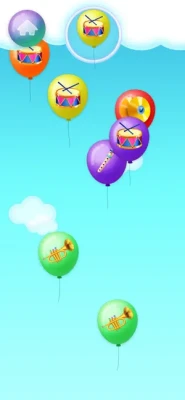
Musical Instruments
The musical instrument category introduces children to different instruments and their names.
The visual format helps make the vocabulary more memorable because players do not simply see or hear a word—they interact with the corresponding image.
Professions
The professions category introduces familiar jobs such as doctors, firefighters, and astronauts.
This gives the game an additional educational dimension by combining vocabulary learning with recognition of different occupations.
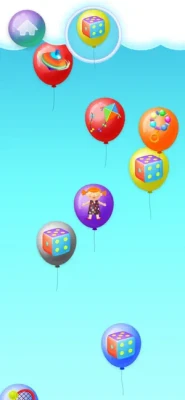
Toys
The toys category focuses on familiar play objects, including examples such as dolls, cars, and puzzles.
Because these are objects children commonly recognize, this category can provide an accessible way to practice vocabulary through play.
Main Features
Educational Balloon Popping
The central activity combines simple balloon popping with vocabulary learning. Children learn while interacting directly with the objects displayed on the screen.
Image and Word Association
The game encourages children to connect an object with its name. This image-to-word relationship is central to the educational design.
Five Languages
Balloons Pop - Toys is available in English, Spanish, French, Portuguese, and Italian, allowing the same basic activity to be used for vocabulary exposure in different languages.
Colorful Balloons and Bubbles
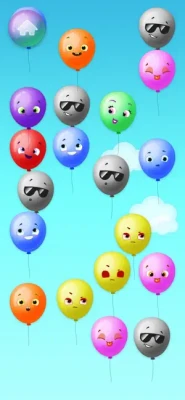
Different shapes, colors, images, and balloon designs help keep the visual presentation interesting for young players.
Simple Touch Controls
The main interaction is tapping the screen. There are no complicated controls to learn, making the game accessible to young children.
Friendly Guidance
A friendly bear appears at the beginning of the activity and explains which balloon the player should find and pop.
Gentle Sounds and Animations
The game includes animations and gentle, relaxing sounds designed to create a pleasant learning environment.
Educational Value
Balloons Pop - Toys is designed around playful vocabulary practice rather than traditional classroom-style exercises.
A child has to:
Listen to an instruction.
Recognize an object.
Find the corresponding picture.
Make a selection.
Receive visual and audio feedback.
Continue to the next word.
This creates an interactive learning cycle that can make basic vocabulary practice feel more like a game.
The App Store description specifically presents the game as a way to support language development through balloon and bubble popping.
Full Balloons Pop - Toys Strategy and Learning Guide
Although this is an educational children's game rather than a conventional puzzle game, parents and educators can use a few simple approaches to make the experience more productive.
1. Start With Familiar Categories
Begin with categories containing objects the child already knows.
Food and toys can be especially approachable because children may already recognize many of the objects.
Once the child becomes comfortable with the basic interaction, move toward categories with less familiar vocabulary.
2. Say the Word Out Loud
When the correct balloon appears, repeat the word aloud.
For example:
"Car."
Then ask the child to repeat it.
This turns the game from a simple tapping activity into an opportunity for pronunciation practice.
3. Connect the Game to Real Objects
If the game introduces a word such as "car," point to a real toy car or picture afterward.
This creates a connection between:
Game image → spoken word → real-world object
That can make vocabulary practice more meaningful.
4. Use the Language Selection to Your Advantage
Because the game supports English, Spanish, French, Portuguese, and Italian, parents can use it for exposure to different languages.
For example, a child learning English could first identify an object in a familiar language and then encounter the equivalent vocabulary in English.
5. Let the Child Search Independently
Avoid immediately pointing out the correct balloon.
Give the child time to scan the screen and make the connection independently.
The search itself is part of the learning activity.
6. Ask Follow-Up Questions
After a balloon is popped, ask a simple question about the object.
Examples:
"What color is it?"
"Where do we see one?"
"What does it do?"
"Have you seen one before?"
This extends the learning beyond the single word.
7. Repeat Difficult Words
If a particular object is difficult to recognize, repeat it several times during the session.
Keep the practice short and positive rather than turning the game into a test.
8. Explore Different Categories
Once the child understands the basic gameplay, rotate between categories.
Moving from food to transportation or toys to professions introduces a broader vocabulary range.
9. Introduce a Second Language Gradually
The game supports five languages, but children do not need to work with all of them at once.
Start with one language and introduce another gradually if multilingual vocabulary practice is the goal.
10. Keep Sessions Comfortable
The game is designed for casual educational interaction. Short sessions can be more enjoyable than forcing a child to continue after they lose interest.
The goal should be positive exposure to words rather than completing as much content as possible.
Tips for Parents
Play Together
For younger children, playing alongside them can make the experience more interactive.
Encourage Speaking
Ask children to say the word after they identify the correct balloon.
Praise Correct Recognition
Positive feedback can make vocabulary practice more enjoyable.
Avoid Turning It Into a Test
The game works best as playful learning. If a child does not know a word, explain it rather than treating the mistake as a failure.
Connect Digital Learning With Real Life
When a word appears in the game, look for opportunities to identify the same object outside the game.
Language Learning With Balloons Pop - Toys
One of the more interesting aspects of Balloons Pop - Toys is its multilingual design.
The game supports:
English
Spanish
French
Portuguese
Italian
This gives families different ways to approach vocabulary learning.
For children learning a second language, visual vocabulary can be particularly approachable because the meaning of a word is supported by an image rather than presented only as text.
Difficulty and Progression
Balloons Pop - Toys does not follow the traditional structure of an action game with increasingly difficult enemies or complex levels.
Instead, its challenge comes from vocabulary recognition.
The player gradually encounters different objects across several categories and has to identify the requested item among the available balloons.
The game therefore emphasizes recognition, attention, vocabulary, and simple interaction rather than reflexes or advanced problem solving.
Who Is Balloons Pop - Toys For?
The App Store gives the game a 4+ age rating, and its design is clearly aimed at young children and families.
It can be particularly suitable for:
Preschool children
Early learners
Children practicing basic vocabulary
Families looking for educational games
Children learning English
Multilingual families
Parents looking for simple interactive learning activities
Young children who enjoy balloon-popping games
Honest Review
Balloons Pop - Toys keeps its concept deliberately simple. Rather than combining many complicated mechanics, it uses balloon popping as the interactive layer for vocabulary learning.
Its strongest feature is the connection between visual recognition and language. Children see an object, hear or learn its name, and then interact with the matching balloon.
The five-language support also gives the game more flexibility than a basic balloon-popping game. The categories are broad enough to introduce vocabulary covering everyday food, transportation, instruments, professions, and toys.
The main limitation is that children looking for a more varied game experience may find the core balloon-popping mechanic repetitive. That is less of a problem when the app is viewed primarily as a short educational activity rather than a traditional game.
The App Store currently shows a 4.4/5 rating from 58 ratings on the U.S. listing.
Pros and Cons
Pros
Simple child-friendly controls
Educational vocabulary focus
Five language options
Food, transportation, instruments, professions, and toy categories
Colorful balloon and bubble designs
Friendly bear guidance
Gentle sounds and animations
Suitable for young children
4+ age rating
Free to download
Cons
Balloon popping can become repetitive over longer sessions.
The gameplay is intentionally simple rather than challenging.
Some features require in-app purchases.
The App Store listing indicates advertising-related data practices, including coarse location, device identifiers, usage data, and diagnostics.
Frequently Asked Questions
What is Balloons Pop - Toys?
Balloons Pop - Toys is an educational vocabulary game from Edujoy Games S.L. Players pop balloons containing different images while learning words from several categories.
What can children learn in the game?
The game covers vocabulary related to food, transportation, musical instruments, professions, and toys.
What languages does Balloons Pop - Toys support?
The game supports English, Spanish, French, Portuguese, and Italian.
Is Balloons Pop - Toys suitable for young children?
The App Store currently gives it a 4+ age rating.
How do you play Balloons Pop - Toys?
The player follows the instruction provided by the friendly bear, finds the requested object among the balloons, and taps it to pop the correct balloon.
Does the game help with vocabulary?
The game is specifically designed around learning words and new vocabulary through image recognition and interactive balloon popping. The developer describes it as supporting language development.
Can children learn another language with the game?
The app supports five languages, including English, Spanish, French, Portuguese, and Italian, making it suitable for multilingual vocabulary exposure.
Is Balloons Pop - Toys free?
The App Store lists the game as free with in-app purchases. The available purchases include options for removing interruptions and premium features.
What devices support Balloons Pop - Toys?
The App Store lists support for iPhone and iPad and requires iOS 14.0 or later or iPadOS 14.0 or later.
Balloons Pop - Toys Learning Checklist
For a productive play session:
🎈 Let the child identify the requested balloon.
👀 Encourage careful visual recognition.
🗣️ Repeat the new word aloud.
🔤 Practice the word in the selected language.
🌎 Connect the word with a real-world object.
🍎 Explore different vocabulary categories.
🚗 Try transportation words.
🎵 Practice musical instrument names.
👩🚒 Explore professions.
🧸 Practice toy vocabulary.
🌍 Introduce another supported language gradually.
😊 Keep learning playful and positive.
Final Thoughts
Balloons Pop - Toys takes a very simple activity—popping balloons—and turns it into an interactive vocabulary exercise. Its five categories cover familiar subjects including food, transportation, musical instruments, professions, and toys, while support for five languages adds another layer of educational flexibility.
The game is not designed to provide complex puzzles or challenging gameplay. Its purpose is much simpler: make basic word learning interactive, visual, and enjoyable for young children.
For parents looking for a colorful educational game that can introduce children to everyday vocabulary while they play, Balloons Pop - Toys offers an approachable learning experience on iPhone and iPad.
Rate the Game
User Reviews





Popular Games
















 Android
 iOS
iOS Windows
 Xbox
Xbox