



Latest Version
September 10, 2026
Tripledot Studios
Puzzle
iOS
0
Report a Problem
More About :game
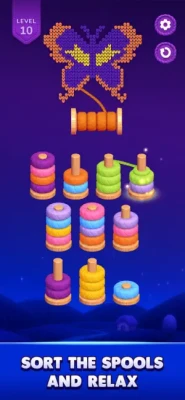
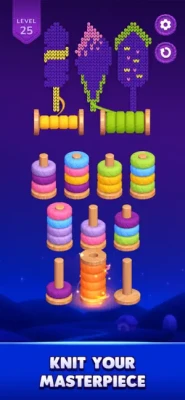
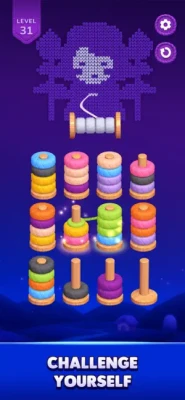
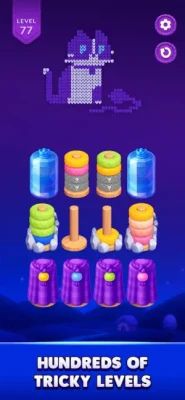
Wool Knit: Sort Colors takes the familiar color-sort puzzle formula and gives it a soft, handcrafted yarn theme.
Instead of sorting liquids or numbered tiles, you work with colorful balls of yarn stacked on spools. Your goal is to separate the colors so that each completed spool contains yarn of only one color.
The basic move is simple: tap a spool to pick up the top yarn ball, then tap another spool to place it. A move is allowed when the destination spool is empty or its top yarn matches the color being moved.
What makes the game interesting is the order in which you make those moves.
A seemingly harmless move can bury a useful color, consume your only free spool, or leave you with nowhere to place a difficult group later.
How to Play Wool Knit: Sort Colors
The basic objective is:
Sort every yarn color into its own spool.
The process works like this:
- Look at every spool before making your first move.
- Identify the colors that are already grouped.
- Find the yarn balls blocking useful colors.
- Move matching colors together whenever it is safe.
- Use empty spools as temporary storage.
- Continue exposing and combining colors.
- Finish with each spool containing one color.
The game does not use a countdown timer, so there is no reason to rush. The best move is usually the one that gives you the most useful options later.
The Best Wool Knit Strategy
1. Study the Board Before Moving
The most common beginner mistake is making the first obvious move immediately.
Instead, inspect the entire board.
Look for:
- Colors that are already partially grouped
- Colors buried underneath other yarn
- Empty spools
- Spools with only one or two colors
- Colors that have very few available destinations
- Groups that can be completed quickly
A few seconds of planning can save many moves later.
2. Think About the Top Yarn First
Only the top yarn ball of a spool can be moved.
That means the visible top color is extremely important.
If the color you need is buried under three different colors, you must first find a safe way to remove those layers.
Before moving a top yarn ball, ask:
What color will become visible after I move this one?
This question is often more useful than simply asking where the current yarn can go.
3. Protect Empty Spools
An empty spool is one of your most valuable resources.
It gives you somewhere to temporarily place a color while you uncover another one.
Do not fill every empty spool immediately.
Think of empty spools as working space, not unfinished goals.
A common mistake is using all available empty spools to create temporary mixed groups and then discovering that there is no room left for the next important move.
4. Complete Matching Groups Carefully
If two or more yarn balls of the same color can be combined safely, that is usually a strong move.
But there is an important exception.
Do not complete a color simply because you can.
Ask whether completing that group:
- Blocks another color
- Uses your only useful empty spool
- Creates a difficult arrangement
- Prevents a large group from being exposed
A completed color is valuable because it removes clutter, but space and flexibility are sometimes more valuable than immediate completion.
5. Work on the Most Restricted Color
Some colors have many possible moves.
Others have almost none.
Prioritize the restricted colors.
For example, if a particular color is buried under several other yarn balls and can only be moved into one suitable spool, you should plan around that color before spending your available space on easier groups.
This prevents the classic situation where everything looks nearly solved but one color is impossible to finish.
6. Use Empty Spools as Temporary Storage
Temporary storage is the key to solving harder Wool Knit puzzles.
Suppose a blue yarn ball is hidden underneath red and yellow yarn.
You may need to move the red and yellow pieces elsewhere before reaching the blue.
The important part is where you place them.
Try to move them toward their own matching colors instead of randomly scattering them.
A good temporary move should make the next move easier.
7. Think Several Moves Ahead
Before making an important move, consider:
Move 1: Where does this yarn go?
Move 2: What color becomes exposed?
Move 3: Where can that color go?
Move 4: Will I still have an empty spool?
You do not need to calculate the entire puzzle from beginning to end.
Usually, looking three or four moves ahead is enough to avoid the most dangerous mistakes.
Advanced Wool Knit: Sort Colors Strategy
Identify the Bottleneck
Every difficult board normally has a bottleneck.
It could be:
- One buried color
- One nearly full spool
- A lack of empty space
- A color with only one useful destination
- A group blocking several other colors
Find the bottleneck first.
Then build your solution around it.
Keep Flexible Colors Flexible
If a color can currently be moved into several different spools, you do not necessarily need to move it immediately.
Flexible colors give you options.
Restricted colors do not.
When choosing between two otherwise reasonable moves, usually prioritize the move that solves the more restricted situation.
How to Solve Hard Wool Knit Levels
When a level becomes difficult, use this method.
Step 1: Count the Colors
Determine how many different yarn colors are present.
Step 2: Find Completed Groups
Look for colors that are already close to being separated.
Step 3: Find Buried Colors
Identify the colors that cannot currently be accessed.
Step 4: Locate the Free Spools
Determine which spools can safely act as temporary storage.
Step 5: Identify the Bottleneck
Ask which color is most likely to cause a dead end.
Step 6: Clear the Path
Move only the yarn necessary to expose that color.
Step 7: Consolidate
Once a color becomes accessible, bring matching yarn together.
Step 8: Reassess
After several moves, stop and examine the board again.
Do not continue following an old plan if the board has changed.
The Importance of Move Order
In Wool Knit, two moves can both look correct while only one leads to a successful solution.
Imagine that you have:
- A red yarn on top of a spool
- A blue yarn underneath it
- Another spool containing blue yarn
- One empty spool
Moving the red yarn into the empty spool might expose the blue yarn, which can then be joined with the other blue yarn.
But if you instead use the empty spool for an unrelated color, you may lose the space needed to expose the blue group.
The lesson is simple:
Do not judge a move only by where the yarn goes. Judge it by what the move reveals.
Wool Knit Tips for Beginners
If you are new to color-sorting puzzles, start with these rules:
Tip 1: Never Rush
There is no timer, so use the time available to plan.
Tip 2: Watch the Top Yarn
Only the exposed top yarn can be moved.
Tip 3: Preserve Empty Spools
They are essential for temporary moves.
Tip 4: Match Whenever It Is Safe
Combining identical colors reduces clutter.
Tip 5: Do Not Randomly Mix Colors
A temporary spool should have a purpose.
Tip 6: Think Ahead
Try to predict what color will be exposed after every important move.
Tip 7: Use Undo
If a move creates a bad arrangement, undo it rather than continuing down the same path. Wool Knit includes an undo feature specifically for correcting mistakes.
Advanced Tips for Difficult Levels
Finish the Most Convenient Color First
If a color can be completed without sacrificing useful space, completing it may simplify the entire board.
Removing one color from active play creates more room for everything else.
But Do Not Force Completion
If completing a color requires using your only free spool in a dangerous way, wait.
A partially completed group can sometimes be more useful than a completed group.
Avoid Filling a Spool With Unrelated Colors
Mixed temporary stacks are often unavoidable, but they should be used carefully.
A spool containing several unrelated colors can become a bottleneck because each upper layer must be removed before the lower colors can be accessed.
Work From the Top Down
Because only the top yarn can move, solve the board in layers.
Ask:
What must move first to expose the color I actually need?
That question often reveals the correct sequence.
Common Mistakes to Avoid
Using Every Empty Spool
More storage does not always mean more progress.
If all empty spools become occupied, your flexibility disappears.
Moving the Same Color Too Early
A matching move is not automatically a good move.
Sometimes a color is better left where it is because it is helping maintain access to another group.
Ignoring the Next Exposed Color
Every move changes what is visible.
Always look at what will appear next.
Creating Deep Mixed Stacks
If possible, avoid stacking many unrelated colors together.
They can become difficult to dismantle.
Solving One Color at the Expense of Another
The objective is to solve the entire board, not just one attractive section.
Restarting Without Understanding the Mistake
If a puzzle fails, identify why.
Did you use the last empty spool too early?
Did you bury a restricted color?
Did you move a flexible color when you should have dealt with a restricted one?
Learning the reason for the failure makes future levels easier.
How to Use Hints Effectively
Wool Knit includes hints, which can help when you reach a position where the correct sequence is difficult to see.
Do not treat hints as the first solution.
Try this order:
- Inspect the top colors.
- Check your available empty spools.
- Find the most restricted color.
- Undo your last questionable move.
- Look for a safer sequence.
- Use a hint if you still cannot identify the next useful move.
This makes the hint system more useful as a learning tool rather than something you depend on for every puzzle.
How to Use Undo Properly
Undo is especially useful when testing a move.
If you are unsure whether a move is safe:
- Make the move.
- Observe what it exposes.
- Look at the new placement options.
- If the board becomes less flexible, undo it.
- Try the alternative.
This turns the undo feature into a way of exploring the puzzle without permanently committing to a bad decision.
Wool Knit Themes, Skins and Visual Features
The game's cozy presentation is part of its identity.
The official App Store listing highlights soft yarn visuals, custom yarn styles, spool designs, cozy backgrounds, relaxing sound design, and an occasional mischievous cat helper.
The visual design also makes progress satisfying because the colorful yarn gradually becomes organized as the puzzle is solved.
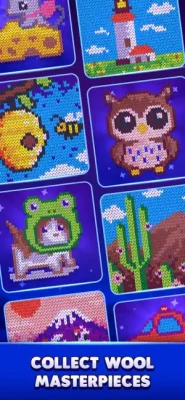
Some player reviews specifically praise the way the colors come together and the satisfaction of seeing the final hidden item revealed.
Why Wool Knit Is Relaxing
Unlike a fast arcade game, Wool Knit does not require quick reactions.
There are:
- No countdown timers
- No need to rush
- Simple tap controls
- Gradual puzzle progression
- Soft yarn visuals
- Relaxing audio
- Undo and hint options
The result is a puzzle experience that can be played for a few minutes or for a much longer session. The developer specifically presents it as a stress-free sorting game with no countdown pressure.
Wool Knit: Sort Colors Features
Color Sorting Puzzles
Separate colorful yarn balls until each spool contains a single color.
Increasing Difficulty
The early puzzles are straightforward, while additional colors and spools make later boards more challenging.
No Timer
You can think through your moves without countdown pressure.
Hints and Undo
Mistakes can be corrected and difficult positions can receive assistance.
Custom Themes and Skins
The game includes different yarn styles, spool designs, and backgrounds to unlock.
Cozy Sound Design
Soft yarn sounds and ambient music are designed to complement the relaxed presentation.
Cat Helper
A playful cat can appear during gameplay, adding a little personality to the otherwise calm puzzle experience.
Is Wool Knit: Sort Colors Difficult?
The basic mechanics are easy to understand, but the difficulty increases as more colors and spools are introduced.
The real challenge is not learning the controls. It is learning how to manage limited space and predict the consequences of each move.
Early puzzles can often be solved by recognizing obvious matches. Later boards require more careful sequencing and several steps of forward planning.
Is Wool Knit Good for Puzzle Fans?
Yes, particularly if you enjoy:
- Color sorting games
- Yarn sorting puzzles
- Logic puzzles
- Brain games
- Relaxing casual games
- Matching and organization games
- No-timer puzzle games
- Spatial and sequencing challenges
The App Store currently lists Wool Knit: Sort Colors in the Puzzle category with a 4.9-star rating from about 2,000 ratings.
The Android version also has more than 100,000 downloads and a 4.8-star rating with more than 11,000 reviews, showing that the game has attracted a substantial audience beyond iOS.
Pros and Cons
Pros
- Simple and intuitive controls
- Relaxing yarn theme
- Easy-to-learn color sorting
- Increasing puzzle difficulty
- No countdown timer
- Undo functionality
- Hint system
- Custom yarn and spool themes
- Relaxing sound design
- Short or long play sessions
- Satisfying visual progression
Cons
- Later levels can require significant planning
- Mistakes can consume valuable empty-spool space
- The repetitive sorting format may not appeal to players who prefer more varied puzzle mechanics
- The App Store listing indicates advertising and optional in-app purchases.
Wool Knit Strategy Checklist
Before every important move, ask:
1. What color am I moving?
2. What color will become visible afterward?
3. Where can that newly exposed color go?
4. How many empty spools will remain?
5. Am I helping a restricted color?
6. Am I burying another useful color?
7. Will this move make the next few moves easier or harder?
If you can answer those questions, even difficult boards become much more manageable.
Best Overall Strategy
The most reliable Wool Knit strategy can be summarized in five principles:
Protect space.
Prioritize restricted colors.
Expose buried yarn carefully.
Build matching groups whenever it is safe.
Always think about the next move.
Do not measure a move only by immediate progress. Measure it by how many useful options remain afterward.
That is the key difference between simply moving yarn around and actually solving the puzzle efficiently.
Frequently Asked Questions
What is Wool Knit: Sort Colors?
Wool Knit: Sort Colors is a color-sorting puzzle game from Tripledot Studios. Players move colorful yarn balls between spools until each spool contains only one color.
How do you play Wool Knit?
Tap a spool to pick up its top yarn ball, then tap another spool to place it. The destination must either be empty or have a matching color on top. Continue sorting until every spool contains one color.
Does Wool Knit have a timer?
No. The game is designed without countdown pressure, allowing you to study the board and plan your moves.
Does Wool Knit have hints?
Yes. Wool Knit includes hints as well as an undo option for players who need help or want to reverse a mistake.
What is the best Wool Knit strategy?
Protect your empty spools, prioritize colors that are difficult to access, and think about what each move will reveal. Avoid filling temporary spools without a clear plan.
How do I solve difficult Wool Knit levels?
Start by finding the most restricted color and identifying the yarn blocking it. Use empty spools to temporarily move the blocking colors, then consolidate matching groups while preserving enough space for the remaining colors.
Is Wool Knit relaxing?
Yes. The game is designed around calm color sorting, has no countdown timer, and includes soft yarn visuals and relaxing sound design.
Can I undo a move?
Yes. An undo feature is included, making it possible to reverse mistakes and experiment with different sorting sequences.
Does Wool Knit have different themes?
Yes. The game includes unlockable yarn styles, spool designs, and cozy backgrounds.
Is Wool Knit free?
The App Store lists Wool Knit: Sort Colors as free with optional in-app purchases, and the listing indicates that the game contains advertising.
What devices support Wool Knit?
The current App Store listing supports iPhone and iPad with iOS/iPadOS 13.0 or later. It also lists Mac compatibility for macOS 11.0 or later on Macs with an Apple M1 chip or later.
Is Wool Knit suitable for beginners?
Yes. The controls and objective are very easy to understand, while the addition of more colors and spools creates a deeper challenge for experienced puzzle players.
Final Verdict
Wool Knit: Sort Colors is a cozy take on the classic color-sorting puzzle formula. Its yarn theme gives the familiar mechanics a distinctive personality, while the increasing number of colors and spools keeps the puzzles from becoming completely predictable.
The most important skill is not speed. It is planning.
Keep empty spools available, pay attention to which colors are buried, avoid creating unnecessary mixed stacks, and always consider what your current move will reveal.
With no countdown timer, you can take your time and treat each board as a small logic problem. The combination of colorful yarn, relaxing audio, hints, undo, customizable themes, and progressively harder puzzles makes Wool Knit a good fit for players looking for a calm but mentally engaging sorting game.
Rate the Game
User Reviews









Popular Games



















 Android
 iOS
iOS Windows
 Xbox
Xbox