


Latest Version
October 27, 2026
Rollic Games
Puzzle
iOS
0
Report a Problem
More About :game
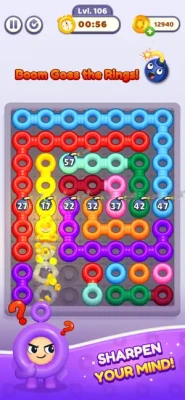
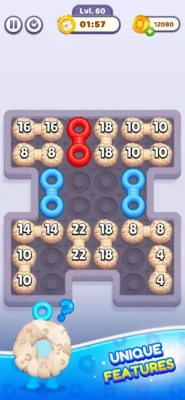
Ring Clash is a casual puzzle game developed by Rollic Games that combines colorful ring movement with logic-based challenges. Its simple premise makes it easy to pick up, but the changing board layouts and obstacles encourage players to think carefully before making a move.
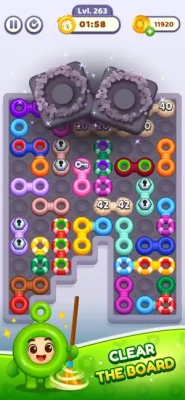
The main objective is to slide colorful rings across the grid and clear the board by finding the right sequence of actions. As the puzzles become more complicated, players must navigate crowded ring arrangements, work around icy obstacles, and pay attention to directional arrows that influence movement.
Every level presents an opportunity to recognize patterns, improve planning skills, and discover a more effective solution. The combination of bright visuals, straightforward controls, and increasingly challenging puzzles makes Ring Clash appealing to players who enjoy casual brain games and color-based challenges.
Whether you want a quick puzzle during a break or a longer session devoted to difficult stages, Ring Clash offers an accessible way to test your logic and patience.
What Is Ring Clash?
Ring Clash is a mobile puzzle game centered on sliding colorful rings across a grid to create clashes and clear the board. Rather than simply matching colors without considering their positions, players must study the arrangement and determine how the rings can move through the available space.
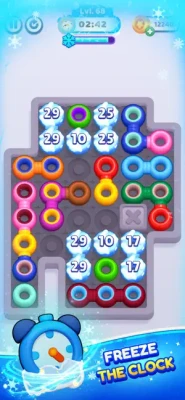
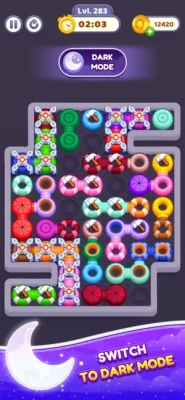
The game introduces obstacles and layered arrangements that make the puzzles more demanding as you progress. Directional arrows provide important movement clues, while icy barriers and crowded clusters can limit your options. Success depends on understanding the board and selecting the correct sequence of moves.
Ring Clash is designed to be easy to learn but challenging to master. Early puzzles help players become familiar with the core mechanics, while harder stages demand more careful observation and forward planning.
The result is a colorful puzzle experience that rewards logical thinking rather than relying entirely on quick reactions.
Main Features of Ring Clash
Colorful Ring-Sliding Gameplay
The central mechanic revolves around sliding rings across the grid. Each move can affect the available space and determine whether other rings can reach their intended positions. Learning how the pieces interact is essential to solving increasingly complex puzzles.
Color-Matching Challenges
Colors are a major part of the puzzle-solving experience. Players must recognize useful color combinations and understand how different rings can interact to clear portions of the board. Observing these relationships before moving can help prevent unnecessary mistakes.
Clever Obstacles
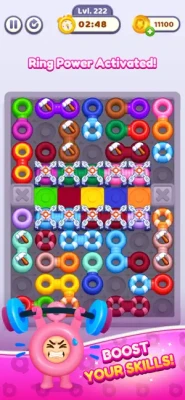
Ring Clash includes obstacles that make otherwise straightforward puzzles more complicated. Icy sections, directional arrows, and tightly packed ring clusters require players to adjust their strategies instead of relying on the same solution every time.
Layered Puzzle Arrangements
Some stages feature layered elements or complicated ring formations that conceal the best route to clearing the board. These arrangements encourage players to look beyond the most obvious move and consider how one action affects the rest of the puzzle.
Increasing Difficulty
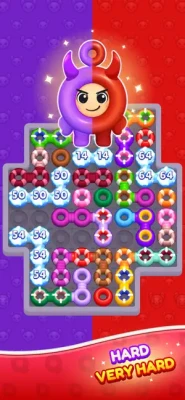
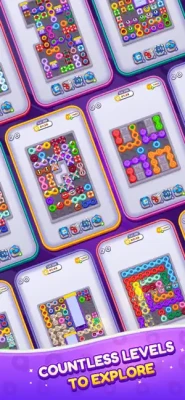
The game offers a range of puzzle challenges, including very hard stages. This progression gives players opportunities to improve their skills and apply more advanced strategies as they encounter unfamiliar layouts.
Satisfying Visual Effects
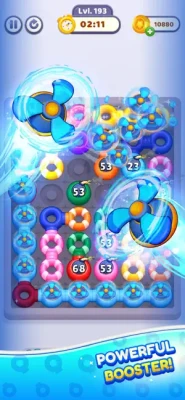
Bright colors and clear animations make successful moves easy to follow. Watching rings clash and sections of the board clear provides immediate feedback and makes progress feel rewarding.
Free-to-Play Access
Ring Clash is available as a free download with optional in-app purchases. Advertising and additional purchase options may be part of the experience, depending on the current version and settings.
Mobile-Friendly Controls
The game uses simple touch-based interactions, allowing players to focus on the puzzle rather than complicated controls. Its accessible format makes it suitable for casual play on compatible iPhone and iPad devices.
How to Play Ring Clash
Examine the Grid
Begin by looking at the entire board. Identify the colors of the rings, notice which pieces are blocking others, and check for arrows or icy sections. Understanding the starting arrangement will help you recognize which moves are possible and which actions could create problems.
Learn How Rings Move
Select or slide a ring according to the game's controls and observe how it travels across the grid. Pay attention to the direction of movement, the spaces available, and any restrictions imposed by nearby obstacles.
Understanding these basic interactions is essential before attempting more complicated levels.
Identify Useful Color Matches
Look for rings that can interact to create a clash and clear part of the board. Consider whether moving one ring into position will open a path for another or remove an obstacle that is blocking progress.
The goal is to make purposeful moves that contribute to clearing the puzzle.
Navigate Obstacles
Pay special attention to directional arrows and icy barriers. These elements can change which paths are available and may prevent rings from moving as expected. Study their placement before committing to a move.
Clear the Board
Continue sliding rings and resolving color interactions until the level's objective is complete. If the board becomes difficult to manage, stop and reconsider the remaining pieces instead of making random moves.
Prepare for Harder Puzzles
After completing a level, apply the lessons you learned to the next one. As layouts become more complicated, careful planning and a better understanding of obstacle mechanics will become increasingly important.
Complete Ring Clash Strategy Guide
Study the Board Before Making Your First Move
One of the best strategies in Ring Clash is to examine the entire grid before touching any rings. Identify the main color groups, the most crowded areas, and the obstacles that could interfere with movement.
Look for rings that appear ready to clash and determine whether clearing them will open useful space. A move that seems beneficial at first may block another ring or leave an important section inaccessible.
Spending a few seconds studying the board can help you avoid unnecessary moves and establish a clearer plan.
Plan Several Moves Ahead
Try to predict what will happen after each action. Ask yourself whether moving a particular ring will open a route, create a useful color match, or make another ring harder to access.
You do not need to predict the entire solution immediately. Planning two or three moves ahead is a practical starting point, especially when the board contains several interacting obstacles.
As you gain experience, you will become better at recognizing sequences that lead toward a complete solution.
Prioritize Moves That Open Space
Crowded ring arrangements can make a puzzle difficult because they restrict your available options. Whenever possible, look for a move that clears a section of the board or creates more room for other rings to move.
Opening space can make subsequent actions easier to understand. It can also reveal color combinations or routes that were difficult to recognize when the grid was crowded.
However, avoid clearing a ring simply because it is convenient. Consider whether the move supports the overall objective.
Use Color Relationships to Your Advantage
Pay attention to the colors of nearby rings and the combinations that can produce a clash. Identifying useful matches early can help you organize your moves more efficiently.
If several color groups are available, consider which one will provide the greatest benefit. Clearing one group may open a path for another, while choosing a less useful combination could leave the board unnecessarily crowded.
Always base your decision on the current arrangement rather than assuming that a particular color should come first in every puzzle.
Understand Directional Arrows
Directional arrows are important clues in Ring Clash. They can influence how rings travel or which directions are available, depending on the specific obstacle.
Before moving a ring near an arrow, inspect its orientation and consider how the indicated direction affects your intended route. Do not assume that a ring can move freely through every part of the grid.
When a planned move fails, review the arrows first. The problem may be related to movement restrictions rather than the color combination itself.
Approach Icy Obstacles Carefully
Icy sections introduce another layer of difficulty because they can restrict movement or interfere with the sequence needed to clear a puzzle.
Study where the icy elements appear and determine whether they block a critical route. Consider which rings can move freely and whether another section of the board needs to be cleared before you can deal with the obstruction.
The most effective approach is to treat ice as a specific problem to solve rather than trying to work around it without a plan. Always check the visual rules of the current level to understand exactly how the obstacle behaves.
Break Complicated Boards Into Smaller Objectives
When a level looks overwhelming, divide it into manageable sections. Focus on the most obvious color interaction, a blocked route, or a group of rings that can be cleared without disrupting the rest of the board.
After completing one small objective, reassess the grid and determine what has changed. This process makes it easier to recognize new opportunities and prevents you from trying to solve every part of the puzzle simultaneously.
Avoid Moves That Create Unnecessary Blockages
A ring may appear to be in the right position for a match, but moving it there could obstruct another important route. Before committing to an action, consider where the ring will end up and whether its new position will limit your options.
Pay particular attention to narrow passages and crowded areas. Keeping these spaces accessible can be more valuable than completing a convenient match immediately.
Learn From Failed Attempts
An unsuccessful attempt can reveal useful information about the level's mechanics. It may show that a route is blocked, a color combination is not immediately available, or a different order of actions is required.
Instead of repeating the same sequence, identify the decision that caused the problem. Change that part of your plan and observe whether the new approach creates a better outcome.
If the game offers a restart option, use it when the current arrangement no longer allows you to make meaningful progress.
Save Assistance for Difficult Situations
If Ring Clash provides hints, extra moves, or other assistance, use these options strategically. First, inspect the board for a solution you may have overlooked.
When you do use a hint, pay attention to the reasoning behind the suggested action. Understanding why a particular move helps can make future puzzles easier to solve independently.
Check whether assistance consumes coins or other resources before activating it.
Advanced Ring Clash Tips and Tricks
Think About the Consequences of Every Move
The most effective players do not judge an action only by its immediate result. They consider how it changes the available routes, affects neighboring rings, and influences future color matches.
Before moving a ring, briefly compare the current board with the arrangement you expect afterward. If the move creates more problems than it solves, consider an alternative.
Focus on Bottlenecks
A bottleneck is a narrow or restricted area that limits the movement of several rings. These locations deserve special attention because a single blocked passage can prevent progress across a large part of the board.
Identify these areas early and determine which rings depend on them. Clearing or freeing a bottleneck at the right moment may make several later moves possible.
Avoid Solving the Easiest Match Automatically
The most obvious color match is not necessarily the best first move. A simple clash may offer little benefit if it leaves a critical route blocked.
Compare the available matches and consider their strategic value. Prioritize actions that contribute to your overall plan, particularly when several rings compete for the same space.
Reassess the Grid After Every Major Clash
When rings disappear or a section of the board clears, the puzzle may become significantly easier. Take advantage of this change by reviewing the remaining pieces and identifying any newly available routes.
Do not continue following your original plan if the board has changed in an unexpected way. Effective puzzle solving requires adapting to the current situation.
Keep Your Strategy Flexible
Some levels can be solved in several ways, while others require a particular sequence of moves. Avoid becoming attached to one solution before you have confirmed that it works with the current layout.
If a route is blocked or a match is no longer possible, step back and examine the alternatives. A flexible approach is especially valuable on very hard stages.
Improve Your Visual Scanning Skills
Practice scanning the grid in a consistent order. Start with the outer edges, inspect the center, and then examine the arrows and obstacles. This method can help you avoid overlooking rings that are partly obscured by other elements.
With repeated practice, you may begin to recognize promising moves almost immediately.
Common Ring Clash Mistakes to Avoid
Making Random Moves
Moving rings without a clear objective can make the board more confusing and reduce your available options. Every action should contribute to clearing a color group, opening a route, or resolving an obstacle.
Ignoring Directional Restrictions
Failing to notice arrows can lead to incorrect assumptions about where a ring can travel. Check the direction indicators before planning a route through a restricted area.
Overlooking Icy Sections
Ice can change the way a puzzle must be approached. Examine these obstacles early and account for their effects when deciding which rings to move first.
Blocking Important Paths
Moving a ring into a narrow passage without considering its consequences can prevent other pieces from reaching their destinations. Think about the space each ring occupies and preserve access to important routes whenever possible.
Repeating an Unsuccessful Sequence
If the same moves keep producing the same problem, continuing to repeat them is unlikely to help. Identify what went wrong and change the order of your actions.
Rushing Through Difficult Levels
Although Ring Clash is easy to control, its harder puzzles require patience. Taking a moment to inspect the board can save time and help you find a more efficient solution.
Using Hints Too Early
A difficult-looking board may have a straightforward solution that becomes visible after closer inspection. Try identifying the main obstacle and testing a logical sequence before spending resources on assistance.
How to Beat Very Hard Levels in Ring Clash
Identify the Main Obstacle First
Begin by locating the part of the grid that most restricts movement. This could be a crowded ring cluster, an icy section, or a narrow passage controlled by directional arrows.
Understanding the primary obstacle gives you a clear starting point and helps you avoid wasting moves on less important areas.
Find the Best Opening Move
Look for an action that creates useful space or makes a critical route accessible. The best opening move is not always the easiest match; it is the move that improves your position for the rest of the puzzle.
If two options appear equally useful, consider which one preserves more possibilities for future actions.
Clear the Board in a Logical Sequence
Work through the puzzle by addressing the most restrictive elements first, then use the newly available space to resolve the remaining color groups.
The exact order depends on the level, so avoid applying a fixed sequence to every board. Focus on understanding the relationships between the rings and the obstacles.
Check Your Progress Frequently
After each major action, review the remaining rings and available routes. If the board has opened up, identify the new opportunities. If your options have become more limited, reconsider whether the previous move was the best choice.
Frequent reassessment prevents small mistakes from developing into larger problems.
Restart When Your Position Is Unrecoverable
Sometimes a sequence of moves leaves too few options to complete the level. If you cannot identify a productive next action, restarting may be more efficient than continuing to experiment with an unfavorable arrangement.
Before restarting, consider what the attempt taught you. Use that information to choose a better opening move and avoid the same mistake.
Is Ring Clash Easy to Learn?
Ring Clash is designed around straightforward touch controls, making its basic gameplay accessible to new players. The central challenge is learning how rings interact, how the grid limits movement, and how obstacles affect the order of actions.
As the puzzles become more complex, players must rely increasingly on observation, planning, and problem-solving. This gradual increase in difficulty helps the game remain approachable while offering a challenge for experienced puzzle fans.
Is Ring Clash Good for Casual Players?
Ring Clash is a suitable choice for players who enjoy short, focused puzzle sessions. Its colorful presentation and simple interactions make it easy to start playing, while its more demanding stages offer a reason to keep improving.
The game can also appeal to people who enjoy untangling crowded arrangements, finding color combinations, and solving problems through careful planning.
Is Ring Clash Free to Play?
Ring Clash is listed as a free download with optional in-app purchases. The game also includes advertising, according to its store listing. Optional purchases may provide additional resources or other benefits, depending on the available features.
Players who prefer not to spend money can review the in-game options carefully and decide which features, if any, are worth purchasing.
Which Devices Support Ring Clash?
The game is available for compatible iPhone and iPad devices and requires iOS 15.0 or later according to its App Store listing. Compatibility with other Apple devices depends on the device and operating system requirements.
Before installing the game, check your device's available storage and software version to ensure a smooth installation.
Does Ring Clash Require Strategy or Quick Reactions?
Ring Clash primarily emphasizes strategic thinking. While its animations create an energetic experience, the central challenge is finding the right sequence of moves to clear the board.
Players benefit most from studying the grid, identifying useful color interactions, understanding obstacles, and planning ahead. Quick decisions become easier once these mechanics are familiar.
What Makes Ring Clash Different From Other Color Puzzle Games?
Ring Clash combines sliding rings and color-based clashes with movement restrictions, layered arrangements, and environmental obstacles. These elements make the puzzles more involved than a basic color-matching activity.
Instead of focusing only on finding identical colors, players must consider how the pieces move and how each action affects the rest of the board. This combination of spatial reasoning and color recognition gives the game its distinctive puzzle-solving appeal.
Final Thoughts on Ring Clash
Ring Clash is an engaging casual puzzle game that combines colorful ring-sliding mechanics with strategic board clearing. Its accessible controls make it easy to begin, while directional arrows, icy obstacles, crowded clusters, and harder stages create challenges that reward careful planning.
The best way to improve is to study the entire grid, identify movement restrictions, prioritize useful clashes, and think about the consequences of every action. Avoid random moves, preserve important routes, and learn from unsuccessful attempts.
Whether you enjoy relaxing color puzzles or challenging logic games, Ring Clash offers an enjoyable way to test your problem-solving skills and work toward clearing increasingly complicated boards.
Rate the Game
User Reviews



Popular Games



















 Android
 iOS
 Windows
 Xbox