
Latest Version
August 10, 2026
Palm Court LLC
Word
iOS
0
Report a Problem
More About :game
The iPhone and iPad version supports 2 to 10+ players, allowing friends to play together in the same room or remotely. It is free to play, contains no ads, and includes a large collection of original spectrum prompts created specifically for the app.
What Is Wavelength?
Wavelength is a cooperative word and party game developed by Palm Court LLC. The basic idea is simple: players must work together to determine where a hidden target sits between two opposite ideas.
A spectrum might range from something like "hot" to "cold" or "soft" to "hard." The clue giver knows where the target is but cannot simply reveal its location.
Instead, they provide a clue.
The rest of the group then has to interpret that clue and decide where the target should be placed.
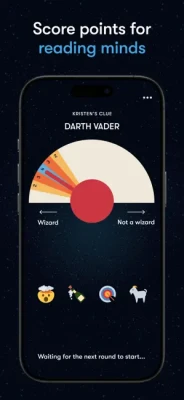
The closer the group gets, the better the result.
How Wavelength Gameplay Works
Each round revolves around a hidden target on a spectrum.
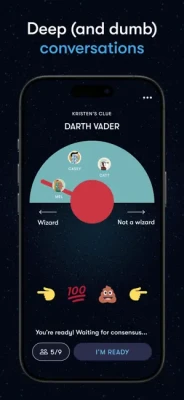
One player becomes the clue giver and sees where the target is located. They then provide a word, phrase or idea that they believe will help the other players identify the target's position.
For example, imagine a spectrum running from:
"Not scary" → "Terrifying"
If the target is somewhere near the middle, a clue such as "watching a horror movie alone" might lead the group toward the intended area.
The challenge is that different people interpret the same clue differently.
That is where the mind-reading element comes into play.
Reading Your Friends' Minds
Wavelength isn't really about knowing a correct answer. It's about predicting how your friends will interpret a clue.
A clue that seems obvious to one person may be completely different to another.
This creates conversations, arguments, jokes and surprising guesses throughout the game.
The better you understand the people you're playing with, the better your chances of placing the dial near the target.
Cooperative Party Gameplay
One of Wavelength's defining features is that it is 100% cooperative.
Rather than competing individually, everyone works together to achieve a high score.
This makes the game particularly suitable for groups where players want to laugh and discuss clues instead of worrying about eliminating opponents.
The App Store listing specifically describes the experience as cooperative and highlights the ability to work together toward a high score.
Play With Friends Anywhere
Wavelength supports both local and remote play.
You can gather around the same room and play together, or connect with friends who are somewhere else.
The game supports 2 to 10+ players, making it flexible for everything from a small group of friends to a larger social gathering.
Because the gameplay depends heavily on conversation, players can also use voice or video chat when playing remotely.
Spectrum Cards and Prompts
The heart of Wavelength is its huge collection of spectrum prompts.
The current App Store description says the game includes a large library of unique prompts, including 390 prompts that are not found in the physical board game, along with occasional themed packs.
These prompts create endless opportunities for different interpretations.
Examples of spectrum concepts can include:
- Hot vs. cold
- Soft vs. hard
- Good vs. bad
- Normal vs. strange
- Exciting vs. boring
- Useful vs. useless
- Magical vs. ordinary
- Familiar vs. unfamiliar
The fun comes from discovering where your friends believe each idea belongs.
Real-Time Dial Movement
The digital version adds interactive features that aren't possible in exactly the same way with the physical board game.
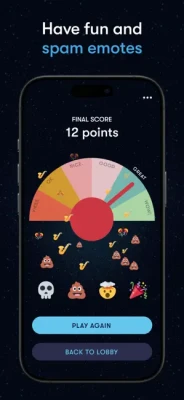
Players can see real-time synchronized dial movements, making it possible to watch the group gradually settle on a position.
This creates a more dynamic experience as everyone debates and adjusts their answer.
Emoji Reactions
Wavelength also includes emoji reactions.
These allow players to communicate their reactions quickly during a round without interrupting the conversation.
A well-timed reaction can make an already funny disagreement even more entertaining.
Customizable Avatars
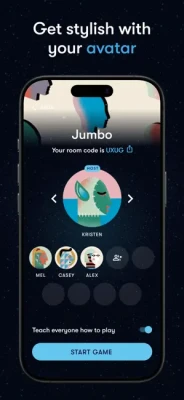
Players can create their own in-game appearance using customizable avatars.
The App Store listing states that there are more than four million possible avatar combinations, giving players plenty of ways to create a look that suits them.
Achievements and High Scores
Although Wavelength is primarily a social experience, it also gives groups reasons to keep playing.
Players can work together to beat their previous high scores, while individuals can earn personalized achievements.
This adds a light progression system without taking away from the game's relaxed party atmosphere.
No Ads
One particularly useful feature of the current mobile version is that the game is advertised as having no ads.
Players can concentrate on the conversation and clues without being interrupted by advertising during the game.
Game Modes and Play Styles
Local Party Mode
Gather everyone in the same room and use the app as the center of the game.
This works especially well for family gatherings, parties and game nights.
Remote Multiplayer
Friends can play even when they're in different locations.
Voice or video chat can complement the app and make remote sessions feel more like an in-person party.
Cooperative High-Score Sessions
Groups can repeatedly play together and attempt to improve their previous scores.
Casual Social Sessions
There is no need to take the game seriously. The best rounds often come from unusual clues and unexpected interpretations.
Why Wavelength Is So Addictive
The biggest strength of Wavelength is that every group approaches clues differently.
A spectrum can produce completely different answers depending on who is playing.
A clue that works perfectly with your closest friends might completely confuse a group of coworkers.
That unpredictability creates replay value without requiring complicated progression mechanics.
Beginner's Guide
1. Think About the Group
Before giving a clue, consider who is playing.
The best clue isn't necessarily the most obvious one. It is the clue that your specific group is most likely to interpret correctly.
2. Avoid Extremely Broad Clues
A clue that could fit almost anywhere on the spectrum may not give your teammates enough information.
Try to choose something that naturally points toward a particular area.
3. Use Shared Experiences
Inside jokes, movies, celebrities, hobbies and memories can make excellent clues because your friends already understand the context.
4. Listen to the Discussion
Once players start debating their positions, pay attention to how they interpret the clue.
The conversation itself can reveal where the group is leaning.
5. Don't Overthink Everything
Wavelength is supposed to be social and entertaining.
Sometimes the funniest clue is better than the technically perfect clue.
Advanced Wavelength Strategies
Experienced players can improve their scores by learning how their group thinks.
Learn Individual Interpretation Styles
Some players tend to choose extreme positions, while others usually move toward the middle.
Understanding these tendencies can help you predict where they will place the dial.
Build Clues Around Shared References
If your group has common experiences, use them.
A reference everyone understands can communicate a very precise idea without needing a long explanation.
Consider the Entire Spectrum
Don't think only about the target.
Think about both ends of the spectrum and how your clue will be interpreted relative to them.
Avoid Ambiguous Clues
An extremely clever clue isn't necessarily a good clue.
If players can reasonably interpret it in several completely different ways, it may create confusion rather than accuracy.
Graphics and Interface
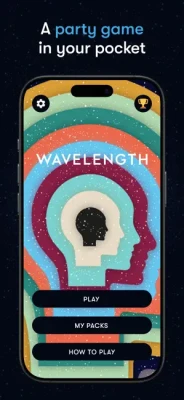
Wavelength uses a clean, colorful digital presentation designed to keep attention on the spectrum and the conversation.
The interface doesn't need to overwhelm the player because the real entertainment comes from the discussion between players.
The synchronized dial, reactions and avatar system add personality without making the core gameplay complicated.
Sound and Social Atmosphere
The game's atmosphere comes primarily from the players themselves.
There is no need for an elaborate story or action soundtrack. The entertainment is generated by disagreements over clues, unexpected interpretations and the personalities of the people playing.
That makes Wavelength particularly effective as a party and social game.
Difficulty
Wavelength is easy to learn but can become surprisingly difficult to master.
The basic rules can be understood very quickly, but consistently predicting how other people will interpret clues is much harder.
The difficulty therefore comes from social understanding rather than complex game mechanics.
Replay Value
Wavelength has strong replay value because the experience changes depending on the group.
Even if you have seen a particular type of spectrum before, a different group of players can produce completely different discussions and answers.
The large prompt library and additional themed content also help keep games fresh.
Wavelength for Families and Friends
The game's social format makes it suitable for family gatherings, casual parties and groups of friends.
Its current App Store age rating is 9+, although some spectrum topics and humor may naturally be more appropriate for particular groups.
Wavelength for Remote Game Nights
Wavelength is particularly useful for people who want to play a party game remotely.
Instead of needing everyone around a physical board, players can connect from different locations and use the app alongside voice or video communication.
This makes it a convenient option for virtual game nights, friends living in different cities and online social groups.
Technical Details
Game: Wavelength
Developer: Palm Court LLC
Genre: Word / Party / Social Game
Platform: iPhone and iPad
Players: 2–10+
Game Style: Cooperative
Online Play: Yes
Local Play: Yes
Age Rating: 9+
Current App Size: Approximately 168 MB
Minimum iOS: iOS 15.0 or later
Minimum iPadOS: iPadOS 15.0 or later
Mac: macOS 12.0 or later with Apple M1 or later
Apple Vision: visionOS 1.0 or later
Ads: No ads
In-App Purchases: Yes
Game Center: Leaderboards and achievements
These details reflect the current U.S. App Store listing.
Current Content and Purchases
The game is free to play and offers optional paid content through themed and expanded prompt packs.
The current App Store listing includes packs and bundles such as Big Bundle, Originals Bundle, Divisive Nonsense, Chaotic, Weird, Lickable, Culture, Jumbo and Latest content.
The optional content allows players to expand the variety of available spectrums while the base game remains playable.
Player Reception
Wavelength currently has an exceptionally strong reception on the U.S. App Store, with approximately 4.9 out of 5 stars from more than 60,000 ratings. Apple also recognizes it as an Editors' Choice title and has featured it as a Game of the Day.
The high rating reflects the game's strength as a social experience, particularly for people who enjoy discussing subjective questions and trying to predict how their friends think.
Pros and Cons
Pros
- Easy to learn
- Excellent for groups
- 2–10+ players
- Local and remote play
- Cooperative gameplay
- Large collection of spectrum prompts
- Hundreds of app-exclusive prompts
- Real-time synchronized dial
- Emoji reactions
- Customizable avatars
- More than four million avatar combinations
- No ads
- Achievements and high scores
- Strong replay value
Cons
- The game depends heavily on having other people to play with.
- Remote games work best when players also have voice or video communication.
- Some players may prefer competitive games with individual winners.
- Optional content is sold through in-app purchases.
Who Should Play Wavelength?
Wavelength is ideal for people who enjoy:
- Party games
- Word games
- Social games
- Family game nights
- Multiplayer games
- Cooperative games
- Conversation games
- Remote game nights
- Games like Codenames
- Casual games for friends
If you enjoy games where the conversation is just as important as the score, Wavelength is an excellent choice.
Wavelength vs. Traditional Board Games
The Wavelength app keeps the central concept of the physical board game while adding digital features.
Real-time dial movement, emoji reactions, customizable avatars, achievements and a large library of app-exclusive prompts make the mobile version more flexible for modern game nights.
It also removes the need to physically own or set up the board, while allowing players to connect remotely.
Wavelength vs. Competitive Party Games
Many party games require players to compete directly against each other.
Wavelength takes a different approach.
Everyone works toward a shared score, making the game less about defeating your friends and more about understanding how they think.
That cooperative design is one of the reasons it works well with mixed groups.
Overall Rating
Overall: 9.3/10
Gameplay: 9.5/10
Party Fun: 9.7/10
Multiplayer: 9.5/10
Replay Value: 9.3/10
Accessibility: 9.4/10
Content Variety: 9.2/10
Mobile Design: 9.4/10
Final Verdict
Wavelength turns a simple question into a surprisingly entertaining test of friendship and intuition.
Its rules are easy enough for new players to understand almost immediately, but the game becomes more interesting as players learn how their friends interpret different ideas.
The combination of cooperative scoring, clever clues, real-time dial movement, emoji reactions, customizable avatars and a huge collection of spectrum prompts gives the mobile version plenty of personality.
Whether you're sitting around a table with friends or connecting from different locations, Wavelength is an excellent choice for a relaxed multiplayer game night.
Its strong App Store reception, Editors' Choice recognition, no-ad experience and support for 2–10+ players make it one of the more accessible social party games available on iPhone and iPad.
Frequently Asked Questions
What is Wavelength?
Wavelength is a cooperative party and word game where players give clues and try to determine where a hidden target sits on a spectrum between two opposing concepts.
How many people can play Wavelength?
Wavelength supports 2 to 10+ players, and games can be played locally or remotely.
Is Wavelength free on iPhone?
Yes. The current App Store listing describes Wavelength as free to play, with optional in-app purchases for additional content.
Does Wavelength have advertisements?
No. The current App Store description specifically states that the game has no ads.
Can you play Wavelength online?
Yes. Wavelength supports remote play, allowing friends to play together even when they are in different locations.
Can Wavelength be played in person?
Yes. Players can use Wavelength in the same room for a traditional group game-night experience.
Is Wavelength a cooperative game?
Yes. Everyone works together toward a shared high score rather than competing for a traditional individual victory.
Does Wavelength have many questions?
Yes. The current app contains a large collection of spectrum prompts, including 390 prompts that aren't included in the physical version, plus additional themed content.
Does Wavelength support achievements?
Yes. The app includes personalized achievements as well as Game Center leaderboards and achievements.
Can you customize your character?
Yes. Wavelength includes customizable avatars with more than four million possible combinations.
What devices support Wavelength?
The current listing supports iPhone and iPad running iOS/iPadOS 15 or later. It also lists Mac support for macOS 12 or later on Apple M1-and-newer Macs and Apple Vision support.
Rate the Game
User Reviews




Popular Games



















 Android
 iOS
iOS Windows
 Xbox
Xbox