


Latest Version
January 21, 2026
Coco Play By TabTale
Puzzle
Android
0
com.crazylabs.hex.nine
Report a Problem
More About :game
Although the basic rules are easy to understand, the limited space on the board makes every placement important. A good move can create several merging opportunities, while a careless placement can quickly fill the grid and leave you with nowhere useful to put the next piece.
The result is a casual puzzle experience that works well for short sessions but can also keep players focused when they are trying to beat their previous high score.
Game Overview
UP 9 Hexa Puzzle! Merge em all is a puzzle and casual game developed by Coco Play By TabTale.
The Android version is free to play and currently listed with advertisements and optional in-app purchases. Google Play categorizes it as a puzzle, merge, casual, single-player, abstract, and offline game.
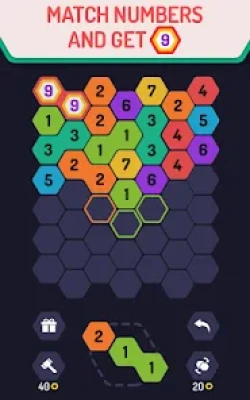
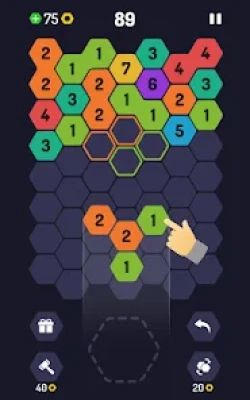
The central gameplay loop is based on placing hexagonal number pieces, rotating them when necessary, and merging three or more matching numbers to create higher values.
The Main Goal
Your ultimate target is 9.
You begin with lower-numbered hexagon pieces and gradually combine matching pieces to create higher numbers. Reaching higher values requires careful board management because the honeycomb grid can become crowded surprisingly quickly.
The challenge is therefore not simply making merges. It is deciding where and when to make them.
How the Hexagon Merge System Works
The core mechanic is easy to learn:
- Receive a hexagon piece.
- Examine the available spaces.
- Rotate the piece if necessary.
- Place it on the honey grid.
- Connect matching numbers.
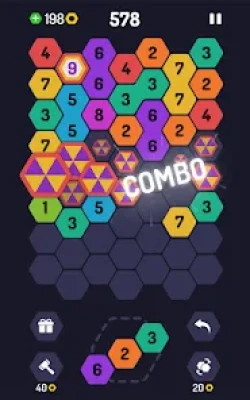
- Merge three or more matching hexagons.
- Create a higher number.
- Continue until you reach 9 or the board becomes too crowded.
This simple system creates a satisfying chain of decisions because every new piece can change the shape of the board.
The Honeycomb Grid
The honeycomb-style board is what gives UP 9 its distinctive identity.
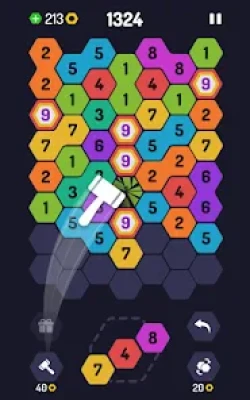
Instead of using a traditional square puzzle grid, the game uses hexagonal spaces that allow pieces to connect in different directions. This changes how you plan merges and makes spatial awareness an important part of the experience.
A move that looks harmless on a normal block puzzle can have very different consequences on a hexagonal board.
Rotate Before You Drop
One of the most useful mechanics is the ability to rotate the incoming piece before placing it.
Rotation gives you more control over the board and can help you:
- Connect matching numbers
- Create larger groups
- Preserve open spaces
- Prepare future merges
- Avoid awkward gaps
- Build more efficient combinations
Learning when to rotate a piece can make a noticeable difference during longer sessions.
Merging Numbers
The objective is to combine three or more hexagon blocks with the same number.
Successful combinations create higher values and move you closer to 9.
For example, when several matching pieces are positioned correctly, they can merge into a stronger number. Repeating this process gradually builds your board toward the final target.
The game's official description specifically highlights merging three or more matching hexagons and reaching 9 as the central objective.
Why Reaching 9 Is Challenging
At first, creating higher numbers feels easy.
The challenge increases as the board fills with pieces.
You must constantly balance two priorities:
Create merges now
and
Keep enough space for future pieces.
If you merge too aggressively without considering the next placement, you can create a crowded board. If you avoid merging for too long, you may run out of usable space.
That balance is what gives UP 9 its strategic element.
Unlimited Reloads and No Time Limits
The Google Play listing highlights unlimited reloads and no time limits.
This makes the game suitable for relaxed play. You can take time to examine the board instead of racing against a countdown.
The absence of a traditional timer also makes it easier to play casually while commuting, relaxing, or taking a short break.
Offline Puzzle Gameplay
UP 9 is listed as an offline game, meaning players can enjoy its core puzzle experience without requiring a constant internet connection.
That makes it a convenient choice for situations where connectivity is limited.
High Score Challenge
There is more to the game than simply reaching 9 once.
Players can challenge themselves to improve their score and develop better placement strategies over repeated sessions.
The high-score focus gives the game replay value because each new round provides another opportunity to make smarter decisions.
Game Features
Hexagon Number Merging
Combine matching hexagonal numbers to create increasingly valuable pieces.
Honeycomb Puzzle Board
Place blocks on a distinctive hexagonal grid rather than a traditional square board.
Piece Rotation
Rotate incoming puzzle pieces before placing them.
Reach Number 9
Build your numbers through successful merges and aim for the game's ultimate target.
No Time Pressure
Play without a countdown forcing you to make rushed decisions.
Offline Play
Enjoy the puzzle experience when you don't have an internet connection.
High Score Competition
Keep improving your strategy and challenge your previous results.
Simple Controls
The touch-based mechanics are easy to understand and suitable for casual mobile play.
Gameplay Experience
UP 9 has a deliberately simple presentation. There are no complicated character systems, large inventories, or lengthy story missions to manage.
Instead, the entire experience revolves around the puzzle board.
That simplicity is one of its biggest advantages. You can open the game, understand the objective quickly, and start playing almost immediately.
At the same time, the limited board space creates enough strategic depth to make experienced players think carefully about every placement.
Beginner's Guide
If you're playing UP 9 for the first time, don't concentrate only on the biggest possible merge.
Instead, think about the board as a space-management puzzle.
Beginner Tip 1: Keep the Board Organized
Try to avoid scattering numbers randomly across the grid.
Organized groups are easier to merge later.
Beginner Tip 2: Look at the Next Move
Before dropping a piece, consider where your next few pieces might fit.
Planning ahead helps prevent the board from becoming blocked.
Beginner Tip 3: Use Rotation
Don't automatically place every piece in its original orientation.
Rotate pieces whenever another position creates a better connection.
Beginner Tip 4: Protect Open Spaces
Open spaces are valuable.
A board full of isolated pieces can be much harder to recover than a board with several planned groups.
Beginner Tip 5: Don't Rush
There is no time limit, so take advantage of it.
Study the available positions before committing to a move.
Advanced Strategy
Build Around Future Merges
Experienced players should think beyond the current combination.
Instead of asking:
"Can I merge this now?"
ask:
"What will this merge allow me to do next?"
A smaller immediate gain can sometimes create a much better board position.
Maintain Multiple Merge Opportunities
Avoid building a board that depends entirely on one particular number.
Keeping several possible combinations available gives you more flexibility when the next piece arrives.
Avoid Dead Zones
Some areas of the board can become difficult to use effectively.
Try to recognize these positions early and avoid filling them unnecessarily.
Use Rotation Strategically
Rotation is more than a convenience. It is a way to influence where future groups can form.
Use it to connect pieces while preserving valuable empty spaces.
Think About Space First
When the board becomes crowded, the best move isn't necessarily the one that produces the highest immediate number.
Sometimes the best move is the one that creates breathing room.
Difficulty
UP 9 is easy to learn but becomes progressively more challenging through board management.
The rules themselves remain simple throughout the experience. What changes is the amount of planning required as the grid becomes more crowded.
This creates a gentle difficulty curve:
Learn → Merge → Plan → Manage Space → Improve Scores
Controls
UP 9 uses straightforward touch controls.
Players interact with the hexagon pieces by tapping and placing them on the honeycomb grid. Pieces can also be rotated before being dropped.
There are no complicated button combinations or character controls to memorize.
Game Modes and Activities
The main experience centers on the endless-style number merging puzzle.
Key activities include:
- Placing hexagon blocks
- Rotating pieces
- Matching numbers
- Creating merges
- Building higher numbers
- Reaching 9
- Managing the board
- Chasing higher scores
- Replaying to improve strategy
Visual Style
UP 9 uses a clean, colorful abstract puzzle presentation.
The developers specifically describe the colors as eye-friendly, helping the game maintain a light and accessible visual style.
The hexagonal pieces and honeycomb layout also give the game a recognizable appearance compared with conventional number puzzles.
Sound and Atmosphere
The game is designed around a casual puzzle atmosphere rather than an intense action presentation.
Its simple visual design and relaxed pacing make it suitable for players looking for a low-pressure brain game.
Who Is UP 9 Hexa Puzzle For?
The game is a good fit for players who enjoy:
- Number puzzles
- Merge games
- Hexagon puzzles
- Block puzzles
- Brain-training games
- Casual mobile games
- Offline puzzle games
- High-score challenges
- Relaxing games
- Strategy-based puzzles
It is particularly appealing if you like games that are easy to start but gradually demand better planning.
UP 9 vs Traditional Number Merge Games
Many number merge games use square grids or simple sliding mechanics.
UP 9 introduces a hexagonal honeycomb board and allows pieces to be rotated before placement.
That additional geometry changes the way players think about space. Instead of simply moving numbers vertically or horizontally, you must consider how hexagonal pieces connect across the board.
UP 9 vs Traditional Block Puzzles
Traditional block puzzles often focus on completing rows or columns.
UP 9 instead focuses on combining matching numbered hexagons.
The result is a different type of challenge: rather than simply clearing lines, you're building numerical value while trying to preserve enough room for future pieces.
Pros and Cons
Pros
- Easy to learn
- Simple touch controls
- Interesting hexagonal board
- Number merging provides satisfying progression
- Piece rotation adds strategic flexibility
- No time limits
- Offline gameplay
- High-score replayability
- Suitable for short or long sessions
- Colorful and accessible presentation
Cons
- Ads can interrupt gameplay
- The core gameplay can become repetitive for some players
- Board management can become frustrating during difficult rounds
- Limited variety compared with larger puzzle adventures
- Contains optional in-app purchases
Google Play currently lists the game with ads and in-app purchases.
Player Experience
UP 9 has maintained a positive overall reception on Google Play, currently showing around 4.5 stars from approximately 1.68K reviews and more than 500K downloads.
Third-party tracking also records more than 500K installs and a rating around 4.45, broadly consistent with the current Google Play listing.
Player feedback commonly highlights the game's addictive nature and straightforward puzzle mechanics, while some reviews have criticized advertising frequency and occasional technical problems.
Expert Rating
8.3/10
Rating Breakdown
- Gameplay: 8.5/10
- Puzzle Design: 8.5/10
- Controls: 8.5/10
- Visuals: 8.0/10
- Replay Value: 8.5/10
- Accessibility: 9.0/10
- Variety: 7.5/10
Latest Update
The current Google Play listing shows the game was updated on October 13, 2025.
The latest listed version information from third-party tracking identifies version 2.9.x around the same update period.
Technical Details
Game: UP 9 Hexa Puzzle! Merge em all
Developer: Coco Play By TabTale
Package ID: com.crazylabs.hex.nine
Platform: Android
Genre: Puzzle / Casual
Gameplay: Single player
Internet: Offline play supported
Monetization: Ads and in-app purchases
Content Rating: Teen
Downloads: 500K+
Google Play Rating: Approximately 4.5 stars
Latest Listed Update: October 13, 2025
These details are based primarily on the current Google Play listing and supporting app-tracking data.
How to Get Better Scores
If your goal is to beat your previous high score, focus on consistency rather than trying to create huge numbers immediately.
A strong approach is to:
- Keep the board organized.
- Preserve several open spaces.
- Rotate pieces before placement.
- Create matching groups whenever they help your future position.
- Avoid filling corners or awkward spaces without a plan.
- Look for chain reactions.
- Think about the next placement before making the current one.
- Use each round to learn which board positions are most useful.
Common Mistakes to Avoid
Filling the Board Too Quickly
A crowded board gives you fewer options.
Ignoring Rotation
A poorly oriented piece can waste valuable space.
Chasing Every Immediate Merge
Not every possible merge is a good merge.
Creating Isolated Numbers
Scattered pieces can become difficult to combine later.
Playing Too Fast
The absence of a timer means there is little reason to rush.
Is UP 9 Hexa Puzzle Worth Playing?
Yes, especially if you enjoy simple number puzzles with a strategic twist.
The game does not attempt to overwhelm players with complicated systems. Instead, it focuses on one strong idea: combine numbered hexagons, create higher values, manage your space, and aim for 9.
Its offline support, no-time-limit design, easy controls, and replayable high-score structure make it a convenient casual puzzle for mobile players.
Final Verdict
UP 9 Hexa Puzzle! Merge em all turns a simple number-merging concept into a surprisingly thoughtful hexagonal puzzle.
The controls are accessible, the objective is immediately understandable, and the honeycomb board creates enough spatial complexity to keep repeated rounds interesting. The ability to rotate pieces before placement adds another layer of control, while the goal of reaching 9 gives every merge a clear purpose.
The real challenge comes from managing limited space. A successful player needs to think beyond the current move and create a board that remains flexible for future pieces.
If you enjoy hexagon puzzles, number merge games, block puzzles, brain games, and relaxing offline challenges, UP 9 is a worthwhile casual game to try.
Frequently Asked Questions
What is UP 9 Hexa Puzzle?
UP 9 Hexa Puzzle! Merge em all is a hexagon-based number merging puzzle developed by Coco Play By TabTale.
What is the goal of UP 9?
The goal is to merge matching numbered hexagons and build higher numbers, with 9 serving as the final target.
How do you play UP 9?
Place numbered hexagon pieces on the honeycomb grid, rotate them when needed, and merge three or more matching numbers to create higher values.
Can you rotate the pieces?
Yes. The game allows players to tap an item to rotate the puzzle piece before placing it.
Does UP 9 have a time limit?
No. The Google Play description specifically lists no time limits.
Can you play UP 9 offline?
Yes. UP 9 is listed as an offline game on Google Play.
Is UP 9 free?
Yes. The game is free to play but currently contains advertisements and optional in-app purchases.
How many people have downloaded UP 9?
Google Play currently lists more than 500,000 downloads.
Is UP 9 a good brain game?
It can be a useful casual problem-solving game because successful play requires spatial planning, number matching, and managing limited board space.
What makes UP 9 different from ordinary merge games?
Its hexagonal honeycomb board and piece-rotation system create a different spatial puzzle compared with traditional square-grid number merge games.
Rate the Game
User Reviews








Popular Games



















 Android
 iOS
iOS Windows
 Xbox
Xbox