


Latest Version
September 10, 2026
Tripledot Studios
Puzzle
iOS
0
Report a Problem
More About :game
The game features more than 12,000 levels, fish-themed tile designs, boosters, offline play, and progressively more complicated layouts. It is available on iPhone and iPad and requires iOS 13 or later.
What Is Tidal Tile?
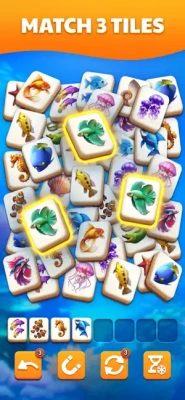
Tidal Tile combines the familiar match-3 mechanic with a 3D tile board.
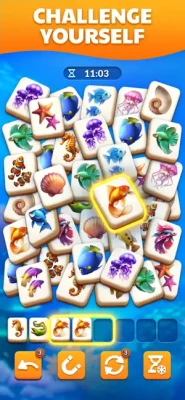
Instead of immediately removing a tile when you tap it, the selected tile moves into your tray. When three matching tiles occupy the tray, they disappear.
The catch is that the tray has limited space.
That changes the game completely.
You are not simply looking for three identical tiles. You are deciding which tiles to take now, which ones to leave for later, and how to avoid filling your tray with unfinished groups.
The App Store describes Tidal Tile as an ocean-themed puzzle game featuring fish tiles, underwater sounds, boosters, new tile sets, offline play, and more than 12,000 challenging levels.
How to Play Tidal Tile
The basic rules are straightforward:
- Tap a visible tile.
- The tile moves into the tray.
- Find two more tiles of the same type.
- Match all three.
- The completed set disappears.
- Continue until the board is cleared.
If the tray fills before you can complete a match, the level can fail.
That means tray management is the central skill in Tidal Tile.
The Most Important Tidal Tile Strategy
The biggest mistake beginners make is thinking:
"I found two matching tiles, so I should take them."
Not necessarily.
A pair sitting in the tray is unfinished business.
If you take two matching tiles without knowing where the third one is, you have used two valuable tray spaces without actually clearing anything.
A better rule is:
Prefer moves that either complete a triple immediately or create a very realistic path to completing one.
For example:
Situation A
Tray:
Blue Fish + Blue Fish
You see the third Blue Fish clearly accessible.
Take it.
The triple clears immediately.
Situation B
Tray:
Blue Fish + Blue Fish
You cannot see the third Blue Fish.
Several unrelated tiles are blocking the board.
Be careful.
You may have just consumed two tray spaces while having no immediate way to clear them.
That difference becomes increasingly important on difficult levels.
1. Protect Your Tray
Think of the tray as your limited budget.
Every unfinished tile costs you one space.
A useful mental system is:
Safe
A triple can be completed immediately.
Good
You have two matching tiles and the third is clearly accessible.
Risky
You have two matching tiles but don't know where the third is.
Dangerous
You are adding completely different tiles while the tray already contains several unmatched pieces.
Try to keep the tray as clean as possible.
2. Complete Easy Triples First
If three identical tiles are already available, clearing them is usually a strong move.
Why?
Because a completed triple:
- Removes three tiles
- Frees three tray positions
- Reduces clutter
- Reveals more of the board
- Gives you more options for subsequent moves
This creates a positive cycle:
Match → clear tray → reveal tiles → create more matches.
3. Don't Automatically Chase Pairs
Pairs are useful, but they can also become traps.
Suppose your tray contains:
- Fish A
- Fish A
- Shell B
- Star C
You discover another Fish A.
That triple should normally be your priority because it immediately removes three pieces.
But if you only have:
- Fish A
- Fish A
and the third Fish A is buried, adding more unrelated tiles may make your position worse.
Before taking a pair, ask:
"Where is the third one?"
If you cannot answer that question, consider another move.
4. Work From the Most Accessible Tiles
Not every tile has equal strategic value.
A tile sitting completely exposed is much easier to use than one buried underneath several other pieces.
Prioritize tiles that:
- Are fully visible
- Have matching partners nearby
- Reveal important tiles underneath
- Complete an existing pair
- Remove a potential bottleneck
This gives you more control over the board.
5. Think About What Each Move Reveals
A good Tidal Tile move does more than place a tile in your tray.
It can also expose tiles underneath it.
Before tapping a tile, ask:
"What will become visible when I remove this?"
Suppose removing one shell exposes another shell.
That may be much better than taking a random fish, even if the fish looks easier to match.
You are effectively solving two problems at once:
clearing the tray + opening the board.
6. Use the "Three-Move Test"
Before making a questionable move, look approximately three moves ahead.
You don't need to calculate the entire level.
Ask:
- What happens if I take this tile?
- What matching tile can I take next?
- Will I still have enough tray space to finish the group?
For example:
Move 1: Take Red Fish
Move 2: Take Red Fish
Move 3: Third Red Fish is accessible
That's a strong sequence.
But:
Move 1: Take Shell
Move 2: Take Star
Move 3: Take Blue Fish
Now the tray is filling with unrelated pieces.
That's dangerous.
7. Create a Matching Chain
The strongest moves often create a chain.
Imagine you have:
Two Blue Fish → third Blue Fish → three Shells → three Stars
If one completed match exposes another group, prioritize that sequence.
A good chain might look like:
Match → reveal → match → reveal → match
This is much safer than taking random tiles across the board.
8. Look for Bottleneck Tiles
A bottleneck is a tile that blocks access to several other tiles.
Suppose one tile is sitting on top of:
- Two fish
- A shell
- A star
- Another fish
Removing that top tile could open a large portion of the board.
Even if the tile doesn't immediately complete a triple, it may be strategically important.
Bottleneck rule
If one tile blocks several useful pieces, consider removing it before taking an unrelated easy tile.
This becomes particularly valuable as layouts become more complicated.
9. Don't Fill the Tray With Singletons
A singleton is a tile with no matching partner currently in the tray.
One or two singletons are manageable.
Four or five can become a serious problem.
For example:
Fish → Shell → Star → Crab → Turtle
Every move consumes another tray slot.
If none of those groups can be completed soon, you are effectively running out of room.
Instead, try to build around one or two active groups at a time.
10. Use the Tray as a Planning Board
Don't think of the tray as somewhere tiles simply wait.
Use it to organize your strategy.
For example:
Pair 1: Blue Fish + Blue Fish
Pair 2: Shell + Shell
Single: Star
Your immediate objective should be finding:
Blue Fish
or
Shell
rather than introducing several new tile types.
The fewer unfinished groups you maintain, the easier the board becomes.
11. When to Use Boosters
Tidal Tile includes boosters designed to help with difficult positions, including tools for shuffling, undoing moves, and removing tiles.
Don't automatically spend a booster just because a level becomes slightly inconvenient.
A better hierarchy is:
First
Try solving the position normally.
Second
Undo a questionable move if an undo option is available.
Third
Rearrange the board if the current layout is preventing you from finding useful matches.
Fourth
Use a removal-style booster when one particular tile is causing the problem.
The exact best booster depends on the position.
12. Save Undo for Expensive Mistakes
An undo is most valuable when you realize:
"That move created a bad tray position."
For example, you may have taken a tile that looked useful, only to discover that it blocked your ability to complete another group.
Instead of continuing from a damaged position, undo the move and choose a different route.
Don't waste an undo simply because another tile looks slightly better.
13. When a Shuffle Is Better Than a Removal
If the problem is that you cannot see a useful matching route, a shuffle can be more valuable than removing one tile.
Use a shuffle when:
- The board is visually cluttered
- Your available matches are poor
- Important tiles appear inaccessible
- Your current route is producing too many unmatched pieces
Use a removal tool when:
- One particular tile is blocking progress
- You need to eliminate a dangerous tray piece
- A single obstacle is preventing a known match
14. Advanced Tray Management
One of the strongest habits for advanced players is to divide the tray mentally into three categories:
Active Group
A group that is close to being completed.
Support Group
A pair or useful tile that has a clear future purpose.
Dead Weight
A tile with no obvious matching route.
Your goal is to eliminate dead weight quickly.
If the tray contains too many dead-weight tiles, stop taking new random pieces and look for a way to clear an existing group.
15. Use the Board, Not Just the Tray
A common mistake is staring at the tray while ignoring the remaining board.
You should constantly switch between:
Tray → Board → Tray → Board
Example:
You have:
Two Fish
Now scan the board specifically for the third Fish.
If you can't find it, don't keep adding unrelated pieces.
Instead, find a different group that can be completed.
This simple habit prevents many avoidable failures.
16. Solve the Most Restricted Match First
Not every available triple is equally valuable.
Suppose you have:
Group A
Three matching tiles are completely exposed.
Group B
Three matching tiles exist, but one is behind several other tiles.
Group A is usually safer to clear immediately.
However, if removing one of Group B's tiles will unlock a large portion of the board, Group B may become the better strategic choice.
So use this priority:
Immediate safe triple → bottleneck removal → accessible pair → risky pair
17. How to Recover From a Bad Position
Suppose your tray looks like:
Fish A
Fish B
Shell C
Star D
Crab E
Fish A
Don't panic.
First, identify the most realistic completion.
If the third Fish A is accessible, complete it.
That immediately removes three spaces and dramatically improves the position.
If it isn't accessible, look for a different pair already in the tray.
The key is:
Don't add more tile types unless they help create a clear match.
18. How to Handle Harder Levels
As Tidal Tile introduces more complicated layouts, stop thinking one move at a time.
Use this process:
Step 1: Scan the entire board
Find all obvious triples and pairs.
Step 2: Identify blocked areas
Determine which tiles are preventing access to deeper pieces.
Step 3: Find the safest opening
Choose a move that either completes a triple or opens useful tiles.
Step 4: Track the tray
Avoid accumulating too many different tile types.
Step 5: Reassess after every clear
A completed triple can dramatically change the board.
Step 6: Repeat
Don't assume your original plan remains correct after the board changes.
19. A Practical Example
Imagine the board contains:
- Three Blue Fish
- Two Yellow Shells
- Three Red Stars
- Several unrelated tiles
The Blue Fish are all exposed.
The Red Stars are partially blocked.
The Yellow Shells have their third tile buried.
Best approach
Start with the Blue Fish.
Why?
You can immediately remove three tiles without creating long-term tray pressure.
Then reassess the board.
If clearing the Blue Fish exposes the Red Stars, work toward those next.
Leave the Yellow Shell pair alone until you have a realistic path to the third shell.
This is much safer than taking the Yellow Shell pair simply because two are visible.
20. The Golden Rules of Tidal Tile
If you remember only a few things, remember these:
1. Protect your tray.
2. Complete guaranteed triples whenever possible.
3. Don't collect pairs without knowing where the third tile is.
4. Look for tiles that unlock large sections of the board.
5. Avoid filling the tray with unrelated single tiles.
6. Think two or three moves ahead.
7. Reassess the board after every completed match.
8. Use boosters to solve specific problems, not just because they are available.
Beginner Tips
- Start with obvious triples.
- Learn the different fish and tile designs quickly.
- Keep track of pairs already in your tray.
- Don't tap tiles randomly.
- Look underneath exposed groups before committing to a move.
- Try to keep several tray spaces free.
- Use undo when a move clearly creates a bad position.
- Save stronger boosters for genuinely difficult boards.
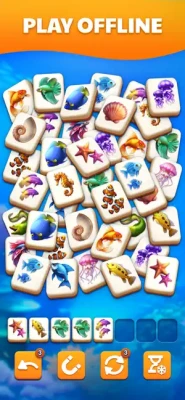
- Take advantage of offline play when you want to play without an internet connection.
Advanced Tips
Control the number of active groups
Try to work on one or two tile groups rather than creating five different pairs.
Clear before collecting
A move that clears three tiles is generally more valuable than a move that simply adds one tile.
Prioritize access
Sometimes the best move isn't the one that creates the fastest match. It is the one that exposes the most useful tiles.
Think in sequences
Look for:
A → A → A → reveal → B → B → B
rather than:
A → random → random → random
Keep emergency tray space
Don't intentionally fill the final tray slots unless you already know how the next group will clear.
Common Mistakes
Taking Every Matching Pair
A pair isn't useful if its third tile is inaccessible.
Ignoring the Tray
A good board position can become a losing position if the tray becomes overcrowded.
Playing Too Quickly
The relaxed presentation can make the game feel casual, but the limited tray means careless moves can still end a level.
Clearing Only the Easiest Tiles
Sometimes a slightly harder move is better because it reveals several important tiles underneath.
Spending Boosters Too Early
A booster can rescue a difficult situation. Don't waste it on a position you can solve normally.
Forgetting to Recalculate
Every time three tiles disappear, the board changes. Look again before following your previous plan.
Tidal Tile Features
The current App Store listing highlights:
- 3D match-3 tile gameplay
- Ocean and fish-themed designs
- More than 12,000 levels
- Limited tray mechanics
- Shuffle, undo, and removal boosters
- Unlockable tile sets
- Underwater sounds
- Offline play
- Progressive difficulty
- Regular level and visual updates
The App Store currently lists the game at 4.8/5 from 279 ratings. It is free, contains advertising, and is rated 4+.
Is Tidal Tile Really Relaxing?
The core gameplay is designed to be relaxing, with an underwater theme, fish designs, and calming sounds. However, players should know that the experience is not necessarily pressure-free at every stage.
One recent App Store reviewer specifically complained about a timer appearing around Level 26, while another reviewer criticized the advertising experience. Because of this feedback, it is better to describe Tidal Tile as a relaxing-looking puzzle game with increasingly demanding levels, rather than promising a completely pressure-free experience.
Tidal Tile Difficulty
The basic rules are extremely easy to understand.
The difficulty comes from the limited tray.
Early levels allow you to experiment and learn the matching system. Later layouts require you to:
- Remember where matching tiles are located
- Predict what will be uncovered
- Avoid unnecessary pairs
- Manage tray capacity
- Choose between several possible matching routes
- Decide when to use boosters
The store listing says the game contains more than 12,000 challenging levels and that the layouts become more intricate as you progress.
Tidal Tile Pros and Cons
Pros
- Easy-to-learn match-3 mechanics
- Attractive underwater theme
- Fish-themed tiles
- Large number of levels
- Useful boosters
- Offline play
- Increasing strategic depth
- Relaxing presentation
- Suitable for short sessions
Cons
- Limited tray can make later puzzles frustrating
- Advertising is part of the experience
- Some player feedback criticizes the presence of timers
- Some players report frustration with ads and level difficulty
Frequently Asked Questions
What is Tidal Tile?
Tidal Tile is an ocean-themed 3D match-3 puzzle game where you tap tiles into a limited tray and match three identical tiles to clear them.
How do you win in Tidal Tile?
Clear all the tiles from the board without filling the tray with too many unmatched pieces.
What happens if the tray fills up?
If the tray becomes full before you can create the necessary matches, the level can fail.
How many levels does Tidal Tile have?
The current store description advertises more than 12,000 challenging levels.
Does Tidal Tile have boosters?
Yes. The game includes boosters such as shuffle, undo, and tile-removal tools to help with difficult positions.
Can you play Tidal Tile offline?
Yes. Offline play is listed as one of the game's features.
Is Tidal Tile free?
Yes. The App Store lists Tidal Tile as free and indicates that the game contains advertising.
Is Tidal Tile difficult?
The basic matching system is easy to learn, but later levels require careful tray management and planning because of the limited number of available tray spaces.
What is the best Tidal Tile strategy?
Don't simply collect matching tiles. Prioritize guaranteed triples, keep your tray open, avoid creating unnecessary pairs, and choose moves that reveal useful tiles underneath the board.
Final Verdict
Tidal Tile takes a familiar match-3 formula and gives it a more strategic twist through its limited tray.
The most important lesson is simple: don't match tiles just because you can.
Think about what happens after the match.
Will it free tray space?
Will it reveal useful tiles?
Will it create another immediate triple?
Or will it leave you with several unfinished groups?
The strongest players treat every tile as part of a sequence rather than an isolated move. Keep the tray under control, prioritize safe triples, identify bottlenecks, and use boosters when they solve a specific problem.
With its underwater presentation, large level count, fish-themed tiles, and increasingly complex layouts, Tidal Tile is a good fit for players who enjoy relaxed-looking puzzle games that still reward careful planning.
Rate the Game
User Reviews









Popular Games




















 Android
 iOS
iOS Windows
 Xbox
Xbox