


Latest Version
January 11, 2026
HAPIGA VIET NAM COMPANY LIMITED
Word
iOS
0
Report a Problem
More About :game
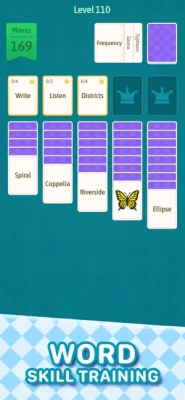
Solitaire Word Quest offers a clever alternative to traditional solitaire and conventional word games. Its main idea is simple: sort words according to their meaning and connection to a category.
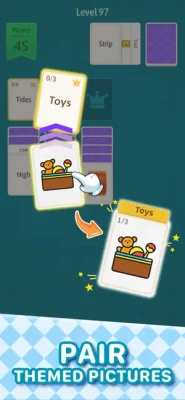
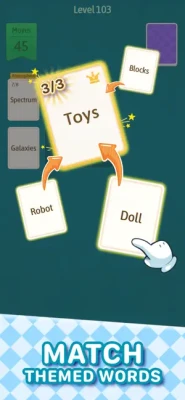
You begin by analyzing the cards on the board and identifying a category. Once the category is placed, you need to find the word cards that logically belong to it. Completing these groups gradually clears the board and takes you closer to finishing the level.
The game is designed around thoughtful decision-making rather than fast reactions. There is no timer, so you can examine the cards, consider possible relationships, and make your move at your own pace.
What Makes Solitaire Word Quest Different?
Many word games focus on spelling words, finding hidden letters, or creating words from a collection of characters.
Solitaire Word Quest takes a different approach.
Instead of asking:
"Can you spell this word?"
it asks:
"What other words belong with this idea?"
That makes the game more focused on meaning, vocabulary, categorization, association, and logical thinking.
It also replaces traditional solitaire cards with word-based cards, creating a hybrid experience that can appeal to both card-game fans and word-puzzle players.
Game Story and Concept
Solitaire Word Quest does not rely on a traditional adventure story with characters, battles, or lengthy dialogue.
Its "quest" is intellectual.
Each level presents a collection of words that need to be organized into meaningful groups. You gradually uncover relationships between words, recognize categories, and clear the board.
Every completed group represents another step toward solving the puzzle.
The result is a calm journey through:
Words → Categories → Connections → Logic → Completion
Core Gameplay
The central gameplay loop is:
Analyze the board → Choose a category → Find related words → Complete the set → Clear the cards → Advance
Each level gives you a collection of cards.
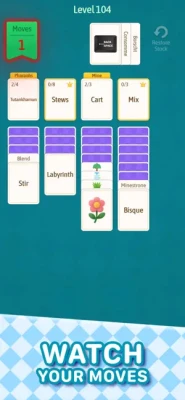
Some cards represent categories, while others contain words that need to be assigned to the appropriate category.
Your job is to determine which words logically belong together.
The game specifically describes levels as small logic challenges that test both vocabulary and strategic thinking.
How to Play Solitaire Word Quest
1. Study the Board
Take a moment to examine the available cards.
Look for obvious relationships before making your first move.
2. Identify a Category
Find a category card that gives you a useful starting point.
3. Search for Related Words
Look through the available word cards and determine which ones belong to that category.
4. Build the Set
Place the appropriate words with the selected category.
5. Clear the Completed Group
Correctly sorting the words moves you closer to clearing the level.
6. Continue Analyzing
Once a group is completed, reassess the remaining cards.
7. Finish the Puzzle
Clear the required cards without running out of available moves.
Word Association Gameplay
Word association is at the heart of Solitaire Word Quest.
Some connections are obvious.
Others are intentionally less direct.
The game encourages players to think beyond simple definitions and consider how words relate to one another through:
- Meaning
- Categories
- Concepts
- Common associations
- Context
- Logical relationships
As you progress, recognizing these connections becomes an important part of solving more difficult levels.
Vocabulary Challenge
Solitaire Word Quest naturally tests your vocabulary.
You may encounter familiar words that are easy to categorize, followed by words that require more thought.
This creates an interesting balance.
You don't necessarily need to know every word immediately. Instead, you can use the other cards and categories to infer possible relationships.
That makes the game suitable for players who enjoy expanding their vocabulary while solving puzzles.
Logic and Strategic Thinking
Vocabulary alone isn't enough.
You also need to make smart decisions about which cards to place first.
A word might appear to fit several possible categories, so rushing into a decision can make the remaining puzzle more difficult.
Good players therefore consider:
- Which category is most certain?
- Which words have the strongest connection?
- Which cards could belong elsewhere?
- What will remain after completing this group?
- Could this move limit future possibilities?
This strategic layer is what separates Solitaire Word Quest from a simple word-matching game.
No Timer, No Rush
One of the game's most appealing features is its relaxed pace.
There is no time limit, allowing players to solve each puzzle without the pressure of a countdown.
That makes it suitable for:
- Short breaks
- Evening relaxation
- Quiet puzzle sessions
- Daily brain training
- Casual word-game sessions
You can think through a difficult association rather than being forced to make a quick guess.
Level Progression
Solitaire Word Quest features hundreds of handcrafted levels with increasing complexity.
The progression starts with relatively accessible word relationships and gradually introduces puzzles that require more careful analysis.
A typical progression can be thought of as:
Early Levels
Learn the category-and-word system.
Intermediate Levels
Handle less obvious word relationships.
Advanced Levels
Use deduction and strategic card placement.
Later Challenges
Combine vocabulary knowledge with careful planning.
Beginner's Guide
If you're new to Solitaire Word Quest, don't worry about solving everything immediately.
Start With Obvious Categories
Look for the easiest group first.
Find Strong Associations
Choose words that clearly belong together.
Don't Guess Too Quickly
If a word could fit several categories, leave it until you have more information.
Use the Board as a Clue
Remaining cards can help reveal the correct category.
Think About the Whole Puzzle
A good move should help you solve the current group without creating problems later.
Advanced Strategy Guide
Experienced players can improve their solving speed and accuracy by using deduction.
Look for the Strongest Relationship
If three words clearly belong together, they can reveal the category you need.
Protect Ambiguous Words
Don't commit a word to a category if another possibility seems equally strong.
Work Backward
Sometimes identifying a group of words can help you determine the category rather than the other way around.
Reduce Uncertainty
Prioritize moves that make the remaining board easier to understand.
Think Beyond Definitions
Consider cultural, functional, contextual, and conceptual relationships.
Solitaire Word Quest Tips and Tricks
Tip 1: Don't Rush
There is no timer, so use the relaxed pace to your advantage.
Tip 2: Start With Certainty
Complete the groups with the clearest relationships first.
Tip 3: Watch for Hidden Connections
Some associations are less obvious than others.
Tip 4: Keep Ambiguous Cards Available
A difficult word may become easier to categorize after another group is removed.
Tip 5: Think in Groups
Don't analyze each word in isolation. Look for clusters of related words.
Tip 6: Learn From Mistakes
If you make an incorrect association, use it to understand the puzzle's intended logic.
Tip 7: Expand Your Vocabulary
Learning unfamiliar words can make later levels easier.
Difficulty and Challenge
The game describes itself as simple to learn but rewarding to master, with levels becoming increasingly complex.
Its difficulty doesn't come from complicated controls.
Instead, it comes from the relationships between the words.
A level can become challenging when:
- Several words appear to fit the same category.
- A category is not immediately obvious.
- Some words have multiple meanings.
- The correct association is indirect.
- You need to plan several moves ahead.
This creates a form of mental challenge without requiring fast reflexes.
Relaxing Puzzle Experience
Solitaire Word Quest deliberately avoids the stressful atmosphere found in many mobile games.
There is no countdown forcing you to rush.
There is no action sequence demanding rapid reactions.
Instead, the game encourages quiet concentration and gradual problem-solving. Apple describes it as a balance between challenge and relaxation.
That makes it particularly suitable for players who prefer thoughtful brain games.
Brain Training and Mental Exercise
Solitaire Word Quest can provide several forms of mental exercise through its gameplay:
- Vocabulary recognition
- Categorization
- Logical reasoning
- Pattern recognition
- Deductive thinking
- Memory
- Strategic planning
- Word association
It should be viewed primarily as entertainment, but its mechanics naturally encourage active thinking.
Controls and Interface
The controls are designed around simple card interaction.
Players analyze the board and move or place cards according to the puzzle's rules.
There are no complicated button combinations or action controls.
The challenge comes almost entirely from deciding where each card belongs.
This makes the game accessible to players who enjoy puzzle-solving without demanding strong gaming reflexes.
Game Modes
The core experience centers on its handcrafted puzzle levels.
Word Category Levels
Identify categories and place matching words.
Logic Challenges
Solve less obvious connections between cards.
Progressive Levels
Move through puzzles that increase in complexity.
Relaxed Play
Solve puzzles without a countdown or time pressure.
Handcrafted Levels
One of the game's advertised features is its collection of hundreds of handcrafted levels.
This matters because manually designed puzzles can focus on specific relationships and intended solutions rather than relying entirely on random combinations.
The level structure is designed to gradually introduce more demanding associations.
Shop and In-App Purchases
Solitaire Word Quest is free to download and includes in-app purchases. The U.S. App Store also identifies advertising.
Current U.S. App Store purchases include:
- Gold Pack 2 — $1.99
- Gold Pack 3 — $8.99
- Remove Ads — $9.99
- Remove Ads Bundle — $19.99
- Gold Pack 4 — $29.99
- Gold Pack 5 — $59.99
- Gold Pack 6 — $99.99
Prices and available offers can change.
Player Ratings and Reviews
The U.S. App Store currently shows 4.8 out of 5 from 243 ratings.
Player feedback is generally positive, with reviewers describing the game as fun and challenging. Some users have asked for an ad-free option, while others have criticized the repetition of certain categories.
One reviewer also reported encountering a progression issue at level 61, where they could not complete the level because they believed there were not enough cards.
Including these points gives prospective players a more balanced view of the current experience.
Updates and Version History
The App Store shows a series of updates during late 2025.
Version 0.1.0 — December 31, 2025
- Added more levels
Version 0.0.9 — December 19, 2025
- Polished the game feel
- Added Korean language support
Version 0.0.8 — December 16, 2025
- Updated levels
- General polish
Version 0.0.7 — December 5, 2025
- Updates
- Bug fixes
Version 0.0.5 — November 25, 2025
- Added a new feature
Version 0.0.4 — November 23, 2025
- Added shop
- Additional polish
The original version 0.0.1 was released on November 12, 2025.
Technical Details
| Detail | Information |
|---|---|
| Game | Solitaire Word Quest |
| Category | Word |
| Genre | Word Puzzle / Card Puzzle / Brain Game |
| Developer | HAPIGA VIET NAM COMPANY LIMITED |
| Platforms | iPhone, iPad, iPod touch |
| Age Rating | 4+ |
| App Size | 226.1 MB |
| Minimum iOS | iOS 13.0 or later |
| Minimum iPadOS | iPadOS 13.0 or later |
| Languages | English, French, German, Japanese, Korean, Simplified Chinese, Spanish, Traditional Chinese |
| Price | Free |
| In-App Purchases | Yes |
| Advertising | Yes |
Apple lists compatibility with iPhone, iPad and iPod touch, as well as Macs with Apple M1 chips or later under the stated macOS requirements. Apple Vision compatibility is also listed.
Pros and Cons
Pros
- Creative combination of solitaire and word puzzles
- Hundreds of handcrafted levels
- No time limit
- Relaxing gameplay
- Tests vocabulary and logic
- Simple controls
- Increasing puzzle complexity
- Suitable for short sessions
- Good choice for word-game fans
- Strong current App Store rating
Cons
- Advertising is present
- Some players find categories repetitive
- Some users have reported progression problems
- Players looking for traditional solitaire may need time to adjust to the word-based format
- In-app purchases are available
Expert Rating
Overall Rating: 8.7/10
| Category | Rating |
|---|---|
| Gameplay | 8.8/10 |
| Puzzle Design | 8.7/10 |
| Word Challenge | 9.0/10 |
| Controls | 9.1/10 |
| Relaxation | 9.3/10 |
| Progression | 8.4/10 |
| Replay Value | 8.3/10 |
| Accessibility | 9.0/10 |
| Overall | 8.7/10 |
Solitaire Word Quest vs Traditional Solitaire
Traditional solitaire primarily tests card sequencing and probability.
Solitaire Word Quest replaces those conventional cards with words and categories, shifting the challenge toward language and association.
| Feature | Traditional Solitaire | Solitaire Word Quest |
|---|---|---|
| Main Focus | Card arrangement | Word relationships |
| Cards | Playing cards | Word/category cards |
| Vocabulary | Not required | Important |
| Logic | Card strategy | Word categorization |
| Timer | Varies | No time limit |
| Theme | Classic cards | Language and associations |
| Difficulty | Card strategy | Vocabulary + logic |
Who Should Play Solitaire Word Quest?
This game is a strong fit for players who enjoy:
- Word puzzles
- Solitaire games
- Brain games
- Vocabulary games
- Logic puzzles
- Word association games
- Card puzzles
- Relaxing mobile games
- Mental challenges
- Casual iPhone games
- iPad puzzle games
- No-timer puzzle games
It is especially appealing if you like games that let you think at your own pace.
What Makes the Game Stand Out?
The strongest feature is its unusual combination of two familiar genres.
Solitaire provides the card-based structure.
Word puzzles provide the intellectual challenge.
The result feels different from both traditional solitaire and standard word games.
Instead of racing against a clock, you can stop, inspect the board, consider the possible relationships and gradually build the correct solution.
Final Verdict
Solitaire Word Quest is a thoughtful word puzzle that successfully combines card-game structure with vocabulary-based logic.
Its strongest advantage is its calm approach. There is no timer, so players can concentrate on finding meaningful relationships instead of rushing through a level.
The hundreds of handcrafted levels, increasing complexity and simple controls make it a good option for people who enjoy brain games but don't necessarily want stressful gameplay.
The current 4.8/5 App Store rating from 243 ratings also indicates strong early player reception, although some users have noted repetitive categories and occasional progression issues.
If you enjoy word association games, solitaire puzzles, vocabulary challenges and relaxing brain games, Solitaire Word Quest is worth adding to your mobile puzzle collection.
Frequently Asked Questions
What is Solitaire Word Quest?
Solitaire Word Quest is a word puzzle game that combines solitaire-style card mechanics with word categorization and association challenges.
How do you play Solitaire Word Quest?
Analyze the board, choose a category card, then identify and place the word cards that belong to that category. Correctly sorting the words helps clear the level.
Is Solitaire Word Quest free?
Yes. The game is free to download and includes advertising and optional in-app purchases.
Does Solitaire Word Quest have a timer?
No. The game is designed without time limits, allowing players to solve puzzles at their own pace.
Is Solitaire Word Quest a word game?
Yes. Apple categorizes it under Word, and its gameplay centers on vocabulary, categories and word associations.
Does Solitaire Word Quest use traditional playing cards?
No. Traditional playing cards are replaced by word and category cards.
Does Solitaire Word Quest have many levels?
Yes. The developer describes the game as having hundreds of handcrafted levels with increasing complexity, and later updates added more levels.
Can Solitaire Word Quest help improve vocabulary?
The game is designed around word relationships and explicitly promotes vocabulary expansion and logical thinking as part of its experience.
Is Solitaire Word Quest available on iPhone?
Yes. Apple lists it for iPhone, iPad and iPod touch, requiring iOS 13.0 or later.
What age rating does Solitaire Word Quest have?
The U.S. App Store gives Solitaire Word Quest a 4+ age rating.
Does Solitaire Word Quest contain ads?
Yes. The App Store identifies advertising, and a Remove Ads purchase is available.
Rate the Game
User Reviews







Popular Games




















 Android
 iOS
iOS Windows
 Xbox
Xbox