





Latest Version
September 09, 2026
Tripledot Studios
Puzzle
iOS
0
Report a Problem
More About :game
Shikacat is a casual Shikaku puzzle game developed by Tripledot Studios.
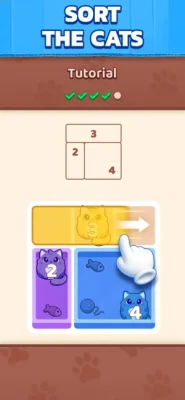
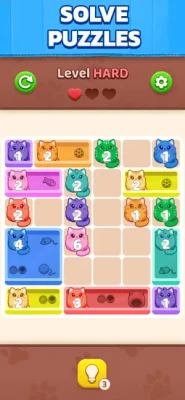
The game's main challenge is to divide each board into the correct rectangular areas. Every numbered cat indicates how many grid tiles its area needs to contain. The player must position the blocks correctly while filling the entire board without leaving gaps or creating overlaps.
The concept gives Shikacat a distinctive identity compared with traditional match-three, Sudoku or word puzzles. It is primarily about spatial reasoning, deduction and careful planning.
The current App Store listing categorizes Shikacat as a Puzzle game and rates it 4+. It supports iPhone and iPad and currently lists a size of 268.7 MB.
Game Theme & Atmosphere
Shikacat takes an otherwise mathematical grid puzzle and gives it a playful cat-themed presentation.
Instead of working with plain numbered squares, players interact with colorful cat blocks. This makes the logical challenge feel more approachable and gives the game a cozy visual personality.
The overall atmosphere is:
- Cute
- Relaxing
- Colorful
- Minimal
- Brain-focused
- Casual
- Satisfying
The developer specifically describes the experience as a mixture of relaxing play and increasingly tricky boards.
How Shikacat Works
The central idea is simple:
Every numbered cat represents the number of tiles that its area must occupy.
Your task is to determine the correct shape and position for each area so that the entire grid is completed.
For example, if a cat has the number 6, its area must cover six grid tiles. The challenge is deciding how those six tiles should be arranged while making sure the remaining cats can also fit into the board.
This creates a puzzle where every decision can affect several other areas.
Shikaku Puzzle Gameplay
Shikaku is a logic puzzle based on dividing a grid into rectangular regions.
Shikacat presents this concept in a more approachable format by using cat blocks and colorful visuals.
The general solving process involves:
- Examining the numbered cats.
- Identifying areas that have limited placement possibilities.
- Determining possible rectangular shapes.
- Dragging blocks into the grid.
- Checking how each placement affects surrounding spaces.
- Eliminating impossible arrangements.
- Filling the entire board.
- Completing the puzzle without gaps or overlaps.
The result is a puzzle that rewards deduction rather than speed.
Numbered Cat Blocks
The numbered cat blocks are the most important clues on the board.
Each number tells you how many grid spaces must belong to that particular area.
This means players should not simply place blocks wherever they visually fit. The number must always be considered when determining the final shape.
Understanding these numbers is the key to solving more difficult Shikacat boards efficiently.
Grid-Based Logic
The grid creates the game's main strategic challenge.
Every empty space must eventually belong to a valid region, meaning one incorrect placement can make another part of the puzzle impossible.
This encourages players to think several moves ahead.
A placement that looks correct initially may need to be reconsidered if it leaves an awkward group of empty spaces elsewhere on the board.
No Gaps, No Overlaps
A completed Shikacat board must satisfy two fundamental conditions:
No gaps.
Every grid tile needs to be included in a valid area.
No overlaps.
Two different cat regions cannot occupy the same tile.
These simple rules create surprisingly deep puzzles because each region must fit perfectly with all of the others.
Level Progression
Shikacat is designed around progressive puzzle difficulty.
Early boards introduce the fundamental concept and allow players to understand how numbered areas work.
As the layouts become more complicated, players need to:
- Consider multiple possible shapes
- Compare different placements
- Eliminate impossible arrangements
- Think further ahead
- Reconsider earlier assumptions
- Use logical deduction rather than trial and error
The developer describes the game as containing many handcrafted levels that become increasingly challenging.
Handcrafted Puzzle Levels
The game advertises handcrafted levels, giving the puzzle experience a more deliberately designed structure rather than relying solely on randomly generated boards.
This is important for a logic game because carefully constructed puzzles can create specific reasoning challenges and satisfying solutions.
Each board becomes its own small logical problem to solve.
Controls & Interface Guide
Shikacat uses simple touch controls.
Basic Controls
- Select a cat block.
- Drag the block across the grid.
- Position it over the required number of tiles.
- Check how the placement affects surrounding areas.
- Adjust the block if the arrangement creates an impossible remaining space.
- Complete the board without gaps or overlaps.
The drag-and-drop design is intended to make the game easy to learn even for players unfamiliar with Shikaku puzzles.
Beginner's Guide
1. Start With the Most Restricted Numbers
Look for cats whose possible areas appear limited.
These often provide the strongest clues.
2. Count the Tiles Carefully
Always remember that the number on a cat represents the size of its complete area.
3. Think About Rectangles
Don't only look at the number of spaces. Think about which rectangular arrangements could contain that exact number of tiles.
4. Watch the Borders
Edges and corners can dramatically reduce the number of possible placements.
5. Avoid Filling Spaces Randomly
Every placement affects the remaining board.
6. Look for Forced Moves
If only one possible position works without creating a contradiction, that is usually an important move.
7. Use Boosters When Necessary
If you reach a difficult position, helpful boosters can provide support.
Advanced Shikacat Strategy
Once the basic rules are familiar, solving becomes much more about deduction.
Study Corners First
Corner spaces have fewer neighboring possibilities, making them useful when identifying forced regions.
Analyze Multiple Possibilities
If a numbered cat can occupy several different rectangles, don't immediately commit to one.
Instead, consider what each possibility would leave behind.
Protect Small Spaces
Be careful not to create isolated spaces that cannot accommodate another valid region.
Use Elimination
Sometimes it is easier to prove that a placement cannot work than to prove that another placement is correct.
Think About the Whole Board
A locally perfect placement can still cause a global contradiction.
Always consider the remaining grid.
Booster System
Shikacat includes helpful boosters designed to support players when a puzzle becomes difficult.
Boosters can be particularly useful when:
- You have reached an uncertain position.
- Several placements appear possible.
- You have made a mistake.
- A late-stage puzzle becomes difficult.
- You want assistance without abandoning the level.
For experienced players, boosters are best treated as occasional assistance rather than something to rely on for every puzzle.
Difficulty
Shikacat has an approachable starting point but is designed to become more demanding as the boards grow more complicated.
Easy
Early puzzles teach the basic relationship between numbers and areas.
Medium
More possible placements appear, requiring players to compare alternatives.
Hard
Later boards demand deeper deduction and careful management of the remaining empty spaces.
Expert Challenge
The hardest puzzles can require several logical deductions before a single placement becomes obvious.
The appeal comes from this gradual increase in complexity rather than from fast reflexes.
Brain Training & Logic
Shikacat is naturally suited to players who enjoy puzzles involving:
- Spatial reasoning
- Logical deduction
- Pattern recognition
- Area calculation
- Planning
- Problem solving
- Concentration
- Sequential reasoning
The game describes itself as a way to keep the brain active while remaining light and relaxing.
It is better understood as a recreational logic puzzle than as a formal educational tool.
Relaxing Puzzle Experience
Although the puzzles can become difficult, Shikacat is deliberately presented as a calm alternative to action-oriented mobile games.
There are no complicated combat systems or fast reflex requirements.
Instead, the core loop is:
Look → Think → Place → Adjust → Solve
That makes it suitable for short sessions when you want something mentally engaging without requiring constant speed.
Cat-Themed Presentation
The cat theme is more than a simple visual decoration.
The numbered cat blocks make an abstract mathematical concept easier to recognize and give the game a friendly identity.
For players who enjoy cozy puzzle games, the combination of cute characters and structured logic provides a softer alternative to traditional number-grid puzzle apps.
Game Progression System
Shikacat's progression is primarily puzzle-based.
Rather than building a large character roster or managing a virtual economy, the main sense of advancement comes from successfully solving increasingly demanding boards.
The progression loop is:
Solve a puzzle → Complete the board → Advance → Face a more challenging layout → Improve your solving skills
This keeps the focus firmly on logic.
Player Experience
The current U.S. App Store page says the game has not yet received enough ratings or reviews to display an overall review summary.
That is worth mentioning rather than inventing a player score.
The game's published presentation emphasizes three main qualities: cute cat visuals, relaxing gameplay and progressively more difficult logic challenges.
Because Shikacat is a relatively new title, its long-term player reception may change as more people complete its puzzle collection.
Pros & Cons
Pros
- Original cat-themed Shikaku concept
- Simple rules
- Genuine logical challenge
- Easy drag-and-drop controls
- Handcrafted levels
- Progressively harder boards
- Helpful boosters
- Bright visual presentation
- Relaxing gameplay
- Suitable for short sessions
- No reflex-heavy gameplay required
Cons
- Players unfamiliar with Shikaku may need time to understand the concept
- The gameplay is intentionally focused on one core puzzle mechanic
- Players seeking action or fast-paced gameplay may find it too slow
- The current App Store listing does not yet have enough ratings for an overall review summary
- Contains advertising according to the current App Store listing.
Game Modes & Activities
Shikacat is primarily centered around its Shikaku puzzle boards rather than multiple unrelated game modes.
Shikaku Puzzle Mode
The main experience involves placing numbered cat areas across the grid.
Progressive Challenges
Boards become more complicated as players advance.
Booster-Assisted Solving
Players can use helpful boosters when a puzzle becomes difficult.
This focused structure helps keep the game easy to understand.
Accessibility & Convenience
The current App Store listing does not indicate specific accessibility features provided by the developer.
However, the core interaction is straightforward drag-and-drop gameplay, which keeps the basic controls relatively simple.
The game supports iPhone and iPad and requires iOS 15 or later on iPhone and iPadOS 15 or later on iPad.
Technical Details
Game: Shikacat: Logic Puzzle Game
Subtitle: Shikaku Puzzles & Cat Blocks
Developer: Tripledot Studios
Genre: Puzzle
Core Gameplay: Shikaku / Logic Grid Puzzle
Platforms: iPhone, iPad
Price: Free
Age Rating: 4+
App Size: 268.7 MB
iOS Requirement: iOS 15.0 or later
iPadOS Requirement: iPadOS 15.0 or later
Mac: Requires macOS 12.0 or later and Apple M1 chip or later
Apple Vision: Requires visionOS 1.0 or later
Languages: English and Latin
Advertising: Yes
Shikacat on iPhone and iPad
The game is designed for both iPhone and iPad.
On iPhone, the drag-and-drop interaction makes it easy to manipulate the numbered cat blocks with touch controls.
On iPad, the larger screen can provide additional space for examining more complicated grid arrangements.
The App Store currently lists iPhone and iPad compatibility.
Shikacat vs Sudoku
Shikacat and Sudoku are both logic-based puzzle games, but they test different skills.
| Feature | Shikacat | Sudoku |
|---|---|---|
| Grid-based | Yes | Yes |
| Number clues | Yes | Yes |
| Area placement | Yes | No |
| Rectangular regions | Yes | No |
| Spatial reasoning | Strong | Moderate |
| Number placement | Indirect | Central |
| Cat theme | Yes | Usually no |
| Drag-and-drop blocks | Yes | Usually no |
| Boosters | Yes | Varies |
Shikacat is therefore closer to a spatial-logic puzzle than a traditional number-placement game.
Shikacat vs Traditional Shikaku
Traditional Shikaku puzzles are usually presented with simple grids and numbers.
Shikacat adds:
- Cat characters
- Colorful blocks
- Touch controls
- Handcrafted progression
- Boosters
- More approachable presentation
- A casual mobile-game structure
The underlying logical concept remains recognizable, but the presentation is designed for a broader mobile audience.
Who Should Play Shikacat?
Shikacat is a good choice for:
- Logic puzzle fans
- Shikaku enthusiasts
- Sudoku players looking for something different
- Brain-training game fans
- Cat lovers
- Casual puzzle players
- Players who enjoy spatial reasoning
- People who like relaxing mobile games
- Players who prefer thoughtful gameplay over fast action
- Anyone looking for short brain-teasing sessions
It may not be ideal for players who prefer action, competitive multiplayer or fast reflex-based challenges.
Expert Rating
Overall Rating: 8.6/10
Puzzle Design: 9.0/10
Learning Curve: 8.8/10
Visual Appeal: 8.6/10
Controls: 9.0/10
Relaxation Factor: 9.0/10
Long-Term Challenge: 8.5/10
Why 8.6/10?
Shikacat takes a relatively specialized puzzle format and makes it approachable through cute visuals and simple touch controls.
Its strongest feature is the relationship between simplicity and depth: the rules can be explained quickly, but solving more complicated boards requires careful reasoning.
The biggest limitation is also its focus. Players who do not enjoy spatial logic puzzles may find the core gameplay repetitive.
Verdict
Shikacat: Logic Puzzle Game is a charming introduction to Shikaku-style puzzle solving.
Its numbered cat blocks, rectangular area challenges and no-gap/no-overlap rule create a simple but surprisingly thoughtful gameplay system.
The game is particularly appealing if you enjoy logic puzzles, spatial reasoning, brain games, cute cats and relaxing mobile challenges.
With handcrafted levels, progressively trickier layouts, drag-and-drop controls and helpful boosters, Shikacat offers a focused puzzle experience that is easy to learn but capable of testing your reasoning skills.
App Store: Shikacat: Logic Puzzle Game on the App Store
Frequently Asked Questions
What is Shikacat?
Shikacat is a logic puzzle game based on Shikaku, where players arrange numbered cat blocks into correctly sized areas on a grid.
What is Shikaku?
Shikaku is a grid-based logic puzzle where numbered clues represent areas that must be divided into rectangular regions of the correct size.
How do you play Shikacat?
Look at the number on each cat, drag the corresponding block into the grid, and arrange all regions so the board is completely filled without gaps or overlaps.
Is Shikacat difficult?
The basic rules are easy to learn, but the layouts become more challenging as you progress, requiring more planning and logical deduction.
Does Shikacat have boosters?
Yes. The game includes helpful boosters intended to support players when a level becomes difficult.
Does Shikacat have handcrafted levels?
Yes. The App Store description specifically advertises lots of handcrafted levels.
Is Shikacat good for brain training?
It is well suited to recreational logic and spatial-reasoning practice because solving the boards requires planning, deduction and careful placement.
Is Shikacat free?
The App Store lists Shikacat as free and indicates that the game contains advertising.
Is Shikacat available for iPhone?
Yes. The current listing supports iPhone and requires iOS 15.0 or later.
Is Shikacat available for iPad?
Yes. It supports iPad and requires iPadOS 15.0 or later.
Does Shikacat have a player rating?
The current U.S. App Store listing says the game has not yet received enough ratings or reviews to display an overview.
Who developed Shikacat?
Shikacat was developed by Tripledot Studios.
Final Summary
Shikacat: Logic Puzzle Game gives the classic Shikaku concept a friendly mobile makeover. Instead of working with a plain mathematical grid, players arrange colorful cat blocks while using numbered clues to determine the correct area sizes.
The rules are straightforward: fill the entire board, leave no gaps, create no overlaps and make every numbered cat occupy the correct number of tiles. As the puzzles become more complicated, success depends increasingly on planning and logical deduction.
With handcrafted levels, cute visuals, smooth drag-and-drop controls and helpful boosters, Shikacat is a good option for players who want a relaxing but genuinely challenging logic puzzle game.
Rate the Game
User Reviews














Popular Games




















 Android
 iOS
iOS Windows
 Xbox
Xbox