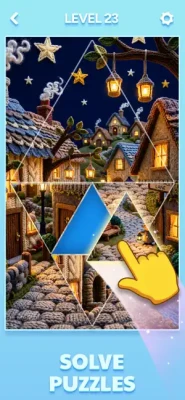



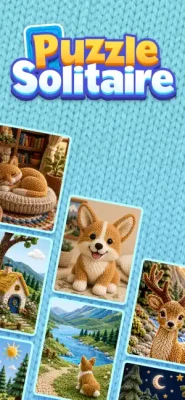
Puzzle Solitaire is a creative twist on traditional solitaire that combines familiar card-game rules with handcrafted logic puzzles. Each level challenges you to think carefully about card placement and planning while gradually revealing colorful artwork.
The game features hundreds of puzzles, daily challenges, boosters, offline gameplay, smooth animations, and a relaxing soundtrack. It is designed to be easy to learn while introducing more demanding strategic decisions as the levels progress.
Puzzle Solitaire is a casual solitaire and logic puzzle game from Tripledot Studios.
Rather than simply recreating a traditional Klondike or Spider Solitaire experience, the game combines Solitaire mechanics with puzzle-solving. The App Store describes each level as a handcrafted challenge designed to make players think differently, creating an "aha" moment when the correct solution becomes clear.
The game is aimed at players who enjoy:
Solitaire card games
Logic puzzles
Brain teasers
Casual puzzle games
Jigsaw-style artwork
Strategic card placement
Daily challenges
Relaxing games
How to Play Puzzle Solitaire
The key to Puzzle Solitaire is understanding that every card movement matters.
Instead of playing purely for speed, you should examine the available cards and think about how each move affects the rest of the puzzle.
A good general approach is:
Study the board before making a move.
Identify cards that are blocking important areas.
Look for the safest available sequence.
Think about what your move will reveal.
Avoid creating unnecessary dead ends.
Use boosters only when they provide meaningful value.
Complete the puzzle and reveal the artwork.
The game's core appeal comes from combining familiar Solitaire ideas with the extra planning required by handcrafted logic puzzles.
Full Strategy Guide
1. Don't Make the First Available Move
One of the easiest mistakes is immediately selecting an obvious card.
Puzzle Solitaire is designed around planning, so the first legal move isn't necessarily the best one.
Before moving anything, quickly scan the available options.
Ask yourself:
Which move gives me the most useful choices afterward?
That question is more important than simply asking which card you can move right now.
2. Look for the Move That Opens the Board
Some cards are more important because they are blocking other cards.
If you can choose between:
removing an exposed card, or
removing a card that unlocks several additional possibilities,
the second option is often stronger.
Opening the board gives you more information and more potential moves.
3. Think Two or Three Moves Ahead
You don't need to calculate the entire puzzle.
Instead, try to predict the immediate consequences of important moves.
For every significant move, consider:
Move → What does it reveal? → What can I do next?
This simple process helps prevent situations where you make a legal move and immediately run out of useful options.
4. Preserve Flexible Cards
Some cards may have several possible destinations or can participate in multiple future sequences.
Don't automatically use these cards just because they're currently available.
A flexible card can become much more valuable later when the board becomes restricted.
Keep your future options open whenever possible.
5. Avoid Blocking Useful Cards
A move can look productive while actually making the puzzle harder.
For example, you might create a neat-looking sequence but place a card in a position that prevents another important card from being accessed.
Always consider the board after the move rather than judging the move itself.
6. Prioritize Information
In puzzle games, information has value.
If a move reveals previously inaccessible cards, it can be better than a move that simply removes one card.
Try to uncover:
New cards
New sequences
Blocked positions
Possible combinations
Future solution paths
The more of the board you understand, the easier it becomes to solve the level.
7. Don't Waste Boosters
Puzzle Solitaire includes boosters, including Hint and Solve tools.
Use them strategically.
Hint
A hint is useful when you are unsure about your next move but still want to solve the puzzle yourself.
Use it when:
You have several possible moves.
You've checked the board but cannot identify the best option.
You're trying to understand a difficult level.
Solve
A full solve-type tool should be treated as an emergency option.
Save it for situations where you are genuinely stuck rather than using it on an easy puzzle.
8. Don't Rush Daily Challenges
Daily challenges provide another reason to return to the game.
Instead of approaching them as speed tests, focus on solving them efficiently.
Look for the safest sequence first, especially if the challenge has limited resources or unusual layouts.
9. Learn From Failed Attempts
If you reach a dead end, don't simply restart and repeat the exact same moves.
Ask:
Where did my options disappear?
Which move caused the problem?
Did I use a flexible card too early?
Did I ignore a card that could have opened the board?
Did I create a blockage?
Understanding why a sequence failed is more valuable than simply trying random alternatives.
10. Look for the "Aha!" Move
The game is deliberately designed around moments where the solution suddenly becomes clear.
When the board looks complicated, don't assume you need a complicated solution.
Sometimes the correct move is the one that changes the entire structure of the puzzle.
Look for moves that:
Open multiple cards
Connect several possibilities
Clear a blockage
Create a long sequence
Transform the available options
Advanced Puzzle Solitaire Tips
Work Backward
If you can identify a card or position that must eventually be cleared, work backward.
Ask:
What needs to happen before I can reach it?
Then determine which cards must move first.
This is especially effective on difficult handcrafted levels.
Protect Your Escape Route
Don't make moves that leave you with only one possible direction unless you're confident that direction works.
A strong position gives you multiple possible next moves.
Use the Board as a Whole
Don't focus on one small section.
A move on one side of the puzzle may completely change what becomes possible elsewhere.
After every major move, take a second to reassess the entire board.
Restart With a Different Opening
If your first few moves consistently lead to a dead end, try changing the opening sequence.
You may discover that the puzzle has a much better solution path than the one you initially followed.
Daily Challenges
Daily challenges add a recurring puzzle component to the game.
Instead of simply progressing through the main level sequence, you can return for fresh challenges and test your puzzle-solving skills against a different setup.
This helps keep the game from feeling like a single continuous campaign.
Levels and Progression
Puzzle Solitaire has been expanded substantially through updates.
The App Store version history records:
New levels
A previous expansion to 2,000 levels
An additional 275 levels
Dynamic content
Level optimization
New boosters
Leagues
Player profiles
Tutorial improvements
Bug fixes
This indicates that the game has evolved beyond its initial release rather than remaining a small fixed puzzle collection.
Leagues and Player Profile
The game has also introduced Leagues and a Player Profile, adding a progression and competitive layer beyond simply completing individual puzzles.
For players who enjoy having goals beyond the next level, these features can provide another reason to keep progressing.
Offline Gameplay
One of the useful features listed by the developer is offline play.
That means Puzzle Solitaire can be used when you don't have Wi-Fi available, making it suitable for:
Flights
Travel
Waiting rooms
Commuting
Breaks
Quiet evenings
The App Store specifically promotes playing the game offline.
Graphics and Atmosphere
Puzzle Solitaire takes a more visual approach than a basic card-table solitaire game.
The App Store describes smooth animations, clear graphics, relaxing music, and artwork that develops as you solve puzzles.
This gives the game a calmer atmosphere than many strategy-focused card games.
The combination of cards and visual puzzle progression also provides a satisfying reward after completing a difficult level.
Difficulty
Puzzle Solitaire is designed around a gradual learning curve.
Beginner
Focus on understanding the card rules and learning how individual moves affect the board.
Intermediate
Start planning multiple moves ahead and identifying cards that unlock additional options.
Advanced
Think about the entire puzzle structure, preserve flexible moves, and use boosters only when they can meaningfully change the outcome.
The game is easy to start but its handcrafted levels can require much more deliberate planning as you progress.
Common Mistakes to Avoid
Playing too quickly
Fast decisions can remove your best future options.
Taking every obvious move
The obvious move isn't always the correct move.
Ignoring blocked cards
Opening inaccessible cards can be more important than making immediate progress.
Wasting boosters
Save powerful assistance for genuinely difficult positions.
Repeating the same failed strategy
If you reach the same dead end repeatedly, change the opening sequence.
Focusing only on card removal
The objective is to solve the puzzle, not simply remove cards as quickly as possible.
Puzzle Solitaire Features
Solitaire-inspired puzzle gameplay
Handcrafted logic levels
Hundreds of puzzles
Large level progression
Daily challenges
Hint booster
Solve booster
Leagues
Player profile
Offline gameplay
Smooth animations
Clear visual design
Relaxing soundtrack
Jigsaw-style artwork
Free-to-play experience
Regular level updates
Puzzle Solitaire Pros and Cons
Pros
Original combination of Solitaire and logic puzzles
Easy to learn
Handcrafted levels
Large number of puzzles
Daily challenges add variety
Helpful boosters
Can be played offline
Relaxing visual presentation
Strong 4.9/5 App Store rating from about 1.5K ratings
Cons
Advertising can interrupt the experience
Some players have reported issues involving ads
Players who want purely traditional Solitaire may prefer a conventional card game
The game can feel easier than expected for some experienced puzzle players
The developer has acknowledged feedback concerning ad frequency
Player Feedback
The current App Store reviews are largely positive, with the listing showing a 4.9/5 rating from approximately 1.5K ratings.
Players have praised the puzzle concept and visual presentation. Some reviewers, however, have criticized the frequency or behavior of advertising, including one review describing ads as appearing after games and another reporting accidental redirects from a banner advertisement. The developer responded to this feedback and said it was being taken seriously.
That makes the game a good example of a title where the core gameplay receives strong feedback while advertising remains a notable criticism.
Is Puzzle Solitaire Worth Playing?
If you enjoy ordinary Solitaire but want something more interactive, Puzzle Solitaire is worth trying.
Its biggest advantage is that the game doesn't simply copy a traditional card format. The handcrafted puzzle structure forces you to think about individual moves and their consequences.
It is particularly appealing to players who enjoy a combination of:
If you're looking for a pure Klondike or Spider Solitaire experience, however, a traditional solitaire game may be a better fit.
Frequently Asked Questions
What is Puzzle Solitaire?
Puzzle Solitaire is a card and logic puzzle game that combines classic Solitaire rules with handcrafted puzzle levels and visual artwork.
Is Puzzle Solitaire free?
Yes. The App Store lists Puzzle Solitaire as free and supported by advertising.
Does Puzzle Solitaire work offline?
Yes. Offline play is listed as one of the game's features.
Does Puzzle Solitaire have daily challenges?
Yes. Daily challenges are part of the game's feature set and provide new puzzles to complete.
Does Puzzle Solitaire have hints?
Yes. The game includes a Hint booster, along with a Solve booster for more difficult situations.
How many levels does Puzzle Solitaire have?
The game has received multiple level expansions. Its version history records an update that brought the game to 2,000 levels and another that added 275 more levels.
Can I play Puzzle Solitaire on iPhone?
Yes. The App Store lists iPhone compatibility and requires iOS 13 or later.
Can I play Puzzle Solitaire on iPad?
Yes. Puzzle Solitaire is designed for iPad and requires iPadOS 13 or later.
Is Puzzle Solitaire a traditional Solitaire game?
Not exactly. It uses Solitaire-inspired rules but combines them with handcrafted logic puzzles, making it different from standard Klondike or Spider Solitaire.
What is the best Puzzle Solitaire strategy?
Study the board before moving, prioritize cards that open new possibilities, preserve flexible moves, think several steps ahead, and use boosters only when they can prevent a dead end.
Puzzle Solitaire is a refreshing alternative to conventional solitaire because it makes the cards part of a larger logic challenge. The handcrafted levels, daily puzzles, boosters, visual artwork, and offline support give it more variety than a basic card game.
Its main weakness is the advertising experience, which appears repeatedly in player feedback despite the game's strong overall rating.
For fans of solitaire card games, logic puzzles, brain games, casual puzzle games, and relaxing offline games, Puzzle Solitaire is a strong choice—especially if you prefer games that make you stop and think rather than simply play cards automatically.
Comments will not be approved to be posted if they are SPAM, abusive, off-topic, use profanity, contain a personal attack, or promote hate of any kind.