
Latest Version
September 09, 2026
Tripledot Studios
Puzzle
iOS
0
Report a Problem
More About :game
Puzzle Match Solitaire is a casual picture puzzle game from Tripledot Studios.
It puts a clever twist on the traditional jigsaw format. Rather than simply finding pieces based on their shape, players are challenged to determine which image fragment genuinely belongs to the current picture.
Three pieces appear during each turn:
- One correct piece
- Two convincing decoys
The decoys are intentionally similar to the real answer, often sharing comparable colors, textures and overall visual themes.
The objective is to identify the genuine piece, place it correctly and gradually reconstruct the entire image.
Game Theme & Atmosphere
Puzzle Match Solitaire has a relaxed visual-puzzle atmosphere centered around attractive photographs and curated image sets.
The game can present visually similar scenes, such as different beaches, forests and other environments. This means the challenge comes from noticing small differences rather than reacting quickly.
There is no countdown timer, allowing players to examine the pieces and take their time before making a decision.
Game Concept
The game sits somewhere between:
- Jigsaw puzzles
- Spot-the-difference games
- Visual memory challenges
- Observation puzzles
- Brain-training games
However, it is not a traditional jigsaw puzzle.
The player does not simply need to determine where a piece physically fits. They must first determine whether the piece belongs to the image at all.
That distinction is what gives Puzzle Match Solitaire its main challenge.
How Puzzle Match Solitaire Works
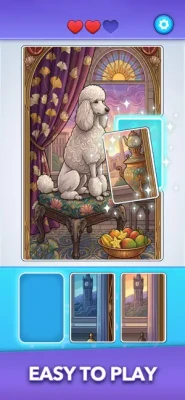
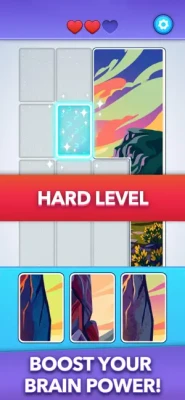
Each puzzle begins with an incomplete picture.
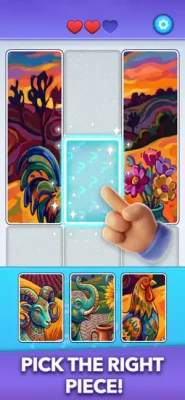
A glowing cell indicates where the next piece belongs.
Three possible image pieces are presented.
Only one is the correct match.
The player must inspect the options and select the piece that continues the picture naturally.
If the selection is correct, the image develops further.
If the wrong piece is selected, the player loses a life. Three mistakes result in game over.
Gameplay Overview
The basic gameplay loop is:
- Look at the incomplete picture.
- Identify the highlighted position.
- Examine the three available pieces.
- Compare colors and textures.
- Look for matching visual details.
- Select the piece that belongs.
- Place it into the highlighted position.
- Continue building the image.
- Complete the puzzle.
- Move on to a more challenging picture.
The further players progress, the more convincing the decoy images become.
The Three-Piece Challenge
The central mechanic is the three-piece choice.
Instead of overwhelming the player with dozens of possible pieces, the game creates a smaller but more focused decision.
For every choice, players need to answer:
Which piece actually belongs here?
The wrong options are designed to look plausible, so simply matching the general color is not always enough.
Players should examine:
- Lines
- Textures
- Colors
- Object edges
- Lighting
- Patterns
- Shadows
- Image continuity
This turns every placement into a small visual investigation.
Jigsaw Puzzle Mechanics
The picture gradually builds as correct pieces are selected.
The App Store listing states that the game includes grids ranging from 3×3 to 8×8, creating different levels of complexity. Smaller grids provide a more accessible introduction, while larger grids create more opportunities for visual confusion.
Main Features
Hundreds of Handcrafted Levels
The game includes hundreds of curated puzzle levels and image sets.
Three-Piece Selection
Each turn presents three possible pieces, with only one being the genuine match.
Visual Decoys
Incorrect pieces are designed to resemble the correct image, increasing the observation challenge.
Multiple Grid Sizes
Puzzle grids range from 3×3 through 8×8.
No Timer
Players can study the image without a countdown clock forcing a rushed decision.
Adaptive Difficulty
The listing says puzzle difficulty adapts to the player's skill, with challenges becoming harder as progress is made.
Coins
Players can earn coins by solving puzzles and completing levels.
Revive System
Coins can be used to continue after a game-over situation.
Smooth Controls
Pieces can be selected using tap controls or dragged and dropped into place.
Picture-Based Brain Training
The game emphasizes observation and visual comparison rather than speed.
Booster System
Puzzle Match Solitaire includes three primary boosters.
Eliminate
The Eliminate booster removes one fake piece, leaving the player with fewer options to evaluate.
This is useful when two choices look particularly similar.
Skip
The Skip booster moves a difficult piece to the back and provides new choices.
This can be useful when the current visual comparison is unusually difficult.
Zoom
The Zoom booster magnifies the puzzle area, allowing players to inspect small visual details more closely.
Controls & Interface Guide
The controls are intentionally simple.
Tap
Tap the piece you believe is correct.
Drag and Drop
Drag a selected piece toward the highlighted location.
Zoom
Use the Zoom booster when visual details are difficult to distinguish.
Selection Feedback
Correct choices help progressively complete the picture, while an incorrect choice costs a life.
The simple interface keeps the focus on observation rather than complicated controls.
Game Progression
Puzzle Match Solitaire gradually increases the visual challenge.
Early puzzles can introduce the basic concept using relatively straightforward images.
Later puzzles become harder because:
- Images become more detailed.
- Decoys become more convincing.
- Larger grids provide more visual information.
- Similar colors become harder to distinguish.
- Small texture differences become important.
The game's adaptive difficulty system is designed to increase the challenge as the player improves.
Picture Puzzle Difficulty
The game is not difficult because of complicated controls.
Instead, difficulty comes from visual accuracy.
A player might see three pieces that all contain blue sky, green vegetation or orange sunset colors. The challenge is determining which one contains the precise details that continue the current picture.
This rewards patience and close observation.
How to Play
Step 1: Examine the Board
Look at the highlighted location before considering the three pieces.
Step 2: Study All Three Pieces
Do not immediately select the first piece that looks similar.
Step 3: Compare Details
Check colors, textures, edges, lighting and objects.
Step 4: Look for Continuity
Imagine how each piece would connect to the surrounding image.
Step 5: Choose Carefully
Select the piece with the strongest visual match.
Step 6: Complete the Picture
Continue making accurate choices until the image is finished.
Beginner's Guide
Start Slowly
There is no timer, so take advantage of the relaxed pace.
Compare Before Choosing
Never judge a piece only by its dominant color.
Look at the Surrounding Image
The pieces need to make sense relative to the neighboring parts.
Check Edges
Lines and boundaries can reveal whether an image fragment belongs.
Save Boosters
Do not use a booster simply because two pieces look similar. Save assistance for genuinely uncertain choices.
Protect Your Lives
Three incorrect choices can end the game, so accuracy matters more than speed.
Advanced Strategy
Study the Whole Picture
Do not focus only on the highlighted square.
Understanding the larger scene can make subtle differences easier to recognize.
Identify Unique Features
Look for objects, branches, buildings, clouds, shadows or patterns that are difficult for a decoy to reproduce accurately.
Compare Texture
Two pieces can share the same colors while having completely different textures.
Follow Lines
Roads, fences, horizons, tree branches and other continuous elements are useful clues.
Use Zoom Strategically
When two pieces appear nearly identical, Zoom can reveal details that are difficult to see at normal size.
Don't Guess Repeatedly
If you're unsure, consider using Eliminate or Skip rather than risking another life.
Strategy & Tips
- Take your time.
- Use the complete image for context.
- Compare all three options before selecting.
- Look beyond dominant colors.
- Examine edges carefully.
- Follow continuous lines and patterns.
- Watch for shadows and lighting differences.
- Use Zoom when details are too small.
- Save Eliminate for close choices.
- Use Skip when a particular piece is unusually confusing.
- Avoid unnecessary guesses.
- Remember that the decoys are intentionally similar.
Difficulty
Overall Difficulty: Easy to Moderate
The controls are extremely accessible, but the visual challenges can become demanding.
The absence of a timer makes the game less stressful than many fast-paced puzzle games. However, the three-mistake limit means players still need to make thoughtful decisions.
The adaptive difficulty system also means the experience can become more challenging as the player's observation skills improve.
Game Modes & Activities
Puzzle Match Solitaire primarily revolves around its picture-puzzle progression.
Picture Puzzle Levels
Complete images by identifying the correct piece.
Different Grid Sizes
Progress from smaller 3×3 layouts toward larger 8×8 puzzles.
Brain Training
Use visual comparison and attention to detail to solve increasingly deceptive puzzles.
Booster Challenges
Use Eliminate, Skip and Zoom when difficult decisions appear.
Level Progression
Complete puzzles to advance and earn coins.
Rewards & Coins
Players can earn coins for solving puzzles and completing levels.
Coins have an additional strategic purpose because the game's revive system allows players to spend coins to continue after game over.
This creates a simple resource-management layer alongside the visual puzzle mechanics.
Revive System
Making three mistakes causes a game-over state.
However, players can use coins through the revive system to continue instead of starting over immediately.
This makes accumulated coins valuable, particularly when attempting more difficult puzzles.
Player Experience
The current U.S. App Store listing shows a 5.0/5 rating from 2 ratings. Because the sample is extremely small, this rating should not be treated as a strong indicator of broad player sentiment yet.
The game's strongest appeal is likely to be its relaxed pace and visual challenge.
Players who enjoy traditional jigsaw puzzles may appreciate the familiar picture-completion concept, while fans of observation games may enjoy the added challenge of identifying decoy pieces.
Pros & Cons
Pros
- Original twist on the jigsaw format
- Simple controls
- No timer
- Hundreds of handcrafted levels
- Multiple grid sizes
- Adaptive difficulty
- Visual brain-training gameplay
- Three useful boosters
- Coin and revive system
- Relaxing picture-based presentation
- Suitable for short or longer sessions
Cons
- The core gameplay revolves around a relatively narrow mechanic.
- Players who prefer traditional jigsaws may find the decoy system unusual.
- Three mistakes can end a run.
- Advertising is included.
- In-app purchases are available.
- The current rating has only two ratings, so there is limited public review data.
Technical Details & System Requirements
| Detail | Information |
|---|---|
| Game | Puzzle Match Solitaire |
| Subtitle | Jigsaw Art Slide Puzzle Game |
| Developer | Tripledot Studios Limited |
| Genre | Puzzle |
| Price | Free |
| In-App Purchases | Yes |
| Advertising | Yes |
| Age Rating | 4+ |
| Current Listed Version | 1.2.7 |
| Latest Listed Update | July 30 |
| Size | 326.9 MB |
| iPhone | iOS 13.0 or later |
| iPad | iPadOS 13.0 or later |
| Mac | macOS 11.0+ with Apple M1 or later |
| Apple Vision | visionOS 1.0+ |
| Languages | English + 8 more |
| Developer | Tripledot Studios Limited |
These specifications are based on the current App Store listing.
Updates & What's New
Puzzle Match Solitaire has received a series of level-focused updates.
Version 1.2.7
- New levels
Version 1.2.5
- New levels
Version 1.2.4
- Optimized levels
Version 1.2.3
- New levels
Version 1.2.2
- Bug fixes
Version 1.2.1
- New levels
Version 1.2.0
- New levels
The recent version history shows an emphasis on expanding the level library and refining existing puzzles.
Accessibility
The developer has not indicated specific accessibility features for Puzzle Match Solitaire in the current App Store listing.
Privacy
According to the developer's App Store privacy disclosure, identifiers may be used to track users across apps and websites owned by other companies.
The listing also indicates that non-linked data such as device identifiers, usage data, advertising data, product interaction and diagnostics may be used for advertising, marketing, analytics, personalization and app functionality.
Apple notes that these privacy disclosures are provided by the developer and have not been verified by Apple.
Advertising & In-App Purchases
Puzzle Match Solitaire is free to download but contains advertising and optional purchases.
The current listing specifically includes a No Ads purchase priced at $7.99, along with several coin and bundle options.
This gives players the choice between using the free experience with advertising or purchasing additional options.
Puzzle Match Solitaire vs Traditional Jigsaw Games
Traditional jigsaw games generally ask players to determine where a piece fits based on shape, image and position.
Puzzle Match Solitaire changes that formula.
Here, the player is first presented with several visually similar options and must determine which one actually belongs.
That makes the game closer to a combination of:
Jigsaw + Spot the Difference + Visual Brain Training
This distinction gives it a more observation-focused identity than a conventional jigsaw game.
Puzzle Match Solitaire vs Match-3 Games
Despite the word “Match” in its title, Puzzle Match Solitaire is not a traditional match-3 game.
There are no standard rows of three matching gems or tiles.
Instead, the player matches picture details and selects the correct jigsaw piece.
This is an important distinction for players searching for a visual puzzle rather than a tile-matching game.
Who Should Play Puzzle Match Solitaire?
This game is particularly suitable for players who enjoy:
- Jigsaw puzzles
- Picture puzzles
- Visual brain games
- Spot-the-difference challenges
- Observation games
- Relaxing puzzle games
- Casual mobile games
- Image-based challenges
- Brain-training activities
It is also a good option for players who prefer puzzle games without a countdown timer.
Expert Rating
8.5/10
| Category | Rating |
|---|---|
| Gameplay Concept | 8.8/10 |
| Puzzle Design | 8.7/10 |
| Visual Challenge | 9.0/10 |
| Controls | 9.2/10 |
| Difficulty Balance | 8.5/10 |
| Variety | 8.2/10 |
| Replay Value | 8.3/10 |
| Accessibility | 7.5/10 |
| Overall | 8.5/10 |
Why 8.5/10?
The game's strongest quality is its clever variation on the familiar jigsaw formula.
Instead of making the puzzle difficult through complicated controls, it makes players question what they see.
The three-piece selection mechanic is easy to understand but can become surprisingly challenging when decoy images closely resemble the correct answer.
Frequently Asked Questions
What is Puzzle Match Solitaire?
Puzzle Match Solitaire is a picture-based brain puzzle where players choose the correct jigsaw piece from three visually similar options and gradually complete an image.
Is Puzzle Match Solitaire a traditional solitaire game?
No. Despite its name, the current App Store description presents it as a jigsaw art and visual picture puzzle rather than a traditional card-solitaire game.
Is Puzzle Match Solitaire a match-3 game?
No. It does not use the conventional match-3 mechanic. Its main gameplay involves matching image details and identifying the correct jigsaw piece.
How many pieces are offered at once?
Three picture pieces are presented during each decision, with only one being the correct match.
What happens if I choose the wrong piece?
A wrong selection costs a life. Three mistakes result in game over.
Does Puzzle Match Solitaire have a timer?
No. The App Store specifically states that there is no timer, allowing players to study each picture carefully.
What boosters are available?
The game includes Eliminate, Skip and Zoom boosters.
What does the Zoom booster do?
Zoom magnifies the jigsaw area so players can examine visual details more closely.
What does Eliminate do?
Eliminate removes one fake piece, making the decision easier.
What does Skip do?
Skip moves a difficult piece to the back and provides new choices.
Does the game have different puzzle sizes?
Yes. The listing states that grids range from 3×3 to 8×8.
Is Puzzle Match Solitaire free?
Yes. The game is free to download, but it contains advertising and optional in-app purchases.
Can I remove advertisements?
Yes. The current App Store listing includes a No Ads purchase for $7.99.
Who developed Puzzle Match Solitaire?
The game was developed by Tripledot Studios Limited.
Can I play it on iPhone?
Yes. The current listing requires iOS 13.0 or later.
Can I play Puzzle Match Solitaire on iPad?
Yes. It supports iPad and requires iPadOS 13.0 or later.
Is Puzzle Match Solitaire available on Mac?
The listing states that Mac requires macOS 11.0 or later with an Apple M1 chip or later, although the U.S. listing currently says the app is not verified for macOS.
Final Verdict
Puzzle Match Solitaire takes a familiar jigsaw concept and gives it a clever visual twist.
Instead of simply asking players to find a piece that fits, the game presents three possible pieces and challenges them to determine which one actually belongs to the picture.
The two incorrect pieces are deliberately similar, which means players need to look beyond broad colors and examine textures, edges, patterns and small visual details.
The absence of a timer is another strong point. Players can approach the puzzles at their own pace rather than being forced into rapid decisions.
With hundreds of handcrafted levels, 3×3 through 8×8 grids, adaptive difficulty, coins, a revive system and three useful boosters, the game offers more depth than its simple presentation initially suggests.
Its biggest limitation is that the fundamental mechanic remains focused on visual piece selection, so players looking for a large variety of puzzle types may eventually want something more diverse.
Overall Score: 8.5/10
Best for: Jigsaw fans, observation-game players, casual puzzle enthusiasts and anyone who enjoys visual brain challenges.
Main strength: Clever three-piece visual matching mechanic.
Main weakness: Limited gameplay variety beyond its core picture-matching system.
Verdict: A relaxing but surprisingly challenging picture puzzle that rewards sharp eyes, patience and attention to detail.
Final Summary
Puzzle Match Solitaire transforms traditional jigsaw gameplay into a visual decision-making challenge.
Each level presents an incomplete picture and three possible pieces. Only one belongs to the image, while the other two are carefully designed decoys.
Players must compare colors, textures, shapes and surrounding details before making their choice. Correct selections gradually complete the picture, while three mistakes can end the game.
The addition of Eliminate, Skip and Zoom boosters, multiple grid sizes, adaptive difficulty, coins and a revive system gives the straightforward concept additional strategic depth.
For players looking for a relaxing picture puzzle, jigsaw brain game or visual observation challenge, Puzzle Match Solitaire is a strong casual choice.
Final Rating: 8.5/10
Rate the Game
User Reviews








Popular Games















 Android
 iOS
iOS Windows
 Xbox
Xbox