

Latest Version
September 09, 2026
Tripledot Studios
Puzzle
iOS
0
Report a Problem
More About :game
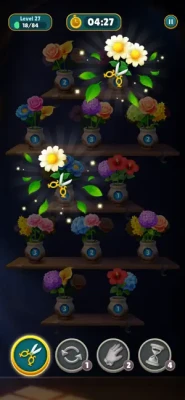
The concept is easy to understand: arrange the flowers correctly, make matches, clear the board, and complete the level. The challenge comes from deciding which flower to move first because every move can change what becomes available next.
The game features hundreds of handcrafted levels, colorful visuals, chain reactions, boosters, and offline gameplay. Its calm presentation makes it relaxing to play, while the increasingly complicated arrangements give the puzzles more depth.
How to Play Magic Bloom Sort
The main objective is to sort flowers into the appropriate vases and create groups of three matching blooms.
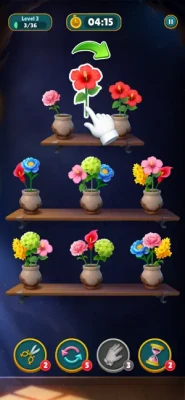
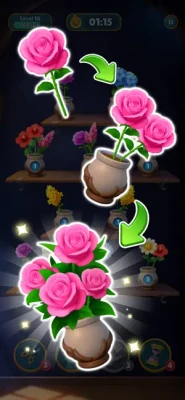
You tap to move flowers, arrange them into useful positions, and complete matches. When three identical flowers are combined, they merge and clear, creating room for additional moves.
The important part is that you cannot treat every possible match as equally good. A move that looks helpful immediately may block a better combination later.
Basic Gameplay Loop
- Examine all visible flowers before moving anything.
- Identify flowers that can potentially form a group of three.
- Move flowers between the available vases.
- Complete matches of three identical blooms.
- Use the newly created space to expose or arrange more flowers.
- Look for chain reactions before making the next move.
- Use boosters when normal moves cannot efficiently solve the board.
- Clear the entire puzzle to progress.
Main Features
Flower Sorting Puzzles
Magic Bloom Sort turns flower matching into a sorting challenge. You need to consider both the flower color/type and the position of the available vases.
This gives the game more planning than a simple tap-to-match puzzle.
Match Three Mechanics
The core rule is straightforward: match three identical blooms to merge and clear them.
The simplicity of this mechanic makes the game accessible, but later boards can require several moves to prepare the correct combination.
Hundreds of Handcrafted Levels
The App Store describes the game as having hundreds of handcrafted levels, with different layouts and challenges designed to keep the sorting puzzles varied.
Chain Reactions
Good moves can lead to additional matches. Setting up one successful combination can therefore create an opportunity for another clear without having to start from scratch.
Learning to recognize these possibilities is one of the keys to solving harder boards efficiently.
Boosters and Tools
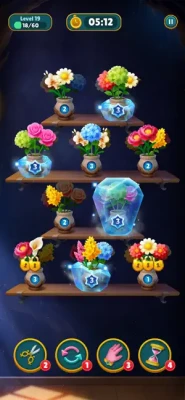
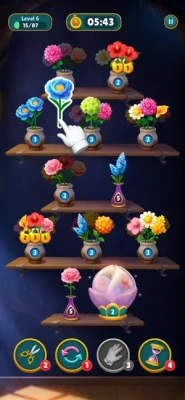
Magic Bloom Sort includes boosters and tools that can help when a puzzle becomes difficult.
Rather than using them immediately, it is usually better to identify exactly what is preventing progress and choose a booster that addresses that problem.
Offline Gameplay
The App Store listing states that the game can be played offline, making it suitable for flights, travel, commuting, or quick puzzle sessions without Wi-Fi.
Magic Bloom Sort Strategy Guide
The most useful way to approach Magic Bloom Sort is to stop thinking about individual matches and start thinking about board space and future moves.
A successful move should ideally accomplish at least one of three things:
- Complete a match.
- Create useful space.
- Prepare a future match.
The best moves often accomplish two or all three.
1. Study the Entire Board First
Don't immediately tap the first obvious flower.
Before making your opening move, look at:
- Which flowers already have pairs.
- Which flowers are isolated.
- Which vase positions are useful.
- Which move will expose another flower.
- Where your next three-match could come from.
This initial scan can prevent you from making an unnecessary move that restricts the rest of the puzzle.
2. Prioritize Existing Pairs
If two identical flowers are already close to completing a match, they deserve attention.
For example, if two blue flowers can easily be joined by moving a third blue flower, completing that match may be more valuable than starting an entirely new color arrangement.
Pairs provide a clear target and reduce the number of uncertain moves you need to make.
3. Don't Move the Third Flower Too Early
A common mistake is seeing a potential three-flower combination and immediately completing it.
Sometimes the third flower is more useful where it currently sits because moving it can expose another flower or create a second combination.
Before completing a match, ask:
What becomes available after this flower moves?
That question can reveal a much better sequence.
4. Keep Useful Vases Available
Empty or partially filled vases are valuable because they provide flexibility.
If you fill every available space with unrelated flowers, you can eventually find yourself with the correct colors but nowhere useful to put them.
Try to preserve at least one flexible area whenever possible.
5. Avoid Creating a Color Bottleneck
A color bottleneck happens when several flowers of the same type become trapped behind other flowers or occupy inconvenient positions.
If you see multiple identical blooms that cannot currently be combined, consider whether another move can expose them.
Removing the obstruction may be more important than completing an unrelated match.
6. Plan Two or Three Moves Ahead
You don't need to predict the entire puzzle.
Instead, use a short planning sequence:
Move A → What does it expose? → Move B → What does that create?
If Move A produces no useful follow-up, reconsider it.
This is particularly important on compact boards where one misplaced flower can interfere with several future combinations.
7. Look for Chain Reactions
After setting up a match, don't immediately assume the board is finished with that color.
Check whether the clear creates another group of three.
A good chain can save multiple moves and open several areas at once.
The best chain reactions usually come from preparing the board before making the first match rather than relying entirely on luck.
8. Clear Obstructions Before Chasing Combos
A large combination is tempting, but sometimes the board has a more immediate problem.
If one flower is blocking access to several others, remove the obstruction first.
A small clear that unlocks three future possibilities can be much stronger than a large clear that leaves the rest of the board restricted.
9. Use Empty Space as a Resource
Think of empty vase capacity as part of your strategy.
When you have several possible moves, prefer the sequence that preserves more usable space.
This is especially important when the puzzle contains several different flower types that cannot immediately be matched.
10. Don't Mix Too Many Colors at Once
When possible, work toward completing one useful color group before creating several partially completed groups.
Having multiple unfinished groups can make the board harder to manage because each requires additional space.
However, this doesn't mean you should blindly finish one color. If another move exposes a critical flower, take the opportunity.
11. Use Boosters to Solve Specific Problems
Boosters should have a job.
A good booster use might:
- Remove an obstacle.
- Create space.
- Finish a difficult arrangement.
- Open an otherwise inaccessible section.
- Rescue a board where normal moves are becoming limited.
Using one simply because a puzzle feels slightly inconvenient can waste a valuable resource.
12. Save Powerful Tools for Genuine Trouble
If you can solve a level with normal moves, do so.
Boosters become more valuable when a board has reached a position where several moves have already been exhausted and there is no efficient way forward.
Keeping some tools in reserve also gives you a safety net for particularly awkward puzzles.
Advanced Tips for Difficult Levels
Find the Critical Flower
On complicated boards, there is often one flower that is effectively controlling the puzzle.
It may be blocking another color, occupying a valuable position, or preventing a three-match.
Instead of asking:
“What can I match?”
ask:
“Which flower is preventing me from matching more?”
That change in perspective can make difficult layouts much easier.
Work Backward From the Goal
If you can see that a particular group needs three identical flowers, trace where those flowers must come from.
Determine:
- Where the first flower is.
- Where the second flower is.
- How to access the third.
- Which moves must happen before they can be combined.
This creates a mini-plan instead of relying on trial and error.
Protect Your Best Position
Not every vase position has the same strategic value.
A position that can accept several different flowers is more flexible than one that only helps a single color.
When choosing between two otherwise similar moves, preserve the more flexible position.
Reassess After Every Major Clear
A board can change dramatically after one successful match.
Don't continue following a plan simply because it was good two moves ago.
After a large clear, stop and scan the board again. You may now have a completely different and much stronger move.
Common Mistakes
Making the First Available Match
The first possible match isn't necessarily the best one.
Always consider what the move will expose or block.
Filling Every Available Space
Using every available position can leave you with no room to maneuver later.
Chasing Big Combos
A combo is useful only when it improves the board.
Don't sacrifice flexibility just to create a visually impressive clear.
Using Boosters Too Early
A booster can solve a problem, but using it before identifying the actual obstacle can waste it.
Ignoring the Flowers Behind the Front Layer
The visible flower is not always the important one.
Sometimes the real objective is to remove the flower currently blocking access to a more useful bloom.
Graphics and Atmosphere
Magic Bloom Sort has a bright, peaceful presentation built around colorful flowers, vases, smooth animations, and garden-inspired visuals.
The visual style complements the game's slower puzzle-solving rhythm. Rather than relying on intense action, the game focuses on the satisfaction of organizing the board and watching successful matches clear away.
The App Store description specifically presents the game as a combination of strategic challenge and relaxation.
Difficulty
Magic Bloom Sort starts with mechanics that are easy to understand, but the strategic difficulty comes from the order in which flowers are moved.
Later puzzles can require:
- Careful space management.
- Short-term planning.
- Pattern recognition.
- Identifying blocked flowers.
- Creating chain reactions.
- Choosing when not to make an obvious match.
The game is therefore suitable for casual players but still provides enough decision-making for people who enjoy logic and sorting puzzles.
Pros and Cons
Pros
- Simple controls
- Easy-to-understand match-three rules
- Colorful flower theme
- Hundreds of handcrafted levels
- Strategic sorting mechanics
- Chain reactions and combos
- Boosters for difficult puzzles
- Relaxing presentation
- Offline gameplay
- Suitable for short sessions
Cons
- Some puzzles can require considerable trial and error
- Players who prefer fast action may find the gameplay slow
- Repeated sorting mechanics may not appeal to everyone
- Contains advertising and optional in-app purchases
Magic Bloom Sort Game Information
Game: Magic Bloom Sort
Subtitle: Flower Sorting Puzzle Game
Developer: Tripledot Studios
Genre: Puzzle
Gameplay: Flower sorting, matching, match-three puzzles
Platforms: iPhone, iPad
Age Rating: 4+
Price: Free with in-app purchases
Offline Play: Yes
Language: English
App Size: 414.6 MB
Requires: iOS 13.0 or later
Contains: Advertising
In-App Purchases: Yes
The current App Store listing also shows compatibility with Apple Silicon Macs and Apple Vision in addition to iPhone and iPad, subject to the listed operating-system requirements.
Updates and Current Version
The App Store currently lists version 0.04.16, with recent updates focused primarily on stability, performance, bug fixes, and improvements to the overall flower-sorting experience.
Frequently Asked Questions
What is Magic Bloom Sort?
Magic Bloom Sort is a flower sorting and matching puzzle game where players move flowers between vases and match three identical blooms to clear them.
How do you play Magic Bloom Sort?
Tap flowers to move them between vases, arrange matching blooms, and create groups of three identical flowers. The goal is to clear the puzzle while managing available space.
Does Magic Bloom Sort have match-three gameplay?
Yes. Matching three identical flowers is one of the game's central mechanics.
Does Magic Bloom Sort have boosters?
Yes. The game includes boosters and tools intended to help players overcome difficult puzzle arrangements.
Can Magic Bloom Sort be played offline?
Yes. The App Store listing specifically describes offline gameplay.
How many levels are in Magic Bloom Sort?
The App Store describes the game as having hundreds of handcrafted levels.
Is Magic Bloom Sort free?
Yes. It is free to download and includes advertising and optional in-app purchases.
Is Magic Bloom Sort difficult?
The basic mechanics are easy to learn, but later puzzles can require more careful planning, space management, and pattern recognition.
What is the best strategy for Magic Bloom Sort?
The strongest general approach is to preserve flexible space, identify blocked flowers, plan several moves ahead, and avoid making a match simply because it is immediately available.
Final Verdict
Magic Bloom Sort takes the familiar appeal of match-three games and combines it with a more deliberate flower-sorting system. The result is a puzzle game where the order of your moves matters almost as much as the matches themselves.
Its colorful presentation and relaxing atmosphere make it approachable, while the need to manage vase space, expose blocked flowers, prepare combinations, and recognize chain reactions gives the puzzles meaningful strategic depth.
For players who enjoy flower sorting games, match-three puzzles, relaxing brain games, and offline puzzle games, Magic Bloom Sort is an appealing choice, especially for those who like puzzles that reward planning rather than speed.
Rate the Game
User Reviews













Popular Games




















 Android
 iOS
iOS Windows
 Xbox
Xbox