
Latest Version
September 09, 2026
Tripledot Studios
Puzzle
iOS
0
Report a Problem
More About :game
The game offers different board sizes and level types, smooth controls, clean visuals, and no timers, allowing players to solve puzzles at their own pace.
How to Play Loom Link
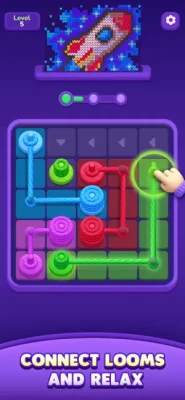
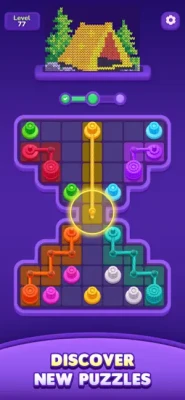
Each puzzle contains pairs of matching colored spools.
Your objective is to connect each matching pair with a continuous line while ensuring that:
- Every matching pair is connected.
- Lines do not cross.
- The paths fit within the available board.
- You do not accidentally block the route needed by another color.
The important part is that solving one color affects the space available to every other color.
A path that looks perfect for one pair may make the rest of the puzzle impossible.
Core Gameplay
The basic gameplay loop is simple:
- Study the entire board.
- Identify the matching color pairs.
- Look for pairs with obvious or restricted routes.
- Connect the most constrained paths first.
- Leave enough space for the remaining colors.
- Check whether your lines are blocking another route.
- Complete all connections without crossing lines.
There is no countdown timer, so the game encourages careful observation rather than speed.
Main Features
Connect Matching Colors
The central mechanic is connecting pairs of identical colors. Every connection must reach its matching spool without crossing another completed path.
No-Crossing Puzzle Design
The no-crossing rule is what creates the game's strategic depth. A route that works locally may be a problem globally if it divides the board and prevents another color from reaching its destination.
Different Board Sizes
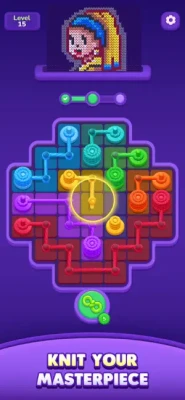
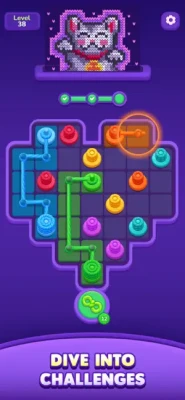
Loom Link includes different board sizes and level types, giving players layouts with varying amounts of space and different routing challenges.
Relaxed Puzzle Experience
There are no timers, allowing you to stop and inspect the board before making a move. This makes the game suitable for players who prefer thoughtful logic puzzles over fast-paced challenges.
Smooth Controls
The game uses straightforward touch controls for drawing connections, making the mechanics easy to understand without a complicated tutorial.
Quick or Longer Sessions
Because individual puzzles can be approached at your own pace, Loom Link works well as a short brain-training game or as a longer puzzle session.
Loom Link Strategy Guide
The key to Loom Link is not simply finding a path between two matching colors.
You need to find paths that leave the remaining board solvable.
That means every connection should be considered in relation to the other colors.
1. Find the Most Restricted Pair First
Start by looking for a color pair with very few possible routes.
For example, if a pair is positioned near the edge or surrounded by other spools, it may have only one or two realistic ways to connect.
Solve these constrained pairs before the colors with lots of open space.
Why?
Because flexible pairs can usually adapt to whatever space remains. Restricted pairs cannot.
2. Don't Always Connect the Closest Pair
Two matching spools may appear close together, but distance is not the most important factor.
A short connection can cut across the middle of the board and divide the remaining space.
Before drawing the line, ask:
What area will this path separate from the rest of the board?
If it creates a barrier, another color may become impossible to connect.
3. Protect the Middle of the Board
The center of a puzzle is often valuable because several colors may need to pass through it.
Avoid filling the central area unnecessarily when you still have several unresolved pairs.
Instead, consider routing some connections around the edges.
This preserves central space for colors that genuinely need it.
4. Use the Edges When They Are Safe
The outer edges of the board can provide useful routing space.
If a matching pair can be connected around the outside without interfering with another pair, that route may be preferable to cutting through the middle.
However, don't assume every edge route is automatically correct. Check what happens to the remaining open areas afterward.
5. Think of Lines as Walls
One of the best ways to understand Loom Link is to imagine that every completed connection becomes a wall.
Once a line is drawn, other colors cannot cross it.
So before connecting a pair, imagine the path already completed and ask:
Can every remaining pair still reach its partner?
If the answer is uncertain, try a different route.
6. Solve Corners Carefully
Corner positions can be deceptively important.
A pair located near a corner may have fewer escape directions than a pair in an open area.
Look at the surrounding spaces before connecting it.
Sometimes the correct solution requires routing along the edge instead of taking the visually shortest path.
7. Look for Forced Moves
Some puzzles contain connections that are effectively forced.
If a pair has only one viable corridor, solve that connection first.
Once it is placed, the rest of the puzzle often becomes easier because you have eliminated an important uncertainty.
8. Don't Draw a Path Just Because It Fits
A path can technically connect two matching colors and still be wrong.
The real test is whether it leaves a valid route for every other color.
This is one of the biggest differences between an easy-looking board and a difficult one.
9. Recheck the Board After Every Connection
After completing a line, don't immediately start drawing the next one.
Pause and reassess:
- Which pairs are now restricted?
- Which routes disappeared?
- Did you divide the board?
- Is there an isolated region?
- Which pair now has the fewest options?
Your next move should be based on the new board, not the original layout.
10. Work From Constraints, Not Colors
Instead of thinking:
“I'll connect red, then blue, then green.”
think:
“Which pair has the fewest available routes?”
This approach is much more reliable on complicated boards.
The order of colors is different from puzzle to puzzle, but the principle remains useful.
Advanced Loom Link Tips
Use the "Remaining Space" Test
Before committing to a connection, mentally remove the proposed path from the board.
Then examine the remaining open space.
If another pair appears trapped or separated, your proposed line is probably wrong.
Watch for Closed-Off Regions
A path can create a pocket of empty space that contains no matching endpoint.
That empty area may be effectively useless.
If a connection creates a large isolated region, reconsider the route.
Keep Multiple Routes Open Early
During the opening moves, avoid unnecessarily committing to long paths if the board still has many unresolved colors.
Early flexibility is valuable.
Once the number of remaining pairs decreases, longer connections become easier to evaluate.
Identify the Board's Natural Corridors
Some layouts naturally create horizontal or vertical channels.
If several pairs are positioned along these corridors, use them intelligently rather than forcing diagonal paths through the center.
Think Backward From Difficult Endpoints
If a particular endpoint has very limited space around it, start by imagining where its line must approach from.
Then work backward toward its matching color.
This can reveal the correct route before you make any other connections.
Common Mistakes
Choosing the Shortest Path
The shortest line is not necessarily the correct solution.
It may block several other routes.
Starting With the Easiest Pair
Easy pairs are flexible, so they can often wait.
Solve the pairs with fewer options first.
Filling the Center Too Early
A central connection can split the board and make several remaining paths impossible.
Ignoring the Remaining Colors
Every move should be evaluated against the entire board.
Making Several Moves Without Rechecking
The board changes after every connection. A route that looked safe earlier may become unnecessary or harmful after another line is added.
A Reliable Step-by-Step Method
For difficult Loom Link puzzles, use this sequence:
Step 1: Identify every matching pair.
Step 2: Mark the pair with the fewest possible routes.
Step 3: Imagine two or three possible paths for that pair.
Step 4: Eliminate paths that cut off another color.
Step 5: Choose the route that preserves the most usable space.
Step 6: Recheck the board.
Step 7: Repeat with the next most restricted pair.
Step 8: Leave flexible pairs until the board becomes more defined.
This method reduces trial and error because you are solving the puzzle according to its constraints rather than simply drawing lines that look convenient.
Difficulty
Loom Link starts with an approachable concept, but the difficulty comes from spatial planning.
The challenge increases when:
- More color pairs appear.
- The board becomes larger.
- Several paths compete for the same space.
- A connection can divide the board.
- Multiple routes appear possible but only one leaves a solvable layout.
The game is therefore more about planning and spatial reasoning than reaction speed.
There is also no timer, so players can take their time and experiment with possible routes.
Graphics and Atmosphere
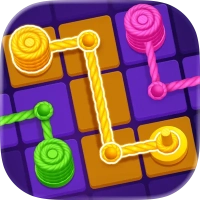
Loom Link uses a clean, colorful presentation centered around spools of thread and connecting lines.
The minimalist design keeps the player's attention on the puzzle rather than filling the screen with unnecessary visual elements.
Its lack of a timer also gives the game a calm atmosphere. The experience is designed around thinking, connecting, correcting mistakes, and gradually completing the board.
Player Feedback
The App Store currently shows a 4.0/5 rating from two ratings, so the available review sample is very small. One player praised the relaxing experience, while another felt that later puzzles could use more difficulty and that some levels began to feel similar after around Level 100.
Because the review count is so limited, these comments should be treated as individual impressions rather than a broad measure of player opinion.
Pros and Cons
Pros
- Simple rules that are easy to understand
- No timer pressure
- Colorful and clean presentation
- Different board sizes
- Strong focus on logic and spatial planning
- Good for short puzzle sessions
- Easy to pick up but capable of requiring careful thought
- Smooth touch controls
Cons
- Some players may find the early puzzles too easy
- Later-level variety may feel limited for some players
- The current App Store review sample is very small
- The game contains advertising
Loom Link - Connect Colors Game Information
Game: Loom Link - Connect Colors
Subtitle: Connect colors - Train your mind
Developer: Tripledot Studios
Seller: Tripledot Studios Limited
Genre: Puzzle
Core Mechanic: Connect matching colors without crossing lines
Price: Free
Platforms: iPhone, iPad
Language: English
Age Rating: 16+
App Size: 268 MB
Requires: iOS 13.0 or later
iPad Requirement: iPadOS 13.0 or later
Advertising: Yes
Current Listed Version: 1.2.2
The App Store also lists compatibility with Apple Silicon Macs and Apple Vision, subject to the stated operating-system requirements.
Updates
The current App Store listing shows version 1.2.2, released March 12. Previous updates repeatedly introduced the Loom Link/Connect Colors experience and focused on the relaxing no-crossing color-pair puzzle concept.
Frequently Asked Questions
What is Loom Link - Connect Colors?
Loom Link is a logic puzzle game where you connect matching colored thread spools without allowing the connecting lines to cross.
How do you play Loom Link?
Select a colored spool and draw a path to its matching spool. Complete every color connection while keeping all lines separate.
Can the lines cross in Loom Link?
No. The central puzzle rule is that matching colors must be connected without crossing another connection.
Does Loom Link have a timer?
No. The game does not use timers, allowing players to solve puzzles at their own pace.
Is Loom Link difficult?
The basic rules are simple, but larger and more complicated layouts require more planning because every line affects the routes available to the remaining colors.
What is the best strategy in Loom Link?
Start with the most restricted color pair rather than the easiest one. Preserve open space, avoid blocking the center unnecessarily, and always check whether your proposed line leaves routes for every remaining pair.
Is Loom Link free?
Yes. The App Store lists the game as free and indicates that it contains advertising.
What devices can run Loom Link?
The App Store lists iPhone and iPad support, with iOS 13.0 or later required for iPhone and iPadOS 13.0 or later for iPad. It also lists Apple Silicon Mac and Apple Vision compatibility.
Final Verdict
Loom Link - Connect Colors is a straightforward but thoughtful color-connection puzzle built around one excellent rule: every matching pair must be connected without crossing another line.
The game works particularly well for players who enjoy logic puzzles, color matching, spatial reasoning, and relaxing brain games. The absence of a timer makes it comfortable for casual play, while the more complicated boards require players to think about the consequences of every connection.
The most important lesson is simple: don't solve one color in isolation. Solve the entire board. A successful connection is only a good move if the remaining colors still have somewhere to go.
Rate the Game
User Reviews












Popular Games



















 Android
 iOS
iOS Windows
 Xbox
Xbox