








Latest Version
September 10, 2026
Tripledot Studios
Puzzle
iOS
0
Report a Problem
More About :game
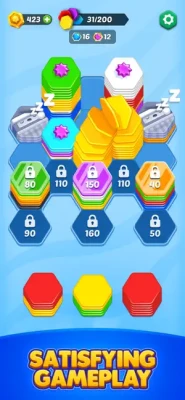
Developed by Tripledot Studios, HexaGo combines color sorting with satisfying merging mechanics, colorful 3D graphics, relaxing sound effects, power-ups, new islands, and changing board challenges. The App Store listing currently shows a 4.9/5 rating from more than 5,000 ratings.
What Is HexaGo - Sorting Puzzle?
HexaGo is a brain puzzle built around sorting colorful hexagonal pieces into useful combinations. Rather than simply matching whatever is immediately available, successful play depends on deciding which pieces should move first, which spaces need to remain open, and which color combinations can create the most useful chain of merges.
The game gradually introduces more complicated situations, making early levels useful for learning the basic movement and matching system before the board becomes more demanding.
The presentation is deliberately relaxing, with bright colors, 3D pieces and calming sound effects. At the same time, the later puzzles can require considerably more thought than the simple opening levels suggest.
How to Play HexaGo
The basic idea is straightforward:
- Examine the entire board before making a move.
- Identify hexagons that can be combined or moved toward a useful match.
- Sort pieces by color and position.
- Create merges whenever they improve your available space.
- Avoid filling important spaces with pieces that cannot immediately contribute.
- Continue opening the board until the puzzle objective is completed.
The important distinction is that a legal move is not automatically a good move. A move can create a match while leaving the rest of the board in a worse position.
That is where HexaGo becomes a strategy puzzle.
The Best HexaGo Strategy
1. Don't Make the First Available Match
One of the easiest mistakes is immediately merging the first two compatible pieces you see.
Before moving anything, scan the board and ask:
- Which color appears most often?
- Which pieces are blocking other colors?
- Which move opens the most space?
- Can one move create another useful merge?
- Will the resulting stack make the next move easier or harder?
If two moves are both possible, prefer the one that opens more of the board rather than simply the one that produces the fastest visual reward.
2. Think About the Board in Layers
Treat each group of hexagons as having a front layer and a deeper layer.
A piece that looks unimportant may actually be blocking a more valuable combination behind it.
Instead of asking:
“What can I merge right now?”
ask:
“What does this move allow me to reach next?”
This small change in thinking makes difficult levels much easier.
3. Protect Your Open Spaces
Open space is one of your most valuable resources.
Don't fill every available position simply because you can.
When several pieces are waiting to be sorted, leave room for colors that have a clear path toward a future merge. If you fill the board with isolated colors, you can create a position where every move technically works but none of them actually solves the puzzle.
A useful rule is:
If a move does not create a match, expose a useful piece, or improve your sorting position, question whether you really need it.
4. Build Around the Most Common Color
When several pieces of one color are already visible, that color should usually become one of your priorities.
For example, suppose the board contains:
- several blue pieces,
- a smaller number of red pieces,
- one isolated yellow piece,
- and blue pieces blocking access to another section.
Rather than scattering your blue pieces around the board, try to organize them into a position where subsequent blue moves become easier.
The objective is not simply to collect a color. You want to create a chain of useful moves.
5. Avoid Creating Dead Groups
A dead group is a collection of pieces that occupies valuable space but has no obvious productive follow-up.
This often happens when players move pieces simply to get them out of the way.
Before placing a piece, check what will happen afterward.
If placing a red group means the next red piece can no longer reach it, you may have made the board harder even though the move itself was legal.
6. Use the “Next Three Moves” Test
When a level becomes difficult, stop looking at the entire puzzle at once.
Choose a possible move and mentally simulate the next three actions:
Move 1: What does this create?
Move 2: What can I do because of Move 1?
Move 3: Does Move 2 open another useful area?
If you cannot find a productive third move, look for another opening.
This is particularly useful when several possible matches appear equally attractive.
How to Handle Difficult HexaGo Levels
Step 1: Find the Bottleneck
Every difficult board usually has one or two areas causing most of the trouble.
It might be:
- a crowded section,
- an awkward color,
- a blocked route,
- an important piece hidden behind others,
- or a limited area where several groups must eventually be combined.
Find that bottleneck first.
Step 2: Work Backward
Once you identify the difficult area, ask:
“What needs to happen immediately before I can clear this?”
Then ask the same question again.
For example:
Clear target → combine color → expose piece → move blocking group → create space
This backward approach is much more reliable than randomly moving pieces until something works.
Step 3: Solve the Most Restrictive Color First
If one color has only one practical place where it can be used, treat it as more important than a color that can go almost anywhere.
A flexible color can usually wait.
A restrictive color often cannot.
This is a powerful rule for avoiding situations where the board looks nearly solved but one awkward group remains.
Booster Strategy
HexaGo includes power-ups and boosters intended to help with harder puzzles.
The biggest mistake is using a booster simply because it is available.
Instead, save boosters for situations where they change the outcome.
Use a Booster When:
- one blocked area is preventing several useful moves;
- the board has entered a genuinely bad position;
- a booster can create multiple follow-up opportunities;
- you have already identified the correct strategic direction;
- using it prevents you from restarting a difficult level.
Don't Use a Booster When:
- the level can still be solved normally;
- you are unsure what the actual problem is;
- you are using it only because the board looks messy;
- one additional normal move could reveal the solution.
A booster should solve a specific problem, not compensate for random moves.
A Reliable Emergency Recovery Method
If the board starts going badly, don't immediately panic.
Use this sequence:
1. Stop moving.
Take a moment to inspect every available group.
2. Identify the most blocked color.
Determine which group has the fewest useful destinations.
3. Look for a space-producing move.
Prioritize moves that create room.
4. Avoid starting new groups unnecessarily.
If an existing group can be completed, finish it before creating another problem elsewhere.
5. Only then consider a booster.
If the board remains locked, use the booster that directly addresses the bottleneck.
This approach prevents a common mistake: spending several boosters while continuing to make the same underlying strategic error.
Beginner Tips
Look at the Whole Board First
Don't start tapping immediately. A few seconds of planning can save many moves.
Match With a Purpose
Every merge should either clear space, expose something useful, or advance a larger combination.
Keep Flexible Areas Open
Don't occupy every convenient space.
Prioritize Blockers
If one group prevents access to several others, deal with it early.
Don't Chase Every Possible Match
Some matches are useful now but harmful later.
Learn From Failed Levels
When you lose, identify the exact move that caused the board to become unsalvageable. Replaying the same sequence without changing that decision usually produces the same result.
Advanced HexaGo Techniques
The Space Economy
Think of empty positions as currency.
A move that creates two useful spaces can be more valuable than a move that produces a single immediate merge.
When choosing between two moves, compare their space value, not just their matching value.
The Chain-Merge Setup
The strongest positions often come from setting up several compatible moves in sequence.
For example:
Open space → move color A → expose color B → merge color B → free color A → finish the section
The first move may appear unimportant, but it creates the conditions for everything that follows.
Don't Finish a Group Too Early
Sometimes completing a color immediately is not ideal.
If that completion blocks the position needed for another important color, delaying the merge can be better.
This is one of the differences between beginner play and advanced play:
Beginners ask which group can be completed. Advanced players ask which completion produces the best board afterward.
Use Restricted Pieces as Anchors
If one piece has very few useful destinations, build your plan around it.
Flexible pieces can move later.
Restricted pieces determine the structure of the solution.
Recalculate After Every Major Merge
A large merge can completely change the board.
Don't blindly continue with the plan you made five moves earlier.
After a major change, stop and reassess:
- What became available?
- What became blocked?
- Which color is now closest to completion?
- Which space is most valuable?
- Did a new route open?
New Islands and Changing Challenges
HexaGo has expanded beyond its basic sorting format with new islands, new board mechanics, obstacles and additional challenges. Its version history also records new islands, new mechanics, new obstacles, a color-blind mode and other gameplay improvements.
That means a strategy that works perfectly on early boards may need to be adjusted as new mechanics appear.
When a new mechanic is introduced, don't immediately try to play quickly. First determine whether it:
- blocks movement,
- changes the order in which pieces should be cleared,
- consumes space,
- creates a new opportunity,
- or requires a particular color or sequence.
Treat every new mechanic as a new puzzle rule rather than simply another visual decoration.
How to Improve Faster
If you want to become consistently better at HexaGo, practice these three habits:
Habit 1 — Plan before moving
Spend a few seconds identifying the most restrictive area.
Habit 2 — Think three moves ahead
Don't judge a move only by its immediate result.
Habit 3 — Protect space
When in doubt, prefer the move that leaves more useful options for your next turn.
After several levels, these habits become much more natural and you'll start recognizing good moves almost immediately.
Common Mistakes to Avoid
Moving pieces randomly:
Random movement may occasionally work on simple levels, but it becomes unreliable as the board gets more complicated.
Using boosters too early:
Save them for genuine bottlenecks.
Focusing on one color for too long:
A nearly completed color is not always the most important color.
Ignoring blocked areas:
A difficult section can become much worse if you leave it until the end.
Filling empty spaces unnecessarily:
Space gives you options. Don't spend it without a reason.
Repeating the same failed opening:
If a level repeatedly collapses at the same point, change the earlier sequence rather than trying to rescue the identical position.
HexaGo Features
- 3D hexagon sorting and merging
- Color-based puzzle gameplay
- Increasingly challenging levels
- Vibrant visual presentation
- Relaxing sound effects
- Power-ups and boosters
- New islands and changing environments
- Additional board mechanics and obstacles
- Color-blind mode
- Quick sessions or longer puzzle runs
- Portrait-oriented mobile gameplay
- Free to play with advertising and optional in-app purchases
The current App Store listing identifies HexaGo as a Puzzle game from Tripledot Studios, with iPhone and iPad support, a 13+ rating, advertising, and in-app purchases.
Current Player Feedback
The overall App Store rating is strong at 4.9/5 from 5.2K ratings.
Players generally enjoy the underlying puzzle concept, but the reviews also reveal some practical complaints. Some users have reported freezes or situations where matching pieces appeared not to combine correctly. Others have criticized the frequency or placement of advertisements.
The game has continued receiving updates, including stability improvements and new content. The version history also shows fixes for specific level issues and the addition of new obstacles, islands and color-blind support.
Is HexaGo Difficult?
Early levels: Easy
Intermediate levels: Moderate
Later challenges: Increasingly strategic
The controls are easy to learn, but that doesn't mean every level is easy. The difficulty comes from planning the order of your moves and avoiding positions that leave too few useful options.
If you enjoy color sorting games but want something with more strategic decision-making than simple matching, HexaGo is a good fit.
Pros and Cons
Pros
- Easy-to-understand controls
- Attractive 3D hexagon design
- Satisfying sorting and merging mechanics
- Increasing challenge
- Boosters for difficult situations
- New islands and gameplay mechanics
- Color-blind mode
- Strong player rating
Cons
- Advertising can interrupt the experience
- Some players have reported occasional freezes or matching glitches
- Later levels can become significantly more demanding
- The game includes optional in-app purchases
Frequently Asked Questions
What is HexaGo - Sorting Puzzle?
HexaGo is a 3D color sorting and merging puzzle from Tripledot Studios. Players organize colorful hexagonal pieces and work through increasingly challenging boards.
How do you get better at HexaGo?
Focus on creating useful space, identifying restricted colors, planning several moves ahead and avoiding unnecessary placements. Don't automatically take the first available match.
When should I use boosters?
Use boosters when they solve a specific bottleneck or rescue a genuinely difficult position. Saving them for important moments is generally more effective than using them whenever they are available.
Is HexaGo easy to learn?
Yes. The basic concept is straightforward, but later puzzles require considerably more planning because the order of your moves becomes important.
Does HexaGo have new levels?
Yes. The game's update history shows new islands, new mechanics, obstacles and other additions over time.
Does HexaGo have ads?
Yes. The App Store listing indicates that the game contains advertising and offers in-app purchases.
Can I play HexaGo on iPad?
Yes. The current App Store listing supports iPhone and iPad.
Final Verdict
HexaGo - Sorting Puzzle takes a simple color-sorting idea and adds enough space management and strategic decision-making to keep the later levels interesting. The strongest way to play is not to chase every immediate merge, but to think about what each move does to the next three moves.
The most important rule is simple:
Create options before you need them.
Keep valuable spaces open, deal with restrictive groups early, plan your chain of moves, and use boosters only when they solve a clearly identified problem. Those habits will take you much further than simply matching whatever color is available first.
Rate the Game
User Reviews












Popular Games




















 Android
 iOS
iOS Windows
 Xbox
Xbox