


Latest Version
September 13, 2026
Amanotes Pte. Ltd.
Puzzle
iOS
0
Report a Problem
More About :game
The game is designed to work equally well as a quick puzzle during a short break or as a longer, more focused session. Its combination of logic puzzles, musical feedback and visual rewards gives each completed board a satisfying sense of progress.
What Is Hexa Block Away: Melody Puzzle?
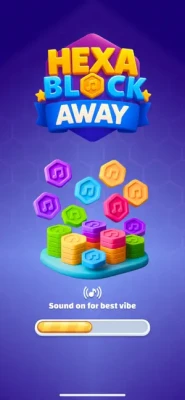
Hexa Block Away: Melody Puzzle takes the familiar idea of moving blocks away from a puzzle board and gives it a relaxing musical presentation. Each successful movement contributes to clearing the board, while the accompanying piano notes make the process feel more like a calm interactive experience than a traditional high-pressure puzzle game.
The game is published by Amanotes Pte. Ltd. and is available on iPhone and iPad. The App Store listing currently describes it as a free game with optional in-app purchases and a 4+ age rating.
Main Gameplay Features
Hexa Block Puzzle Gameplay
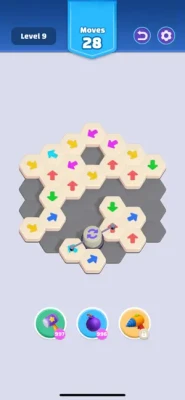
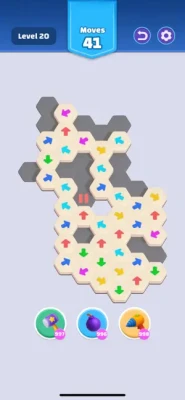
The central mechanic is straightforward: move the hexagonal pieces in the correct direction so they can leave the board. The challenge comes from understanding which blocks can move first and which pieces are blocking the path of others.
The controls are intentionally simple, making the game easy to pick up without a lengthy tutorial.
Relaxing Piano Music
Music is one of the game's defining features. Tile interactions produce gentle piano notes, creating a soothing rhythm as you work through a puzzle.
This makes Hexa Block Away particularly appealing if you prefer puzzle games that emphasize concentration and relaxation rather than fast reactions.
Artwork to Unlock
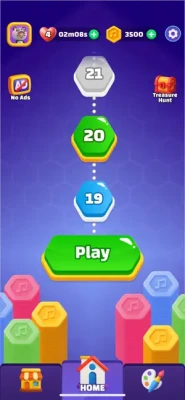
Completing puzzles gradually reveals artwork. Instead of simply finishing a board and immediately moving to another, players have a visual reward that develops as they progress through the levels.
Minimalist Visual Style
The clean interface, soft colors and relatively uncluttered presentation help keep attention on the puzzle itself.
Short or Long Sessions
There is no requirement to dedicate a large amount of time to every session. You can solve a few puzzles during a break or continue for a longer session when you want something relaxing to play.
How to Play Hexa Block Away
The basic concept is easy to understand, but later boards require considerably more planning.
- Look at the entire board before moving anything.
- Identify blocks with a clear route out.
- Remove pieces that are blocking several other pieces.
- Avoid making unnecessary moves.
- Recheck the board after every important removal.
- Save useful moves when the board becomes crowded.
- Work toward a complete solution rather than simply removing the easiest block.
The biggest mistake beginners make is treating every available move as equally valuable. It isn't. A move that removes one block but creates a dead end can be much worse than a move that temporarily changes the board while opening several future routes.
Full Strategy Guide
1. Study the Board Before Your First Move
Don't immediately start sliding pieces simply because a move is available.
Spend a few seconds identifying:
- Blocks that can leave immediately
- Pieces trapped behind others
- Potential bottlenecks
- Blocks occupying important spaces
- Groups of pieces that appear dependent on one another
This small pause can prevent a chain of unnecessary moves later.
2. Find the Blocking Pieces
The most useful piece is not always the easiest one to remove.
Look for blocks that prevent multiple other pieces from moving. Removing one strategically important hexagon can sometimes open several routes at once.
Think of these pieces as keys rather than ordinary tiles.
3. Work Backward From the Most Difficult Area
When the board becomes complicated, identify the piece that appears hardest to remove.
Then ask:
What needs to move before this piece can escape?
That question often gives you a better solution than simply searching for the next obvious move.
4. Avoid Random Sliding
Random moves can make a puzzle look easier temporarily while actually making the final solution harder.
Before moving a block, consider:
- Where will it end up?
- Does it open another route?
- Does it block another important piece?
- Will I need to move it again later?
If the answer is unclear, examine another option first.
5. Prioritize Multi-Purpose Moves
A strong move usually accomplishes more than one thing.
For example, the best move may:
- Clear one block
- Open a route
- Give another tile room to move
- Reduce congestion around the center
These moves create momentum and are particularly valuable when move limits become restrictive.
6. Protect Your Remaining Moves
The game's later levels can become significantly more demanding. Player reviews specifically report difficulty around the higher levels, including one review describing Level 48 as having 35 tiles and 36 moves.
Because of that, don't assume you can recover from several inefficient moves at the end.
Try to maintain a small margin whenever possible.
7. Don't Rush Difficult Levels
When a puzzle appears impossible, restarting immediately isn't always the best answer.
Instead, identify where the solution began to go wrong.
Ask:
- Which move created the bottleneck?
- Did I remove a useful block too early?
- Did I leave an important piece trapped?
- Could two pieces have been exchanged in a different order?
Learning the structure of the board is more valuable than repeatedly making the same sequence.
8. Use Helpers Carefully
Some versions of the game offer assistance such as bombs, hammers or extra moves, and the App Store listing also shows optional purchases and ad-supported elements.
Treat these tools as emergency options rather than your normal strategy.
A good approach is:
Try → identify the mistake → restart → improve the solution → use a helper only when necessary.
That keeps the puzzle-solving aspect meaningful.
9. Focus on Efficiency
A successful completion is good, but an efficient completion is better.
Once you understand a level, try to solve it again with fewer unnecessary movements.
This is especially useful if you care about leaderboard performance. The game has added a leaderboard feature in recent updates.
10. Stay Calm on Hard Boards
The relaxing presentation can actually help here.
If you get stuck, stop moving pieces for a moment and look at the board again. Puzzle solutions often become easier to see after you stop focusing on the last move you made.
Advanced Hexa Puzzle Tips
Look for Forced Moves
Sometimes only one block has a genuinely useful route. Finding that forced move can simplify the entire puzzle.
Identify Dead Zones
A piece moved into the wrong area can become difficult to reposition. Before sliding a block, consider whether its new position will restrict future movement.
Clear the Center Carefully
Central pieces often interact with several surrounding blocks. Removing one can completely change the board, so don't treat center pieces like ordinary tiles.
Solve in Layers
Instead of trying to understand every block simultaneously, divide the puzzle mentally:
Outer pieces → blocking pieces → central pieces → final trapped pieces.
This makes complicated boards much easier to read.
Think Two or Three Moves Ahead
You don't always need to predict the entire solution.
Simply asking "What will this move allow me to do next?" is often enough to avoid mistakes.
Difficulty and Progression
Hexa Block Away begins with an accessible puzzle concept, but the difficulty becomes more noticeable as boards become more crowded and the number of possible interactions increases.
The developer has released updates aimed at improving level design and progression, including new levels, UI improvements, performance improvements and a leaderboard. The latest listed version is 1.4.0.
However, current App Store reviews are mixed. One player praised the early experience but criticized the difficulty and move requirements around Level 48, while another reported that higher levels became extremely difficult.
That is worth knowing before starting: the game is relaxing in presentation, but it is not necessarily easy throughout the entire progression.
Is Hexa Block Away: Melody Puzzle Worth Playing?
If you enjoy relaxing logic games, hexagon puzzles, tile-clearing challenges and calming background music, there is a lot to like here.
The combination of:
- Hexa block puzzles
- Piano sounds
- Artwork rewards
- Minimalist visuals
- Short puzzle sessions
- Gradual progression
- Leaderboard competition
gives the game a distinct identity.
The main concern is difficulty at later stages. Current App Store feedback includes complaints about demanding move limits and increasingly difficult levels, so players looking for a consistently effortless experience should keep that in mind.
Pros and Cons
Pros
- Relaxing hexa puzzle concept
- Simple controls
- Pleasant piano feedback
- Artwork rewards
- Clean visual presentation
- Suitable for short sessions
- Leaderboard adds an extra challenge
- Easy to understand but increasingly strategic
Cons
- Later levels can become quite difficult
- Some players have criticized move limitations
- Optional purchases are available
- Advertising is present
- The current App Store rating is low, although based on only three ratings at the time of checking
Tips for Beating Hard Levels
If you're stuck on a difficult Hexa Block Away level, use this checklist:
1. Stop making random moves.
2. Find the blocks with the fewest escape options.
3. Determine which pieces are blocking them.
4. Remove blockers in the correct order.
5. Avoid using a move simply because it is available.
6. Keep an eye on your remaining moves.
7. If the board becomes unsolvable, restart and change the first few moves rather than repeating the same sequence.
8. Save helpers for situations where they genuinely change the outcome.
9. Once you solve the level, remember the successful order for future attempts.
Game Information
| Information | Details |
|---|---|
| Game | Hexa Block Away: Melody Puzzle |
| Developer | Amanotes Pte. Ltd. |
| Genre | Hexa puzzle / relaxing logic puzzle |
| App Store Category | Music |
| Platforms | iPhone, iPad |
| Age Rating | 4+ |
| Language | English |
| Size | About 311 MB |
| Business Model | Free with in-app purchases |
| Ads | Yes |
| Latest listed version | 1.4.0 |
| iOS Requirement | iOS 15.0 or later |
The App Store currently lists support for iPhone and iPad, with iOS 15.0 or later required. It also lists Mac compatibility on Apple Silicon Macs running macOS 12.0 or later.
Recent Updates
Recent updates have focused on improving the overall experience rather than changing the core puzzle concept.
Notable additions and improvements include:
- New levels
- Improved level design
- Better early and mid-game progression
- Leaderboard functionality
- UI and UX improvements
- Refined tile visuals
- Performance improvements
- Bug fixes and stability improvements
Frequently Asked Questions
Is Hexa Block Away: Melody Puzzle free?
Yes. The App Store lists the game as free with optional in-app purchases.
Is Hexa Block Away a difficult game?
The basic mechanics are easy to learn, but later levels can become much more challenging. Some current player reviews specifically criticize the difficulty of higher levels.
Does Hexa Block Away have music?
Yes. Musical feedback is a major part of the experience, with gentle piano notes accompanying tile movements.
Can you unlock artwork?
Yes. Completing puzzles gradually reveals artwork as part of the game's progression.
Does Hexa Block Away have a leaderboard?
Yes. A leaderboard was added in a recent update, allowing players to compare their performance.
What devices support the game?
The App Store lists iPhone and iPad support with iOS 15.0 or later. It also lists Apple Silicon Mac compatibility with macOS 12.0 or later.
Final Verdict
Hexa Block Away: Melody Puzzle is best described as a calm puzzle game with a deceptively strategic core. Its gentle piano sounds, minimalist presentation and artwork rewards make it attractive for players who want something relaxing, while the increasingly complicated boards provide enough brain-teasing challenge to keep the gameplay interesting.
The key to progressing is not speed. Study the board, identify the blocking pieces, plan several moves ahead and protect your remaining moves. Once you stop treating every available move as equally useful, the game's more complicated levels become much easier to understand.
For players who enjoy hexa puzzles, block puzzles, relaxing brain games, tile-clearing games and musical puzzle experiences, Hexa Block Away: Melody Puzzle is worth trying—provided you are prepared for a noticeable increase in difficulty later in the progression.
Rate the Game
User Reviews















Popular Games



















 Android
 iOS
iOS Windows
 Xbox
Xbox