


Latest Version
September 09, 2026
Tripledot Studios
Puzzle
iOS
0
Report a Problem
More About :game
Developed by Tripledot Studios, Fix It Puzzle is designed for players who enjoy casual brain games, 3D puzzles, spatial challenges, and relaxing gameplay. The App Store listing currently describes hundreds of levels, a collection of restored objects, intuitive tap-and-rotate controls, and a calming soundtrack.
What Is Fix It Puzzle?
Fix It Puzzle turns repairing broken objects into a simple but surprisingly engaging brain challenge.
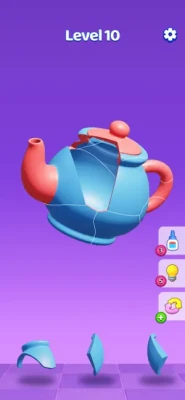
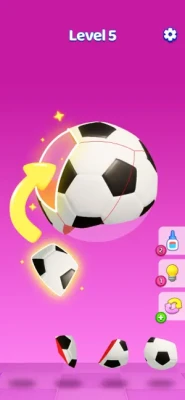
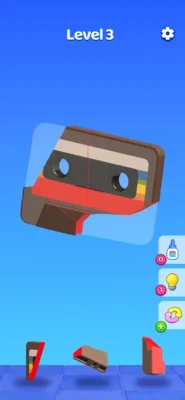
At the beginning of a puzzle, an object is broken into multiple pieces. Your task is to inspect the fragments, understand their shapes and positions, rotate them in 3D, and place them into the correct locations.
The appeal comes from the combination of visual recognition, spatial reasoning, rotation, and problem solving. There is no need to rush through a level. You can take your time examining the object and deciding where each fragment should go.
The game is particularly suitable for players who enjoy:
- 3D puzzle games
- Brain-training games
- Relaxing puzzle games
- Spatial reasoning challenges
- Object restoration puzzles
- Casual mobile games
- Logic and observation games
- Satisfying completion-based gameplay
How Fix It Puzzle Gameplay Works
The basic gameplay loop is easy to understand:
- Start with a broken or incomplete object.
- Examine the available pieces.
- Pick up a fragment.
- Rotate the piece in 3D.
- Compare its shape with the unfinished object.
- Find the position where it belongs.
- Place the piece correctly.
- Continue until the object is completely restored.
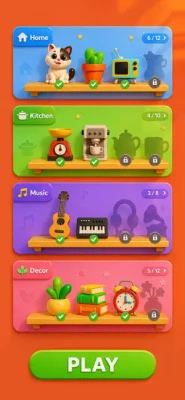
- Add the completed object to your collection.
The controls are intentionally simple, but later puzzles can demand considerably more attention because the objects become more complex. Apple describes the controls as tap, rotate, and place, with increasingly difficult objects designed to keep players engaged.
Complete Fix It Puzzle Strategy Guide
1. Don't Start by Randomly Placing Pieces
One of the biggest mistakes in a 3D repair puzzle is trying to place fragments immediately without understanding the object.
Take a few seconds to study the whole structure first.
Look for:
- Large missing sections
- Unusual shapes
- Flat surfaces
- Curved edges
- Distinctive corners
- Pieces with obvious attachment points
- Symmetrical sections
Understanding the overall shape gives you a reference point for everything that follows.
2. Start With the Most Recognizable Pieces
Not every fragment is equally difficult.
Some pieces have distinctive shapes that make their location relatively obvious. Start with these whenever possible.
For example, a fragment with a unique curve or a highly recognizable edge can reveal which part of the object you are rebuilding.
Once that piece is correctly positioned, the surrounding structure becomes easier to understand.
General rule: solve the pieces that give you the most information first.
3. Use Shape Before Color
Color can be useful, but shape is usually the stronger clue.
When examining a fragment, ask:
- What surfaces does this piece have?
- Is it curved or flat?
- Does it have a unique corner?
- Does it appear to connect to another section?
- What orientation would make its surfaces continue naturally?
A piece may look visually similar to several locations, while its geometry may only fit one.
4. Rotate the Object, Not Just the Piece
A common mistake is staring at a fragment from one angle and trying to force it into place.
Instead, change your viewing angle.
A piece that looks confusing from the front may become obvious when viewed from the side, top, or rear.
Use the 3D perspective to answer questions such as:
Where does this surface continue?
Which direction should this edge face?
Does the depth of the piece match the surrounding structure?
The ability to freely examine 3D objects is one of the central mechanics of Fix It Puzzle.
5. Pay Attention to Negative Space
Sometimes the easiest way to identify a piece is to study the empty space rather than the fragment itself.
Look at the hole or unfinished area and determine:
- Its approximate size
- Its shape
- Its depth
- Its corners
- Its surrounding surfaces
Then search for a fragment that matches those characteristics.
This approach is especially helpful when several pieces appear similar.
6. Solve the Outside Before the Middle
When possible, use recognizable exterior edges to establish the object's boundaries.
Outer pieces often provide stronger visual clues because they have:
- Straight edges
- Curved outlines
- Distinct corners
- Visible surfaces
Once the outside structure is established, the interior pieces become easier to identify.
This is similar to solving a traditional jigsaw puzzle: establish the framework first, then work toward the center.
7. Use Symmetry as a Clue
Many objects contain symmetrical or repeated structures.
If one side of an object has a recognizable shape, check whether another part should mirror it.
Symmetry can help you determine:
- Which direction a piece should face
- Where a matching piece might belong
- Whether your current placement is correct
- Which fragments are likely to be related
However, don't assume that every object is perfectly symmetrical. Treat symmetry as evidence rather than an absolute rule.
Advanced Fix It Puzzle Tips
8. Think in Three Dimensions
Don't treat Fix It Puzzle like a flat jigsaw.
A piece may appear to fit because its outline looks correct, but the depth or orientation may still be wrong.
Always consider three factors:
Shape + Position + Orientation
A correct solution requires all three.
9. Compare Adjacent Surfaces
When two pieces appear to connect, inspect the surfaces around their meeting point.
Ask whether:
- The edges continue naturally
- The curves line up
- The depth looks correct
- The surfaces form a consistent structure
This is much more reliable than simply matching colors.
10. Use Completed Sections as Anchors
Once you successfully place several pieces, stop thinking about them individually.
Treat the completed section as one large reference point.
Then ask:
What part of the remaining object should connect to this section?
This reduces the number of possible positions for the remaining pieces and makes difficult puzzles easier to manage.
11. Don't Overthink Easy Pieces
Some fragments have an obvious location.
If the shape clearly matches one area, place it and move forward.
Spending too much time analyzing an easy piece can make the puzzle feel more complicated than it actually is.
Save your deeper analysis for fragments that genuinely have multiple possible positions.
12. When Stuck, Change Your Perspective
If you have been looking at the same piece for too long, don't keep repeating the same approach.
Instead:
- Rotate the object.
- Inspect the opposite side.
- Examine the piece from another angle.
- Look at the empty space.
- Compare surrounding surfaces.
- Return to the piece with a fresh perspective.
A new viewpoint can reveal information that was hidden before.
Best Strategy for Difficult Fix It Puzzle Levels
When a level becomes complicated, use this sequence:
Step 1: Survey the Object
Don't touch anything immediately. Understand its general shape.
Step 2: Identify Unique Pieces
Look for fragments with unusual curves, corners, or surfaces.
Step 3: Establish the Framework
Use obvious exterior pieces to understand the object's boundaries.
Step 4: Build Connected Sections
Instead of solving isolated pieces, create recognizable sections.
Step 5: Rotate Frequently
Check the puzzle from multiple angles.
Step 6: Use Negative Space
Match fragments to the empty areas they appear designed to fill.
Step 7: Confirm Orientation
A piece isn't necessarily correct simply because its outline fits.
Step 8: Finish the Remaining Gaps
Once most of the object is restored, the remaining pieces should become easier to identify.
Common Mistakes to Avoid
Forcing a Piece Into a Similar-Looking Space
Two areas can look similar while having different geometry.
If a piece doesn't naturally fit, reconsider the placement rather than forcing it.
Ignoring Depth
A correct 3D solution requires more than matching a two-dimensional outline.
Staying on One Camera Angle
A hidden surface can contain the clue you need.
Moving Too Quickly
Fix It Puzzle doesn't require a frantic pace. The game is designed around relaxed observation and solving.
Treating Every Piece as Independent
Some pieces make more sense when viewed as part of a larger completed section.
How to Improve Your Spatial Puzzle Skills
Fix It Puzzle rewards several useful skills.
Spatial Awareness
Practice mentally imagining how an object changes when rotated.
Visual Recognition
Learn to notice small differences between similar shapes.
Logical Elimination
If a fragment clearly cannot fit several locations, eliminate those possibilities.
Patience
Taking a few extra seconds to inspect an object can prevent many incorrect placements.
Three-Dimensional Thinking
Instead of seeing only the front surface, imagine the entire object as a solid structure.
Why Fix It Puzzle Is Relaxing
Fix It Puzzle combines a brain challenge with a low-pressure presentation.
The App Store description specifically emphasizes that there is no clock, allowing players to think, rotate, and place pieces at their own pace. It also features a calming soundtrack and a collection where completed objects can be admired after restoration.
That makes the game a good choice for players who want something mentally engaging without the pressure commonly found in timed puzzle games.
Fix It Puzzle Features
3D Object Restoration
Rebuild broken objects by positioning their individual fragments.
Simple Controls
The core interaction revolves around tapping, rotating, and placing pieces.
Increasing Difficulty
The puzzles become more complex as you progress.
Hundreds of Levels
The App Store listing describes hundreds of puzzles to complete.
Object Collection
Completed objects are added to a collection or gallery.
Relaxing Soundtrack
The game includes calming music designed to complement the slower puzzle experience.
No Timer Pressure
You can focus on solving instead of racing against a countdown.
Fix It Puzzle Difficulty
The game begins with relatively approachable puzzles before introducing more complicated objects.
The main source of difficulty isn't fast reflexes. Instead, the challenge comes from figuring out:
- Where a fragment belongs
- Which direction it should face
- How its shape connects with neighboring pieces
- What the finished object should look like
- Which perspective reveals the correct solution
This makes the difficulty more about observation and spatial reasoning than speed.
The developer has also released updates that include new levels and difficulty/level optimization.
Fix It Puzzle Tips for Beginners
If you're playing for the first time, remember these five rules:
1. Look before placing.
Understand the object before making your first move.
2. Find distinctive shapes.
Unique pieces are usually easier to identify.
3. Rotate everything.
The correct answer may only be visible from another angle.
4. Build from recognizable areas.
Completed sections make the remaining puzzle easier.
5. Don't rush.
The game is designed to let you solve puzzles at your own pace.
Is Fix It Puzzle Good for Casual Players?
Yes. Fix It Puzzle is particularly well suited to players who enjoy short, relaxing sessions but still want some mental stimulation.
Its simple controls make it easy to understand, while the increasing complexity of the objects gives the game more depth than a basic tap-to-match puzzle.
It can work well for:
- Casual gamers
- Puzzle fans
- Families
- Players who enjoy 3D games
- Fans of brain-training challenges
- People looking for relaxing mobile games
- Players who enjoy object-building and restoration puzzles
The App Store currently lists the game as a free puzzle title with a 4+ age rating.
Fix It Puzzle Pros and Cons
Pros
- Easy-to-understand controls
- Relaxing gameplay
- Satisfying 3D restoration mechanic
- Increasing puzzle difficulty
- Hundreds of levels
- No timer pressure
- Collection of completed objects
- Encourages spatial thinking
Cons
- Players looking for fast-paced action may find it too relaxed
- Similar-looking pieces can become challenging
- Later puzzles require more careful observation
- The game contains advertising according to its App Store listing.
Fix It Puzzle Game Information
Game: Fix It Puzzle
Developer: Tripledot Studios
Genre: Puzzle
Platform: iPhone and iPad
Age Rating: 4+
Price: Free
Languages: English and Polish
iOS Requirement: iOS 13.0 or later
iPad Requirement: iPadOS 13.0 or later
Mac: Requires macOS 11.0 or later with an Apple M1 chip or later
Gameplay: 3D object restoration and spatial puzzles
Modes: Level-based puzzle progression
Core Mechanics: Rotate, inspect, position, and restore
Latest App Store version listed: 1.2.0
Developer updates: New levels and difficulty/level optimization have been added.
Fix It Puzzle vs. Traditional Jigsaw Puzzles
Traditional jigsaw puzzles usually focus on matching two-dimensional pieces.
Fix It Puzzle adds another layer because the objects can be examined in 3D.
Instead of asking only:
"Where does this piece go?"
you also have to ask:
"Which direction should it face?"
and:
"How does its three-dimensional shape connect to the object?"
That makes the experience especially appealing to players who enjoy spatial puzzles rather than simple matching games.
Fix It Puzzle Strategy at a Glance
| Situation | Best Approach |
|---|---|
| New level | Study the entire object first |
| Easy piece | Place obvious pieces quickly |
| Similar pieces | Compare geometry carefully |
| Can't find a location | Rotate the object |
| Piece looks correct | Check depth and orientation |
| Several pieces remain | Build connected sections |
| Completely stuck | Examine negative space |
| Difficult final pieces | Use surrounding completed areas |
| Making repeated mistakes | Stop and change perspective |
Frequently Asked Questions
What is Fix It Puzzle?
Fix It Puzzle is a 3D casual puzzle game where players restore broken objects by rotating and placing individual fragments in their correct positions.
How do you play Fix It Puzzle?
Study the broken object, select a fragment, rotate it in 3D, determine where it belongs, and place it correctly. Continue until the entire object has been restored.
Does Fix It Puzzle have a timer?
The App Store description says the game does not use a clock for its puzzles, allowing players to solve them at their own pace.
Is Fix It Puzzle difficult?
The early puzzles are designed to be approachable, while later objects become more complex and require stronger observation and spatial reasoning.
How do you solve difficult Fix It Puzzle levels?
Start with distinctive pieces, establish the object's outer structure, rotate the object from different viewpoints, and use completed sections as reference points.
Does Fix It Puzzle have 3D puzzles?
Yes. Three-dimensional object rotation and placement are central to the gameplay.
How many levels are in Fix It Puzzle?
The App Store description currently states that the game contains hundreds of levels.
Is Fix It Puzzle relaxing?
Yes. The game is specifically presented as a relaxing puzzle experience, with no timer, a calming soundtrack, and a focus on careful object restoration.
What devices support Fix It Puzzle?
The App Store lists iPhone and iPad support, with iOS 13.0 or later and iPadOS 13.0 or later. It also lists compatibility with Apple-silicon Macs and Apple Vision.
Final Verdict
Fix It Puzzle takes a simple idea—repairing broken objects—and turns it into a satisfying 3D spatial puzzle experience. Its greatest strength is the combination of easy controls and increasingly challenging visual problems.
There is no need to memorize complicated rules or master difficult controls. The real challenge is learning to look at an object from different perspectives and understand how individual pieces fit together.
For players who enjoy 3D puzzles, brain games, relaxing mobile games, spatial reasoning, object restoration, and casual puzzle challenges, Fix It Puzzle is an easy game to pick up while still offering enough complexity to keep the brain engaged.
The most important strategy is simple: don't rush the placement—understand the object first, rotate it often, and let its shape tell you where each piece belongs.
Rate the Game
User Reviews










Popular Games

















 Android
 iOS
iOS Windows
 Xbox
Xbox