
Latest Version
September 09, 2026
Tripledot Studios
Puzzle
iOS
0
Report a Problem
More About :game
Feed the Frogs: Sort Puzzle is a color sorting and sand puzzle game developed by Tripledot Studios. Instead of sorting colored liquids in bottles or arranging traditional blocks, the game uses flowing sand and frog-shaped containers to create its own take on the sorting puzzle genre.
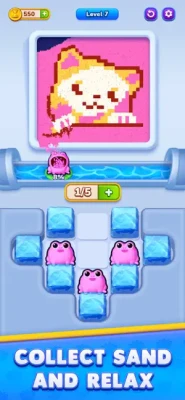
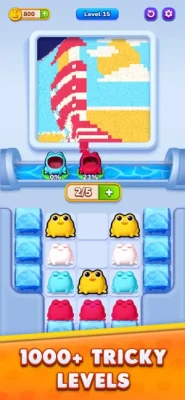
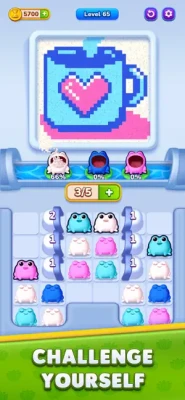
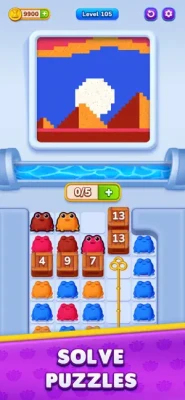
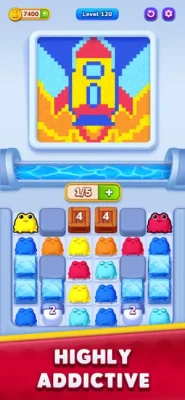
Each puzzle begins with a colorful pixel-art image. As the level progresses, the picture breaks apart and colored sand begins flowing downward. Frogs move along a conveyor beneath the falling sand, and your objective is to make sure each frog receives the correct color.
What makes the game interesting is that you cannot simply match colors at your leisure. The moving conveyor, changing layers, and limited opportunities to position the puzzle elements mean that you need to think ahead.
How to Play Feed the Frogs
The controls are designed to be simple, but solving the more difficult stages requires considerably more thought.
Your main objective is to:
- Identify the color of each incoming sand stream.
- Match the sand with the appropriate frog.
- Position the available cauldrons at the right moment.
- Allow the correct colors to reach the correct frogs.
- Continue sorting until every required color has been completed.
- Avoid wasting opportunities that can make later sections harder.
The most important skill is learning to look at what is coming next rather than concentrating only on the sand currently falling.
A move that appears correct immediately may create a problem a few seconds later when another color or frog arrives.
Sand Sorting Gameplay
The flowing sand is one of the game's most distinctive features.
Rather than presenting a static color-matching board, Feed the Frogs turns the puzzle into a constantly changing scene. Sand cascades from pixel-art structures while frogs travel along a conveyor underneath.
This creates a satisfying combination of:
Color matching + timing + spatial planning + puzzle solving
The visual movement also makes successful solutions feel rewarding. Watching the correct sand flow into the matching frog provides the kind of small, satisfying feedback that makes sorting games easy to pick up for short sessions.
Pixel Art and Visual Style
Feed the Frogs has a colorful pixel-art presentation that gives the game a distinctive personality.
The artwork is not simply a background decoration. Pixel-art pictures gradually dissolve as their colored layers turn into flowing sand. This means the visual design is directly connected to the puzzle mechanic.
As you solve a level, you can watch the original image transform while different colors are revealed.
The combination of:
- Pixel-art pictures
- Colorful sand
- Animated frogs
- Moving conveyors
- Sparkling visual effects
- Flowing particle effects
creates a calm and playful atmosphere.
Hidden Color Layers
One of the elements that adds depth to Feed the Frogs is its hidden color layers.
At first glance, a puzzle may appear straightforward because only some of its colors are immediately visible. As the sand flows away, additional layers can be revealed.
This means you need to consider the puzzle as a sequence rather than a single color-matching exercise.
A good solution therefore involves asking:
What color is coming next?
Which frog will need it?
Where should the available cauldron be positioned?
Will this move interfere with a later color?
Thinking one or two steps ahead becomes increasingly important as the puzzles become more complicated.
Difficulty and Level Progression
Feed the Frogs starts with an approachable concept and gradually introduces more demanding situations.
Early levels allow you to learn the basic relationship between sand, colors, frogs, and containers. Later stages increase the challenge through faster movement, tighter layouts, additional colors, and more complicated pixel-art layers.
The difficulty comes less from complicated controls and more from making the right decision at the right time.
That makes the game suitable for players who enjoy easy-to-learn puzzle games with progressively harder challenges.
Tips and Strategy Guide
1. Watch Before Making Your Move
Do not immediately react to the first color you see.
Take a moment to observe the sand flow and identify which frogs are approaching. Understanding the sequence can prevent mistakes later in the level.
2. Think About the Next Color
The most useful habit is to look ahead.
If you send a color toward the correct frog now, consider what will happen when the next color arrives. A successful move should ideally make the following move easier rather than harder.
3. Pay Attention to the Conveyor
The frogs are moving, so the correct position can change quickly.
Instead of thinking only about where a frog is now, consider where it will be when the sand reaches it.
4. Don't Waste Useful Positions
Cauldrons and other puzzle elements can determine how efficiently you handle the incoming sand.
A careless placement may leave you with fewer good options when another color appears.
5. Look for Hidden Layers
When a pixel-art section begins to dissolve, pay attention to what is being revealed.
A newly exposed color can change your priorities, so avoid committing too far ahead without checking what is underneath.
6. Use Undo When a Move Goes Wrong
The undo feature can be particularly useful when you realize that a seemingly harmless move has created a difficult situation.
Rather than continuing with a bad setup, reconsider the previous decision.
7. Slow Down on Difficult Levels
Feed the Frogs is designed around timing, but rushing is not always the best approach.
On harder puzzles, carefully observing the sequence can be more valuable than making fast moves.
Helpful Puzzle Tools
Feed the Frogs includes several tools intended to help when a puzzle becomes difficult.
Undo
The undo function lets you reconsider a previous decision instead of being forced to continue from a mistake.
Extra Cauldrons
Additional cauldrons can provide more flexibility when dealing with complicated sorting situations.
Reveal Layers
Layer-reveal tools can help you understand what is hidden within a puzzle and make better decisions about the colors that are coming next.
These tools are especially useful on levels where one incorrect decision can make the remaining sequence much more difficult.
Why Feed the Frogs Is Satisfying to Play
The appeal of Feed the Frogs comes from the combination of simple rules and increasingly complex decisions.
You do not need to memorize complicated controls or learn a long list of mechanics. Instead, the challenge comes from recognizing colors, following the movement of the frogs, predicting the sand flow, and planning your next move.
There is also a strong visual reward when a puzzle works correctly.
The sand flows, colors match, frogs are filled, and the pixel-art image gradually disappears.
That makes the game suitable for players looking for a relaxing puzzle game, color sorting game, brain teaser, or casual game for short sessions.
Is Feed the Frogs Difficult?
The game is easy to understand but can become difficult to master.
The opening stages are designed to introduce the sorting concept, while later puzzles require more attention to timing and sequence.
Players who are familiar with color sorting games should understand the basic idea quickly. However, the moving frogs and flowing sand introduce additional variables that can make advanced levels more challenging than traditional static sorting puzzles.
Is Feed the Frogs a Relaxing Game?
Yes. The game is specifically designed around a calm visual experience.
The App Store describes it as a no-pressure puzzle experience without a conventional timer, allowing players to concentrate on the flowing sand and color sorting rather than racing against a countdown.
That makes it a good choice for players who enjoy calming puzzle games, relaxing brain games, satisfying sorting games, and casual gameplay.
Main Features
- Hundreds of handcrafted puzzle levels
- Color sorting gameplay
- Flowing sand physics
- Pixel-art designs
- Moving frog containers
- Conveyor-based gameplay
- Hidden color layers
- Progressive difficulty
- Undo tool
- Extra cauldron options
- Layer reveal assistance
- Color matching challenges
- Relaxing visual effects
- Simple controls
- Short-session-friendly gameplay
The App Store listing specifically highlights hundreds of levels, hidden color layers, sand physics, frog containers, and the available puzzle assistance tools.
Feed the Frogs Game Information
| Information | Details |
|---|---|
| Game Title | Feed the Frogs: Sort Puzzle |
| Developer | Tripledot Studios Limited |
| Genre | Puzzle |
| Gameplay Style | Color Sorting / Sand Puzzle |
| Platforms | iPhone, iPad |
| Age Rating | 13+ |
| Languages | English plus 9 additional languages |
| Game Size | About 304.8 MB |
| Business Model | Free with in-app purchases |
| Latest App Store Version | 1.0.1 |
| Core Challenge | Sort colored sand into matching frogs |
| Visual Style | Colorful pixel art |
| Key Mechanics | Sand flow, color matching, moving frogs, hidden layers |
The App Store currently lists iOS 13 or later as required for iPhone and iPad, with a listed size of approximately 304.8 MB.
Platforms and Compatibility
Feed the Frogs: Sort Puzzle is available for iPhone and iPad. The current App Store listing requires iOS 13.0 or later, while iPad compatibility is also listed. Mac compatibility is available on Apple Silicon Macs running macOS 11.0 or later, according to the App Store information.
The game is also available on Android, where the listing describes the same sand-sorting gameplay and pixel-art puzzle concept.
Updates
The current App Store version history lists version 1.0.1, released April 29, 2026, with bug fixes and performance improvements. The original version 1.0 was released April 24, 2026.
Because Feed the Frogs is a relatively new puzzle game, future updates may expand its level selection, improve performance, or introduce additional content.
Pros and Cons
Pros
- Easy to understand
- Interesting color sorting mechanic
- Relaxing presentation
- Satisfying sand physics
- Attractive pixel-art visuals
- Hundreds of levels
- Increasing difficulty
- Useful assistance tools
- Good for short or longer puzzle sessions
Cons
- Players looking for action may find the gameplay too slow
- Later levels can require considerable concentration
- The basic color-sorting concept may feel familiar to fans of the genre
- In-app purchases are available
Who Should Play Feed the Frogs?
Feed the Frogs is a good fit for players who enjoy:
- Color sorting games
- Sand sorting puzzles
- Brain games
- Logic puzzles
- Casual mobile games
- Relaxing puzzle games
- Pixel-art games
- Satisfying physics games
- Matching and sorting challenges
- Short puzzle sessions
It is particularly appealing if you like games that start simple but gradually introduce more strategic decision-making.
Final Verdict
Feed the Frogs: Sort Puzzle takes the familiar idea of color sorting and gives it a distinctive twist with flowing sand, moving frogs, pixel-art pictures, and hidden layers.
Its strongest feature is the way the visual presentation and gameplay work together. You are not simply matching colors on a static board; you are watching an image dissolve while trying to control where its colored sand goes.
The result is a puzzle game that is easy to pick up, visually satisfying, and increasingly challenging as the levels become more complex.
If you enjoy relaxing brain games, color sorting puzzles, sand puzzles, and casual mobile games, Feed the Frogs is worth trying.
Frequently Asked Questions
What is Feed the Frogs: Sort Puzzle?
Feed the Frogs is a color sorting puzzle game where players guide flowing colored sand into matching frogs while solving increasingly challenging levels.
How do you play Feed the Frogs?
Watch the incoming sand, identify its color, and position the puzzle elements so that the correct sand reaches the matching frog. Timing and planning become increasingly important in later levels.
Is Feed the Frogs a color sorting game?
Yes. Color matching and sorting are at the heart of the gameplay, but the game adds moving frogs, flowing sand, pixel-art layers, and timing-based decisions.
Does Feed the Frogs have many levels?
Yes. The game's listings describe hundreds of handcrafted levels featuring different pixel-art designs and progressively more difficult puzzles.
Is Feed the Frogs relaxing?
Yes. The game emphasizes flowing sand, calming visuals, and no-pressure puzzle sessions rather than traditional timed gameplay.
Does Feed the Frogs have puzzle helpers?
Yes. The game includes tools such as undo, extra cauldrons, and options for revealing layers.
What platforms is Feed the Frogs available on?
The game is available on iPhone and iPad, with Mac compatibility listed for Apple Silicon devices. It is also available on Android.
Is Feed the Frogs free?
The game is listed as free to play with optional in-app purchases.
What makes Feed the Frogs different from other sorting games?
Its combination of flowing sand, moving frog containers, pixel-art pictures, and hidden color layers gives the traditional sorting concept a more dynamic presentation.
Rate the Game
User Reviews









Popular Games




















 Android
 iOS
iOS Windows
 Xbox
Xbox