

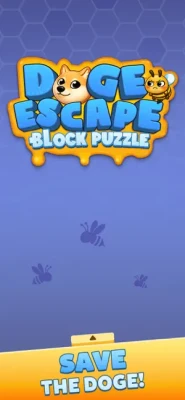
Latest Version
September 28, 2026
UNICO STUDIO
Puzzle
iOS
0
Report a Problem
More About :game
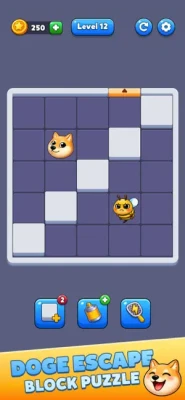
The central idea is simple: find the right sequence of moves before Doge reaches danger. As the puzzles become more complicated, the board introduces larger blocks, locked blocks, moving enemies, beehives, and special threats that can change the situation while you play.
The game is available on iPhone and iPad and requires iOS/iPadOS 15 or later. The App Store lists it as a free puzzle game with advertising and optional in-app purchases.
How Doge Escape: Block Puzzle Works
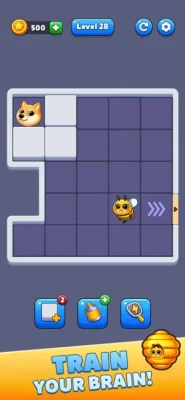
Each puzzle places Doge inside a crowded board filled with colorful blocks and hazards. Blocks have directional arrows that indicate how they can be moved.
Your objective is to:
- Examine the entire board.
- Identify the exit route.
- Slide blocks according to their arrows.
- Open space around Doge.
- Avoid bees and beehives.
- Unlock gates and restricted blocks when necessary.
- Lead Doge safely to the exit.
The important part is planning rather than simply moving blocks quickly. A move that appears useful at first can easily close the only safe route later.
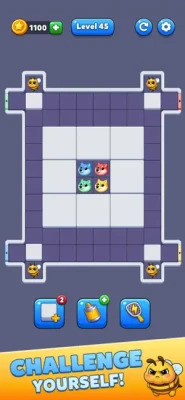
The game features 1x1, 1x2, and 2x1 blocks, locked blocks that require the correct colored Doge, several types of bee enemies, and special boosters.
Main Gameplay Features
Directional Block Puzzles
The colored blocks are the foundation of every level. Their arrows determine the direction in which they can be moved, turning each stage into a small spatial-planning problem.
Dog Rescue Missions
The goal is not merely to empty the board. You need to create a route that allows Doge to reach the exit without touching dangerous obstacles.
Different Block Sizes
Levels use several block sizes, including:
- 1x1 blocks
- 1x2 blocks
- 2x1 blocks
- Locked blocks
Larger blocks can be particularly useful because moving one may open or close several spaces at once.
Locked Blocks
Some areas cannot be opened immediately. The correct colored Doge is needed to unlock certain blocks, adding another layer of planning to the escape route.
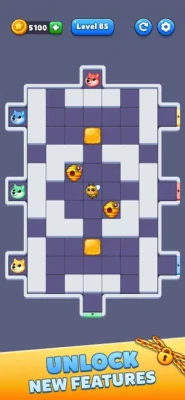
Bee Enemies and Hazards
The bees are what turn an ordinary block puzzle into a rescue challenge.
Normal Bees
Regular bees patrol the puzzle area. Their position needs to be considered before you move Doge through an opening.
Big Bee
The Big Bee occupies a 2x2 space, making it considerably harder to work around. Its larger footprint can block important routes and reduce the amount of free space available.
Hornet
The Hornet is a more disruptive enemy. According to the game's listing, it can destroy blocks and alter the puzzle layout, meaning a solution that looked safe can change during the level.
Beehive
Beehives can spawn additional bees as you make moves. This makes them particularly important targets to consider when planning a route.
The Golden Rule
Do not think only about where Doge is now. Think about where Doge will be after your next several moves.
That single habit makes later levels much easier to understand.
Doge Escape Boosters
The game includes several boosters that can help when a puzzle becomes difficult.
Hammer – Unlocks at Level 7
The Hammer allows you to smash a block that is preventing progress.
Use it when one specific block is creating a bottleneck that cannot reasonably be solved through normal movement.
Spray – Unlocks at Level 12
The Spray temporarily stuns bees and freezes their movement.
This is especially useful when you have already created a route but the timing or positioning of a bee makes the final escape dangerous.
Zap – Unlocks at Level 15
Zap uses an electric blast to clear immediate threats around the puzzle.
It can be valuable when several dangers are preventing Doge from reaching an otherwise open exit.
Full Strategy Guide for Doge Escape: Block Puzzle
1. Study the Board Before Moving Anything
Don't immediately slide the first block you see.
Look at:
- Doge's position
- The exit
- Locked blocks
- Bee positions
- The beehive
- Large blocks
- Available open spaces
- The direction of every important block
The first few seconds of observation can save many failed attempts.
2. Find the Final Route First
Before worrying about individual blocks, identify the general route Doge needs to take.
Ask:
Where does Doge need to go immediately before reaching the exit?
Then work backward.
If the exit is on the right side, determine what space Doge needs immediately before the final move. Then determine what must be cleared to create that space.
3. Don't Move Blocks Randomly
A common mistake is moving blocks simply because they can move.
Every move should have a purpose.
Good reasons include:
- Opening Doge's route
- Creating a turning space
- Moving an obstacle
- Reaching a locked block
- Separating Doge from a bee
- Preparing the next move
If a block doesn't contribute to your solution, leave it alone.
4. Use Large Blocks Carefully
A 2x1 or 1x2 block can control a surprisingly large portion of the board.
Moving one may open a path, but it can also block another route.
Before moving a large block, check both sides of the board and ask:
What spaces will become inaccessible after this move?
5. Treat Bees as Moving Obstacles
Don't plan only around their current position.
A bee may move after your action, so consider possible changes before sending Doge toward an apparently safe area.
If a bee is threatening the route, either:
- Move the route away from it.
- Remove the obstruction around Doge.
- Wait for a safer position.
- Use Spray when appropriate.
6. Deal With the Beehive Early
A beehive can become more dangerous as the puzzle continues because it can produce additional bees.
If the board gives you a realistic opportunity to neutralize the situation around the hive, consider doing so before attempting a complicated Doge route.
7. Don't Waste the Hammer
The Hammer is powerful because it directly removes a blocking piece.
Don't use it merely because you are impatient.
Save it for situations where:
- A block creates a genuine dead end.
- Removing it opens the main route.
- The remaining solution is otherwise straightforward.
8. Save Spray for Timing Problems
Spray is most useful when the puzzle is already close to completion but moving bees make the final route unsafe.
Instead of using Spray at the beginning, consider saving it until Doge is ready for the final sequence.
9. Use Zap When Multiple Threats Are Blocking Progress
Zap becomes particularly useful when several immediate threats are clustered around Doge.
Before activating it, check whether normal block movement could solve the situation. If not, Zap can turn a crowded section into a manageable one.
10. Think Several Moves Ahead
The most important skill in Doge Escape is recognizing sequences.
For example:
Move Block A → open space → move Block B → expose route → reposition Block C → move Doge → reach exit
The best move isn't necessarily the one that gives you the most open space immediately. It is often the move that creates the best next move.
How to Solve Difficult Levels
When a level feels impossible, stop moving for a moment.
Use this process:
Step 1: Locate the exit.
Step 2: Trace the route backward.
Step 3: Identify the first obstruction preventing that route.
Step 4: Determine which block must move.
Step 5: Check whether moving it creates another obstruction.
Step 6: Consider bee movement.
Step 7: Execute the sequence slowly.
Step 8: Use a booster only if the normal solution becomes impractical.
This method is much more reliable than experimenting with random moves.
Hard Mode Strategy
The harder stages are less forgiving because there is less usable space and more interaction between blocks and enemies.
For difficult puzzles:
- Don't rush.
- Analyze the whole board first.
- Prioritize Doge's safety.
- Avoid unnecessary block movement.
- Watch the beehive.
- Consider the Hornet's ability to alter the board.
- Keep boosters available for genuine emergencies.
- Reconsider the entire route after a major board change.
A puzzle can sometimes be solved simply by changing the order of your moves rather than finding a completely different route.
Common Mistakes to Avoid
Moving the First Available Block
A block that can move isn't necessarily a block that should move.
Ignoring the Exit
Players sometimes focus so heavily on clearing obstacles that they forget the exact route Doge needs to take.
Getting Too Close to Bees
An open path isn't automatically a safe path.
Using Boosters Too Early
A booster can rescue a difficult situation, but using it before understanding the puzzle can waste a valuable tool.
Forgetting About Board Changes
The Hornet can destroy blocks and change the layout, so don't assume the puzzle will remain exactly as it looked at the beginning.
Solving One Area Without Considering Another
A move that clears one section can accidentally block another. Always look at the entire board before committing to major movements.
Progression and Rewards
Doge Escape: Block Puzzle includes progression through increasingly challenging puzzles, including harder stages described by the developer as Hard Mode challenges.
The game also features global and local leaderboards, rewards, avatars, and profile frames. These systems give players additional reasons to continue beyond simply completing individual puzzles.
The Hammer, Spray, and Zap boosters become available at Levels 7, 12, and 15 respectively, providing additional tools as the puzzle difficulty develops.
Atmosphere and Presentation
Doge Escape uses a bright, playful presentation built around the recognizable Doge character, colorful blocks, animated bees, and simple puzzle-board environments.
The overall design keeps the basic puzzle concept approachable while adding enough hazards and special mechanics to make later stages more tactical.
Difficulty
The early puzzles are designed to introduce the core block-sliding concept gradually. As additional enemy types, locked blocks, larger pieces, and changing layouts appear, the game becomes increasingly dependent on planning.
The difficulty is therefore less about fast reactions and more about:
- Spatial awareness
- Sequence planning
- Risk management
- Recognizing patterns
- Predicting enemy movement
- Knowing when to use boosters
Is Doge Escape: Block Puzzle Good for Puzzle Fans?
Doge Escape is particularly suited to players who enjoy block escape games, sliding puzzles, brain teasers, dog rescue games, and casual strategy puzzles.
Its main point of difference is the rescue objective. You are not simply arranging blocks—you are building a safe route for Doge while dealing with active hazards.
Pros and Cons
Pros
- Simple controls
- Easy-to-understand core objective
- Colorful Doge-themed presentation
- Multiple block sizes
- Locked-block mechanics
- Several enemy types
- Useful puzzle boosters
- Harder challenges for experienced players
- Leaderboards and customization
- Suitable for short puzzle sessions
Cons
- Advertising is included
- Optional in-app purchases are available
- Later puzzles can become significantly more demanding
- Some levels require careful planning rather than quick experimentation
The App Store currently lists the game with advertising and optional in-app purchases.
Platform and Requirements
Developer: UNICO STUDIO
Genre: Puzzle
Platforms: iPhone, iPad
Minimum iOS: iOS 15.0
Minimum iPadOS: iPadOS 15.0
Age Rating: 4+
Business Model: Free with advertising and optional in-app purchases
The current App Store listing also supports Mac with an Apple M1 chip or later and lists Apple Vision compatibility, although the primary listed mobile platforms are iPhone and iPad.
The Google Play version is also available and currently lists 10K+ downloads, advertising, and in-app purchases.
Recent Updates
The App Store version history shows repeated bug-fix and performance-improvement releases, including versions 1.0.42 and 1.0.37. The current listing also shows a newer 1.0.43 release with bug fixes and performance improvements.
These updates suggest that the developer is continuing to refine the game's performance and stability rather than leaving the current release unchanged.
Ratings and Player Feedback
At the time of checking the US App Store listing, Doge Escape: Block Puzzle showed a 4.7/5 rating from 115 ratings.
Player feedback is not completely uniform. Some reviews praise the gameplay, while other reviewers have raised concerns about the game's treatment of bees and hornets. The developer has acknowledged that feedback rather than dismissing it.
That makes the game's content worth considering for parents, even though the App Store age rating is currently 4+.
Frequently Asked Questions
What is Doge Escape: Block Puzzle?
Doge Escape: Block Puzzle is a block-sliding puzzle game where players guide Doge through increasingly challenging boards while avoiding bees, unlocking paths, and reaching the exit.
How do you play Doge Escape?
Tap and slide blocks in the directions indicated by their arrows. The objective is to create a safe route for Doge to reach the exit without hitting bees or dangerous areas.
What enemies are in Doge Escape?
The game includes normal bees, a larger 2x2 Big Bee, Hornets, and beehives that can spawn additional bees.
When do boosters unlock?
The Hammer unlocks at Level 7, Spray at Level 12, and Zap at Level 15.
What does the Hammer do?
The Hammer destroys a block that is obstructing your route.
What does Spray do?
Spray temporarily stuns bees and freezes their movement.
What does Zap do?
Zap uses an electric blast to clear immediate threats around the puzzle.
Does Doge Escape have Hard Mode?
Yes. The developer describes the game as having hundreds of levels ranging from easier escape puzzles to Hard Mode challenges.
Does Doge Escape have leaderboards?
Yes. The game includes global and local leaderboards.
Is Doge Escape free?
The game is free to download, but the App Store listing includes advertising and optional in-app purchases.
Is Doge Escape available on Android?
Yes. A Google Play version is available under the same game name.
Final Tips for Doge Escape: Block Puzzle
The best way to approach Doge Escape is to stop thinking of each block as an individual object. Instead, view the entire board as a connected system.
Every move changes the available space.
Before sliding a block, ask:
What does this move open? What does it block? Where will the bees move? And does it bring Doge closer to a genuinely safe exit?
Once you start planning several moves ahead, the game's tougher rescue puzzles become much more manageable.
Rate the Game
User Reviews





Popular Games



















 Android
 iOS
 Windows
 Xbox