

Latest Version
September 09, 2026
Tripledot Studios
Puzzle
iOS
0
Report a Problem
More About :game
With hundreds of handcrafted levels and progressively more difficult layouts, Cube Tap Sort is designed to be easy to start but much harder to master.
What Is Cube Tap Sort?
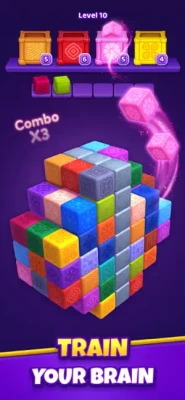
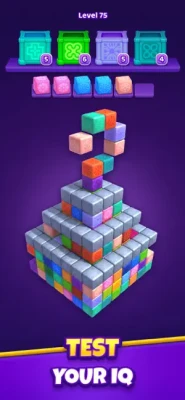
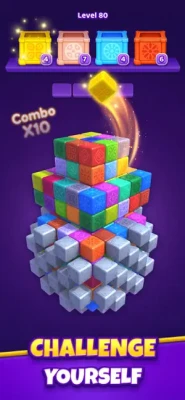
Cube Tap Sort is a 3D color-matching brain puzzle developed by Tripledot Studios. Instead of simply matching two or more identical colors, you must study a three-dimensional arrangement and remove cubes according to the active color order.
A wrong tap does not simply disappear. It goes into your buffer. If the buffer becomes full before you can clear it, the level ends.
That makes every move a small decision:
- Which cube can I safely remove?
- Which color should I expose next?
- Will this move block an important route?
- How much room is left in my buffer?
- Should I wait rather than make a risky tap?
The App Store describes the game as a puzzle that takes seconds to learn but becomes increasingly challenging as the levels progress.
How to Play Cube Tap Sort
The core mechanics are straightforward.
1. Study the 3D Structure
Before tapping, look around the entire arrangement. Cubes may be partially hidden behind or underneath other cubes.
Do not immediately tap the first matching-looking block.
2. Follow the Active Color
The game provides an order for the colors you need to clear. Focus on cubes that correspond to the currently required color.
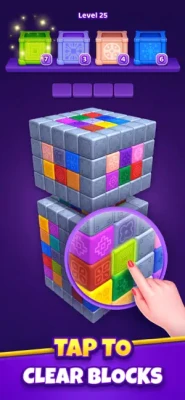
3. Tap the Correct Cubes
When you select a cube that fits the active sequence, it can be cleared.
The goal is to remove groups efficiently rather than randomly tapping around the structure.
4. Avoid Filling the Buffer
If you tap the wrong cube, it is placed into the buffer.
This is one of the most important mechanics in the entire game. A few accidental taps can turn a nearly solved puzzle into a losing position.
5. Clear the Structure
Continue exposing and removing cubes until the entire structure has been cleared.
Complete Cube Tap Sort Strategy Guide
1. Never Start Tapping Immediately
One of the biggest beginner mistakes is treating the puzzle like a reaction game.
It is not.
Take a few seconds at the beginning of each level to inspect the structure.
Look for:
- Easily accessible cubes
- Hidden cubes
- Colors that are currently required
- Cubes blocking other colors
- Areas where removing one piece could expose several others
A short inspection can prevent several unnecessary buffer moves later.
2. Think About the Next Color, Not Just the Current One
A common mistake is clearing the current color without considering what happens afterward.
Suppose red is active and you can remove several red cubes.
Do not automatically clear every red cube you see.
Instead, ask:
What will become available after I remove this red cube?
A good move should ideally accomplish two things:
- Progress the current color.
- Improve access to the next color.
This makes the puzzle much more manageable.
3. Treat the Buffer Like a Limited Resource
The buffer is effectively your safety margin.
Every unnecessary cube placed there reduces your future options.
A useful rule is:
Do not spend buffer space unless the move creates a clear advantage.
If a cube does not help expose the required color or advance the sequence, leave it alone.
This becomes especially important on complicated 3D layouts.
4. Look for Blocking Cubes
Sometimes the cube you need is technically visible but cannot be reached efficiently because another cube is in the way.
In these situations, identify the minimum number of cubes that must be removed to open the route.
Do not start clearing an entire section just because one useful cube is buried there.
Instead:
- Identify the target.
- Find what blocks it.
- Remove only the necessary blockers.
- Return to the target color.
- Reassess the structure.
This prevents unnecessary buffer usage.
5. Use the 3D Perspective to Your Advantage
Cube Tap Sort is not a flat matching puzzle.
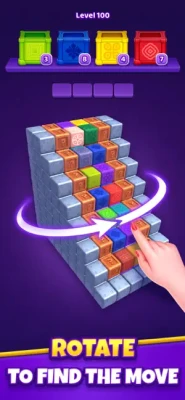
Rotate your view and inspect the structure from different angles.
A cube that appears inaccessible from one side may become obvious from another.
Pay particular attention to:
- Back rows
- Bottom layers
- Cubes hidden behind larger clusters
- Narrow gaps
- Cubes surrounded by several colors
Before using a helper, make sure you have actually inspected the structure from multiple angles.
6. Create a Mental Route Through the Puzzle
Instead of thinking about individual cubes, try to create a route.
For example:
Current color → blocking cube → exposed color → next target → final group
This is much more effective than tapping whatever looks convenient.
On harder levels, mentally planning even three or four moves ahead can make a major difference.
7. Don't Waste Easy Matches
When the correct color is clearly accessible, take advantage of it.
Leaving an obvious match untouched can create unnecessary clutter and make the structure harder to read.
However, there is an important exception:
Do not clear a useful color if doing so blocks or removes your best route to the next required color.
The best move is not always the move that clears the most cubes.
8. Avoid Random Tapping
Random tapping is particularly dangerous because incorrect selections occupy buffer space.
If you are unsure about a cube, don't tap it simply to see what happens.
Instead:
- Rotate the structure.
- Check its position.
- Identify its color.
- Determine whether it blocks another piece.
- Decide whether the move advances your sequence.
A few seconds of observation is usually cheaper than recovering from a bad move.
Advanced Cube Tap Sort Tips
Plan Two Colors Ahead
Beginners tend to think:
“Which cube do I need right now?”
Experienced players think:
“Which cube do I need now, and what will I need immediately afterward?”
That small change makes the game much easier.
Before clearing a color, identify at least one likely route toward the next color.
Preserve Important Access Points
Some cubes act like gateways to the structure.
Removing them may reveal several new pieces.
Other cubes may be useful because they keep an important route open.
Before removing a large cluster, ask:
Will this make the remaining structure easier or harder to navigate?
If removing a cube exposes several useful pieces, it is usually a strong move.
Prioritize Moves That Reveal Information
When two moves appear equally safe, prefer the one that reveals more of the structure.
A move that exposes several previously hidden cubes gives you more information and more future options.
This is especially useful when the level contains several colors mixed together.
Keep the Buffer as Empty as Possible
A nearly empty buffer gives you flexibility.
A nearly full buffer means you have very little room for mistakes.
Therefore, don't judge your position only by how many cubes remain.
Also ask:
How much buffer space do I have left?
A level with 20 cubes remaining and an empty buffer may be safer than a level with 10 cubes remaining and almost no buffer space.
How to Handle Difficult Levels
When a level becomes difficult, stop trying to solve it faster.
Instead, slow down.
Step 1: Inspect the entire structure
Find the current color and determine where it appears.
Step 2: Identify blockers
Determine which cubes prevent access to the target.
Step 3: Find the shortest route
Remove only the cubes necessary to open the route.
Step 4: Reassess
The structure changes as cubes disappear, so your original plan may no longer be optimal.
Step 5: Protect the buffer
If the next move is uncertain, pause and inspect rather than guessing.
Step 6: Repeat
Hard Cube Tap Sort levels are often solved by several small, safe decisions rather than one brilliant move.
Common Mistakes to Avoid
Tapping too quickly
Fast tapping encourages mistakes and fills the buffer unnecessarily.
Ignoring the 3D layout
The puzzle is designed around spatial relationships. Looking only from one angle can hide important information.
Clearing the biggest group first
The largest available group is not necessarily the correct group.
Using the buffer as storage
The buffer should be treated as a limited emergency resource, not a second inventory.
Ignoring what comes next
Solving the current color while creating a bad position for the next one can leave you trapped.
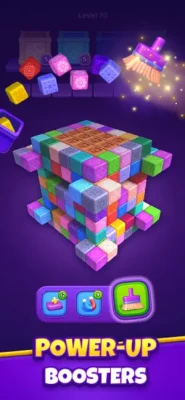
Using a helper before understanding the problem
Helpers can be useful, but first make sure the problem is genuinely difficult rather than simply overlooked.
Best Strategy for Beginners
If you are just starting Cube Tap Sort, follow this simple routine:
- Look before tapping.
- Find the active color.
- Locate the easiest accessible cubes of that color.
- Check what they will expose.
- Keep the buffer mostly empty.
- Rotate the structure when something looks hidden.
- Think at least one move ahead.
- Avoid random taps.
- Reassess the board after major clears.
- On difficult levels, prioritize safe progress over speed.
The game is not about how quickly you can tap. It is about how accurately you can read the structure.
Cube Tap Sort Features
According to the current App Store listing, Cube Tap Sort offers:
- 3D colored cube puzzles
- Color-matching gameplay
- Sequence-based clearing
- A limited buffer system
- Hundreds of handcrafted levels
- Progressively harder puzzles
- Smooth 3D visuals
- Responsive controls
- Short sessions or longer play sessions
- Puzzle-focused brain challenges
The current listing identifies the game as a free puzzle title with in-app purchases and an age rating of 13+.
Is Cube Tap Sort Difficult?
The first levels are relatively easy because the mechanics are simple to understand.
The real difficulty comes from increasingly complicated 3D structures.
Later puzzles require you to combine:
- Color recognition
- Spatial awareness
- Sequence planning
- Buffer management
- Short-term prediction
- Careful decision-making
The difficulty is therefore less about reflexes and more about avoiding a sequence of bad decisions.
Cube Tap Sort Pros and Cons
Pros
- Easy-to-understand core mechanics
- Satisfying 3D cube-clearing gameplay
- Requires genuine planning rather than simple tapping
- Large number of puzzle levels
- Progressively increasing challenge
- Good choice for short puzzle sessions
- Colorful and visually clean presentation
Cons
- Advertising can interrupt the experience
- Some players have reported technical issues or lost progress
- Later levels can become frustrating when the correct route is difficult to see
- Some players have criticized the cost of removing ads
- The large app size may be a consideration for users with limited storage
Recent App Store reviews specifically mention frustration with frequent advertisements, while other players have reported glitches involving levels, missing cubes, or lost progress. These are player reports rather than evidence that every user experiences the same problems.
Player Feedback: What People Like and Dislike
The strong overall App Store rating shows that the basic puzzle concept has attracted a substantial player audience. The current US listing shows approximately 11K ratings and a 4.8/5 score.
Players commonly enjoy the relaxing, untimed nature of the puzzle and the satisfaction of working out a difficult 3D arrangement.
However, recent reviews also highlight concerns about advertisements and occasional technical problems. Some players have reported interruptions during play, while others describe situations where a level appeared to become stuck or progress was lost.
That makes the game easier to recommend for the puzzle mechanics themselves than for players who strongly dislike advertising or expect completely trouble-free progression.
Cube Tap Sort Game Information
| Information | Details |
|---|---|
| Game | Cube Tap Sort |
| Subtitle | 3D Color Match Brain Game |
| Developer | Tripledot Studios |
| Genre | Puzzle |
| Platform | iPhone, iPad |
| Age Rating | 13+ |
| Business Model | Free with in-app purchases |
| Size | About 588.8 MB |
| Languages | English + 8 more |
| Levels | Hundreds of handcrafted levels |
| Gameplay | 3D color matching and sequence puzzles |
| Current Listed Version | 1.6.0 |
| Latest Listed Update | August 24 |
| Rating | 4.8/5 from about 11K ratings |
The App Store currently lists version 1.6.0 with performance improvements and general gameplay enhancements.
Frequently Asked Questions
Is Cube Tap Sort free?
Yes. Cube Tap Sort is listed as a free game with optional in-app purchases.
How does Cube Tap Sort work?
You clear colored cubes from 3D structures in the required order. Incorrect selections go into a buffer, and filling the buffer can end the level.
Is Cube Tap Sort timed?
The core puzzle is focused on making the correct moves rather than racing against a conventional countdown timer. This allows players to concentrate on planning their sequence.
What is the best Cube Tap Sort strategy?
Study the entire 3D structure before tapping, follow the active color order, protect your buffer space, and plan at least one or two moves ahead.
Why do I keep losing Cube Tap Sort levels?
Most failed attempts come from unnecessary buffer usage, tapping inaccessible or incorrect cubes, or clearing a color without considering what the move exposes next.
Does Cube Tap Sort have many levels?
Yes. The developer describes the game as having hundreds of handcrafted levels that progressively become more difficult.
Who developed Cube Tap Sort?
Cube Tap Sort was developed by Tripledot Studios.
Is Cube Tap Sort available on iPad?
Yes. The App Store lists Cube Tap Sort for iPhone and iPad.
Final Verdict
Cube Tap Sort takes a familiar color-matching idea and adds an important layer of spatial strategy. The 3D structures mean that simply finding the right color is not enough—you need to decide when and where to remove each cube.
Its strongest feature is the buffer mechanic. Because incorrect taps have consequences, the game rewards observation and planning instead of mindless tapping.
If you enjoy 3D sorting games, color puzzles, brain teasers, and spatial challenges, Cube Tap Sort is worth trying. Just be aware that player feedback has raised concerns about advertising and occasional technical issues, so the overall experience may depend on how you feel about those aspects.
Rate the Game
User Reviews













Popular Games




















 Android
 iOS
iOS Windows
 Xbox
Xbox