
Latest Version
September 07, 2026
LEAP BILISIM TEKNOLOJILERI VE YAZILIM TICARET ANONIM SIRKETI
Puzzle
iOS
0
Report a Problem
More About :game
Every puzzle is designed around a unique solution, so guessing is not the main strategy. Players must calculate, compare connected clues, eliminate possibilities and find the one number that keeps the entire grid correct.
What Is Crossnumbers - Puzzle Games?
Crossnumbers is a logic and mathematics puzzle game designed for players who enjoy numbers, deduction and structured problem-solving.
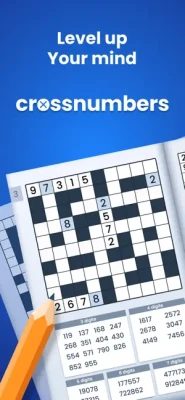
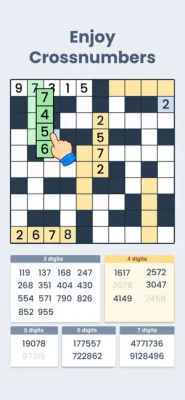
The concept is easy to understand. Numerical clues are arranged across a grid, and the answers have to intersect correctly. A number placed in one position can affect another equation crossing it, meaning every move needs to make sense from more than one direction.
This creates a satisfying chain of deduction. Rather than simply calculating individual answers, players gradually build a complete mathematical grid in which every equation agrees with the others.
How Crossnumbers Works
The central gameplay loop is based on three ideas:
- Read the numerical clue.
- Calculate the possible answer.
- Place the answer where it satisfies the intersecting equations.
A correct number can unlock additional information elsewhere in the grid. As more intersections are completed, previously uncertain positions become easier to solve.
The game specifically states that there is no guessing requirement: every puzzle can be completed through reasoning, calculation and intersection validation.
Number Fill-In Gameplay
Unlike a traditional crossword, Crossnumbers replaces words with numbers and equations.
The goal is not simply to find a mathematically correct answer. The answer must also fit the structure of the surrounding grid.
This means players constantly move between calculation and logic.
A number might appear to work in one location, but if it causes the crossing equation to fail, it cannot be the correct placement.
Horizontal and Vertical Intersections
The intersection system is what gives Crossnumbers its distinctive puzzle structure.
Each placement can influence both:
- Horizontal equations
- Vertical equations
A successful move therefore confirms more than one part of the puzzle.
When several equations converge around the same intersection, the player can narrow down possible answers through deduction rather than trial and error.
One Unique Solution
Each level is designed to have one unique valid solution.
That design changes the way players approach difficult puzzles. Instead of wondering whether several answers might be acceptable, you can use the surrounding equations to eliminate incorrect possibilities until only one placement remains.
Mental Math and Calculation
Crossnumbers naturally exercises mental arithmetic because solving the grid requires players to calculate numerical clues.
Early puzzles concentrate on fundamental operations such as:
- Addition
- Subtraction
More advanced levels introduce:
- Multiplication
- Division
- Compound equations
- More complex clue relationships
The gradual progression lets players become comfortable with the basic concept before facing more demanding mathematical structures.
Difficulty Progression
Crossnumbers increases its challenge step by step.
Beginner boards use smaller grids and simpler calculations. As players advance, grids become larger and the relationships between clues become more complicated.
This creates a natural learning curve:
Simple arithmetic → interconnected equations → larger grids → advanced calculations → complex deduction
The progression is designed to test both mathematical accuracy and logical organization.
Grid Sizes
Grid sizes scale from small beginner layouts to larger and more intricate boards.
Small grids are useful for learning how intersections work, while larger grids demand more concentration because a single placement can influence several connected equations.
The increasing grid size also makes later puzzles feel more like full mathematical challenges rather than isolated arithmetic questions.
Hint System
Crossnumbers includes a hint system for players who become stuck.
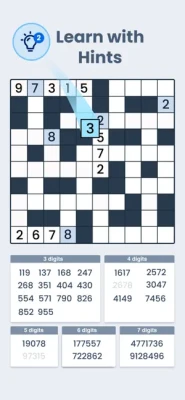
Each hint reveals one number per use, rather than simply solving an entire section of the puzzle for you.
This makes hints useful as a nudge toward the next logical step while preserving the main challenge of completing the grid yourself.
No Time Pressure
One of the game's most relaxing features is that puzzles can be solved without time pressure.
Players can stop, reconsider a calculation and examine the surrounding intersections before making their next move.
This makes Crossnumbers suitable for both focused puzzle sessions and slower, more casual play.
Offline Puzzle Gameplay
Crossnumbers can be played offline, allowing players to work through number puzzles without requiring a constant internet connection.
That makes it a convenient choice for travel, waiting rooms, commutes or any situation where an internet connection may not be available.
Why the Intersection System Matters
The most interesting part of Crossnumbers is that every answer has consequences.
Imagine that one horizontal equation suggests several possible numbers. A vertical equation crossing that position may immediately eliminate all but one.
That creates a continuous process of:
Calculate → compare → eliminate → confirm → advance
The satisfaction comes from watching the grid gradually resolve itself.
How to Play Crossnumbers
Step 1: Examine the Grid
Start by looking for the easiest numerical clues.
Step 2: Solve Simple Equations
Begin with calculations that have obvious answers.
Step 3: Fill a Confirmed Number
Place the number only when you have enough information to be confident.
Step 4: Check the Intersection
Look at the equation crossing the newly filled position.
Step 5: Use the New Information
A confirmed number may make another clue easier to solve.
Step 6: Continue the Chain
Move through the grid by using confirmed answers to unlock additional possibilities.
Step 7: Finish With Full Validation
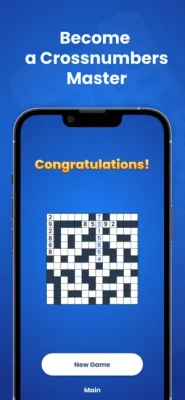
The puzzle is complete when every equation is correct and the entire grid has been logically resolved.
Beginner's Guide
If you are new to Crossnumbers, resist the temptation to solve the grid randomly.
Instead, search for the easiest equations first.
Beginner Tips
- Start with simple addition and subtraction.
- Look for clues with only one obvious answer.
- Check both directions before committing to a number.
- Use intersections to eliminate possibilities.
- Avoid guessing when a calculation can confirm the answer.
- Keep track of numbers that affect multiple equations.
- Save hints for genuinely difficult positions.
- Work from confirmed information toward uncertain areas.
Advanced Strategy
Experienced players can solve puzzles more efficiently by treating the entire grid as one connected mathematical system.
Find the Most Constrained Areas
Look for intersections where multiple equations provide useful information.
Work From Certainty
Prioritize numbers that can be mathematically confirmed rather than speculative placements.
Use Cross-Validation
Whenever you calculate an answer, immediately check what that number does to the crossing equation.
Reduce Possibilities
If several numbers appear possible, use neighboring equations to eliminate them.
Think Several Moves Ahead
A correct placement can unlock multiple clues. Look for moves that provide the greatest amount of new information.
Strategic Problem Solving
Crossnumbers is not purely a math game.
You may know how to perform the calculation but still need to determine where the result belongs.
That distinction makes the game closer to a logic puzzle than a basic arithmetic quiz.
The best players combine calculation with spatial reasoning and systematic elimination.
Focus and Concentration
Large grids require players to maintain attention across several interconnected equations.
The game's design encourages sustained concentration because a number solved several moves earlier may become important later.
Instead of rapidly answering isolated questions, players build a connected chain of mathematical information.
Mental Arithmetic Practice
Crossnumbers naturally encourages repeated mental calculation.
The game's stated player benefits include improving speed and accuracy in mental arithmetic, along with strengthening logical reasoning and structured problem-solving habits.
It should be viewed primarily as a puzzle game rather than a formal educational program, but its mechanics naturally involve mathematical practice.
Logical Reasoning
The game also rewards deduction.
When several clues intersect, the player needs to understand how one answer changes the possibilities elsewhere.
This creates a logic chain in which every confirmed number becomes another piece of evidence.
Accuracy Over Guessing
Crossnumbers is built around internal verification.
When the numbers are placed correctly, the equations remain balanced. Incorrect placements eventually create conflicts that reveal the mistake.
This allows players to identify errors through the structure of the puzzle rather than relying on arbitrary trial and error.
Game Progression
Progression comes primarily through increasingly complex puzzles.
Early levels introduce the fundamentals, while later challenges expand the grid and introduce more sophisticated mathematical relationships.
The result is a progression based on puzzle complexity rather than character levels or equipment upgrades.
Game Modes
Crossnumbers is focused on its core number-grid puzzle experience rather than offering a large collection of separate game modes.
The main variation comes from:
- Different puzzle layouts
- Increasing grid sizes
- More difficult arithmetic
- More complicated clue interactions
- Hint management
- Progressive challenge
This focused design keeps the attention on solving the mathematical grid.
Relaxing Puzzle Experience
Crossnumbers does not force players to rush.
The absence of time pressure means you can approach a difficult puzzle slowly, reconsider previous calculations and return to the grid when you are ready.
For players who enjoy quiet brain teasers, this can make the experience particularly appealing.
Graphics and Interface
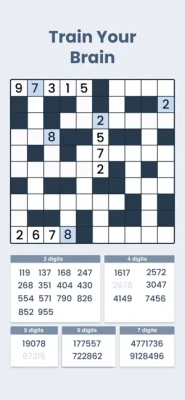
Crossnumbers uses a functional puzzle-focused presentation.
The grid itself is the centerpiece, with numbers and mathematical relationships taking priority over elaborate visual effects.
This is appropriate for the game's concept because the player's attention needs to remain on the equations and intersections.
Accessibility and Languages
The App Store currently lists English plus 34 additional languages, including Arabic, Spanish, French, German, Italian, Japanese, Korean-related localization is not listed in the English page's language set, while several European and Asian languages are included.
The developer has not specifically indicated accessibility features on the App Store listing.
Updates and New Levels
Crossnumbers has received a series of updates since its December 2025 launch.
The App Store version history shows versions 1.0.1 through 1.0.7, with updates repeatedly adding new levels alongside bug fixes and performance improvements. The latest listed version is 1.0.7, dated January 16.
The update history includes:
- New puzzle levels
- Bug fixes
- Performance improvements
- General gameplay refinements
This continuing level expansion is important for a puzzle game because additional boards give players more challenges to work through.
Current App Store Details
| Detail | Information |
|---|---|
| Game | Crossnumbers - Puzzle Games |
| Subtitle | Number fill-in game |
| Category | Puzzle |
| Developer | LEAP BILISIM TEKNOLOJILERI VE YAZILIM TICARET ANONIM SIRKETI |
| Price | Free |
| Latest Listed Version | 1.0.7 |
| Size | 267 MB |
| Age Rating | 4+ |
| Languages | English + 34 more |
| iPhone | iOS 13.0 or later |
| iPad | iPadOS 13.0 or later |
| Mac | macOS 11.0+ with Apple M1 or later |
| Apple Vision | visionOS 1.0 or later |
| Offline Play | Yes |
| Advertising | Contains advertising |
Privacy and Data Practices
According to the App Store disclosure, the developer indicates that identifiers may be used for tracking across apps and websites. The listing also says identifiers can be linked to the user for third-party advertising and analytics, while usage and diagnostic data may be collected for advertising, analytics and app functionality. Apple notes that these privacy practices have not been verified by Apple.
Player Rating
The current App Store listing shows a 5.0/5 rating from 1 rating. Because the number of ratings is currently very small, this score should not be treated as a broad measure of long-term player sentiment.
Pros and Cons
Pros
- Unique number-fill puzzle concept
- Combines arithmetic with logic
- Horizontal and vertical equation intersections
- One unique solution per puzzle
- Progressive difficulty
- Addition and subtraction for beginners
- Multiplication and division in advanced puzzles
- Larger grids as difficulty increases
- Helpful one-number hints
- No time pressure
- Offline play
- Recent level additions
- Multiple language options
- Suitable for casual and dedicated puzzle players
Cons
- Contains advertising
- Gameplay is highly focused on number puzzles
- Very small current review sample
- No major multiplayer component
- Players looking for action or narrative may find it too specialized
- Developer has not listed specific accessibility features
Who Should Play Crossnumbers?
Crossnumbers is a good fit for players who enjoy:
- Math puzzles
- Number puzzles
- Logic games
- Crossword-style games
- Brain teasers
- Mental arithmetic
- Sudoku-style deduction
- Offline puzzle games
- Casual brain-training games
- Relaxing number games
- Challenging grid puzzles
It is particularly appealing to people who enjoy the satisfaction of solving a puzzle logically rather than relying on speed.
Who Might Not Like It?
Players who prefer fast-paced action, story-driven games, competitive multiplayer or visually intense experiences may find Crossnumbers too quiet and methodical.
The entire experience revolves around calculation, deduction and grid completion.
Crossnumbers vs Traditional Crossword Puzzles
Traditional crosswords ask players to interpret clues and enter words.
Crossnumbers applies a similar grid structure to mathematics.
Instead of asking:
“What word fits here?”
the game asks:
“What number fits here while keeping every connected equation correct?”
That small change creates a very different type of puzzle-solving experience.
Crossnumbers vs Sudoku
Crossnumbers and Sudoku both reward logical deduction, but their mechanics are different.
Sudoku is primarily about placing numbers according to row, column and region restrictions.
Crossnumbers is built around equations and mathematical relationships.
Players who enjoy Sudoku but want more direct arithmetic may find Crossnumbers particularly interesting.
Expert Rating
Overall Rating: 8.4/10
Puzzle Design: 8.8/10
Logic Mechanics: 9/10
Math Challenge: 8.7/10
Difficulty Progression: 8.5/10
Replayability: 8/10
Accessibility: 7.5/10
Presentation: 7.8/10
Final Verdict
Crossnumbers - Puzzle Games takes a familiar crossword-style idea and rebuilds it around mathematics.
Its strongest feature is the relationship between calculation and placement. Solving an equation is only part of the task; the answer must also fit perfectly into the surrounding grid. Every correct number provides another piece of information, creating a satisfying chain of deduction until the entire puzzle finally comes together.
The gradual difficulty curve, scalable grids, hints and offline play make it accessible to casual players while still offering more demanding challenges for experienced puzzle fans. The repeated updates adding new levels also give the game room to grow.
If you enjoy number puzzles, mental math, crossword-style grids and logical deduction, Crossnumbers is a focused and enjoyable option for iPhone and iPad.
Frequently Asked Questions
What is Crossnumbers - Puzzle Games?
Crossnumbers is a logic-based mathematical puzzle game where players fill a grid using numerical clues and make sure the horizontal and vertical equations all remain correct.
Is Crossnumbers free?
Yes. The App Store lists Crossnumbers as a free game, although the listing states that it contains advertising.
Is Crossnumbers a math game?
Yes. Mental arithmetic is a central part of solving the puzzles, with the game progressing from basic addition and subtraction to multiplication, division and compound equations.
Does Crossnumbers have different difficulty levels?
The difficulty increases progressively through more complex equations, larger grids and more involved clue interactions.
Does Crossnumbers have hints?
Yes. Each hint reveals one number and is intended to help players discover their next logical step rather than solve the entire puzzle automatically.
Can Crossnumbers be played offline?
Yes. The App Store description specifically states that the game can be played offline without time pressure.
Does Crossnumbers have a time limit?
No. The game is designed without time pressure, allowing players to solve puzzles at their own pace.
Is Crossnumbers available on iPhone?
Yes. The game supports iPhone with iOS 13.0 or later.
Is Crossnumbers available on iPad?
Yes. Crossnumbers supports iPad with iPadOS 13.0 or later.
What languages does Crossnumbers support?
The App Store currently lists English plus 34 additional languages, including Arabic, French, German, Spanish, Italian, Japanese and several others.
Does Crossnumbers have ads?
Yes. The App Store currently marks the game as containing advertising.
What is the latest version of Crossnumbers?
The current App Store listing shows version 1.0.7, with the version history describing new levels, bug fixes and performance improvements.
Is Crossnumbers good for beginners?
Yes. Early puzzles focus on fundamental addition and subtraction, while later challenges gradually introduce more complicated mathematical relationships.
Rate the Game
User Reviews








Popular Games

















 Android
 iOS
iOS Windows
 Xbox
Xbox