






Latest Version
September 13, 2026
Brocker Bus Studio
Puzzle
Android
0
com.bubble.match.logic.puzzle
Report a Problem
More About :game
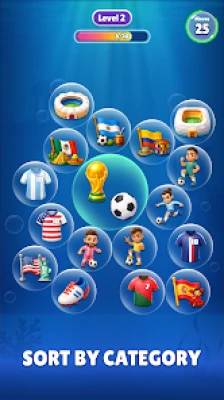
The basic idea is easy to understand: examine the puzzle, identify bubbles that belong together, and create the correct groups. As the challenges become more complicated, careful observation becomes more important than simply tapping quickly.
The game is designed for short puzzle sessions, making it a good choice when you want something simple to pick up but still want to exercise your brain.
According to the Google Play listing, the main focus is discovering hidden connections, grouping matching bubbles, finding patterns, and completing logic puzzles.
What Makes Bubble Merge: Logic Puzzle Interesting?
The strongest part of the game is its emphasis on hidden connections. A group may not always be obvious at first glance, so successful players need to examine the details of each bubble before making a decision.
Rather than relying entirely on fast reactions, Bubble Merge encourages you to:
- Compare objects carefully
- Recognize visual patterns
- Identify matching characteristics
- Sort bubbles into logical groups
- Think before making a move
- Use observation instead of guessing
- Learn from mistakes and improve your approach
This gives the game a more thoughtful feel than a traditional match-three puzzle.
How to Play Bubble Merge: Logic Puzzle
The basic gameplay can be broken down into a few simple steps.
1. Examine the Entire Puzzle
Before selecting anything, take a moment to look at the complete board.
Do not immediately choose the first pair or group that looks similar. Some bubbles may have several characteristics, while only one characteristic is actually important for the current puzzle.
2. Search for the Strongest Connection
Look for obvious relationships first.
Possible clues can include:
- Similar appearances
- Matching objects
- Related themes
- Repeated visual patterns
- Shared characteristics
- Other connections suggested by the level
The objective is to discover which bubbles logically belong together.
3. Build Groups Carefully
Once you have identified a likely connection, group the appropriate bubbles together.
Avoid making a selection simply because two bubbles look similar. The game is designed around discovering the intended relationship, so a superficial match may not always be correct.
4. Recheck Before Committing
If a group seems uncertain, inspect the remaining bubbles first.
Sometimes the easiest way to understand one group is to identify another group. Removing obvious possibilities from consideration can make the remaining solution much clearer.
5. Complete the Puzzle
Continue identifying relationships until the board has been correctly organized.
The satisfaction comes from understanding the logic behind the solution rather than simply clearing bubbles as quickly as possible.
Bubble Merge: Logic Puzzle Strategy Guide
Start With the Most Obvious Group
When a level appears confusing, don't try to solve everything simultaneously.
Find the group with the clearest relationship and use it as your starting point. Once that group is identified, the remaining bubbles become easier to analyze.
Don't Match Only by Appearance
One of the biggest mistakes in logic puzzle games is assuming that visual similarity automatically means two objects belong together.
Instead, ask:
"What do these bubbles have in common?"
Then ask:
"Is that connection stronger than the other possible connections?"
This small change in thinking can make difficult puzzles much easier.
Look for Repeated Patterns
If several bubbles contain similar characteristics, compare all of them before making a selection.
A pattern may become obvious only when you examine the entire board rather than focusing on two objects.
Eliminate Incorrect Possibilities
When you are unsure about a group, use elimination.
For example:
- Find the most obvious relationship.
- Remove that possibility mentally.
- Examine what remains.
- Look for another clear connection.
- Return to the uncertain bubbles afterward.
This prevents you from getting trapped by an attractive but incorrect match.
Avoid Random Guessing
Random selections can make a logic puzzle much harder to understand.
If you're uncertain, stop and inspect the board again. Look for a clue you may have overlooked instead of immediately choosing another bubble.
Think About the Whole Board
A bubble can appear to belong to several possible groups.
The correct answer usually becomes clearer when you consider every bubble at the same time. Ask yourself which grouping creates the most consistent overall solution.
Use Process of Elimination on Difficult Levels
When only a few bubbles remain, compare them systematically.
Instead of asking which bubbles look similar, ask:
- Which group is already complete?
- Which bubble has no obvious partner?
- Which possible group would leave an impossible combination?
- Which relationship explains the greatest number of bubbles?
This approach turns a confusing puzzle into a logical deduction.
Beginner Tips
If you're just starting Bubble Merge: Logic Puzzle, these tips can make the early levels easier:
Take your time. The game rewards observation more than speed.
Scan first, select second. Look at everything before committing to a group.
Look beyond color. A visual similarity may not be the intended connection.
Use elimination. Solving one group can reveal the answer to another.
Remember unusual clues. If a bubble seems different, there may be a reason for that difference.
Don't overthink simple levels. Sometimes the intended relationship is exactly what you first noticed.
Advanced Puzzle-Solving Strategy
As the puzzles become harder, use a more structured approach.
Step One: Categorize What You See
Mentally divide the bubbles into possible categories.
For example, you might notice groups based on appearance, objects, themes, or other shared characteristics.
Step Two: Identify the Strongest Category
Some possible groups will have a much clearer relationship than others.
Start there.
Step Three: Test the Remaining Bubbles
After identifying a strong group, reassess everything that remains.
The removal of one possible category can reveal connections that were previously difficult to see.
Step Four: Challenge Your First Assumption
If a solution doesn't seem to fit perfectly, reconsider it.
A good logic puzzle solution should explain the relationships consistently rather than forcing one or two bubbles into a group.
Step Five: Solve From Certainty to Uncertainty
Always prioritize the clues you understand.
A useful order is:
obvious connection → confirmed group → remaining bubbles → difficult group → final check
This reduces unnecessary guessing.
Common Mistakes to Avoid
Choosing the First Similar Bubbles
Two bubbles can look alike without belonging to the same intended category.
Ignoring the Remaining Board
A possible group should make sense alongside the rest of the puzzle.
Changing Your Strategy Too Quickly
If you encounter a difficult level, don't immediately assume the puzzle is random. Examine the details again.
Overcomplicating Easy Connections
Not every level requires an elaborate theory. Sometimes the simplest shared characteristic is the correct answer.
Playing Too Fast
Because Bubble Merge is a logic and observation game, rushing can cause you to overlook small clues.
How to Get Better at Bubble Merge
The best way to improve is to develop a consistent observation routine.
Before every move:
- Scan the entire board.
- Identify obvious similarities.
- Separate strong connections from weak ones.
- Look for the group that is easiest to prove.
- Check how that choice affects the remaining bubbles.
- Make the move only when the relationship makes sense.
With practice, you'll start recognizing patterns much faster.
Why Play Bubble Merge: Logic Puzzle?
Bubble Merge: Logic Puzzle is a good choice for players who enjoy casual brain games without complicated controls.
The Google Play description specifically highlights hidden matches, pattern discovery, logic puzzles, brain training, and relaxing gameplay.
Main Features
- Hidden-connection puzzles
- Bubble matching and grouping
- Pattern recognition challenges
- Logic-based gameplay
- Relaxing puzzle sessions
- Simple controls
- Brain-training style challenges
- Increasingly clever puzzle situations
- Casual gameplay suitable for short sessions
The game is currently listed as a Teen-rated puzzle game and contains ads.
Difficulty and Progression
Bubble Merge starts with a straightforward concept, but the real challenge comes from recognizing the intended relationship between the bubbles.
Early puzzles help establish the basic idea of matching and grouping. Later challenges can require more careful observation because several bubbles may appear to share characteristics.
The key progression is therefore not simply learning new controls. It is learning how to think about the board differently.
Is Bubble Merge: Logic Puzzle Worth Playing?
If you enjoy logic puzzle games, matching games, brain teasers, pattern-recognition games, and relaxing casual puzzles, Bubble Merge: Logic Puzzle is worth trying.
Its simple concept makes it easy to understand, while the hidden-connection mechanic gives the puzzles more thought than a basic color-matching game.
The Google Play listing currently shows 1K+ downloads, with the game developed by Brocker Bus Studio.
Pros and Cons
Pros
- Easy concept to understand
- Encourages observation and logical thinking
- Simple bubble-based gameplay
- Relaxing style
- Short sessions
- Focuses on hidden connections and patterns
Cons
- May feel simple for players who prefer action games
- Some puzzles can require trial and error while learning the game's logic
- Contains advertisements
- The game has a relatively small public download footprint compared with established puzzle titles
Final Verdict
Bubble Merge: Logic Puzzle takes a simple bubble concept and turns it into an observation challenge. The key isn't tapping quickly; it's finding the hidden connection that makes the entire puzzle work.
For the best results, slow down, inspect the whole board, identify the strongest relationship first, and use elimination when the remaining bubbles become difficult.
If you enjoy casual brain games where recognizing patterns matters more than reflexes, Bubble Merge: Logic Puzzle offers a straightforward and relaxing challenge.
Rate the Game
User Reviews













Popular Games



















 Android
 iOS
iOS Windows
 Xbox
Xbox