


Latest Version
September 28, 2026
UNICO STUDIO
Puzzle
iOS
0
Report a Problem
More About :game
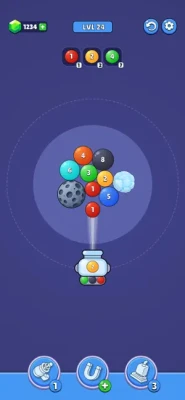
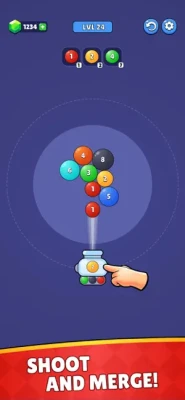
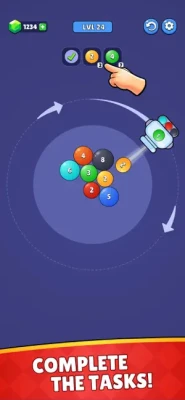
What makes the game different from a traditional merge puzzle is the rotating shooter. You can move the shooter around the central capsule and choose where to fire each new ball. Balls with the same color and number can merge when they touch, producing a higher-value ball.
There is no timer and no time limit, so the challenge comes from making smart decisions rather than playing quickly.
The App Store currently lists Orb of Balls as a free Puzzle game with advertising and optional in-app purchases. It supports iPhone and iPad and requires iOS 15 or later.
How to Play Orb of Balls
Orb of Balls combines three basic actions:
- Rotate the shooter around the orb.
- Aim at a useful position.
- Shoot a ball and create merges.
Every shot adds another ball to the orb. That means space management becomes increasingly important.
When two balls with the same color and number touch, they merge into a higher-numbered ball. Your objective for each level may require creating particular colors or numbers rather than simply making as many merges as possible.
This creates an interesting balance:
Shoot too quickly and the orb fills up.
Wait too long and you may lose a useful merging opportunity.
Main Gameplay Features
Rotating Orb Shooter
The shooter can be rotated around the central orb, allowing you to approach the puzzle from different angles.
This gives you much more control than a standard drop-and-merge game.
Number Ball Merging
Matching balls combine into higher-value balls.
For example, if two identical balls touch, they can combine into a stronger ball that may help complete the level objective.
The higher the merge chain goes, the more important your placement decisions become.
Space Management
Every shot introduces another object into the orb.
As the board becomes crowded, available shooting angles and useful spaces become harder to find.
Good Orb of Balls players therefore think about future space, not just the current merge.
Level Objectives
Levels can have specific goals, such as creating particular colored or numbered balls.
This means you should always know the objective before deciding where to shoot.
No Timer
There is no countdown forcing you to rush.
You can take time to inspect the orb, consider several possible shots, and choose a more efficient merge sequence.
Orb of Balls Ball-Merging Strategy
The most important skill is understanding that not every possible merge is a good merge.
A merge may produce a higher-value ball, but if it occupies an important position, it can make future shots harder.
Before shooting, consider:
- Where will the new ball land?
- What can it merge with?
- Which spaces will remain open?
- Could it block another ball?
- Does the resulting ball help the level objective?
- Can the same shot create a chain reaction?
This turns the game from simple matching into a spatial planning puzzle.
Full Orb of Balls Strategy Guide
1. Read the Level Objective First
Don't start shooting immediately.
Check exactly what the level requires.
If the objective asks for a specific numbered or colored ball, your entire strategy should revolve around creating it efficiently.
A large number of unnecessary merges can actually make the puzzle harder.
2. Inspect the Whole Orb
Before every important shot, examine the available positions.
Look for:
- Matching balls
- Nearly matching pairs
- Empty spaces
- Obstacles
- Ball generators
- Frozen balls
- Connected groups
- Stacked balls
- Potential chain reactions
The game becomes much easier when you stop looking at individual balls and start reading the entire orb as one system.
3. Plan the Landing Position
Don't focus only on what you are shooting at.
Think about where the ball will finish.
A successful shot should ideally do one or more of the following:
- Create a merge
- Prepare a future merge
- Open space
- Advance the objective
- Set up a chain reaction
A shot that does none of these may simply make the board more crowded.
4. Create Chain Merges
The best shots can sometimes trigger several merges.
For example:
New Ball → First Merge → Higher Ball → Second Merge → Objective Progress
Chain reactions are valuable because one shot can accomplish more than one task.
Before firing, look for nearby matching balls that could become involved after the first merge.
5. Protect Your Open Space
Space is one of your most important resources.
Don't fill every available area just because you can.
Keep useful shooting lanes open whenever possible.
A crowded orb can prevent you from reaching the ball you actually need.
6. Don't Always Merge Immediately
Sometimes it is better to leave two matching balls in place.
If merging them creates a large ball in an inconvenient location, delaying the merge can give you more control.
The right question is not:
“Can these balls merge?”
It is:
“Should these balls merge now?”
7. Use the Shooter Position Strategically
Because the shooter rotates around the orb, positioning matters.
Before shooting, consider whether another angle would give you:
- A cleaner trajectory
- Better contact with a matching ball
- Access to an open space
- A better chain reaction
Don't settle for the first available angle.
8. Think Two or Three Shots Ahead
A good shot solves the current problem.
A great shot also prepares the next two moves.
Try to imagine:
Shot → merge → new position → next shot
This is particularly important when the orb starts becoming crowded.
9. Avoid Unnecessary Large Merges
Higher-value balls are useful, but bigger isn't automatically better.
If a large ball occupies a critical area, it may reduce your future options.
Merge with the objective in mind rather than chasing the largest number available.
10. Use the No-Timer Advantage
There is no reason to rush.
The absence of a timer is one of Orb of Balls' most useful features because it lets you analyze complicated situations carefully.
If you're unsure, simply stop and inspect the board.
Orb of Balls Boosters
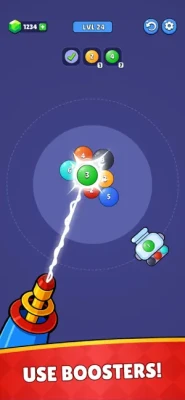
Orb of Balls includes several boosters designed to help when the puzzle becomes difficult.
Laser Gun
The Laser Gun instantly destroys a selected ball.
Use it when one particular ball is blocking an important position or when removing it will create a much better shooting route.
Don't waste the Laser Gun on an object that can easily be handled through normal merging.
Magnet
The Magnet automatically merges matching pairs.
This can be particularly useful when several matching opportunities exist and manually creating the merges would be awkward.
It can also help reduce board clutter.
Vacuum
The Vacuum clears all balls of a selected color.
This is potentially one of the most powerful tools because it can remove several objects at once.
Use it when a particular color is occupying too much space or when clearing that color can significantly improve your available moves.
Advanced Orb of Balls Mechanics
As you progress, Orb of Balls introduces additional mechanics that make the board more complicated.
Hidden Balls
Hidden balls only appear when they reach the orb.
This means you need to account for objects that aren't immediately visible.
Don't assume the board is completely understood just because you can see the current pieces.
Obstacles
Some objects occupy space but cannot be merged.
They effectively reduce the amount of usable room inside the orb.
When obstacles appear, treat the remaining open areas as valuable resources.
Connected Balls
Connected balls move together.
This changes the normal merging rules because you can't always treat each ball as an independent piece.
Before shooting near a connected group, consider how moving or merging it could affect the surrounding area.
Walls and Bombs
Walls and bombs introduce destruction mechanics.
These elements can change the available space and create new tactical opportunities.
When they appear, look for ways to use them to clear crowded areas rather than simply treating them as obstacles.
Frozen Balls
Frozen balls become available through progression.
They add another layer to the puzzle because they may temporarily restrict the board's usable pieces.
Ball Generators
Ball generators continuously introduce new balls.
This can help create merging opportunities but can also increase the pressure on available space.
If a generator is active, don't ignore the rate at which it changes the board.
Stacked Balls
Stacked balls can reveal hidden layers after merging.
This means one successful merge may expose another puzzle underneath.
After making a major merge, always inspect what has been revealed before your next shot.
How to Solve Difficult Orb of Balls Levels
When a level starts getting crowded, use this process.
Step 1: Identify the Objective
Know exactly what number or color you need.
Step 2: Find Existing Matches
Look for pairs or groups that are already close to merging.
Step 3: Find the Bottleneck
Determine what is preventing you from creating the required ball.
Step 4: Protect Empty Space
Don't fill the easiest open areas unnecessarily.
Step 5: Plan the Shot
Choose both the target and the landing position.
Step 6: Look for a Chain Reaction
Ask whether the resulting merge can immediately create another merge.
Step 7: Reassess
After every major merge, inspect the board again.
Step 8: Use a Booster Only When It Changes the Situation
Don't use a booster simply because it is available.
Best Tips for Managing a Crowded Orb
When the orb starts filling up, your priorities should change.
First Priority: Create Space
A crowded board limits every future move.
Second Priority: Protect Important Matches
Don't accidentally separate a useful pair.
Third Priority: Complete the Objective
Avoid spending too many moves on merges that don't contribute to the target.
Fourth Priority: Remove Bad Positions
If a ball is occupying an extremely important location, consider using the Laser Gun or another appropriate booster.
Common Mistakes in Orb of Balls
Shooting Without a Plan
Every shot adds another ball, so careless shooting can quickly create a crowded board.
Chasing Every Merge
Not every possible merge is strategically useful.
Ignoring the Objective
Creating impressive high-value balls doesn't matter if they don't help complete the level goal.
Filling the Center
Central space can become extremely valuable. Avoid unnecessary congestion around important routes.
Forgetting Future Shots
A shot can be successful now but disastrous for the next move.
Using Boosters Too Early
Save powerful tools for positions where they provide meaningful board control.
Ignoring New Mechanics
Hidden balls, generators, frozen pieces, connected balls, walls, bombs, and stacked balls each change how you should approach the board.
How to Get Better at Orb of Balls
Improvement comes mostly from learning to recognize board states.
Instead of asking:
“What can I shoot?”
ask:
“What should the board look like after my next three moves?”
That change in thinking is extremely useful.
Experienced players naturally begin recognizing:
- Good landing zones
- Dangerous bottlenecks
- Valuable empty spaces
- High-potential merge pairs
- Useful chain reactions
- Unnecessary merges
- Booster opportunities
Orb of Balls Difficulty
Orb of Balls starts with a relatively simple combination of aiming and merging, but the difficulty increases as new mechanics are introduced.
The game's challenge comes from combining:
Precision + Number Matching + Space Management + Level Objectives
The absence of a timer means the game doesn't depend on fast reflexes. Instead, later levels test how well you can plan around limited space and changing board conditions.
Is Orb of Balls a Relaxing Puzzle Game?
Yes, the game is specifically designed around a timer-free experience.
The App Store describes it as a relaxing puzzle experience without time limits, while Google Play similarly emphasizes taking your time and planning moves.
However, "relaxing" doesn't mean every puzzle is easy.
The absence of a timer gives you time to think, while the increasing number of mechanics can make later stages considerably more strategic.
Atmosphere and Presentation
Orb of Balls has a clean, colorful puzzle presentation centered on a rotating orb, numbered balls, merging animations, and increasingly complex board layouts.
The visual design supports the main gameplay idea: watching balls come together and combine into higher values gives each successful merge a satisfying sense of progress.
The rotating structure also gives the game a different feel from traditional flat merge puzzles.
Pros and Cons
Pros
- Unique merge-and-shoot combination
- Rotating orb mechanic
- Simple controls
- No timer
- Relaxing pace
- Increasing strategic depth
- Multiple boosters
- Numerous puzzle mechanics
- Space-management challenge
- Suitable for short or long sessions
Cons
- Advertising is included
- Optional in-app purchases are available
- Crowded boards can become challenging
- Some advanced mechanics require careful learning
- The game is still relatively new, so the App Store has a small number of ratings
The US App Store currently shows 4.9/5 from 11 ratings, so that rating should be viewed in the context of the small review sample.
Ratings and Player Feedback
At the time of checking, the US App Store lists 4.9 out of 5 from 11 ratings.
Google Play currently lists Orb of Balls as a Puzzle game and describes the experience as a combination of shooting, merging, and spatial strategy. The Google Play listing was updated July 3, 2026, with bug fixes and performance improvements.
Because the game is relatively new and the App Store review count is still small, its current rating does not provide a large statistical sample of player opinions.
Updates and Version History
The App Store currently lists Version 1.3.0, with the version history describing bug fixes and performance improvements. Earlier releases, including versions 1.1.3, 1.1.2, and 1.0.6, also included stability and performance improvements.
Google Play likewise lists bug fixes and performance improvements in its latest update information.
Platform and Requirements
Developer: UNICO STUDIO
Genre: Puzzle
Platforms: iPhone, iPad
Minimum iOS: iOS 15.0
Minimum iPadOS: iPadOS 15.0
Mac: macOS 12.0+ with Apple M1 chip or later
Apple Vision: visionOS 1.0+
Age Rating: 4+
App Size: Approximately 271 MB
Business Model: Free with advertising and in-app purchases
The game supports multiple languages, including English and Arabic, along with several other languages.
Frequently Asked Questions
What is Orb of Balls?
Orb of Balls is a merge shooter puzzle game where players aim and fire numbered balls into a rotating orb, combine matching balls, and complete level objectives.
How do you play Orb of Balls?
Rotate the shooter around the orb, aim carefully, fire balls, and create matching merges while managing the available space.
Does Orb of Balls have a timer?
No. The game is designed without a timer or time limit, allowing players to plan their shots at their own pace.
What happens when matching balls touch?
Balls with the same color and number merge into a higher-value ball.
What boosters are available?
The game currently lists three main boosters: Laser Gun, Magnet, and Vacuum.
What does the Laser Gun do?
The Laser Gun instantly destroys a selected ball.
What does the Magnet do?
The Magnet automatically merges matching pairs.
What does the Vacuum do?
The Vacuum clears all balls of a selected color.
Does Orb of Balls have obstacles?
Yes. Later gameplay introduces obstacles, connected balls, walls, bombs, frozen balls, ball generators, hidden balls, and stacked balls.
Is Orb of Balls difficult?
The basic controls are simple, but the game becomes more strategic as the orb fills and new mechanics are introduced.
Is Orb of Balls free?
Yes. The game is free to download, with advertising and optional in-app purchases.
Is Orb of Balls available on Android?
Yes. Orb of Balls is also available through Google Play.
Is Orb of Balls available on iPhone?
Yes. The App Store lists it for iPhone and iPad and requires iOS 15 or later.
What is the best strategy for Orb of Balls?
Focus on the level objective, protect open space, plan where every shot will land, and look for chain reactions rather than making every possible merge.
How do I handle a crowded orb?
Prioritize creating space, avoid unnecessary merges, and use boosters such as the Laser Gun or Vacuum when they can significantly improve the board.
Final Orb of Balls Strategy Tip
The most important lesson is:
Don't ask which ball you can shoot. Ask which shot gives you the best board afterward.
Because every shot changes the orb, the strongest strategy is to think ahead. Protect useful space, build merges that contribute to the objective, create chain reactions when possible, and save boosters for moments when they can completely change a difficult position.
With no timer pushing you forward, take your time, rotate the orb, study the available angles, and make each shot count.
Rate the Game
User Reviews











Popular Games



















 Android
 iOS
iOS Windows
 Xbox
Xbox