



Latest Version
September 29, 2026
UNICO STUDIO
Puzzle
iOS
0
Report a Problem
More About :game
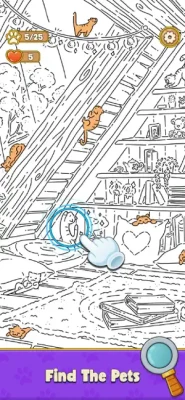
If you enjoy hidden object games, find-the-difference puzzles, animal games, relaxing puzzle games, and seek-and-find challenges, Peek-a-Pet offers a simple but surprisingly demanding experience. Every map asks you to slow down, examine the scene and locate the required animals.
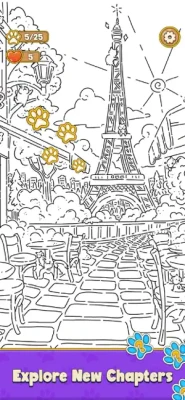
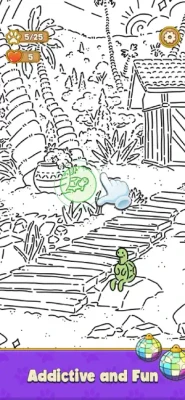
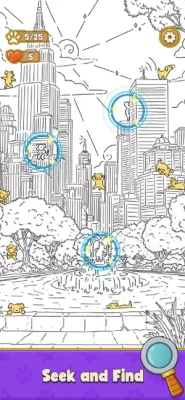
The game's environments range from Lotus Gardens and Metropolis to Tropical Islands, Fairy Tales, Paris, London, Mushroom Plains, Sunny Beaches, Fairgrounds, Stinky Swamps and Mansions. This variety gives the search-and-find gameplay different visual settings instead of repeating one type of scene.
What Makes Peek-a-Pet Different?
The central idea is straightforward: find the hidden animals.
The difficulty comes from the way animals are incorporated into busy illustrations. A pet may blend into surrounding objects, sit in an unexpected location, or become difficult to notice when several similar shapes are close together.
That makes the game less about fast tapping and more about visual attention and pattern recognition.
Gameplay and How It Works
Each level presents a scene containing hidden animals. Your task is to locate the animals required by the level and tap them.
The basic gameplay loop is:
- Enter a hidden-animal level.
- Examine the entire scene.
- Search for the requested pets.
- Tap an animal when you are confident you have found it.
- Continue searching until the objective is complete.
- Use a booster when you genuinely cannot locate the remaining animal.
- Move to the next map and face a more challenging search.
The game also includes a collection system, daily content, additional levels, animal sounds, animations and booster tutorials according to its App Store version history.
Animals You Can Find
Although the title focuses on finding cats, the game contains a much broader collection of hidden pets.
You may encounter:
- 🐱 Cats
- 🐶 Dogs
- 🐦 Birds
- 🐰 Bunnies
- 🐸 Frogs
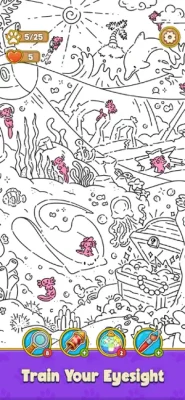
- 🦎 Axolotls
- 🐙 Octopi
- Other hidden animals across different scenes
The variety keeps the search from becoming completely predictable.
Main Game Features
Hidden Animal Hunting
The main attraction is searching through illustrated environments to discover animals that are deliberately difficult to notice.
Detailed Black-and-White Maps
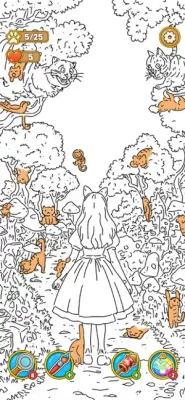
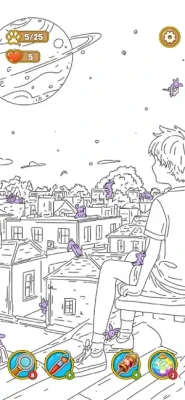
Many of the game's maps use intricate black-and-white artwork, making shapes and outlines important when identifying hidden pets.
Multiple Themed Worlds
The game takes players through a variety of settings, including gardens, cities, islands, beaches, fairs, swamps and mansions.
Daily and Regular Levels
The version history shows additions and fixes for both regular and daily content, giving players additional ways to continue searching.
Collection Cards
A collection card feature was added to help players track their discoveries and make collected animals more rewarding.
Boosters
Boosters can help reveal difficult hidden animals when you are stuck. The game also added booster tutorials to explain how to use them.
Relaxing Puzzle Gameplay
There is no complicated combat system or elaborate control scheme. The challenge comes from observation, making it suitable for short sessions or longer relaxing play.
Full Peek-a-Pet Strategy Guide
1. Don't Start by Tapping Randomly
One of the easiest mistakes is tapping everything that looks remotely like an animal.
Instead, begin by studying the objective. If you need to find several animals of a particular type, learn what their silhouettes look like before scanning the map.
Random tapping can waste time and make a crowded scene even harder to read.
2. Divide the Map Into Sections
Rather than looking at the entire screen simultaneously, mentally divide it into sections.
For example:
Top → upper middle → lower middle → bottom
Search one section completely before moving to the next.
This simple technique prevents you from repeatedly checking the same area while accidentally ignoring another part of the map.
3. Search for Silhouettes First
When a scene is visually crowded, don't immediately look for the complete animal.
Look for:
- A pair of ears
- A tail
- Four legs
- A distinctive body outline
- A face
- An unusual curved shape
Once you recognize part of the silhouette, inspect the surrounding area more carefully.
4. Look at Unusual Places
Hidden-object puzzles are designed to make the obvious areas less useful.
Don't only inspect the center of the scene.
Check:
- Corners
- Behind objects
- Along edges
- Between buildings
- Around trees
- Near decorations
- Above and below larger objects
- Areas with unusual shapes
A pet that seems impossible to find is often hidden somewhere your eyes naturally skip.
5. Change Your Focus
If you have been staring at the same area for several seconds without finding anything, stop looking at it.
Move your attention somewhere else.
After searching another part of the map, return to the difficult section. Your eyes may notice details that were previously invisible simply because you had become accustomed to the image.
6. Use a Scanning Pattern
A systematic scan is usually better than moving your eyes randomly.
Try this:
Left → right → down → left → right
Continue in rows until the whole scene has been examined.
This is particularly useful on large maps containing many small visual details.
7. Search by Shape Instead of Color
Because many of the game's scenes are black and white, color is not always useful for locating animals.
Instead, pay attention to:
- Body proportions
- Ears
- Tails
- Faces
- Legs
- Curves
- Repeated patterns
Think of the animal as a collection of shapes rather than a colorful object.
8. Zoom In When Necessary
If the device and game interface allow you to inspect a particular area more closely, take advantage of it.
Small animals can be difficult to distinguish when they are surrounded by complicated artwork.
On iPad, the larger display can also make detailed scenes easier to inspect.
How to Find Cats Faster
When searching specifically for cats, don't only look for an obvious cat face.
Train yourself to recognize the characteristic shape of a cat:
pointed ears + compact body + tail
Then scan the scene for those features.
A cat can be partially hidden, so finding two recognizable features may be enough to identify its location.
How to Find Difficult Animals
When one animal remains and you cannot find it, use a three-stage approach.
Stage 1: Full Scan
Search the entire map from one side to the other.
Stage 2: Detail Scan
Return to areas containing:
- Dense objects
- Similar shapes
- Darker sections
- Borders
- Corners
- Large decorations
Stage 3: Booster
If you have thoroughly searched the scene and still cannot locate the animal, consider using a booster rather than repeatedly tapping random locations.
The game specifically provides boosters for situations where players become stuck.
Best Booster Strategy
Don't automatically spend a booster as soon as you have trouble.
A better approach is:
Search → narrow the possibilities → search again → use the booster if necessary.
This preserves helpful resources for genuinely difficult situations.
If the game provides a limited number of assistance opportunities, saving them for late-stage searches can make progression smoother.
Daily Level Strategy
Daily content can be approached differently from normal progression.
Use the daily level as an observation exercise rather than trying to finish as quickly as possible.
Before tapping anything:
- Examine the whole scene.
- Identify obvious animals.
- Clear the easy discoveries.
- Re-scan the remaining areas.
- Use assistance only when necessary.
This approach can make difficult daily searches considerably less frustrating.
Collection and Animal Discoveries
The collection card feature gives discoveries an additional purpose beyond simply completing a level.
As you progress, pay attention to the animals you encounter and the collection information associated with them. The collection system was introduced alongside new levels and additional content in an earlier update.
For completion-focused players, this adds another reason to keep exploring rather than treating each level as a one-time challenge.
Common Mistakes to Avoid
Searching Randomly
Random eye movement makes it easy to overlook the same locations repeatedly.
Tapping Everything
Unnecessary taps don't replace careful observation.
Ignoring the Edges
Corners and borders are easy for players to overlook.
Staring at One Area Too Long
If your eyes stop noticing details, move elsewhere and return later.
Using Boosters Too Early
Try a structured search first.
Looking Only for Complete Animals
Sometimes a recognizable ear, tail or body shape is the clue you need.
Difficulty and Progression
Peek-a-Pet starts with a simple concept, but the challenge comes from increasingly complicated scenes and the number of details competing for your attention.
The developer's update history shows that new levels, redesigned chapters, daily content, collection cards, animations and other improvements have been added over time.
This means the game is not simply about finding cats repeatedly on identical screens. The environments and hidden-animal challenges provide the main progression.
Visual Style and Atmosphere
One of the game's defining characteristics is its illustrated hidden-object presentation.
The black-and-white scenes create a distinctive look while making observation more important. Instead of relying heavily on bright colors to identify targets, players have to pay attention to outlines and small visual details.
The themed locations also change the atmosphere from level to level, ranging from peaceful gardens and beaches to mysterious swamps and elaborate mansions.
Is Peek-a-Pet: Find the Cat Relaxing?
Yes, the game's design is well suited to relaxed puzzle sessions.
There is no need to master complicated controls. The core activity is simply observing an image and finding hidden animals.
That makes it a natural choice for players looking for:
- Relaxing puzzle games
- Hidden object games
- Animal puzzle games
- Casual brain games
- Find-and-seek games
- Observation challenges
- Short mobile puzzle sessions
The App Store currently categorizes it as a Puzzle game and gives it a 4+ age rating.
Peek-a-Pet: Find the Cat on iPhone and iPad
The App Store listing supports iPhone and iPad, with iOS 15.0 or later required. It is also listed for Mac with Apple silicon and Apple Vision, subject to the compatibility requirements shown by Apple.
Game information:
- Title: Peek-a-Pet: Find the Cat
- Developer: UNICO STUDIO
- Genre: Puzzle
- Age Rating: 4+
- Platforms: iPhone, iPad
- Required iOS: iOS 15.0 or later
- Size: 370.8 MB
- Business model: Free with advertising and optional in-app purchases
- Languages: English plus 18 additional languages
- App Store rating: 4.8/5 from 431 ratings at the time checked
The App Store listing also shows optional purchases such as an ad-removal option, help pack, coin pack, first-time offer and Pet Wheel.
Recent Updates
The App Store currently shows version 2.0.2, with bug fixes and performance improvements. Its listed changes include daily and regular level fixes, improved pet clicking, crash and ANR fixes, updated animations and performance optimization.
Earlier updates introduced additional levels, collection cards, improved animal sounds, a VIP package, a colorful daily section, booster tutorials, redesigned chapters and other improvements.
Tips for Parents and Younger Players
With its simple tap-based controls and 4+ age rating, Peek-a-Pet is easy to understand.
Younger players can practice:
- Visual attention
- Shape recognition
- Careful observation
- Concentration
- Pattern recognition
For children, it can also be fun to turn the search into a shared activity: one person describes where they think an animal is while the other searches the scene.
Pros and Things to Consider
What Players May Like
- Simple hidden-object gameplay
- Cute animal theme
- Large variety of locations
- Relaxing puzzle format
- Black-and-white illustrated scenes
- Multiple animal types
- Collection elements
- Daily and regular levels
- Boosters for difficult searches
Things to Keep in Mind
- Some scenes can become quite difficult.
- Finding small animals requires patience.
- The game contains advertising.
- Optional in-app purchases are available.
- Detailed scenes may feel challenging for players who prefer faster gameplay.
Frequently Asked Questions
What is Peek-a-Pet: Find the Cat?
Peek-a-Pet: Find the Cat is a hidden-object puzzle game from UNICO STUDIO where players search illustrated scenes for hidden cats and other animals.
Is Peek-a-Pet a puzzle game?
Yes. Apple categorizes Peek-a-Pet: Find the Cat as a Puzzle game.
What animals can you find in Peek-a-Pet?
The game includes cats, dogs, birds, bunnies, frogs, axolotls, octopi and other hidden pets.
Does Peek-a-Pet have boosters?
Yes. Boosters can help players locate difficult hidden animals, and the game includes tutorials explaining how to use them.
Does Peek-a-Pet have different maps?
Yes. Locations include Lotus Gardens, Metropolis, Tropical Islands, Fairy Tales, Paris, London, Mushroom Plains, Sunny Beaches, Fairgrounds, Stinky Swamps and Mansions.
Is Peek-a-Pet free?
The App Store lists the game as free with advertising and optional in-app purchases.
Can I play Peek-a-Pet on iPad?
Yes. The App Store lists the game for iPhone and iPad and requires iOS 15.0 or later.
Is Peek-a-Pet suitable for children?
Apple currently gives the game a 4+ age rating.
Final Gameplay Tips
The biggest advantage in Peek-a-Pet: Find the Cat isn't speed—it's a consistent search method.
Scan systematically, learn animal silhouettes, inspect corners and crowded areas, and save boosters for genuinely difficult discoveries.
Once you stop searching randomly and start treating each map like a visual puzzle, finding the hidden pets becomes much easier and more satisfying.
Rate the Game
User Reviews












Popular Games



















 Android
 iOS
iOS Windows
 Xbox
Xbox