






Latest Version
September 29, 2026
UNICO STUDIO
Puzzle
iOS
0
Report a Problem
More About :game
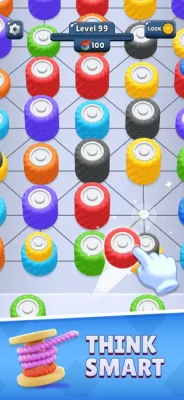
Loop Stack is a color-matching puzzle game centered around colorful thread spools.
Instead of simply matching three identical objects, the game asks you to arrange spools strategically and connect matching thread colors. When a stack is completed, the spools can be cleared from the board.
This creates a gameplay loop based on:
Drag → Match → Stack → Clear → Plan the next move
The game is designed to be relaxing while still requiring concentration and forward planning.
Loop Stack Gameplay
The controls are straightforward.
You drag a spool onto the board and try to connect it with thread of the same color.
As you make matches, stacks are completed and cleared, opening more room for new pieces.
The challenge comes from deciding where each spool should go before you commit to a move.
A move that creates an immediate match isn't necessarily the best move. Sometimes you need to prepare the board for a larger sequence.
Main Features
Colorful Thread Puzzles
Loop Stack uses colorful spools and matching thread as the central puzzle mechanic.
Drag-and-Drop Controls
The game is designed around simple dragging, making the basic controls easy to learn.
Match and Clear Gameplay
Connect matching colors and complete stacks to clear spools from the board.
Increasing Challenge
The game's puzzles become trickier as you progress, requiring more attention to placement and move order.
Relaxing Puzzle Experience
The colorful visual design and straightforward mechanics make it suitable for casual puzzle sessions.
Strategic Thinking
Although the controls are simple, successful play requires planning and understanding how one move affects the next.
How to Play Loop Stack
The main objective is to connect matching thread colors and complete stacks.
A simple approach is:
- Examine the available spools.
- Identify matching colors.
- Look for the safest placement.
- Drag a spool onto the board.
- Connect it with the appropriate matching color.
- Complete the stack.
- Clear the completed stack.
- Use the newly available space to plan your next move.
The important part is not simply making a match.
You need to make matches without creating unnecessary obstacles for future pieces.
Loop Stack Strategy Guide
1. Study the Board Before Moving
Don't immediately drag the first spool you see.
Take a moment to identify:
- Available colors
- Existing stacks
- Partially completed stacks
- Open spaces
- Colors that appear frequently
- Colors that have limited placement options
A few seconds of observation can prevent a poor opening move.
2. Match Colors With a Plan
When you see two matching colors, don't automatically connect them.
Ask yourself:
What happens after this match?
If completing the match opens a useful area, it may be a strong move.
If it blocks another important color, you may want to wait.
3. Prioritize Easy Clears
When several matches are available, look for combinations that can be completed quickly without limiting your future choices.
Clearing a stack gives you more working space.
That extra space can be more valuable than creating a match that does not immediately clear anything.
4. Avoid Filling the Board Too Quickly
One of the easiest mistakes in a sorting puzzle is placing pieces everywhere just because there is room.
A crowded board reduces your options.
Try to maintain enough open space to handle the next few spools.
Think of empty space as a resource.
5. Look for Color Chains
Sometimes several pieces can be arranged in a sequence.
For example:
Blue → Blue → Blue → Clear
Then:
Red → Red → Red → Clear
If you can see a chain like this developing, plan the moves in advance.
This is more efficient than making isolated matches.
6. Think About the Next Spool
A good move isn't only about the spool you are holding.
Consider what you will need to do immediately afterward.
Before placing a spool, ask:
- Where will the next matching color go?
- Will there still be enough space?
- Will this stack block another color?
- Can I complete this group soon?
This simple habit makes difficult puzzles much easier.
7. Use Open Space Strategically
Open areas should not be treated as empty decoration.
They are your flexibility.
Use them to:
- Prepare a match
- Temporarily position a spool
- Separate colors
- Create room for a larger combination
- Recover from an awkward arrangement
Avoid filling all available space unless you have a clear plan.
8. Don't Chase Every Immediate Match
A visible match can be tempting.
But the best move is sometimes the one that doesn't produce an immediate clear.
You may need to place a spool in a temporary position so another color becomes accessible.
Think beyond the current move.
9. Complete Stacks Carefully
Completing a stack can be extremely useful because it clears pieces and creates room.
However, don't rush to complete a stack if doing so prevents you from handling another important color.
Look at the whole board first.
10. Work With the Most Restricted Color
Some colors may have many possible placements.
Others may only have one practical destination.
Deal with restricted colors first.
This prevents you from reaching a position where the remaining spool has nowhere useful to go.
11. Build From the Most Useful Position
When choosing between several possible placements, prefer the position that leaves you with the most options afterward.
A flexible board is usually safer than a board where every piece has become locked into a narrow sequence.
12. Think Several Moves Ahead
On easy puzzles, one move may be enough.
On harder puzzles, try to visualize:
Move 1 → Move 2 → Move 3 → Clear
You don't need to predict the entire level.
Planning just two or three moves ahead can make a major difference.
Loop Stack Tips for Beginners
Observe before dragging
Don't rush into the first available match.
Keep space open
A crowded board makes future moves harder.
Match strategically
Not every possible match is equally useful.
Look for completed stacks
Clearing a stack can create valuable space.
Watch color availability
If a color is difficult to place, prioritize it before easier colors.
Plan the next move
Always know where the next spool could go.
Avoid unnecessary movement
Every placement should have a purpose.
Advanced Loop Stack Strategy
Once you understand the basic mechanics, start treating the board like a resource-management puzzle.
Every move changes three things:
Space + Color Position + Future Options
A strong move improves at least one of these without seriously damaging the others.
For example, completing a stack is valuable because it:
- Removes pieces
- Opens space
- Reduces visual clutter
- Gives you more options
But placing a random spool into an open position may do the opposite.
How to Clear Difficult Loop Stack Puzzles
When a puzzle becomes difficult, use this process.
Step 1: Stop Moving
Don't make another random move.
Step 2: Identify Every Color
Determine which colors are currently active.
Step 3: Find Nearly Completed Stacks
These may provide the quickest way to create additional space.
Step 4: Identify Restricted Colors
Find the colors with the fewest useful destinations.
Step 5: Preserve Open Space
Don't fill your last flexible position without a reason.
Step 6: Plan a Short Sequence
Try to visualize the next two or three moves.
Step 7: Clear a Stack
Once a safe sequence is available, complete the stack and use the newly opened space.
Common Loop Stack Mistakes
Moving Too Quickly
Fast moves can create unnecessary complications.
Matching Without Thinking
A match is not automatically a good move.
Filling Every Open Position
This can leave no room for future spools.
Ignoring Other Colors
Focusing exclusively on one color can create problems elsewhere.
Forgetting the Next Move
A placement that works now may make the next move impossible.
Creating Unnecessary Clusters
If several colors become mixed together, reorganizing them can take more moves.
Loop Stack Walkthrough Method
If you're searching for a Loop Stack walkthrough, the most useful approach is to analyze the board rather than memorize a fixed sequence.
For each puzzle:
First, identify the goal
Determine which colors need to be connected and which stacks need to be completed.
Second, locate the easiest clear
Look for a group that can be completed without creating a blockage.
Third, identify the bottleneck
Find the color or spool that has the fewest useful options.
Fourth, create space
Use completed stacks to open room.
Fifth, continue the sequence
Once the board becomes less crowded, matching becomes easier.
This approach is more adaptable than following a single predetermined sequence because puzzle layouts can change.
How to Improve at Loop Stack
The best way to improve is to pay attention to why a move works.
After completing a difficult puzzle, think about what made the solution successful.
Was it:
- Preserving an open area?
- Completing a stack early?
- Delaying a match?
- Prioritizing a restricted color?
- Creating a chain?
- Clearing the board in a specific order?
Recognizing these patterns will help you solve future puzzles faster.
Loop Stack Difficulty
Loop Stack starts with an accessible color-matching concept, but its strategic demands increase as the puzzles become trickier.
The game's App Store description specifically emphasizes that every move counts and that puzzles become more challenging as players progress.
That means the main difficulty isn't complicated controls.
It is move management.
The game asks you to think about the consequences of each placement rather than simply reacting to the current board.
Is Loop Stack Relaxing?
Loop Stack is designed as a relaxing puzzle experience while still testing strategy and focus.
The colorful thread and spool theme gives the game a casual appearance, while the increasingly difficult arrangements provide enough challenge to keep the gameplay interesting.
It works well for short puzzle sessions because the basic interaction can be understood quickly.
Loop Stack Review
Loop Stack takes a familiar color-matching concept and gives it a distinctive thread-and-spool presentation.
Its biggest gameplay strength is the relationship between matching and positioning. You aren't simply searching for identical colors; you also need to think about where pieces should be placed and how that decision affects the next move.
The App Store currently categorizes Loop Stack as a Puzzle game and lists UNICO STUDIO as its developer. It is free with optional in-app purchases.
At the time of the current App Store listing, Apple says the app has not received enough ratings or reviews to display an overall ratings summary, so there isn't enough App Store review data to make broad claims about player reception.
Pros and Cons
Pros
- Simple drag-and-drop controls
- Easy-to-understand color matching
- Colorful thread and spool theme
- Increasing puzzle difficulty
- Encourages strategic planning
- Suitable for casual sessions
- Multiple supported languages
- Available on iPhone and iPad
Cons
- Later puzzles require more planning
- A poor placement can reduce future options
- Players who prefer fast-paced games may find the slower puzzle format less exciting
- The game contains optional in-app purchases
Loop Stack Game Information
| Feature | Details |
|---|---|
| Game | Loop Stack |
| Tagline | Stack, Match & Clear! |
| Developer | UNICO STUDIO |
| Category | Puzzle |
| Genre | Casual Puzzle |
| Main Mechanic | Color matching |
| Theme | Thread spools |
| Controls | Drag and drop |
| Monetization | Free with in-app purchases |
| Age Rating | 4+ |
| iPhone | Yes |
| iPad | Yes |
| iOS Requirement | iOS 13.0 or later |
| Languages | English + 18 more |
| Current Version | 0.2.0 |
These details are based on the current App Store listing.
Compatibility
The App Store currently lists Loop Stack for:
- iPhone
- iPad
- iPod touch
- Mac with Apple silicon
- Apple Vision
The iPhone and iPad versions require iOS/iPadOS 13.0 or later, while the Mac listing requires macOS 11.0 or later and an Apple M1 chip or newer.
Languages
Loop Stack currently supports 19 languages, including:
- English
- Arabic
- Czech
- French
- German
- Indonesian
- Italian
- Japanese
- Korean
- Malay
- Polish
- Portuguese
- Russian
- Simplified Chinese
- Spanish
- Thai
- Traditional Chinese
- Turkish
- Vietnamese
Recent Updates
The current App Store version history lists version 0.2.0 with performance improvements and bug fixes. Previous versions also contain performance and bug-fix updates.
This indicates that the developer has continued making technical improvements after the game's initial release.
Frequently Asked Questions
What is Loop Stack?
Loop Stack is a colorful puzzle game where players drag and drop thread spools, connect matching colors and complete stacks to clear them.
How do you play Loop Stack?
Drag spools onto the board and connect matching thread colors. Complete the required stacks to clear them and continue solving the puzzle.
What is the best Loop Stack strategy?
Plan each move before making it, preserve open space, prioritize restricted colors and look for opportunities to complete stacks and clear the board.
How do you solve difficult Loop Stack levels?
Study the complete board first, identify the colors with limited options, avoid filling useful open spaces and plan several moves ahead.
Is Loop Stack easy to play?
The controls are simple, but later puzzles require more strategic thinking as the arrangements become more difficult.
Is Loop Stack free?
Yes. The App Store lists Loop Stack as free with optional in-app purchases.
Who developed Loop Stack?
Loop Stack was developed by UNICO STUDIO.
Does Loop Stack work on iPhone?
Yes. Loop Stack supports iPhone and requires iOS 13.0 or later.
Can I play Loop Stack on iPad?
Yes. The App Store lists Loop Stack as designed for iPad and compatible with iPadOS 13.0 or later.
Does Loop Stack have in-app purchases?
Yes. The App Store lists optional purchases, including coin packs and a no-ads bundle.
Final Loop Stack Strategy
Loop Stack looks simple because its controls are straightforward, but the real challenge is deciding where each spool should go and when it should be moved.
The most useful rule is:
Don't make a match just because you can. Make the match because it improves your next move.
Keep open space available, watch the colors that have limited options, complete useful stacks and think a few moves ahead.
Once you begin viewing the board as a combination of colors, space and future possibilities, difficult Loop Stack puzzles become much easier to understand and solve.
Rate the Game
User Reviews













Popular Games



















 Android
 iOS
iOS Windows
 Xbox
Xbox