
Latest Version
September 29, 2026
UNICO STUDIO
Puzzle
iOS
0
Report a Problem
More About :game
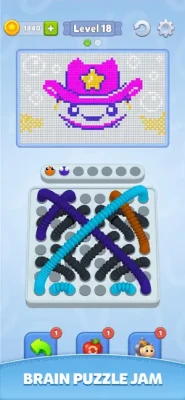
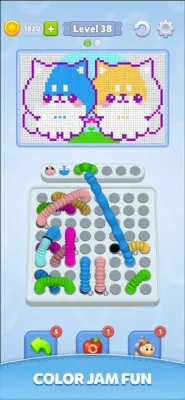
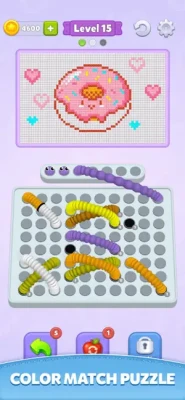
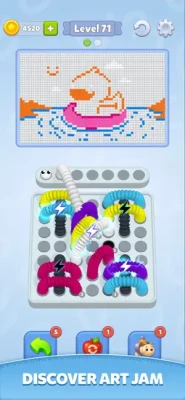
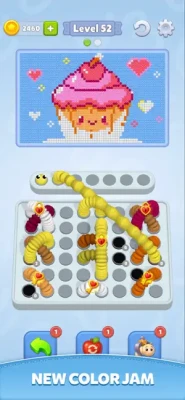
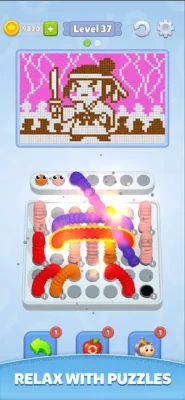
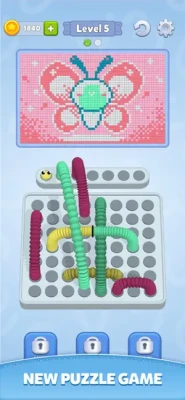
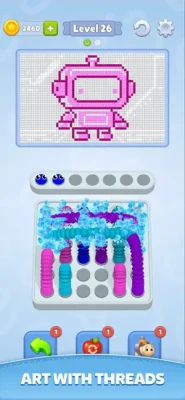
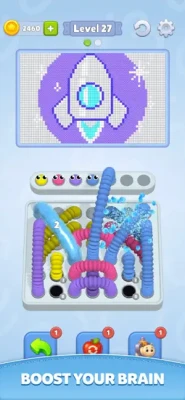
The basic objective is straightforward: tap colorful tubes, place matching colors into your rack, and collect three of the same color. When a complete group is formed, it is released onto the canvas and reveals another part of the hidden picture.
The challenge comes from deciding which tube to select first. Your rack has limited space, so careless moves can leave you with too many unmatched colors and make the puzzle much harder.
The game is designed around relaxed puzzle solving rather than speed. There is no countdown timer, allowing you to examine the board, think about your next few moves, and solve each level at your own pace.
What Makes Wiggle Tangle Different?
Wiggle Tangle combines several familiar puzzle ideas into one format:
- Color sorting
- Match-three grouping
- Limited-space planning
- Hidden image discovery
- Visual pattern recognition
- Relaxed puzzle gameplay
- Progressive level difficulty
The most interesting part is the relationship between the sorting puzzle and the picture above it. Every successful color group contributes to completing the image, giving you a visual reward as you work through the board.
The App Store listing describes hundreds of handcrafted levels, offline play, no time pressure, and a focus on visual memory, planning and attention.
How to Play Wiggle Tangle
The controls are simple, but the order of your moves matters.
1. Examine the Entire Board
Before tapping anything, look at the available tubes and identify:
- Colors that appear several times
- Tubes that are easy to access
- Colors that are partially blocked
- Groups that can potentially be completed quickly
- Colors that may become a problem if placed in the rack too early
Don't immediately choose the first tube you see.
2. Collect Matching Colors
Your rack can hold up to three tubes of the same color. Once you collect three matching tubes, they are matched and released to the image.
A simple example is:
Blue → Blue → Blue = Complete Match
The important part is getting the three colors together without filling the rack with unrelated tubes.
3. Protect Your Rack Space
Your rack is effectively your most important resource.
If you collect:
Red → Green → Yellow → Purple
you have four different colors competing for space.
If none of those colors can immediately be completed, your future choices become much more restricted.
Try to create complete matches instead of collecting too many different colors at once.
4. Reveal the Hidden Image
Every successful match contributes to the image on the canvas.
This gives each level two objectives:
- Solve the color-sorting puzzle.
- Complete the hidden picture.
The picture is therefore more than decoration; it provides a visual sense of progression as the puzzle is cleared.
Wiggle Tangle Strategy Guide
Strategy 1: Think Two or Three Moves Ahead
One of the easiest mistakes is planning only the current move.
Instead, ask:
"If I select this tube, what will I be able to select next?"
Then consider the move after that.
A good sequence often looks like:
Open a color → collect its match → free another tube → create the next match
This approach prevents your rack from becoming filled with unrelated colors.
Strategy 2: Complete Existing Groups First
If you already have two tubes of the same color in your rack and the third one is available, completing that group is often preferable to starting another color.
For example:
- Rack: Blue, Blue
- Board: Blue available
- Alternative: Yellow available
Completing the Blue group immediately clears rack space.
That gives you more flexibility for the next sequence.
Strategy 3: Don't Fill the Rack With Single Colors
A rack containing several different colors can quickly become dangerous.
For example:
Red | Blue | Green | Yellow | Purple
may look harmless, but if the next useful tubes don't match those colors, your options become limited.
Whenever possible, build toward pairs and triples rather than collecting isolated colors.
Strategy 4: Look for the Color You Need Before Moving
Before taking a tube, locate other tubes of the same color.
If you select a red tube but cannot see another red tube that can be accessed soon, you may be creating a dead-end.
On the other hand, if you can already see two more red tubes that can become available, the move is much safer.
Strategy 5: Use Easy Matches to Create Space
Some moves are valuable because they remove a problem rather than immediately revealing a large portion of the image.
If completing a color group opens access to several previously blocked tubes, that match may be more important than a move that simply looks attractive.
Think of each completed group as creating new board space.
Strategy 6: Avoid Random Tapping
Random moves may work on easier levels, but they become increasingly unreliable as the board becomes more complicated.
Before each move, consider:
- What color am I collecting?
- How many of this color do I already have?
- Where is the next matching tube?
- What happens if I cannot find another match?
- Will this move expose a useful tube?
That short mental checklist can prevent many unnecessary mistakes.
How to Solve Difficult Wiggle Tangle Levels
When a level becomes difficult, stop trying to solve everything at once.
Step 1: Find the Most Useful Color
Look for a color that already has multiple accessible tubes.
Step 2: Follow the Chain
Determine which tube becomes available after removing the first one.
Step 3: Complete a Match
Try to remove a full group of three rather than leaving several colors unfinished.
Step 4: Reassess the Board
After a match disappears, the available options may change significantly.
Step 5: Repeat
Treat the level as a series of small decisions rather than one giant puzzle.
This is particularly useful because Wiggle Tangle relies heavily on planning and limited rack space.
Advanced Wiggle Tangle Tips
Prioritize Space Over Speed
There is no need to rush. The game is specifically designed without a countdown timer, so take advantage of that.
A slower solution that preserves rack space is usually safer than a fast sequence of uncertain moves.
Search for Hidden Opportunities
A tube that looks unimportant may be the key to accessing another color.
Before committing to a move, check whether removing one tube exposes another useful tube underneath or behind it.
Build Color Chains
The ideal situation is:
Collect → Match → Clear Space → Access New Tube → Match Again
These chains allow you to keep solving without filling the rack.
Don't Chase the Picture
The hidden image is an enjoyable part of Wiggle Tangle, but don't let the partially revealed picture influence your move selection.
The correct move is determined by the puzzle board, not by which part of the image you want to see next.
Use Mistakes as Information
If a particular move causes the rack to fill quickly, remember the sequence.
On a second attempt, change the order rather than simply repeating the same choices.
Common Mistakes to Avoid
Taking Every Available Tube
Just because a tube is available doesn't mean you should take it.
Starting Too Many Colors
Multiple unfinished colors consume valuable rack space.
Ignoring Future Matches
A move that works immediately may create problems two or three moves later.
Failing to Reassess
After completing a group, look at the board again. New options may have become available.
Playing on Autopilot
The early levels may feel simple, but later puzzles reward deliberate planning.
Wiggle Tangle Level 380 Issue
One notable issue appeared in App Store player reviews around Level 380, where players reported that a required key was not appearing.
The developer responded that the level had been redesigned in an update to improve its logic and flow. Another player also reported the missing-key problem, so if you encounter something similar, make sure the game is updated before assuming the level is unsolvable.
This is a good example of why keeping the game updated can matter when progressing through later puzzles.
Wiggle Tangle Gameplay Features
According to the current App Store listing, the game includes:
- Color-sorting puzzles
- Three-of-a-kind matching
- Hidden image and pixel-art reveals
- Hundreds of levels
- No countdown timer
- Offline gameplay
- Relaxing visual presentation
- Tube-based puzzle mechanics
- Progressive challenges
- Visual memory and planning elements
- Game Center achievements
- Support for multiple languages
The current US App Store listing shows a 4.9/5 rating from more than 800 ratings, although ratings can change over time.
Difficulty and Progression
Wiggle Tangle starts with an accessible concept, but the strategic element becomes more important as puzzles introduce more complicated arrangements and mechanics.
The key progression isn't simply about faster thinking. It is about becoming better at:
- Recognizing color patterns
- Managing limited rack space
- Planning several moves ahead
- Identifying safe moves
- Creating chains of successful matches
- Recovering from imperfect positions
That makes the game suitable for short sessions as well as longer puzzle-solving sessions.
Pros and Cons
Pros
- Simple controls
- Relaxed pace
- No countdown timer
- Colorful visual presentation
- Hidden-picture reward system
- Easy to understand but increasingly strategic
- Offline gameplay
- Suitable for casual puzzle sessions
- Large selection of levels
Cons
- Later puzzles can require careful planning
- Limited rack space can make mistakes costly
- Some players have reported individual level or control issues
- The game contains advertising and optional in-app purchases
The App Store listing confirms advertising and several optional purchases, including coin packs, boosters, an infinite-life pack and an ad-removal option.
Wiggle Tangle Game Information
| Feature | Details |
|---|---|
| Game | Wiggle Tangle - Thread Puzzle |
| Developer | UNICO STUDIO |
| Genre | Puzzle |
| Main Mechanic | Color sorting and matching |
| Visual Goal | Reveal hidden images |
| Players | Casual puzzle players |
| Timer | No countdown |
| Offline Play | Yes |
| Age Rating | 4+ |
| Languages | English + 18 more |
| iPhone | Supported |
| iPad | Supported |
| iOS Requirement | iOS 13.0 or later |
| iPadOS Requirement | iPadOS 13.0 or later |
| Size | About 246.6 MB |
| In-App Purchases | Yes |
| Advertising | Yes |
| Game Center | Supported |
The App Store currently lists iPhone, iPad, iPod touch, Mac with Apple silicon requirements, and Apple Vision compatibility, although the listing notes that Mac compatibility is not verified in the main product header.
Recent Updates
Wiggle Tangle has received a series of updates focused on new mechanics, visual improvements, additional levels, bug fixes and performance improvements.
The version history records a name and visual refresh in version 1.12.1, new mechanics in earlier updates, and later releases containing additional levels and further improvements. The current version history shown by Apple also lists version 2.4.0 with bug fixes and performance improvements.
This continuing update history suggests that the game's mechanics and level experience can change over time, so guides should be used as strategic guidance rather than assuming every puzzle remains identical forever.
Frequently Asked Questions
Is Wiggle Tangle a color-sorting puzzle game?
Yes. Color sorting is the central mechanic. Players collect matching tubes and form groups of three to clear them and reveal sections of the hidden image.
Does Wiggle Tangle have a timer?
The App Store description states that there is no countdown timer, allowing players to solve puzzles at their own pace.
Can you play Wiggle Tangle offline?
Yes. Offline play is listed as one of the game's features.
How do you win a Wiggle Tangle level?
Collect and match the colored tubes while managing your rack space. Completing the required groups gradually reveals the image, and completing the puzzle finishes the level.
What is the best Wiggle Tangle strategy?
The most important strategy is to manage rack space carefully. Look for matching colors before making a move, complete groups whenever possible, and plan several moves ahead.
Is Wiggle Tangle free?
The game is free to download but contains advertising and optional in-app purchases.
Is Wiggle Tangle suitable for beginners?
Yes. The basic controls are simple to understand, while the limited rack and color combinations provide more strategic depth as you progress.
Does Wiggle Tangle have achievements?
Yes. The App Store listing indicates that the game supports Game Center achievements.
Final Wiggle Tangle Strategy
The secret to Wiggle Tangle isn't speed. It is space management and move order.
Before selecting a tube, look for its matching colors and consider what the move will expose. Try to complete groups of three instead of filling the rack with unrelated colors. Once a match clears, reassess the entire board and search for the next useful chain.
The best general pattern is:
Observe → Plan → Match → Clear Space → Reassess → Continue
Once you start treating every tube as part of a larger sequence rather than an isolated move, the color-sorting puzzles become much easier to understand.
Wiggle Tangle's combination of relaxed gameplay, color matching and hidden-image discovery makes each completed puzzle feel like both a logic challenge and a small visual reveal.
Rate the Game
User Reviews




Popular Games
















 Android
 iOS
iOS Windows
 Xbox
Xbox