










Latest Version
September 29, 2026
UNICO STUDIO
Puzzle
iOS
0
Report a Problem
More About :game
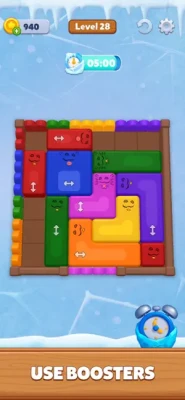
The central idea is simple: move the blocks, clear the path, and help the animals reach freedom.
The App Store describes the game as a combination of cozy farm atmosphere and brain-teasing puzzle mechanics, with hundreds of levels, offline play, relaxing music, and no countdown pressure in its general puzzle experience.
What Is Farm Block Escape?
Farm Block Escape is a block puzzle and sliding escape game built around spatial reasoning.
Each puzzle presents a compact arrangement of blocks and obstacles. Your task is to figure out how the pieces need to move so that the trapped farm animals can get through the available paths.
The controls are easy to understand, but the solution is not always obvious. A move that looks useful at first can block another piece or leave the animal with no viable route.
That makes planning and move order more important than simply moving blocks as quickly as possible.
Farm Block Escape Gameplay
The core gameplay revolves around four basic actions:
- Observe the puzzle
- Move blocking pieces
- Open a route
- Guide the animal to freedom
Some levels are straightforward, while others require you to temporarily move blocks away from their apparent destination so that another piece can pass.
This creates a classic sliding-puzzle situation where one successful move can unlock several additional possibilities.
The App Store listing highlights new layouts, obstacles, logic-based designs and hundreds of levels.
How to Play Farm Block Escape
1. Study the Board Before Moving
Don't immediately start dragging blocks.
First identify:
- The trapped animal
- The exit or available escape route
- Blocks directly blocking the path
- Pieces that can move freely
- Pieces that appear to be locked by neighboring blocks
- Areas where several blocks could interfere with each other
Taking a few seconds to understand the complete layout can save many unnecessary moves.
2. Find the Main Block Blocking the Exit
The most important piece is usually the one preventing the animal from reaching its destination.
However, that doesn't always mean you should move it immediately.
Sometimes the main block cannot move until another piece is repositioned first.
Think of the puzzle as a chain:
Block A → Block B → Main Block → Exit
Your job is to break that chain in the correct order.
3. Create Temporary Space
One of the most useful techniques in sliding puzzles is moving a block away from its final position temporarily.
You may need to:
Move Block A → create space → move Block B → return to Block A
Don't assume every move must directly help the animal.
Some moves are simply preparation.
4. Recheck the Board After Every Important Move
A single block movement can completely change your available options.
After opening a new route, stop and reassess.
Ask:
- Which block can move now?
- Did I create a new path?
- Is the animal closer to the exit?
- Did I accidentally block another route?
- Can I now move the main obstacle?
This prevents you from continuing down a bad sequence.
Farm Block Escape Strategy Guide
Strategy 1: Plan Before You Slide
The biggest mistake in a block escape puzzle is moving pieces without understanding the consequences.
Before each move, consider where the block will end up.
A good question to ask is:
"What does this move allow me to do next?"
If the answer is nothing, another move may be more useful.
Strategy 2: Work Backward From the Exit
Instead of asking only:
"How do I move the animal forward?"
ask:
"What needs to be clear immediately before the animal reaches the exit?"
Then work backward.
For example:
Exit needs to be clear → Block B must move → Block A must move → create space
This backward-thinking method is particularly useful for compact levels.
Strategy 3: Don't Move Everything
You do not need to reposition every block.
Some pieces may never need to move.
Focus on the blocks that actually influence the animal's route.
This reduces unnecessary moves and makes the puzzle easier to understand.
Strategy 4: Identify Locked Pieces
Some blocks cannot move because another block is in their way.
Instead of repeatedly trying to move the same piece, identify what is preventing it from moving.
Then solve that smaller problem first.
Think of it as:
Blocked piece → blocking piece → space needed → solution
Strategy 5: Preserve Useful Space
Open spaces are extremely valuable.
If you move a block into the only area where another important piece needs to travel, you may create a new problem.
Before moving a large piece, consider whether its destination will remain useful later.
How to Solve Difficult Farm Block Escape Levels
When a level seems impossible, don't immediately restart.
Use a systematic approach.
Step 1: Locate the Exit
Determine exactly where the animal needs to go.
Step 2: Identify the Final Obstacle
Find the block that must move immediately before the animal can escape.
Step 3: Determine Why It Is Blocked
Look for the piece preventing that block from moving.
Step 4: Trace the Chain Backward
Continue identifying what must move before the previous piece becomes available.
Step 5: Execute the Sequence
Once you understand the dependency chain, perform the moves in reverse order.
Step 6: Reassess
If the expected route doesn't open, don't keep making random moves. Look at the new layout and identify where the sequence changed.
Tips for Saving Moves
If you want to become more efficient, focus on reducing unnecessary movements rather than simply moving faster.
Avoid Repeated Back-and-Forth
Moving a block left and right repeatedly usually means the previous sequence was not planned carefully.
Use Multi-Purpose Moves
A strong move can accomplish more than one thing.
For example, moving a block might:
- Clear the animal's route
- Open another block
- Create temporary space
These are valuable moves because they advance several parts of the puzzle at once.
Don't Rush Easy Levels
Simple levels are useful practice for learning how the game's block interactions work.
Pay attention to the relationship between pieces instead of treating early levels as something to finish as quickly as possible.
Farm Block Escape Advanced Techniques
The Dependency Chain
Many difficult puzzles can be understood as a dependency chain:
C → B → A → Animal → Exit
If A cannot move until B moves, and B cannot move until C moves, then C is effectively the first key to solving the puzzle.
Finding this chain is often more useful than trying random combinations.
The Space-and-Block Method
When you're stuck, identify:
1. Where is the free space?
2. Which block needs that space?
3. Which block is currently occupying it?
4. Where can that second block safely move?
This turns an apparently complicated board into a sequence of smaller decisions.
Don't Confuse Distance With Progress
Moving a block closer to the edge or closer to the animal doesn't necessarily mean you're closer to solving the level.
The correct move is the one that opens the required route, even if the block itself moves farther away from its apparent goal.
Farm Block Escape Obstacles
As the game progresses, puzzle layouts can introduce additional complications.
The App Store version history shows that the game has received updates addressing problematic levels, obstacles, boosters, interaction issues, visual problems and other gameplay refinements.
This means the exact behavior of certain levels can change with updates.
If a puzzle appears to behave differently from an older walkthrough, first check that you are playing the latest version.
Farm Block Escape Hints
The game includes a Hint option for challenging situations, according to a developer response to player feedback.
Use hints strategically rather than immediately.
A good approach is:
- Try to solve the puzzle yourself.
- Identify exactly where you're stuck.
- Think about the blocking piece.
- Use a hint if you cannot determine the next useful move.
- Continue the sequence yourself once the key idea is revealed.
This lets you learn the puzzle mechanic instead of simply following every suggested move.
Common Farm Block Escape Mistakes
Moving the Closest Block First
The block closest to the animal isn't necessarily the correct first move.
Ignoring Blocking Pieces
If a block won't move, determine what is stopping it instead of repeatedly trying.
Filling the Open Area
Free space is often required later. Don't waste it by placing a large block there without considering the next moves.
Making Random Moves
Random sliding can make the board harder to understand.
Restarting Too Quickly
A seemingly bad position may still be recoverable. Before restarting, look for a sequence that reverses your last few moves.
Focusing Only on the Animal
The animal's position is important, but the blocks determine whether a route exists.
Is Farm Block Escape Difficult?
The game is designed to be easy to understand while becoming more challenging as the level layouts develop.
The App Store describes its levels as easy to learn but hard to master, with new layouts, obstacles and logic-based designs.
The difficulty mainly comes from spatial planning rather than complicated controls.
That makes the game accessible to casual players while still providing increasingly demanding puzzles for people who enjoy logic games.
Farm Block Escape Features
According to the current App Store listing, Farm Block Escape includes:
- Farm-themed sliding puzzles
- Animal rescue gameplay
- Hundreds of levels
- Block-based logic challenges
- Multiple puzzle layouts
- Obstacles
- Intuitive controls
- Offline play
- Relaxing music
- ASMR-inspired feedback
- No-rush gameplay
- Cozy countryside visuals
- Hint functionality
- Events and seasonal content
- Game Center support
The App Store currently shows an age rating of 4+, a 4.8/5 rating from about 4.8K ratings, and a free-to-play model with optional in-app purchases.
Farm Block Escape Game Information
| Feature | Details |
|---|---|
| Game | Farm Block Escape |
| Developer | UNICO STUDIO |
| Genre | Puzzle / Strategy |
| Main Mechanic | Sliding block puzzles |
| Theme | Farm and animal rescue |
| Levels | Hundreds |
| Gameplay | Logic and spatial planning |
| Timer | No-rush puzzle experience |
| Offline Play | Supported |
| Age Rating | 4+ |
| Languages | English + 18 more |
| iPhone | Supported |
| iPad | Supported |
| iOS Requirement | iOS 15.0 or later |
| Size | About 312.3 MB |
| In-App Purchases | Yes |
| Game Center | Supported |
The current listing identifies the game as a free app with in-app purchases and lists iPhone/iPad compatibility.
Farm Block Escape Updates
The current version shown in the App Store is 3.2.1, released July 29, 2026, with bug fixes and performance improvements. Recent versions have also focused heavily on stability and gameplay improvements.
Earlier updates included fixes for problematic levels, improvements to level-end animations, visual changes, IAP presentation fixes, UI improvements, obstacle and booster fixes, and seasonal themes.
Because the game continues to receive updates, older walkthroughs may occasionally differ from the current version.
Farm Block Escape Player Feedback
Player feedback on the App Store is generally reflected in a strong current rating, but individual reviews mention some issues involving advertisements, lives, ads freezing, and occasional level or obstacle behavior. The developer has responded to several of these reports and advised players to update to the latest version or contact support when problems persist.
These reports are individual player experiences rather than evidence that every player encounters the same problems.
Pros and Cons
Pros
- Simple sliding controls
- Cute farm setting
- Animal rescue objective
- Hundreds of puzzles
- Relaxed pace
- Offline gameplay
- Increasing puzzle complexity
- Helpful hint system
- Seasonal events and content
- Suitable for short or longer sessions
Cons
- Some later puzzles require careful planning
- Mistakes can create difficult positions
- Advertising is part of the free experience
- Individual players have reported technical or progression issues
- Updates can change certain level behaviors
Frequently Asked Questions
What is Farm Block Escape?
Farm Block Escape is a farm-themed sliding block puzzle game where you move obstacles and create paths to help trapped animals escape.
How do you solve Farm Block Escape puzzles?
Start by identifying the animal's escape route, then determine which blocks are preventing that route from opening. Move the blocking pieces in the correct order while preserving useful open space.
Does Farm Block Escape have hundreds of levels?
Yes. The App Store listing describes hundreds of levels with different layouts and logic-based challenges.
Can you play Farm Block Escape offline?
Yes. Offline puzzle play is listed as one of the game's features.
Is Farm Block Escape timed?
The game's general puzzle design is described as no-rush and without countdown pressure, although individual modes or events can potentially have different rules.
Does Farm Block Escape have hints?
Yes. A developer response to player feedback specifically refers to using the Hint option when levels are challenging.
Is Farm Block Escape free?
Yes. The App Store lists it as free with optional in-app purchases.
What animals appear in Farm Block Escape?
The App Store specifically mentions pigs, cats and chickens, along with other farm animals.
Is Farm Block Escape suitable for children?
The current App Store age rating is 4+, and the developer describes the game as suitable for different ages. Parents should still consider the game's advertising and optional purchases when deciding whether it is appropriate for a particular child.
Final Farm Block Escape Strategy
The most useful way to approach Farm Block Escape is to stop thinking of the puzzle as a collection of individual blocks.
Think of it as a chain of dependencies.
First identify the escape route. Then find the block preventing that route. If that block cannot move, determine what is blocking it. Continue working backward until you find the first move that can unlock the sequence.
The basic solving pattern is:
Find the Exit → Identify the Main Obstacle → Find What Blocks It → Create Space → Move the Chain → Free the Animal
Don't rush your moves. The game's relaxed design gives you time to inspect the board, and careful planning is usually more effective than repeated trial and error.
Once you learn to recognize blocking pieces, temporary space, and dependency chains, even the more complicated Farm Block Escape puzzles become much easier to break down.
Rate the Game
User Reviews













Popular Games



















 Android
 iOS
iOS Windows
 Xbox
Xbox