



Latest Version
September 29, 2026
UNICO STUDIO
Puzzle
iOS
0
Report a Problem
More About :game
What begins as a simple sorting task gradually becomes more complicated as additional colors, tighter arrangements and trickier towers appear. The game combines the satisfying feeling of organizing objects with logic-based puzzle solving, making it suitable for both quick sessions and longer play.
The current App Store listing describes drag-and-drop nut and bolt puzzles, brain-training challenges, vibrant themes and progressively more difficult sorting levels.
What Is Nut Sort 3D: Color Match?
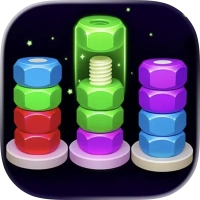
Nut Sort 3D: Color Match is a color sorting puzzle game built around nuts, bolts and careful planning.
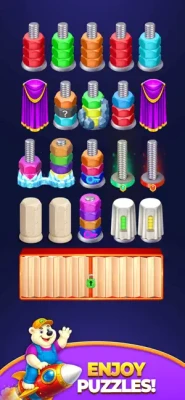
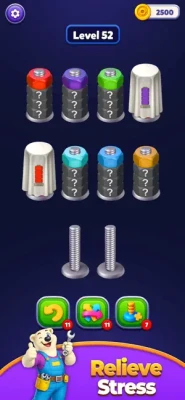
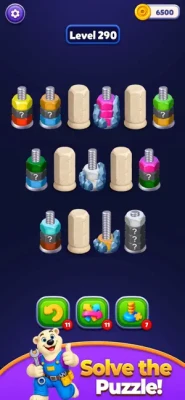
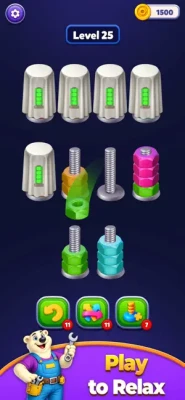
Each level gives you a collection of colored nuts arranged across several bolts. Your task is to move the nuts until matching colors are grouped together and the board is completely sorted.
The basic rule is easy to understand, but the number of possible moves can make later puzzles surprisingly difficult.
The challenge comes from deciding which nut to move first.
A move that looks helpful at the beginning can sometimes block the only useful move later, so successful players need to think several steps ahead.
Nut Sort 3D Gameplay
The basic gameplay works like this:
- Tap a nut to pick it up.
- Move it to another bolt.
- Place it on a nut of the same color or onto an available empty bolt.
- Continue organizing the colors.
- Complete the board by grouping the matching nuts together.
The App Store specifically describes the game as using drag-and-drop interactions and allowing nuts to be placed on matching colors or empty bolts.
The concept is familiar to fans of color-sort games, but the 3D presentation and nut-and-bolt theme give the game its own visual identity.
Main Features
Color Sorting Puzzles
The central challenge is organizing nuts according to their colors while avoiding moves that create dead ends.
Drag-and-Drop Controls
The controls are simple enough for new players to understand quickly. Tap or drag a nut and place it where it belongs.
Increasing Difficulty
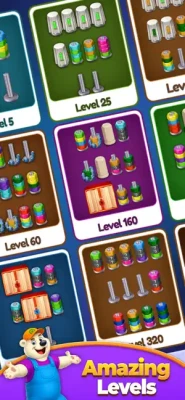
Early puzzles introduce the sorting concept, while later levels require more careful planning and prediction.
Tricky Towers
The game includes increasingly complicated arrangements that test your ability to manage available spaces and preserve useful moves.
Brain-Training Gameplay
The sorting mechanics encourage planning, visual recognition and logical thinking.
Relaxing Puzzle Experience
The game combines colorful visuals with a relatively simple control system, creating a casual puzzle experience that can be played at your own pace.
Rewards and Themes
The App Store listing states that players can earn rewards and unlock colorful themes as they progress.
How to Play Nut Sort 3D
The most important rule is simple:
Move matching colors together without trapping the colors you still need.
Suppose you have several red, blue and yellow nuts.
You should not automatically move every red nut you see.
Instead, first determine:
- Which bolt is nearly complete?
- Which color is blocking another color?
- Which empty space is most valuable?
- Which move will reveal a hidden nut?
- Which bolt should remain available as temporary storage?
Good sorting is about creating future options, not simply making the board look better immediately.
Nut Sort 3D Strategy Guide
1. Look at the Entire Board Before Making a Move
Don't immediately start moving nuts.
Take a few seconds to inspect every bolt.
Identify:
- Completed or nearly completed colors
- Colors buried underneath other nuts
- Empty bolts
- Partially filled bolts
- Colors that appear in several locations
- Nuts blocking important moves
This quick inspection can prevent unnecessary mistakes.
2. Don't Always Complete a Color Immediately
It can be tempting to collect all matching nuts as soon as possible.
Sometimes that's the wrong move.
A completed color may occupy a bolt that you could have used temporarily for another color.
Before completing a stack, ask:
“Will I need this space later?”
If the answer is yes, consider postponing the move.
3. Protect Empty Bolts
Empty bolts are extremely valuable.
They give you room to temporarily move nuts out of the way.
Try not to fill every available empty bolt too early.
A good player treats empty space as a resource.
Think of it as your emergency storage area.
4. Look at the Bottom of Each Stack
A nut at the top is easy to see, but the important nut may be underneath it.
Before moving anything, check which colors are buried below the visible layer.
For example, you may see:
Red → Blue → Yellow
If you need the yellow nut, moving the red without considering the blue may create unnecessary work.
Always think about what your move will reveal.
5. Build One Color With a Purpose
When you begin collecting a color, try to determine whether you can realistically finish that color soon.
If you only have one or two matching nuts available, it may be better to work on another color first.
This reduces unnecessary movement.
6. Use Temporary Moves Carefully
Temporary moves are sometimes necessary.
For example:
Move Blue → Empty Bolt
This may appear like wasted movement, but it can expose a red nut underneath.
The important question is not:
“Does this move solve anything?”
Instead ask:
“What does this move allow me to do next?”
That mindset is extremely useful on harder levels.
7. Avoid Blocking Your Own Options
One of the most common mistakes is placing a color somewhere that prevents access to another useful nut.
Before every important move, check:
- What color will be underneath?
- Will another bolt become inaccessible?
- Will I lose an empty space?
- Can I still move the exposed nut afterward?
A move should be evaluated by its next two or three consequences, not just its immediate result.
8. Prioritize Bottleneck Colors
Some colors appear in positions that block several other moves.
These are your bottleneck colors.
If moving one particular nut opens access to multiple useful pieces, that move may be more valuable than completing another color.
Look for the move that gives you the greatest number of future possibilities.
9. Think in Sequences
Instead of planning only one move, try to imagine a short sequence:
Move A → reveals B → move B → opens C → complete color C
This is much safer than making isolated moves.
Hard levels often become easier once you identify the first move in the correct chain.
10. Don't Waste the Empty Bolt
An empty bolt can serve three purposes:
Storage
Temporarily hold a color while you access something underneath.
Transfer
Move a color through it while reorganizing another stack.
Recovery
Create an escape route if your original plan doesn't work.
Because of this, keeping at least one flexible space available can make a major difference.
11. Work From the Most Restricted Position
When several moves are available, look for the position with the fewest options.
For example, if one color can only be moved to one location while another color has three possible destinations, deal with the restricted color first.
This reduces the chance of reaching a dead end.
12. Don't Panic When the Board Looks Messier
A good solution does not always make the board look cleaner immediately.
Sometimes you need to temporarily separate matching colors before you can bring them together.
That is normal.
A temporary mess can be part of a successful strategy.
Nut Sort 3D Tips for Difficult Levels
Think before every move
A few seconds of planning can save many unnecessary moves.
Keep an empty bolt available
Extra space gives you flexibility.
Don't fill a bolt just because you can
The space may be more useful later.
Expose hidden colors
Moving the top nut can reveal the piece you actually need.
Look for bottlenecks
Some nuts block several important moves.
Build colors gradually
Don't rush to complete a stack unless it benefits the rest of the board.
Plan several moves ahead
Harder puzzles reward sequences rather than individual decisions.
Learn from failed attempts
If a move creates a dead end, identify exactly why it happened.
Nut Sort 3D Walkthrough Strategy
If you're stuck on a particular level, don't immediately restart repeatedly.
Use this process.
Step 1: Identify all colors
Count how many nuts belong to each color.
Step 2: Locate the empty spaces
Determine which bolts can provide temporary storage.
Step 3: Find blocked colors
Look for colors buried beneath other nuts.
Step 4: Find the most restrictive move
Determine which nut has the fewest useful destinations.
Step 5: Create space
Move a blocking nut only when doing so gives you a clear advantage.
Step 6: Start building a color
Once you have a safe sequence, begin grouping matching nuts.
Step 7: Preserve flexibility
Don't consume every empty space unless you are close to finishing.
Step 8: Finish the board systematically
Once several colors are organized, the remaining moves should become easier to predict.
How to Avoid Getting Stuck
The most dangerous situation is having no useful space while several unmatched colors remain.
To prevent this, always monitor your available storage.
A simple rule is:
Before making a move, know where the next nut can go.
If you cannot identify the destination of the next piece, reconsider the current move.
This habit becomes increasingly important as the puzzles become more complicated.
Advanced Nut Sort 3D Strategy
For advanced players, think of every bolt as having a role.
A bolt can be:
- A final color stack
- A temporary storage stack
- A transfer stack
- A blocking stack
- An emergency space
Once you start assigning these roles mentally, complicated boards become much easier to understand.
Color Sorting Puzzle Tips
Nut Sort 3D follows several principles common to successful color-sort puzzle solving.
Preserve Flexibility
A board with multiple possible moves is usually safer than a board where every space has become restricted.
Reduce Blocking
Whenever possible, move pieces that are preventing access to more important colors.
Consolidate Carefully
Grouping matching colors is useful, but only when it does not destroy your available space.
Think Backward
If you know where a color eventually needs to end up, work backward to determine which pieces must move first.
Common Mistakes
Moving Without a Plan
The easiest way to get stuck is to make several random moves.
Filling Every Empty Bolt
This removes your emergency storage.
Focusing Only on Matching Colors
Sometimes the most important move involves a color you are not currently trying to complete.
Ignoring Hidden Nuts
The top nut is not always the important one.
Completing a Stack Too Early
A completed stack can sometimes occupy valuable space.
Restarting Too Quickly
Before restarting, identify what caused the position to fail. That information can help you solve the level on your next attempt.
Nut Sort 3D Difficulty
The basic mechanics are easy to understand, but the strategic difficulty increases as more colors and more complicated arrangements are introduced.
The App Store description specifically notes that puzzles progress from easier starter rounds to more complex challenges that test logic, patience and problem-solving.
This creates a gradual shift:
Learn the rules → recognize patterns → plan moves → manage space → solve complex arrangements.
Is Nut Sort 3D Relaxing?
The game is designed around a combination of colorful visuals, sorting mechanics and gradual puzzle solving.
That makes it possible to play casually while still requiring concentration on harder boards.
The App Store positions the game as both a color-sorting challenge and a stress-relief puzzle experience.
Nut Sort 3D Review
Nut Sort 3D: Color Match has a straightforward concept that becomes increasingly strategic as the board complexity grows.
Its strongest gameplay idea is the relationship between color matching and space management. You aren't simply matching identical colors; you are deciding when and where to move each nut without eliminating future possibilities.
The current US App Store listing shows a 4.8/5 rating from roughly 1.4K ratings.
Player feedback also shows that difficulty and technical reliability can vary. For example, some reviews mention difficulty at higher levels and problems involving “No Moves Available.” The developer has responded to reports and has also specifically stated that a reported Level 181 issue was fixed. These are individual player reports and should not be treated as representative of every player's experience.
Pros and Cons
Pros
- Simple controls
- Easy-to-understand objective
- Colorful 3D presentation
- Increasingly challenging puzzles
- Strong emphasis on logical planning
- Relaxing casual gameplay
- Rewards and unlockable themes
- Suitable for short or extended sessions
Cons
- Later levels require careful planning
- Some puzzles can become quite challenging
- A poor early move can create a difficult position
- Player reports have mentioned occasional level or move-detection issues
- The game contains advertising and optional in-app purchases
The App Store currently lists advertising and several optional in-app purchases, including coins, packs and an option to remove ads.
Game Information
| Feature | Details |
|---|---|
| Game | Nut Sort 3D: Color Match |
| Alternative Name | Nut Sort Game: Color Puzzle |
| Developer | UNICO STUDIO |
| Genre | Puzzle |
| Gameplay | Color sorting |
| Main Mechanic | Nuts and bolts |
| Controls | Tap / drag and drop |
| Age Rating | 4+ |
| Platforms | iPhone, iPad, Mac |
| Languages | English + 18 more |
| Requires | iOS 15.0 or later |
| Monetization | Free with in-app purchases |
| Advertising | Yes |
The App Store currently lists support for iPhone, iPad and Mac, with iOS 15.0 or later required for iPhone.
Recent Updates
The App Store version history shows a long series of gameplay, interface, bug-fix and performance updates.
Recent versions include:
- 3.3.6 — Bug fixes and performance improvements
- 3.3.5 — Bug fixes and performance improvements
- 3.3.4 — Bug fixes and performance improvements
- 3.3.3 — Bug fixes and performance improvements
- 3.3.2 — Bug fixes and performance improvements
Earlier updates also included UI improvements, gameplay enhancements and bug fixes.
Frequently Asked Questions
What is Nut Sort 3D: Color Match?
Nut Sort 3D: Color Match is a color-sorting puzzle game where players organize colorful nuts on bolts by matching colors and carefully planning their moves.
How do you play Nut Sort 3D?
Tap a nut to select it and place it on a bolt with the same color or on an available empty bolt. Continue sorting until all matching nuts are organized.
What is the best strategy for Nut Sort 3D?
The best general strategy is to preserve empty spaces, identify blocked colors, avoid unnecessary moves and plan several moves ahead.
How do you solve difficult Nut Sort 3D levels?
Study the entire board first, identify the most restricted colors, preserve temporary storage and avoid completing a stack if doing so removes an important future move.
Is Nut Sort 3D easy?
The controls and basic rules are easy to learn, but the puzzles become more challenging as the game progresses.
Does Nut Sort 3D have hints or additional resources?
The game includes rewards and in-game systems that can help players progress, while optional purchases are available through the App Store.
Is Nut Sort 3D free?
Yes. The App Store lists it as free with optional in-app purchases.
Who developed Nut Sort 3D: Color Match?
The game is developed by UNICO STUDIO.
Can I play Nut Sort 3D on iPhone?
Yes. The App Store lists the game for iPhone and requires iOS 15.0 or later.
Does Nut Sort 3D work on iPad?
Yes. The game is also listed for iPad and Mac.
Final Nut Sort 3D Strategy
Nut Sort 3D: Color Match may look like a simple color-matching game, but successful play depends heavily on planning.
The most useful rule to remember is:
Don't make a move just because you can. Make it because you know what it enables next.
Keep empty bolts available, watch the colors hidden beneath each stack, avoid unnecessary moves and think several steps ahead.
When a level becomes difficult, slow down and study the board instead of moving faster. Once you begin treating empty space as a resource and each nut as part of a larger sequence, even complicated color-sorting puzzles become much easier to approach.
Rate the Game
User Reviews











Popular Games



















 Android
 iOS
iOS Windows
 Xbox
Xbox