

Latest Version
September 28, 2026
UNICO STUDIO
Puzzle
iOS
0
Report a Problem
More About :game
Face cards work differently. J, Q, and K can only be matched with another card of the same type. This adds another layer of planning because these cards cannot be used to create ordinary combinations that total 10.
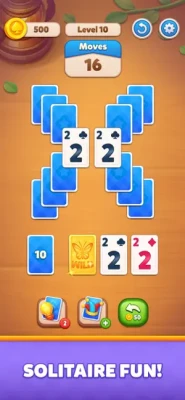
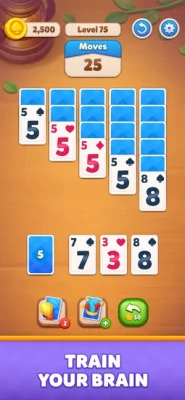
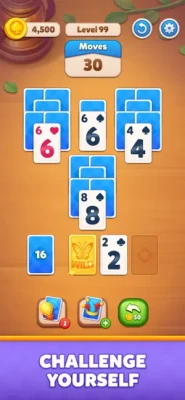
The game combines solitaire, number matching, logic, and puzzle-solving. Its layouts include formations such as Pyramid, Flower, Snake, and other creative board designs, with hidden cards, limited moves, stock cards, bench slots, and boosters making later levels more strategic.
How to Play Make It 10
The objective of each level is to clear the board.
You can select an open card and drag it onto another open card. If their values create a valid combination, both cards disappear.
The basic combinations are:
| Card | Matches With |
|---|---|
| 1 | 9 |
| 2 | 8 |
| 3 | 7 |
| 4 | 6 |
| 5 | 5 |
| 6 | 4 |
| 7 | 3 |
| 8 | 2 |
| 9 | 1 |
| J | J |
| Q | Q |
| K | K |
The important word is open. A hidden card cannot normally be used until the cards covering it have been removed.
That means every successful match can potentially do two things:
Clear cards + reveal new cards.
Understanding that relationship is the foundation of good Make It 10 strategy.
Main Gameplay Features
Number Matching to 10
The primary puzzle mechanic is matching card pairs that total exactly 10.
This gives the game a mathematical element without making the rules complicated.
Face Card Matching
Jacks, Queens, and Kings have their own special rule.
Instead of adding their conventional card values, each face-card type matches with another card of the same type.
So:
- J + J = valid
- Q + Q = valid
- K + K = valid
- J + Q = invalid
- Q + K = invalid
This becomes especially important when face cards appear in positions that are blocking lower-value cards.
Hidden Cards
Many layouts contain cards hidden underneath other cards.
Removing an upper card can reveal another card and create an entirely new matching opportunity.
Stock Pile
When there are no useful open matches, the Stock gives you additional cards.
Learning when to draw from the Stock is an important part of solving harder levels.
Bench Slots
The Bench gives you additional space for managing cards.
However, harder levels can limit the available bench space, so careless storage can quickly leave you without useful options.
Limited Moves
Levels can impose a limited number of moves.
That means simply clearing cards is not enough. You need to make efficient decisions and avoid wasting moves on combinations that don't contribute toward opening the board.
Different Board Layouts
Make It 10 includes multiple puzzle formations, including:
- Pyramid
- Flower
- Snake
- Other creative card arrangements
Each layout changes the relationship between visible and hidden cards, so the best strategy can vary from one level to another.
Make It 10 Card Matching Strategy
The biggest strategic mistake is to think only about whether two cards can match.
Instead, ask:
What will this match reveal?
A pair that adds up to 10 may be available immediately, but another pair could be much more valuable if removing it exposes several hidden cards.
The strongest moves often combine:
Valid match + hidden-card reveal + future match
This is how you turn one move into meaningful board progress.
Full Make It 10 Strategy Guide
1. Scan the Entire Board First
Before making your first match, look at all visible cards.
Identify:
- Available pairs
- Cards covering other cards
- Face cards
- Cards near the top of a layout
- Potential chain reactions
- Bench space
- Stock availability
- Cards that are difficult to access
Don't automatically choose the first valid pair you see.
2. Prioritize Matches That Reveal Cards
Suppose you have two possible matches.
Match A: removes two cards but reveals nothing.
Match B: removes two cards and exposes three hidden cards.
Match B is usually more strategically valuable because it expands your future options.
This principle is particularly important in Pyramid and other layered layouts.
3. Work From the Top of the Structure
In layouts where cards overlap, focus on cards that are preventing access to multiple cards underneath them.
Removing a strategically positioned card can open several possibilities at once.
Think of the board as a structure rather than a collection of independent cards.
4. Don't Waste a Rare Match
Sometimes you have only one available card that can remove a particular blocker.
If you use its matching partner elsewhere, you may lose an important future opportunity.
Before matching a pair, check whether either card is particularly important for opening the board.
5. Keep 5s in Mind
Two 5s create a valid pair.
However, 5s can sometimes be strategically important because each one has only one numerical partner.
If you see both 5s, think carefully about where they are positioned and whether removing them opens anything important.
6. Treat Face Cards Differently
J, Q, and K do not participate in the normal sum-to-10 system.
Don't waste time looking for a numerical combination for them.
Instead, locate their matching type:
- J → J
- Q → Q
- K → K
If a face card is blocking several hidden cards, finding its matching partner can become a major priority.
7. Look for Forced Moves
Some situations have only one practical solution.
For example, if one exposed card is the only card that can unlock an important hidden section, it may effectively become a forced move.
Recognizing forced moves can make difficult layouts much easier.
8. Save the Stock for When You Need It
The Stock is a resource, not simply an automatic next step.
Before drawing another card, check whether you still have a useful move available on the main board.
If you can make meaningful progress without using the Stock, consider doing so first.
9. Use the Bench Carefully
The Bench provides flexibility, but limited slots can become a problem.
Avoid filling every slot with cards that have no obvious future use.
A crowded Bench can prevent you from storing a genuinely useful card later.
10. Plan Around Limited Moves
When a level has a move limit, every unnecessary action matters.
Before making a match, consider:
- Does it remove a blocker?
- Does it reveal a card?
- Does it create another match?
- Does it move you toward clearing the board?
If the answer is no to all four, reconsider the move.
How to Clear Difficult Make It 10 Levels
When a board becomes difficult, use a structured approach.
Step 1: Find Every Immediate Match
Identify all currently available pairs.
Step 2: Mark the Important Blockers
Look for cards covering large sections of the board.
Step 3: Compare Your Options
Determine which match reveals the most useful cards.
Step 4: Check Face Cards
Don't overlook J, Q, and K matches.
Step 5: Protect the Bench
Avoid filling your limited storage with cards that don't contribute to your plan.
Step 6: Delay the Stock When Possible
Use existing board opportunities before drawing new cards.
Step 7: Reassess After Every Reveal
New cards can completely change the puzzle.
Step 8: Count Your Remaining Moves
Don't wait until the final few moves to discover that you've spent too many actions.
Best Strategy for Pyramid Layouts
The Pyramid layout is especially dependent on uncovering cards.
Your goal should be to remove the cards that support or cover the largest number of hidden cards.
A useful priority system is:
- Remove exposed cards that reveal multiple cards.
- Open the central structure when possible.
- Avoid clearing isolated cards if they don't improve access.
- Preserve useful matching partners.
- Reassess after every major reveal.
Don't simply clear the bottom or top because it looks convenient. Think about how each removal changes access to the rest of the pyramid.
Best Strategy for Flower Layouts
Flower-style layouts can spread your available cards across several branches.
Look for matches that open multiple petals or expose cards from different sections.
If one branch has very limited options, prioritize opening it before spending too many moves on a section that already has several available matches.
Best Strategy for Snake Layouts
Snake layouts create a more linear relationship between cards.
Look for matches that advance the board along the structure rather than repeatedly clearing isolated pairs.
A move that opens the next section can be more valuable than a simple match that leaves the main path blocked.
Stock and Bench Strategy
The Stock and Bench systems add an important resource-management element.
When to Use the Stock
Use the Stock when:
- No useful board match remains.
- You need a particular number.
- A hidden-card route is temporarily blocked.
- You need to create a new matching opportunity.
When to Avoid the Stock
Don't draw automatically after every match.
First inspect the board again.
A newly revealed card may already provide the solution you need.
How to Use the Bench
Use the Bench for cards that are:
- Useful but temporarily unmatched
- Blocking a preferred sequence
- Likely to become useful after another reveal
Avoid treating the Bench as permanent storage.
Its limited capacity means every slot should have a purpose.
Make It 10 Boosters
Make It 10 includes boosters designed to help when you run out of obvious options.
Hint
The Hint booster helps identify a useful move.
It's especially useful when several cards are visible but you aren't sure which pair will create the most progress.
For experienced players, it's often better to first inspect the board yourself and save the Hint for a genuinely confusing position.
Joker
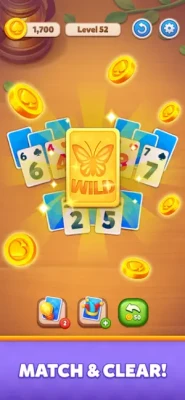
The Joker provides additional flexibility when a normal matching option is unavailable.
It can be particularly valuable when a specific card is preventing you from clearing an important part of the layout.
Don't use it merely to make an easy match.
Save it for situations where it changes the puzzle.
Perfect Match Bonus
The game also includes Perfect Match bonuses that can provide extra move rewards.
This makes efficient matching more valuable than simply clearing cards as quickly as possible.
Advanced Make It 10 Tips
Think Two Moves Ahead
Before making a match, consider what card or cards will become available next.
This is especially important when a match removes a card that is covering a hidden section.
Look for Chain Reactions
A good move can reveal a card that immediately creates another valid pair.
Try to recognize these chains before committing to a different match.
Don't Clear Everything Immediately
Sometimes leaving an exposed card on the board is useful because it can serve as a future match.
Clearing a card is not always progress if the resulting position is worse.
Identify Dead-End Cards
Some cards may have very limited matching opportunities.
If you have an opportunity to remove them safely, consider doing so before they become isolated.
Preserve Flexible Cards
Cards such as 1, 2, 3, 4, 6, 7, 8, and 9 each have a clear numerical partner.
Think about where those partners are located before using either card.
Watch the Move Counter
The limited-move system changes the value of every decision.
A technically valid move can still be strategically poor if it consumes an action without opening the board.
Common Mistakes
Matching the First Pair You See
A valid pair isn't necessarily the best pair.
Ignoring Hidden Cards
The real objective is often to expose the cards underneath the visible layer.
Wasting Bench Space
Limited bench slots can become a serious problem later in a level.
Using Stock Too Quickly
You may already have a useful solution on the board.
Treating Face Cards Like Number Cards
J, Q, and K require same-kind matches.
Spending Boosters on Easy Moves
Save powerful tools for situations where they actually change your options.
Ignoring the Move Limit
A level can be lost even when you understand the puzzle if too many actions are wasted.
Make It 10 Difficulty
Make It 10 starts with an approachable card-matching system, but the strategic depth increases through:
- More complicated layouts
- Hidden cards
- Limited moves
- Bench restrictions
- Stock management
- Face cards
- Booster decisions
- More difficult board setups
Player feedback on Google Play describes the early experience as easy to learn, while another reviewer noted that the game becomes surprisingly tricky as the levels progress.
This creates a progression from simple number matching toward more deliberate solitaire-style puzzle solving.
Is Make It 10 Relaxing?
The game can work as a relaxing puzzle because the basic rules are simple and the card layouts are easy to understand.
At the same time, the limited-move system means some stages require careful planning rather than casual matching.
That balance gives Make It 10 two distinct play styles:
Relaxed: Match obvious pairs and gradually uncover the board.
Strategic: Plan several moves ahead, manage the Stock and Bench, and optimize every action.
Offline Play
Make It 10 supports offline play, allowing players to continue solving levels without requiring a constant internet connection. The App Store listing also states that progress is automatically saved so players can continue later.
This makes it suitable for short puzzle sessions while traveling or during periods when a connection isn't available.
Leaderboards and Progress
The game includes global leaderboards, giving players an additional way to compare their progress with other players.
Progress is automatically saved, so you can return to your game without restarting completed levels.
Ratings and Player Feedback
At the time of checking, the US App Store listing shows 4.9 out of 5 from roughly 865 ratings, while Google Play shows 4.8 stars from about 1,040 reviews and 50K+ downloads.
Player feedback is generally positive, with reviews describing the game as entertaining and relaxing. Some players have also raised concerns about the way moves are counted, advertisements, hints, and certain progression or daily-challenge mechanics. The developer has responded to those comments and said it is reviewing player feedback.
Because these are individual player experiences, they should be treated as feedback rather than universal descriptions of the game.
Recent Updates
The App Store version history currently lists version 0.4.0, released September 4, with bug fixes and performance improvements. Earlier releases, including versions 0.3.1, 0.2.6, 0.1.8, and 0.1.2, also included bug fixes and performance improvements.
Google Play likewise lists bug fixes and performance improvements in its current update information.
Atmosphere and Presentation
Make It 10 uses a clean solitaire-inspired presentation rather than a complicated game world.
The appeal comes from the card layouts themselves: Pyramid, Flower, Snake, and other formations give each level a different visual structure while keeping the central number-matching rule consistent.
The result is a game that feels familiar to solitaire players but introduces enough puzzle mechanics to require more deliberate thinking.
Pros and Cons
Pros
- Simple card-matching rules
- Familiar solitaire-style gameplay
- Easy mathematical concept
- Multiple board layouts
- Hidden-card mechanics
- Stock and Bench systems
- Face-card rules add variety
- Hint and Joker boosters
- Limited-move strategic challenges
- Offline play
- Automatic progress saving
- Global leaderboards
Cons
- Advertising is included
- Optional in-app purchases are available
- Limited moves can make some stages more demanding
- Bench restrictions require careful planning
- Some players have reported concerns about move counting and ad frequency
Who Should Play Make It 10?
Make It 10 is a good fit for players who enjoy:
- Solitaire games
- Number puzzles
- Card matching games
- Math puzzles
- Logic games
- Brain-training style challenges
- Casual puzzle games
- Offline card games
- Strategy-based solitaire
- Short relaxing game sessions
It's particularly interesting for players who enjoy the familiarity of solitaire but want a more puzzle-focused objective.
Platform and Requirements
Developer: UNICO STUDIO
Genre: Puzzle / Card
Platforms: iPhone, iPad
Minimum iOS: iOS 15.0
Minimum iPadOS: iPadOS 15.0
Mac: macOS 12.0+ with Apple M1 chip or later
Apple Vision: visionOS 1.0+
Age Rating: 4+
App Size: Approximately 323.6 MB
Business Model: Free with advertising and in-app purchases
Languages: English plus 18 additional languages, including Arabic
The Google Play version is also available and currently lists 50K+ downloads.
Frequently Asked Questions
What is Make It 10: Solitaire Puzzle?
Make It 10 is a solitaire-inspired card puzzle where players match open cards that add up to 10 and clear each board.
How do you play Make It 10?
Drag one open card onto another. If the two cards create a valid combination, both cards are removed.
Which cards add up to 10?
The standard pairs are 1+9, 2+8, 3+7, 4+6, and 5+5.
Can J, Q, and K be matched with number cards?
No. Jacks, Queens, and Kings must be matched with another card of the same type.
What is the Stock in Make It 10?
The Stock provides additional cards when you don't have enough useful options among the currently open cards.
What is the Bench?
The Bench provides storage slots that can help you manage cards and create future matches. Some harder levels restrict the number of available slots.
Does Make It 10 have a move limit?
Yes. Levels can use limited moves, making efficient planning an important part of the game.
What boosters are available?
The game features boosters such as Hint and Joker, along with Perfect Match bonuses that can provide additional move rewards.
Does Make It 10 have different layouts?
Yes. The game includes layouts such as Pyramid, Flower, Snake, and other creative board designs.
Can I play Make It 10 offline?
Yes. The App Store listing states that the game can be played offline.
Is Make It 10 free?
Yes. It is free to download and play, with advertising and optional in-app purchases.
Is Make It 10 available on Android?
Yes. A Google Play version is available under the same title.
Is Make It 10 suitable for beginners?
Yes. The core rule is very simple, although later layouts and limited moves can require significantly more planning.
What is the best strategy for Make It 10?
Prioritize matches that reveal hidden cards, protect useful matching partners, manage the Bench carefully, delay unnecessary Stock draws, and think about what your current move will reveal next.
Final Make It 10 Strategy Tip
The most important rule is:
Don't make a match simply because it is available. Make the match that improves your next position.
Every card you remove can reveal something new. The best players therefore think beyond the current pair and consider the entire chain:
Match → reveal → new match → open the board → conserve moves → clear the level.
Once you start treating the board as a puzzle rather than a collection of matching cards, Make It 10 becomes much more strategic—and much more satisfying to solve.
Rate the Game
User Reviews












Popular Games



















 Android
 iOS
iOS Windows
 Xbox
Xbox