


Latest Version
September 28, 2026
UNICO STUDIO
Puzzle
iOS
0
Report a Problem
More About :game
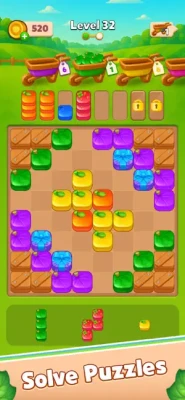
The basic idea is easy to understand: place fruit blocks, complete rows or columns, collect the resulting fruit, and keep the available slots under control. The challenge comes from planning several moves ahead because poorly placed blocks can quickly fill the board and leave you without enough room to continue.
Farmdoku also adds special obstacles, boosters, multi-stage levels, board resets, and larger carts as progression increases. It can be played offline and automatically saves your progress, making it suitable for short puzzle sessions or longer play.
Game Information
Game: Farmdoku: U-Pick Fruits
Subtitle: Harvest Fruit Block Puzzles
Developer: UNICO STUDIO
Genre: Puzzle
Game Style: Block Puzzle / Fruit Matching / Brain Teaser
Players: Single-player
Age Rating: 4+
Platforms: iPhone and iPad
Requires: iOS 15.0 or later
Languages: English plus 18 additional languages
Offline Play: Yes
Automatic Save: Yes
In-App Purchases: Yes
Advertisements: Yes
Current App Store Version: 1.1.9
Latest listed update: February 28, 2026
What Is Farmdoku: U-Pick Fruits?
Farmdoku: U-Pick Fruits combines familiar block puzzle mechanics with a fruit-harvesting system.
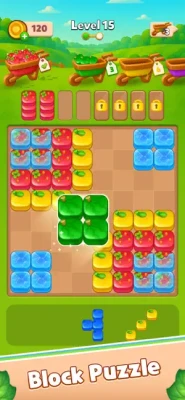
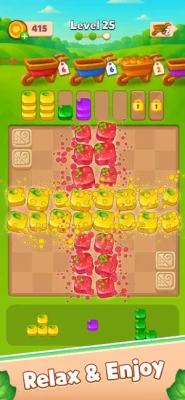
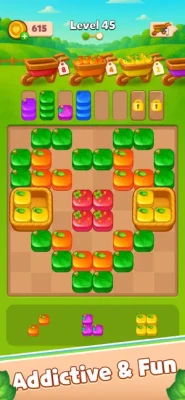
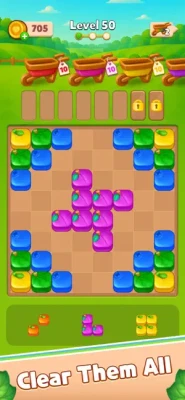
You receive different fruit-shaped blocks and place them on a puzzle board. When you successfully complete rows or columns, the corresponding fruit is collected and sent toward wheelbarrows positioned above the board.
That creates an important difference from a conventional block puzzle.
Clearing a line is not the only objective.
You also need to think about which fruit you are collecting, where it needs to go, how much space remains, and whether your next pieces can still fit on the board.
The game therefore rewards both careful placement and forward planning.
How to Play Farmdoku
The basic controls are simple.
1. Choose a Fruit Block
A new block appears for you to place.
2. Drag the Block Onto the Board
Move the piece to an open position.
3. Build Complete Lines
Place blocks so that you can eventually fill a complete row or column.
4. Harvest the Fruit
Once a line is cleared, the resulting fruit is collected.
5. Fill the Wheelbarrows
Collected fruit is sent to the matching wheelbarrows waiting above the board.
6. Manage Your Slots
Keep an eye on the available slots. If unloaded fruit occupies too much space, the level can end.
7. Continue the Harvest
Complete the required objectives and move through the stages of the level.
Farmdoku Main Features
Fruit Block Puzzle Gameplay
The heart of Farmdoku is its block-placement system.
You need to decide where each piece should go while keeping enough space available for future blocks.
A placement that looks useful immediately may create problems several moves later.
Fruit Harvesting
Completed lines produce fruit that needs to be collected.
This gives every successful line a purpose beyond simply removing blocks from the board.
Wheelbarrow Collection System
The game's distinctive wheelbarrows act as collection targets.
Matching fruit is directed toward the appropriate wheelbarrow, creating a satisfying visual connection between clearing the board and completing the harvest.
Limited Slots
Slots are one of the most important strategic elements.
You cannot simply clear blocks without considering what happens to the collected fruit.
If available slots become full before the necessary fruit can be unloaded, the run can end.
Three-Stage Levels
Farmdoku uses a three-stage level structure.
After completing a stage, the board can reset, giving you a fresh puzzle while the overall level continues toward its larger harvest objective.
Special Blocks
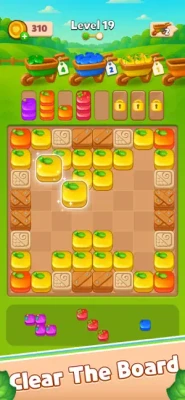
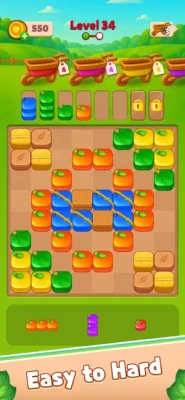
Later challenges introduce obstacles including:
Crates
Ivy
Stones
These special blocks make the board more complicated and require different approaches to clearing space.
Boosters
Boosters can help when the board becomes difficult or when a particular arrangement leaves you with limited options.
They are most valuable when used strategically rather than automatically.
Dynamic Difficulty
The game adjusts its challenge as you progress, keeping the puzzle experience from becoming completely predictable.
Offline Gameplay
Farmdoku can be played without an internet connection, making it convenient for travel, waiting rooms, or quick offline puzzle sessions.
Automatic Saving
Your progress is automatically saved, so you can leave the game and return later without having to start over.
Full Farmdoku: U-Pick Fruits Strategy Guide
1. Think About the Next Block
Do not treat each block as an isolated move.
Before placing a piece, consider what the board will look like afterward.
Ask yourself:
Where can the next piece go?
Will I still have an open area?
Can this placement help complete a line?
Could this block trap another area?
Planning one or two moves ahead can make a major difference.
2. Protect Open Space
Open space is your most valuable resource.
Avoid filling the board with small gaps that cannot accommodate useful shapes.
A board with several large, flexible spaces is generally easier to manage than one containing many awkward holes.
3. Do Not Clear a Line Just Because You Can
Completing a row or column feels rewarding, but sometimes waiting can create a better setup.
Before clearing a line, consider what pieces you may need afterward.
A premature clear can occasionally leave your remaining space poorly organized.
4. Keep the Board Flexible
Try to maintain different types of open areas.
You want enough room for:
Long blocks
Square shapes
L-shaped pieces
Smaller pieces
Future combinations
The more flexible your board is, the more options you have.
5. Watch the Wheelbarrows
The wheelbarrows are not merely decoration.
Keep track of which fruit is being collected and where it needs to go.
Understanding the collection process can help you decide which lines are most useful.
6. Manage Slots Carefully
Limited slots can turn a seemingly successful run into a failure.
Before making a move that generates additional fruit, check how much room remains.
If your slots are already close to full, prioritize moves that help unload or resolve the current collection problem.
7. Avoid Blocking the Center
When possible, avoid creating an arrangement that divides the board into several tiny sections.
A strong central area can give you more options for future pieces.
8. Use Obstacles to Your Advantage
Crates, ivy, and stones can make the board more difficult, but they also help define your objectives.
Instead of trying to clear everything immediately, identify which obstacle is preventing your next useful placement.
Work toward opening that area first.
9. Save Boosters for Real Problems
A booster can be extremely useful when you have limited options.
However, using one simply because it is available may leave you without assistance during a much harder situation.
Keep powerful tools for moments when they can prevent a failed run or create a major opening.
10. Think About the Whole Stage
Farmdoku uses three-stage levels, so completing the first board is not always the end of the challenge.
Think about your resources and overall progression rather than treating every board as completely independent.
Advanced Farmdoku Tips
Build Around the Largest Spaces
When you have several placement options, favor areas that preserve large open sections of the board.
Large spaces can accommodate more future pieces.
Avoid Isolated Empty Squares
Single empty spaces surrounded by blocks can become useless.
Whenever possible, place pieces in ways that maintain connected open areas.
Create Planned Clears
Instead of waiting for a perfect line to happen accidentally, build toward one deliberately.
Look at the incomplete rows and columns and identify which one is easiest to finish with the pieces you are receiving.
Keep an Emergency Area
Try to preserve at least one flexible section of the board.
If the next block does not fit where expected, that emergency space can prevent the run from ending.
Consider Fruit Before Placement
Because the game connects line clearing with fruit collection, the best move is not always the move that clears the most blocks.
Think about:
Board position + fruit collection + available slots.
A smaller clear may sometimes create a better overall position.
How to Deal With Crates
Crates can restrict your available space and make otherwise useful placements difficult.
When dealing with crates:
Identify the most restrictive crate.
Determine which line or placement can affect it.
Avoid filling nearby spaces unnecessarily.
Create room around the obstacle.
Clear it when doing so improves the overall board.
Do not spend every move trying to remove obstacles immediately. Sometimes maintaining board flexibility is more important.
How to Deal With Ivy
Ivy can make sections of the board difficult to use.
When ivy appears, avoid building a wall of blocks around the affected area.
Instead, look for ways to open access to it while preserving enough room for incoming pieces.
The key is to prevent the obstacle from turning one difficult section into several disconnected areas.
How to Deal With Stones
Stones can occupy valuable positions and reduce your available placement options.
When stones appear, think about the surrounding spaces.
Try to work around them rather than allowing the remaining open spaces to become fragmented.
If removing a stone opens a large area, it can be worth prioritizing.
Best Booster Strategy
Boosters are most valuable when they solve a problem that normal placement cannot easily fix.
Consider using a booster when:
The board is nearly full.
A critical area is blocked.
You need to complete an important objective.
A difficult obstacle is preventing useful placement.
Your next pieces have very limited options.
Avoid wasting boosters during comfortable stages.
Farmdoku Level Strategy
Farmdoku's three-stage structure means that a successful strategy should remain flexible.
Stage One
Use the early board to create space and establish a good arrangement.
Do not overfill the board simply to make quick clears.
Stage Two
The challenge begins to build.
Pay closer attention to the collection system and limited slots.
Stage Three
The final stage can require more careful decisions because the board and objectives have become more demanding.
Preserve your remaining space and use boosters only when they provide meaningful value.
The board reset between stages gives you another opportunity to organize your strategy rather than carrying a completely full board into the next stage.
Farmdoku Beginner Tips
If you are just starting, remember these simple rules:
Do not fill the board too quickly.
Keep large areas open.
Think about your next piece before placing the current one.
Watch the available slots.
Pay attention to the wheelbarrows.
Do not waste boosters.
Avoid creating isolated empty spaces.
Treat crates, ivy, and stones as strategic obstacles.
Plan line clears instead of making random placements.
Think ahead rather than focusing only on the current move.
Common Farmdoku Mistakes
Filling Every Available Space
A full board is not necessarily a good board.
You need space for future pieces.
Ignoring Slots
A player can successfully clear lines while still creating a collection problem.
Always monitor the available slots.
Using Boosters Too Early
A booster used on a minor inconvenience may not be available when the board becomes genuinely difficult.
Blocking Useful Areas
Placing a piece in a central or flexible location can make later moves much harder.
Focusing Only on One Fruit
The board and collection system need to be considered together.
Do not lose sight of the overall objective while focusing on one particular fruit.
Is Farmdoku Relaxing or Challenging?
Farmdoku deliberately combines both qualities.
The colorful fruit visuals and simple drag-and-drop controls make the game approachable, while limited slots, special blocks, and progressively harder boards add strategic pressure. The App Store describes it as easy to play but difficult to master.
This makes it suitable for players who want a puzzle that can be enjoyed casually but still rewards careful thinking.
Farmdoku: U-Pick Fruits Pros and Cons
Pros
Simple drag-and-drop controls
Colorful fruit-themed presentation
Unique wheelbarrow collection mechanic
Strategic block placement
Three-stage levels
Special obstacles
Boosters
Dynamic difficulty
Offline gameplay
Automatic saving
Short puzzle sessions
Suitable for casual and puzzle-focused players
Cons
Limited slots can make some situations unforgiving.
Players who prefer traditional block puzzles may need time to understand the fruit-collection system.
Later obstacles add complexity that can make levels considerably more demanding.
The game contains advertising and optional in-app purchases.
Who Should Play Farmdoku?
Farmdoku is a good match for players searching for:
Fruit puzzle games
Block puzzle games
Merge puzzle games
Brain teaser games
Offline puzzle games
Casual puzzle games
Matching and collection games
Relaxing puzzle games
Strategy puzzle games
Logic games
Brain games
Colorful mobile puzzles
Farm-themed puzzle games
It is particularly suited to players who enjoy the familiar feeling of block puzzles but want an additional objective beyond simply clearing lines.
Farmdoku Gameplay vs Traditional Block Puzzles
Traditional block puzzles generally focus on placing shapes and clearing complete rows or columns.
Farmdoku adds another layer.
Every clear contributes to a fruit-harvesting system, and the resulting fruit must be managed through the wheelbarrows and limited slots.
That creates three things to think about:
Where should I place the block?
Which line should I clear?
What will happen to the fruit afterward?
This additional layer makes Farmdoku more than a basic block-placement game.
Farmdoku: U-Pick Fruits FAQ
What is Farmdoku: U-Pick Fruits?
Farmdoku: U-Pick Fruits is a fruit-themed block puzzle game where players place blocks, clear rows and columns, collect fruit, and load matching wheelbarrows.
Who developed Farmdoku?
Farmdoku was developed by UNICO STUDIO.
Is Farmdoku a block puzzle game?
Yes. Its central mechanic involves placing colorful blocks on a board and completing rows or columns to collect fruit.
How do you clear lines in Farmdoku?
Drag available fruit blocks onto the board and arrange them so that a complete row or column is formed. The completed line is then cleared and its fruit is collected.
What are the wheelbarrows for?
Wheelbarrows collect matching fruit after you clear lines. They are a central part of the game's harvesting system.
What happens when the slots are full?
The game warns that if unloaded fruits fill the available slots, the game can end. Managing these slots is therefore an important part of the strategy.
Does Farmdoku have obstacles?
Yes. The game includes special blocks such as crates, ivy, and stones that make board management more challenging.
Does Farmdoku have boosters?
Yes. Boosters can be used to help in difficult situations.
Can Farmdoku be played offline?
Yes. The App Store listing specifically states that the game can be played offline.
Does Farmdoku save progress automatically?
Yes. Automatic saving is listed among the game's features.
Is Farmdoku free?
Farmdoku is listed as free to download, with advertising and optional in-app purchases.
Is Farmdoku suitable for children?
The App Store currently gives Farmdoku an 4+ age rating.
Final Thoughts
Farmdoku: U-Pick Fruits gives the familiar block puzzle formula a distinctive harvesting twist. Instead of simply clearing lines for points, every successful placement contributes to a larger collection system involving fruit and wheelbarrows.
The most important skill is planning ahead.
Keep your board flexible, protect open spaces, watch the limited slots, think about where your fruit will go, and save boosters for situations where they can genuinely change the outcome.
Once you stop thinking about each block as an individual move and start looking at the entire board as a connected puzzle, Farmdoku becomes much easier to understand—and much more satisfying to master.
Rate the Game
User Reviews













Popular Games



















 Android
 iOS
iOS Windows
 Xbox
Xbox