



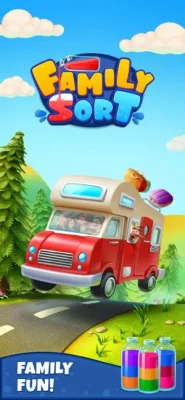
Latest Version
September 28, 2026
UNICO STUDIO
Puzzle
iOS
0
Report a Problem
More About :game
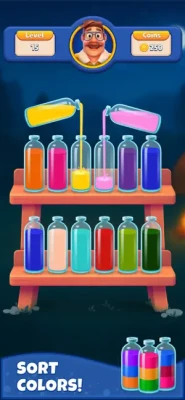
The basic idea is simple: move liquid from one bottle to another, match colors, and organize every bottle until the puzzle is completely sorted. The challenge comes from deciding which color to move first, which bottle to use as temporary space, and how to avoid trapping the colors you need later.
Although the controls are easy to understand, later puzzles require considerably more planning. The App Store describes the game as having hundreds of handcrafted levels, daily challenges, gradually increasing difficulty, and offline gameplay.
How to Play Family Sort
Each puzzle presents several bottles containing different layers of colored liquid.
Your objective is to separate the colors so that the bottles become properly organized.
The basic gameplay loop is:
Choose a bottle → select a destination → pour matching liquid → create space → reorganize the remaining colors → complete the sort.
The important rule is that you cannot simply pour any color anywhere. Your destination needs to be compatible with the liquid you are moving, so every pour should be considered as part of a larger sequence.
Family Sort Gameplay Features
Color Sorting Puzzles
The central mechanic revolves around separating and organizing colored liquids. Matching colors correctly is the foundation of every level.
Bottle Sort Mechanics
Empty bottles and partially filled bottles become important strategic resources. A bottle can provide the temporary space needed to reorganize another group of colors.
Hundreds of Levels
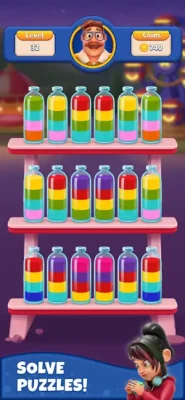
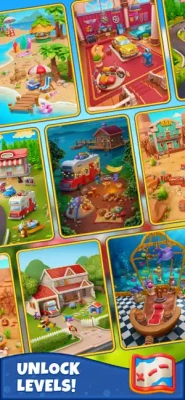
Family Sort includes hundreds of handcrafted puzzles, with layouts becoming more complicated as you progress.
Daily Challenges
Structured daily puzzle challenges provide additional goals outside the standard level progression.
Offline Gameplay
The App Store listing states that the puzzle experience can be played offline, making it suitable for situations where you do not have an internet connection.
Relaxing Presentation
Family Sort emphasizes smooth animations, colorful visuals, gentle interactions, and a calming presentation. The developer also describes the experience as suitable for relaxing, focusing, and winding down.
Full Family Sort Strategy Guide
The easiest mistake in a color sort puzzle is to think only about the next pour.
Instead, think about what that pour will make possible afterward.
A successful solution normally involves creating temporary space, exposing hidden colors, and gradually building completed color groups.
1. Study Every Bottle Before Your First Move
Don't immediately pour the first matching color you see.
Look across the entire board.
Identify:
- Completely empty bottles
- Bottles with two or more colors
- Colors that are already partially grouped
- Colors buried underneath other colors
- Bottles that could become useful temporary storage
- Colors that have very limited movement options
The first few seconds of planning can make the rest of the puzzle much easier.
2. Protect Your Empty Bottles
An empty bottle is one of your most valuable resources.
It gives you somewhere to place liquid temporarily while you reorganize the board.
Avoid filling every empty bottle immediately.
Instead, ask:
“Will I need this space three moves from now?”
If the answer might be yes, keep the bottle available.
3. Build Complete Color Groups
Whenever possible, try to bring identical colors together.
For example, if the top layers of two bottles contain the same color and moving them together will create a larger matching group, that can be a useful early step.
But don't complete a color group blindly.
Before doing so, check whether the move will prevent you from accessing another color underneath.
4. Look Beneath the Top Layer
Only the exposed liquid can normally be moved.
That means the top color is often acting like a blocker.
If the color you need is buried underneath another color, your objective becomes:
Move the blocking color somewhere safe → expose the target color → continue the sorting sequence.
This is one of the most important concepts for difficult Family Sort levels.
5. Use Temporary Bottles Strategically
A temporary bottle isn't necessarily where a color should finish.
Sometimes it is simply a parking space.
For example:
Bottle A: Red → Blue
Bottle B: Blue → Yellow
Bottle C: Empty
You may temporarily move Blue into Bottle C so that Red can be accessed, then reorganize the Blue later.
Temporary moves are not wasted if they create a better position.
6. Don't Fill a Bottle Too Early
A completed bottle may look like progress, but sometimes filling a bottle removes useful flexibility.
Before completing a color, ask:
- Is this bottle going to be needed for temporary storage?
- Is another color blocking an important move?
- Will completing this group reduce my available space?
- Can I complete another color first?
A finished bottle is useful—but an empty bottle can be even more valuable.
7. Plan Several Moves Ahead
A strong Family Sort player doesn't think:
“Where can I pour this?”
Instead, think:
“If I pour this here, what does it allow me to do next?”
Try to visualize at least two or three moves ahead.
For harder puzzles, you may need to plan an entire sequence before committing to the first pour.
8. Prioritize Bottles With Limited Options
Some colors have many possible destinations, while others have only one or two useful destinations.
Deal with restricted colors carefully.
If a color can only be placed in one practical location, avoid accidentally blocking that location with another color.
This is especially important when several bottles are almost full.
9. Avoid Unnecessary Back-and-Forth
Repeatedly moving the same color between bottles is usually a sign that the sequence was not planned far enough ahead.
Before making a temporary move, identify its purpose.
Good temporary move:
Move Blue → creates access to Red.
Weak temporary move:
Move Blue → then immediately move Blue back because there was no plan.
The first creates progress. The second consumes space without improving the board.
10. Solve the Most Constrained Color First
When you're unsure where to begin, find the color that has the fewest useful destinations.
This can be more effective than simply starting with the easiest visible match.
A color that is already easy to move can usually wait.
A trapped or restricted color may determine the entire solution.
Family Sort Advanced Strategy
Use a “Parking Bottle”
Think of one empty bottle as your temporary workspace.
Instead of filling it permanently, use it to:
- Remove blocking colors
- Split mixed stacks
- Expose hidden layers
- Create matching groups
- Rearrange crowded bottles
Once the board becomes clearer, return to completing permanent groups.
Create Space Before You Need It
One of the biggest differences between easy and difficult levels is available space.
Don't wait until you're stuck to create an empty bottle.
Create room proactively.
If you know a large group of one color will need to move soon, make sure there is somewhere suitable for it before starting the sequence.
Work Backward From a Finished Bottle
Another useful technique is reverse planning.
Imagine one bottle completely filled with a single color.
Ask:
Which bottle currently contains the top layer of that color?
Then:
What is blocking the remaining pieces of that color?
Then:
Where can those blocking colors go?
Working backward can reveal the correct opening sequence.
How to Beat Difficult Family Sort Levels
When a level becomes difficult, don't immediately restart repeatedly.
Try this process.
Step 1: Find the bottleneck
Identify the color or bottle preventing further progress.
Step 2: Determine what blocks it
Usually another color needs to move first.
Step 3: Find temporary storage
Locate an empty or partially useful bottle.
Step 4: Create space
Move the blocking color somewhere safe.
Step 5: Expose the target
Once the blocker is removed, continue building your intended color group.
Step 6: Recalculate
After several moves, stop and inspect the new board.
The puzzle may now have a completely different set of possibilities.
Common Family Sort Mistakes
Filling Empty Bottles Immediately
This removes the space you need for future moves.
Moving Without a Plan
A legal move isn't necessarily a useful move.
Ignoring Buried Colors
The visible top layer may be blocking the actual objective.
Completing Colors Too Quickly
A completed bottle can sometimes remove useful flexibility.
Repeating the Same Sequence
If you get stuck after following the same opening, change the opening sequence rather than repeating it.
Using Temporary Storage Carelessly
Temporary bottles are strategic resources. Don't fill them with colors that you will immediately need to move again.
Family Sort Move Management
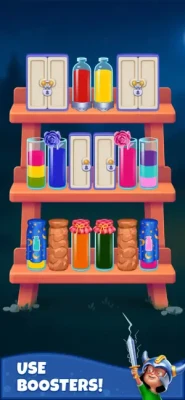
The game can become particularly challenging when you reach a point where there are no apparent moves left. Player reviews on the App Store specifically mention frustration around running out of moves and the use of additional bottles or other options. The developer has acknowledged this feedback and said it was reviewing the balance and clarity around these situations.
Because of this, efficient planning is particularly important.
If you want to minimize the chance of running out of moves:
- Avoid unnecessary pours.
- Keep at least one flexible bottle available.
- Build matching colors whenever it improves access.
- Avoid repeatedly reversing your previous move.
- Look several moves ahead before committing.
Family Sort Daily Challenges
Daily challenges provide a structured way to play outside the main progression.
A good approach is to treat each daily puzzle as a practice exercise.
Try to improve one skill at a time:
- Better opening moves
- Fewer temporary transfers
- Better use of empty bottles
- Faster recognition of blocked colors
- More efficient color grouping
This can gradually improve your performance on the regular levels as well.
Relaxing Gameplay and Atmosphere
Family Sort is deliberately designed around a calm puzzle atmosphere rather than fast action.
The App Store describes smooth animations, soft visual presentation, gentle interactions, and satisfying sorting moments. The developer also positions it as a game for relaxation, focus, mindfulness, and short or extended play sessions.
That makes the game a natural fit for players who enjoy water sort puzzles but prefer a slower, more relaxing experience.
Is Family Sort an Offline Game?
Yes. The App Store listing specifically promotes the game as an offline puzzle experience and says it can be played without Wi-Fi.
This makes it suitable for:
- Travel
- Waiting rooms
- Breaks
- Bedtime
- Commuting
- Short offline gaming sessions
Family Sort Difficulty
The basic rules are simple, but the difficulty increases as the layouts become more complicated.
Early levels are mainly about learning the pouring rules and color grouping.
Later puzzles require:
- Better space management
- Longer planning sequences
- Temporary storage
- Careful ordering
- Recognition of blocked colors
- Efficient use of available bottles
The game describes its progression as gradually increasing in difficulty and includes hundreds of handcrafted levels.
Family Sort Pros and Cons
Pros
- Simple tap-based controls
- Easy-to-understand sorting rules
- Hundreds of handcrafted levels
- Daily challenges
- Offline gameplay
- Relaxing presentation
- Colorful liquid-sorting mechanics
- Gradually increasing difficulty
- Suitable for short sessions
- Game Center support
Cons
- Difficult levels can require careful planning
- Move limitations can become frustrating for some players
- Advertising is part of the free-to-play experience
- Optional purchases are available
- Some player reviews raise concerns about forced advertisements and additional-move situations
The current US App Store listing shows a 4.8/5 rating from roughly 2,000 ratings, although individual player experiences differ.
Ads and In-App Purchases
Family Sort is free to download and contains advertising and optional in-app purchases.
The App Store currently lists purchases including Dog Bones, Kids Boost, a Welcome Pack, No-Ads Bundle, Travel Packs, Family Pass, and other offers.
Player reviews also discuss advertising and optional rewards. One reviewer reported seeing an advertisement after choosing a base reward, while the developer responded that ads should not play in that situation and said it was reviewing the issue.
Latest Family Sort Update
The current App Store listing shows version 1.0179, with the latest release described as bug fixes and performance improvements. The game's recent version history contains frequent updates focused on maintenance, performance, and bug fixes.
Family Sort Rating and Information
Developer: UNICO STUDIO
Category: Puzzle
Current US App Store Rating: 4.8/5
Ratings: Around 2,000
Age Rating: 4+
Size: Approximately 346.8 MB
Languages: English plus 18 additional languages
Contains: Advertising
In-App Purchases: Yes
Game Center: Supported
Platforms and Requirements
Family Sort is available on:
- iPhone
- iPad
- iPod touch
- Apple Vision
- Compatible Apple silicon Mac
The current listing requires iOS 15.0 or later on iPhone, iPadOS 15.0 or later on iPad, and macOS 12.0 or later with an Apple M1 chip or later for Mac.
Frequently Asked Questions
What is Family Sort?
Family Sort is a color sorting and liquid bottle puzzle game where players pour colored liquids between bottles and organize matching colors.
How do you play Family Sort?
Select a bottle and pour its available liquid into a suitable bottle. Continue organizing the colors until each puzzle is correctly sorted.
Is Family Sort free?
Yes. Family Sort is free to download, with advertising and optional in-app purchases.
Can Family Sort be played offline?
Yes. The App Store listing promotes the game as an offline/no-Wi-Fi puzzle experience.
Does Family Sort have many levels?
Yes. The developer describes the game as containing hundreds of handcrafted levels with progressively more complex layouts.
Does Family Sort have daily challenges?
Yes. The game includes structured daily challenge puzzles.
What is the best strategy for Family Sort?
Protect your empty bottles, avoid unnecessary pours, identify blocked colors, and plan several moves ahead before committing to a sequence.
What should I do when I run out of moves?
Review the sequence that created the problem. Look for unnecessary temporary transfers and consider whether you filled a bottle that should have remained available as workspace.
Is Family Sort suitable for beginners?
Yes. The basic pouring and color-matching rules are straightforward, while later levels introduce more complicated logic and planning.
Does Family Sort support Game Center?
Yes. The App Store listing shows Game Center support.
Final Family Sort Strategy Tip
Don't ask only where a color can go—ask where that move will leave you afterward.
The strongest Family Sort players treat empty bottles as valuable resources, protect their available space, and think several moves ahead. Build completed color groups when they improve the board, but don't sacrifice flexibility simply to finish one bottle early.
Once you start viewing every pour as part of a larger sequence, the harder color sort puzzles become much easier to understand and solve.
Rate the Game
User Reviews











Popular Games



















 Android
 iOS
iOS Windows
 Xbox
Xbox