
Latest Version
October 07, 2026
Radiant Cat Studio
Puzzle
iOS
0
Report a Problem
More About :game
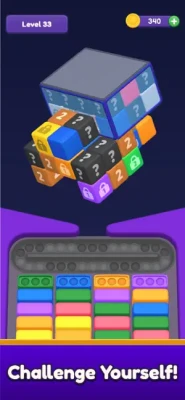
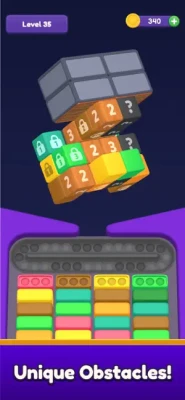
The game combines color matching, spatial planning, timing, and satisfying physics. Every tap can set a chain of marbles in motion, so choosing the correct cube at the correct moment is more important than simply matching colors as quickly as possible.
The App Store describes the game as a ball-sort and color puzzle, with marbles bouncing, rolling, colliding, and moving along a conveyor before reaching their matching trays.
What Makes Cube Marble 3D Different?
At first glance, Cube Marble 3D looks like a straightforward color-matching game.
The deeper challenge comes from the limited conveyor space.
You can have the correct colors available but still lose control of the puzzle if you release marbles in the wrong order.
A successful player therefore needs to think about:
Which cube to tap first
Which color should move next
How many marbles will be released
Where those marbles will travel
Whether the conveyor has enough room
Which tray will receive the next group
Whether a move will block another color
How the current move affects the following moves
The result is a puzzle that combines the accessibility of a color-sorting game with the planning of a logic puzzle.
How Cube Marble 3D Gameplay Works
The basic gameplay loop is easy to understand.
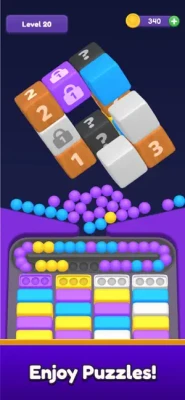
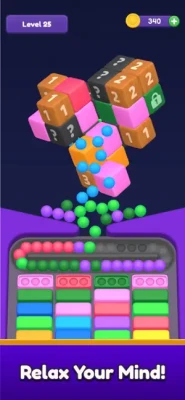
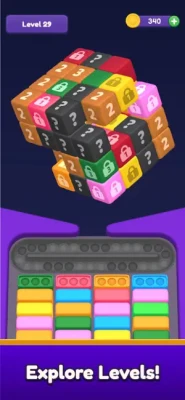
You begin with a board containing 3D cubes and colored marble groups.
Your objective is to clear the board by sending each group of marbles toward its matching color tray.
The general process is:
Examine the available cubes.
Identify the colors represented on the board.
Determine which cube is safest to activate.
Tap the selected cube.
Watch the marbles enter the conveyor.
Allow them to roll toward their matching tray.
Keep the conveyor from becoming overcrowded.
Choose the next cube based on the new board position.
Continue sorting until the puzzle is cleared.
The official listing emphasizes that every tap starts a chain of marbles in motion and that the conveyor has limited space.
The Most Important Rule: Watch the Conveyor
The conveyor is the heart of the strategy.
A move that looks good on the board can become a problem once several marbles are moving simultaneously.
Before tapping a cube, consider:
How much space will these marbles occupy?
Then ask:
Where will they go?
Finally:
Will this create room for my next move?
This simple three-question routine can prevent many unnecessary mistakes.
Cube Marble 3D Color-Sorting Strategy
Color matching is the foundation of the game, but matching the same color is not always enough.
You also need to match colors in an efficient order.
Identify the Available Colors
Start by scanning the board.
Determine:
Which colors are currently accessible
Which colors have matching trays
Which colors are likely to create congestion
Which cube can be activated without disrupting the board
This gives you a better idea of the puzzle's structure before you make the first move.
Look for Immediate Matches
If a cube releases marbles that can quickly reach an available matching tray, it may be a strong opening move.
Clearing a color early can create more room for subsequent groups.
Avoid Blind Color Matching
Do not automatically choose a cube just because its color has a visible matching tray.
The important question is whether the entire movement path is safe.
How to Manage Limited Conveyor Space
The limited conveyor is what prevents the game from becoming a simple tap-and-match experience.
If you release too many marbles without clearing them efficiently, the conveyor can become crowded.
That can leave later marble groups without enough room.
Keep the Conveyor Moving
Whenever possible, favor moves that allow marbles to continue toward their matching trays.
A good board position is one where marbles are constantly leaving the conveyor as new groups arrive.
Avoid Unnecessary Traffic
If one color is already occupying a significant portion of the conveyor, think carefully before releasing another large group.
Sometimes it is better to clear the current traffic before introducing another color.
Best Opening Strategy
At the beginning of a level, do not tap randomly.
Use this sequence:
Scan → Identify → Predict → Tap
Scan
Look at all visible cubes and colors.
Identify
Find the most useful available color group.
Predict
Think about what will happen to the marbles after the tap.
Tap
Only then activate the cube.
This takes slightly longer than immediately tapping the screen, but it gives you much greater control.
How to Choose Which Cube to Tap
When several cubes are available, evaluate them using four factors.
1. Color
Does the marble group have an obvious matching destination?
2. Quantity
How many marbles will be released?
A large group can be helpful if it can be cleared immediately, but dangerous if it overwhelms the conveyor.
3. Position
Where will the marbles enter the conveyor?
The starting position can affect how the board develops.
4. Follow-Up
What will the board look like after the move?
This is often the most important factor.
A move that solves one color but makes the next three moves difficult may be worse than a move that creates a longer chain of opportunities.
Think Two Moves Ahead
Beginners often think:
"Which color can I clear now?"
A stronger player thinks:
"Which color can I clear now, and what will that allow me to do next?"
Try to predict at least two moves ahead.
For example:
Blue → clears tray → opens space → release yellow → clear yellow
This type of chain is much safer than making isolated color matches.
Use Marble Physics to Your Advantage
Cube Marble 3D emphasizes satisfying physics, with marbles bouncing, rolling, colliding, and moving through the puzzle.
The physics are more than visual decoration.
Pay attention to how the marbles move.
A group that looks complicated may naturally separate or move toward its destination once released.
Likewise, releasing another group at the wrong time can create unnecessary congestion.
Watch the Marble Flow
Once you tap a cube, don't immediately plan your next tap without watching what happened.
Observe:
How quickly the marbles moved
Which tray they approached
How much conveyor space remains
Whether another color became accessible
Whether the board changed in an unexpected way
The movement itself provides information for your next decision.
Avoid Overloading One Color
If several groups of the same color are available, it can be tempting to release all of them immediately.
Sometimes that is excellent.
Sometimes it creates congestion.
Before combining several groups of the same color, make sure the matching tray and conveyor have enough capacity to handle the sequence.
Clearing the Board Efficiently
A strong solution generally follows this pattern:
Release → Sort → Clear → Open → Repeat
The goal is to create a continuous cycle where marbles enter the conveyor and leave it efficiently.
If the conveyor fills faster than it empties, reconsider your move order.
Cube Marble 3D Beginner Tips
Tip 1: Don't Tap Randomly
Every cube has consequences.
Look at the board first.
Tip 2: Prioritize Easy Clears
If a color can be sent directly to its matching tray, consider clearing it early.
Tip 3: Protect Conveyor Space
Space is a resource.
Do not waste it.
Tip 4: Watch the Whole Board
The best move may involve a cube that does not look important at first.
Tip 5: Plan Before Every Tap
Because each tap releases marbles, every action can change the board.
Tip 6: Watch the Physics
Observe how the marbles move instead of immediately tapping the next cube.
Tip 7: Create Chains
The best moves often lead naturally into the next move.
Tip 8: Avoid Blocking Yourself
Do not create a conveyor situation where several colors compete for limited space.
Advanced Cube Marble 3D Strategy
Once the basic mechanics become familiar, start thinking about board flow rather than individual colors.
Imagine the level as a system:
Cubes → Marble groups → Conveyor → Color trays
Every move affects one or more parts of this system.
Your objective is to keep the entire flow moving.
The Flow Principle
A good move should ideally do at least one of these things:
Clear marbles
Create conveyor space
Open a useful cube
Complete a color
Set up the next move
Reduce congestion
A move that accomplishes none of these should be questioned.
How to Recover From a Bad Position
If the conveyor becomes crowded, don't panic.
First determine what is causing the congestion.
Ask:
Which color is taking up the most space?
Then:
Can I clear that color immediately?
If yes, prioritize it.
If not, look for the move that opens the path toward its matching tray.
The best recovery move is usually the one that creates the most space rather than the one that produces the most visually satisfying match.
Common Mistakes
Tapping the Most Obvious Cube
The easiest-looking move is not always the best move.
Ignoring Conveyor Capacity
This is one of the biggest strategic errors.
Thinking Only About Color
Color matters, but movement and timing matter too.
Releasing Too Many Marbles
More marbles do not always mean faster progress.
Failing to Watch the Result
After each tap, the board changes.
Use that new information.
Playing Too Quickly
Cube Marble 3D is designed around planning.
Fast tapping can easily turn a solvable puzzle into a congested one.
How to Improve Your Puzzle-Solving Skills
If you want to become consistently better, practice predicting the result before tapping.
Before every move, say mentally:
"If I tap this cube, these marbles will move here, which should create this next opportunity."
Then see whether your prediction is correct.
Over time, you will become much better at reading the board.
Cube Marble 3D and Relaxing Gameplay
Although the puzzles require planning, the game is also designed to feel satisfying.
The colorful marbles roll, bounce, collide, and fall into position with physics-based movement and ASMR-style feedback.
This gives the game two complementary qualities:
Mental challenge through sorting and planning.
Relaxation through the smooth movement and satisfying marble effects.
That combination makes it suitable for short sessions as well as longer puzzle runs.
Graphics and Visual Style
Cube Marble 3D uses a bright, colorful 3D presentation centered around cubes, marbles, conveyors, and matching trays.
The visual design makes color recognition an important part of the experience.
The 3D perspective also helps give the simple sorting concept more depth than a traditional flat color-matching puzzle.
Controls
The controls are intentionally simple.
The main interaction is tapping the 3D cubes.
That simplicity means the challenge comes from decision-making rather than complicated controls.
The App Store lists the game for iPhone and iPad and requires iOS 15.0 or later.
Game Features
3D Cube Puzzles
Tap colorful cubes to release groups of marbles.
Color Sorting
Send marbles toward their matching color trays.
Moving Conveyor
The conveyor creates a limited-space puzzle that forces careful planning.
Marble Physics
Balls bounce, roll, collide, and move through the level with satisfying physics effects.
Strategic Timing
Choosing when to release each group is just as important as identifying its color.
Progressive Logic Challenges
The basic rules remain simple while the arrangement of cubes, marbles, and conveyor space creates increasingly interesting decisions.
Cube Marble 3D Difficulty
Cube Marble 3D is easy to understand but can become more challenging as the board demands better planning.
The basic objective is obvious:
Sort the marbles by color.
The difficult part is determining:
Which color should I release first?
That distinction gives the game its puzzle depth.
Players who think ahead and manage conveyor space carefully should have a much easier time than players who simply tap every available cube.
Who Should Play Cube Marble 3D?
Cube Marble 3D is a good choice for players who enjoy:
Color sorting games
Ball sort puzzles
Marble games
3D puzzle games
Logic puzzles
Casual mobile games
Relaxing games
ASMR-style gameplay
Matching puzzles
Brain games
Strategic sorting challenges
It is particularly appealing to players who like simple rules combined with gradually more demanding decisions.
Pros and Cons
Pros
Simple controls
Easy-to-understand color sorting
3D puzzle presentation
Satisfying marble physics
Moving conveyor adds strategic depth
Encourages planning and logical thinking
Relaxing ASMR-style feedback
Suitable for short gaming sessions
Colorful visual design
Easy to learn but capable of creating challenging situations
Cons
Limited conveyor space can be frustrating when a move goes wrong
Players who prefer fast-paced gameplay may find it slow
The current App Store listing does not yet have enough ratings or reviews to display an overall rating summary
Advertising and optional in-app purchases are included
Cube Marble 3D App Information
Developer: Radiant Cat Studio
Category: Puzzle
Age Rating: 4+
Platforms: iPhone and iPad
Language: English
App Size: Approximately 253.5 MB
Requires: iOS 15.0 or later
iPad: iPadOS 15.0 or later
Contains: Advertising
In-App Purchases: Yes
The current App Store listing also indicates compatibility with Apple Silicon Macs running macOS 15 or later and Apple Vision devices.
In-App Purchases
Cube Marble 3D is free to download and includes optional in-app purchases.
The current App Store listing includes several coin packages and bundles, including Starter, Value, and Royal Packs.
Players can focus on improving their puzzle strategy rather than depending on purchases to understand the core gameplay.
Is Cube Marble 3D Worth Playing?
Cube Marble 3D is worth trying if you enjoy colorful sorting puzzles and relaxing games that still require some planning.
Its strongest idea is the combination of 3D cubes, moving marbles, matching color trays, and limited conveyor space.
The game is easy to understand within a few seconds, but solving a board efficiently requires more thought than simply matching colors.
The most important skill is learning to see the board as a sequence of moves rather than a collection of individual cubes.
Final Verdict
Cube Marble 3D turns a straightforward color-sorting concept into a satisfying 3D puzzle experience.
The marbles provide the visual and physical appeal, while the conveyor creates the strategic pressure. Every tap changes the flow of the board, making move order important.
For casual players, the game offers an easy-to-learn puzzle format. For more strategic players, the limited conveyor space creates opportunities to plan several moves ahead and build efficient sorting chains.
The key to mastering Cube Marble 3D is simple:
Think before you tap, protect your conveyor space, clear colors efficiently, and always plan your next move.
Frequently Asked Questions
What is Cube Marble 3D?
Cube Marble 3D is a color-sorting puzzle game where players tap 3D cubes to release marbles and guide them toward matching color trays.
How do you play Cube Marble 3D?
Tap the appropriate cubes, release the colored marbles, and manage their movement along the conveyor until they reach their matching trays.
What makes Cube Marble 3D challenging?
The conveyor has limited space, so choosing the wrong order can cause congestion and make later moves more difficult.
Are the marbles controlled directly?
The core gameplay involves selecting cubes and managing the resulting marble flow rather than manually controlling each individual ball.
Is Cube Marble 3D a color-matching game?
Yes. Color matching is the central puzzle mechanic.
Does Cube Marble 3D use physics?
Yes. The App Store description highlights bouncing, rolling, collisions, and falling marble effects.
Is Cube Marble 3D relaxing?
The game combines logical sorting with relaxing marble movement and ASMR-style feedback, making it suitable for players who enjoy satisfying puzzle games.
Is Cube Marble 3D available on iPhone?
Yes. It is available for iPhone and iPad and requires iOS 15.0 or later.
Is Cube Marble 3D free?
Yes. The App Store lists the game as free with optional in-app purchases and advertising.
Who developed Cube Marble 3D?
Cube Marble 3D is developed by Radiant Cat Studio.
What is the best Cube Marble 3D strategy?
The strongest approach is to study the board before tapping, prioritize colors that can be cleared efficiently, protect conveyor space, and think at least one or two moves ahead.
Rate the Game
User Reviews











Popular Games



















 Android
 iOS
iOS Windows
 Xbox
Xbox