


Latest Version
October 05, 2026
Gamehouse LLC
Puzzle
iOS
0
Report a Problem
More About :game
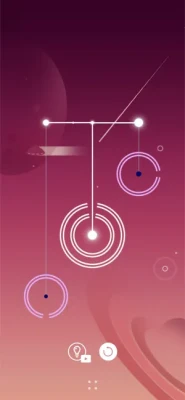
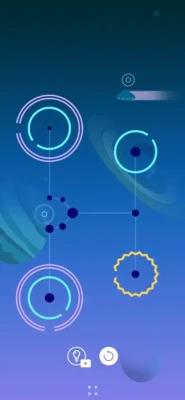
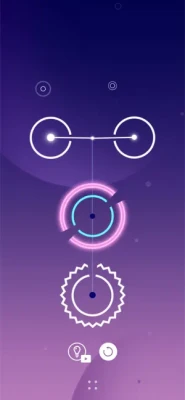
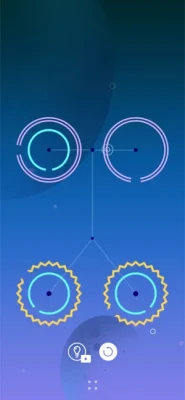
Every ring affects the others, so one move can trigger a chain reaction, change another ring's direction or completely alter your planned solution. With 250 handcrafted puzzles, evolving mechanics, no timers and a calm atmospheric presentation, the game rewards patience, observation and logical thinking rather than speed.
What Is Decipher: Brain Test?
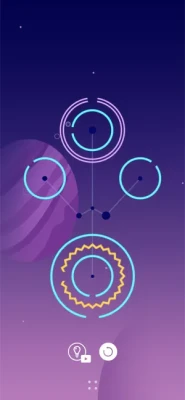
Decipher: Brain Test is a brain-training puzzle game centered around rotating and aligning interconnected rings.
At first, the concept appears simple: manipulate the rings until they reach the correct configuration. The challenge comes from the fact that the rings are connected.
Moving one ring can influence another, creating a chain reaction that changes the entire puzzle.
The result is a puzzle system where every move needs to be considered carefully.
The current App Store listing describes the game as a physics-based puzzle experience with 250 handcrafted puzzles, evolving mechanics and no timers or pressure.
Decipher: Brain Test Gameplay
The core gameplay revolves around three ideas:
Rotation
Alignment
Chain reactions
You aren't simply moving individual objects independently.
Instead, the puzzle behaves like a connected system.
A single rotation may:
Move another ring
Reverse another ring's direction
Change the position of several connected rings
Create a useful chain reaction
Undo progress you've already made
This interconnected structure is what gives Decipher its brain-teasing quality.
How the Ring Puzzle System Works
Think of each ring as part of a mechanical network.
Before making a move, consider:
What will this ring do?
Then ask:
Which other ring will react?
Finally:
Where will everything end up after the reaction?
This three-step thought process is more effective than repeatedly rotating rings and hoping the puzzle eventually solves itself.
The game specifically emphasizes the "Butterfly Effect," where one action can have a much larger consequence elsewhere in the puzzle.
Complete Decipher: Brain Test Strategy Guide
1. Don't Rush Your Moves
One of the biggest advantages in Decipher: Brain Test is that the game does not use a timer.
There is no reason to make a move before understanding its consequences.
Take a moment to inspect the entire puzzle.
Look at:
Ring positions
Ring connections
Current alignment
Direction of movement
Potential chain reactions
Then make your move.
Because there is no time pressure, careful planning is usually more valuable than fast reactions.
2. Understand the Connections First
Before trying to solve a difficult puzzle, determine which rings influence each other.
You can think of the puzzle as a network.
For example:
Ring A → Ring B → Ring C
If you rotate A, B may move.
If B moves, C may move.
That means A indirectly controls C.
Recognizing these relationships is often the key to solving a complicated board.
3. Identify the Most Important Ring
Not every ring has the same strategic importance.
Some rings can influence several others.
These are effectively the control points of the puzzle.
Look for a ring that:
Connects to multiple rings
Triggers several movements
Changes another ring's direction
Appears central to the puzzle structure
Once you've identified that ring, study what happens when it moves.
4. Work Backward From the Goal
Instead of asking:
"What should I move first?"
try asking:
"What needs to happen immediately before the puzzle is solved?"
Then determine which ring movement creates that situation.
Working backward can dramatically reduce the number of possible moves.
This is especially useful when several rings are interconnected.
5. Use Small Experiments
If you don't understand a puzzle, make one controlled move.
Watch what happens.
Then reset your mental plan and use that information.
You're effectively learning the puzzle's rules.
For example:
Rotate Ring A once.
Observe Ring B.
Observe Ring C.
Determine the relationship.
Use that information to plan the next move.
Don't make five random moves at once.
One controlled experiment gives you much more useful information.
The Butterfly Effect Strategy
The Butterfly Effect is central to Decipher's puzzle design.
A small action can produce a much larger result.
This means you should stop thinking about individual moves in isolation.
Instead, think about sequences.
For example:
Move A → reaction B → reaction C → final alignment
Your goal isn't necessarily to put Ring A into the correct position immediately.
Sometimes Ring A must move away from its apparent target so that another ring can eventually reach the correct position.
This is one of the most important concepts for advanced puzzles.
Don't Always Correct a Ring Immediately
Suppose you finally align one ring correctly.
It may be tempting to leave it untouched.
But another necessary move could cause it to rotate again.
Instead of protecting every correctly positioned ring, think about the final state of the entire puzzle.
A temporary mistake may actually be part of the solution.
This is particularly important in interconnected puzzles.
6. Look for Repeating Patterns
As new ring types and mechanics appear, look for patterns in how they behave.
Ask:
Does this ring always rotate clockwise?
Does another ring reverse direction?
Does one movement affect multiple rings?
Is there a repeating sequence?
Does the same type of connection produce the same reaction?
Once you recognize a recurring mechanic, later puzzles become easier because you don't have to rediscover the same rule.
7. Separate the Puzzle Into Sections
Large puzzles can become overwhelming if you try to understand everything simultaneously.
Divide the board mentally into smaller groups.
For example:
Left side → center → right side
or:
Outer rings → middle rings → inner rings
Solve the relationships within each section first.
Then determine how the sections interact.
This reduces mental overload.
8. Protect Your Progress
Once several rings are correctly aligned, avoid unnecessary moves.
Before touching another ring, ask:
Will this affect something I've already solved?
If the answer is yes, calculate the consequences first.
A common mistake is solving one section and then accidentally disturbing it while working on another.
9. Use the Calm Pace to Your Advantage
Decipher is specifically designed without timers.
That changes the ideal strategy.
You don't need:
Fast tapping
Reflexes
Rapid decisions
Guessing
Instead, focus on:
Observation
Logic
Pattern recognition
Planning
Experimentation
The relaxed pace is one of the game's strongest features.
10. Reset Your Thinking When Stuck
If you've tried the same solution several times without success, stop repeating it.
Take a different approach.
Ask:
What assumption am I making?
Maybe you're assuming:
A ring needs to move clockwise.
A correctly aligned ring must remain untouched.
The outer ring should be solved first.
The closest-looking solution is correct.
Questioning your assumptions often reveals the mistake.
Advanced Puzzle-Solving Method
For difficult puzzles, use this five-stage process.
Stage 1: Observe
Study every ring and connection.
Stage 2: Map
Determine which rings influence one another.
Stage 3: Test
Make one controlled move and observe the reaction.
Stage 4: Plan
Create a sequence of moves instead of solving one ring at a time.
Stage 5: Execute
Follow the sequence carefully and adjust only when the puzzle behaves differently than expected.
This method turns an apparently chaotic puzzle into a logical system.
How to Solve a Puzzle Efficiently
A useful mental checklist is:
Goal → Connections → Control Ring → Reaction → Sequence → Final Alignment
Before moving anything, identify the desired final configuration.
Then determine which ring can produce the necessary reaction.
Once you understand that relationship, build the move sequence backward or forward.
Tips for the 250 Puzzles
Decipher: Brain Test contains 250 handcrafted puzzles, so don't expect one universal solution strategy to work for every stage.
As the game introduces new ring types and mechanics, adapt your approach.
For early puzzles:
Learn the basic controls.
Understand ring connections.
Experiment freely.
For intermediate puzzles:
Track chain reactions.
Plan several moves ahead.
Identify important control rings.
For advanced puzzles:
Work backward from the goal.
Analyze multiple possible sequences.
Avoid disturbing solved sections.
Think about the entire system rather than individual rings.
How to Deal With New Ring Types
When a new ring type appears, don't immediately try to solve the puzzle.
First understand the mechanic.
Ask:
What happens when I rotate it?
Which rings respond?
Does its direction change?
Does it create a chain reaction?
Can it affect previously solved areas?
Once you understand the new mechanic, solving the actual puzzle becomes much easier.
Logic Over Speed
Decipher: Brain Test is fundamentally different from fast-paced puzzle games.
There are no timers and no pressure.
That means a player who thinks carefully can outperform someone who simply makes moves quickly.
The best players aren't necessarily the fastest.
They're the players who understand the relationships between the rings.
Relaxing Sci-Fi Atmosphere
The puzzle mechanics are presented inside a minimalist spacecraft drifting through an abstract universe.
The visual design avoids unnecessary distractions and supports the game's calm atmosphere.
Soothing music and abstract visuals complement the slow, thoughtful puzzle-solving experience.
This makes Decipher suitable for players who want something mentally challenging without the stress found in many competitive puzzle games.
Accessibility Features
The game includes a color-blind mode and haptic feedback, giving players additional ways to interact with the puzzle experience.
These features can be useful for players who prefer tactile feedback or need clearer visual differentiation.
Best Strategy for Difficult Decipher Puzzles
When a puzzle seems impossible, use this process:
Step 1
Stop moving rings randomly.
Step 2
Identify every connection.
Step 3
Find the ring that affects the most others.
Step 4
Test that ring once.
Step 5
Record the resulting chain reaction mentally.
Step 6
Determine whether the reaction moves you closer to the goal.
Step 7
Build a sequence around the useful reaction.
Step 8
Protect correctly aligned rings whenever possible.
This method is much more reliable than trial-and-error clicking.
Common Mistakes to Avoid
Making Too Many Moves
Random movement makes it difficult to understand cause and effect.
Solving Rings Individually
The rings are interconnected, so solving one independently may not work.
Ignoring Reverse Reactions
A move that looks helpful can trigger another ring in the opposite direction.
Focusing Only on the Center
Outer rings can have important effects on the entire puzzle.
Refusing to Undo a Good Move
Sometimes you must temporarily disturb a correctly positioned ring to solve the entire board.
Rushing
There is no timer, so rushing only increases mistakes.
Beginner Tips
If you're new to Decipher: Brain Test, remember these simple rules:
Take your time.
Study the connections.
Make one move at a time.
Watch every reaction.
Learn new mechanics before solving.
Think several moves ahead.
Don't panic when a ring moves unexpectedly.
Use chain reactions to your advantage.
Consider working backward from the goal.
Remember that temporary misalignment can be useful.
Advanced Tips
Experienced players should focus on sequence optimization.
Instead of merely finding a solution, look for a cleaner sequence.
Try to reduce:
Unnecessary rotations
Repeated movements
Accidental reversals
Moves that disturb solved sections
The goal is to understand the puzzle well enough that the final sequence feels deliberate rather than experimental.
Features of Decipher: Brain Test
250 Handcrafted Puzzles
The game offers 250 individually designed puzzles with mechanics that evolve as you progress.
Physics-Based Ring Mechanics
Connected rings react to your movements, creating complex chain reactions.
No Timers
You can solve puzzles at your own pace without countdowns or time pressure.
Evolving Mechanics
New ring types and puzzle behaviors appear as you progress.
Minimalist Sci-Fi World
The game takes place aboard a spacecraft surrounded by a calm abstract universe.
Soothing Audio
Relaxing music supports the game's thoughtful atmosphere.
Color-Blind Mode
A dedicated visual option improves accessibility.
Haptic Feedback
Haptics provide additional tactile feedback during gameplay.
Difficulty Guide
The difficulty comes from interaction, not speed.
Early puzzles teach the basic idea of connected rings.
Later puzzles become more demanding as additional mechanics are introduced.
The important transition is from:
"Move this ring into position."
to:
"Move this ring because it will cause another ring to move, which will eventually produce the required final configuration."
Once you begin thinking in chains rather than individual movements, the later puzzles become much easier to understand.
Is Decipher: Brain Test Good for Brain Training?
Decipher is a good choice for players who enjoy exercises involving:
Logical reasoning
Pattern recognition
Spatial thinking
Planning
Cause-and-effect reasoning
Problem solving
However, it is best described as a logic puzzle game rather than a scientifically validated cognitive training program.
Its main strength is providing a structured environment for practicing puzzle-solving and logical thinking while keeping the experience relaxing.
Pros and Cons
Pros
250 handcrafted puzzles
Clever interconnected ring mechanics
No timers
Relaxing sci-fi atmosphere
Evolving puzzle mechanics
Physics-based interactions
Soothing music
Color-blind mode
Haptic feedback
Suitable for short or long puzzle sessions
Strong emphasis on logic rather than reflexes
Cons
Some puzzles can become mentally demanding
Players who prefer action may find the pace too slow
Trial and error can become frustrating when the ring relationships are not immediately clear
The current App Store version includes advertising and subscription options
The game's current US App Store listing has only a small number of ratings, so its overall rating is based on limited review data.
Is Decipher: Brain Test Worth Playing?
Yes, especially for fans of relaxing logic puzzle games.
The game's strongest idea is its interconnected ring system. Every move matters because the rings don't behave as isolated pieces.
The absence of timers is another major advantage. Instead of forcing players to react quickly, Decipher encourages them to understand the puzzle and plan a solution.
The minimalist spacecraft setting, abstract visuals and soothing music reinforce that philosophy.
With 250 handcrafted puzzles, there is also enough content for players who enjoy gradually mastering increasingly complex mechanics.
If you enjoy brain teasers, logic puzzles, spatial puzzles, relaxing games and mechanical puzzle challenges, Decipher: Brain Test is worth trying.
Frequently Asked Questions
What is Decipher: Brain Test?
Decipher: Brain Test is a logic puzzle game in which players rotate and align interconnected space rings to solve puzzles.
How many puzzles are in Decipher?
The game contains 250 handcrafted puzzles.
Is Decipher a timed puzzle game?
No. The game is specifically designed without timers, allowing players to solve puzzles at their own pace.
How do the rings work?
The rings are connected, meaning rotating one can cause another ring to move, reverse direction or trigger a larger chain reaction.
What is the Butterfly Effect in Decipher?
It describes the game's chain-reaction mechanic, where a small movement can produce significant changes elsewhere in the puzzle.
Does Decipher get harder?
Yes. New ring types and mechanics are introduced as you progress, making later puzzles more complex.
Does the game have a color-blind mode?
Yes. The current App Store listing specifically includes a color-blind mode.
Does Decipher support haptic feedback?
Yes. Haptics are listed among the game's features.
Can I play Decipher without rushing?
Yes. There are no timers, so you can take your time analyzing each puzzle.
What is the best way to solve difficult puzzles?
Study the ring connections, identify which pieces influence others, test one movement at a time and plan the complete chain reaction before committing to a sequence.
Is Decipher: Brain Test free?
The US App Store currently lists it as free with in-app purchases. The game is also offered through GameHouse+, with advertising in the free option and a VIP subscription for ad-free access.
Final Verdict
Decipher: Brain Test is a thoughtful puzzle experience built around a deceptively simple idea: rotate connected rings until everything aligns.
What makes it interesting is the relationship between the rings. One small movement can completely change the state of the puzzle, forcing you to think about cause and effect rather than simply moving pieces toward their apparent destinations.
With 250 handcrafted puzzles, evolving mechanics, no timers, relaxing music and a minimalist sci-fi setting, the game offers a strong alternative to stressful or competitive brain games.
The best strategy is simple: slow down, understand the connections, plan the chain reaction and think several moves ahead.
For players who enjoy logic games, brain teasers, spatial puzzles, mechanical puzzles and relaxing problem-solving games, Decipher: Brain Test offers a satisfying challenge without putting you under a clock.
Rate the Game
User Reviews













Popular Games



















 Android
 iOS
iOS Windows
 Xbox
Xbox