
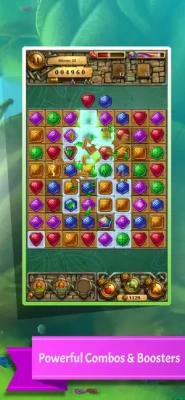
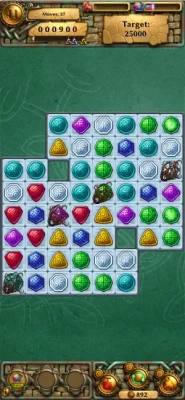
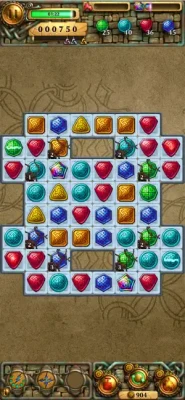
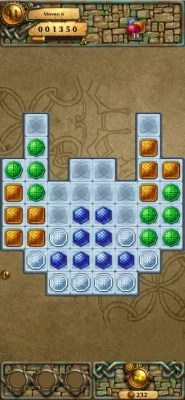
Latest Version
October 05, 2026
Gamehouse LLC
Puzzle
iOS
0
Report a Problem
More About :game
Developed by GameHouse LLC, the game features 120 Match 3 levels, five different game modes, powerful boosters, replayable stages, and 35 achievements to unlock. Its flexible chip-linking system makes every board a small strategy challenge rather than a simple matching exercise.
What Is Jewel Tree - Match It!?
Jewel Tree - Match It! is a strategy-focused matching puzzle game built around connecting colorful chips. The main objective is to create useful chains, clear the board efficiently, build combos, and earn high scores.
What makes it different from many conventional jewel matching games is the freedom of movement. Matching chains can be connected in multiple directions, allowing you to look beyond simple horizontal or vertical combinations.
The game also encourages replaying completed stages so you can improve your previous scores and refine your approach.
How the Gameplay Works
The basic concept is easy to understand, but getting consistently high scores requires planning.
Look for groups of matching chips and connect them into chains. Rather than immediately taking the first available match, examine the surrounding board and consider whether a longer chain or better combination is possible.
The game specifically allows players to:
Link matching chips in different directions
Build longer chains
Backtrack during chain creation
Create combos
Use boosters
Replay levels for better scores
Complete special game modes
Work toward 35 achievements
The unusual chain system is the heart of Jewel Tree - Match It! and gives experienced players considerably more room for strategic play.
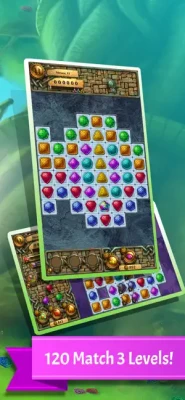
120 Match 3 Levels
The campaign contains 120 Match 3 levels, giving the game a substantial amount of puzzle content.
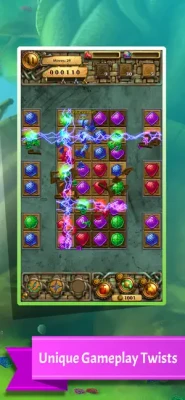
The levels are designed around different gameplay twists rather than relying on exactly the same board pattern every time. As you progress, simply making obvious matches becomes less effective, and planning your chains becomes increasingly important.
A good approach is to treat each level as a scoring puzzle rather than just something you need to finish.
How to Approach a New Level
Before making your first move:
Scan the entire board.
Identify the largest obvious groups.
Look for chips that can create multiple connections.
Check whether a longer chain is possible.
Consider where your move will leave the remaining board.
Save useful opportunities for combinations when possible.
This small pause can prevent you from wasting potentially valuable chains.
The Unique Chip-Linking System
The biggest difference between Jewel Tree - Match It! and traditional match-3 games is its chain-linking mechanic.
You are not restricted to thinking only about adjacent swaps. Matching chips can be connected in different directions, giving you more freedom to construct chains.
This creates an important strategic question:
Should you make a quick match now, or build a longer chain for a stronger score?
In many situations, the longer option is preferable, especially when it can lead into another combination.
Chain Strategy
When several matching chips are available, look for:
Long uninterrupted paths
Diagonal connections
Opportunities to change direction
Groups that can be extended
Chains that create follow-up matches
Positions that help activate boosters
Longer chains are generally more valuable than repeatedly taking small isolated matches, particularly when you are replaying a level to improve your score.
Boosters and Combos
Boosters are an important part of the game's strategy.
Instead of using them immediately whenever they become available, consider the current board first. A booster can be much more valuable when used to solve a difficult section or extend a strong scoring sequence.
Booster Tips
Use boosters strategically when:
The board contains difficult combinations
A move can create a larger chain
You are close to completing a difficult objective
A booster can trigger additional matches
You are replaying a level specifically for a higher score
Avoid wasting powerful tools on easy sections that you could clear naturally.
How to Build Better Combos
Combos are one of the best ways to increase your scoring potential.
A strong combo usually begins with recognizing how one move affects the next.
Instead of thinking:
“What can I match right now?”
Try thinking:
“What will this match create afterward?”
That second approach is much more useful when trying to achieve higher scores.
Combo-Building Tips
1. Search for long chains first
A longer connection can provide more value than several tiny matches.
2. Look beyond the obvious move
The first available combination isn't always the best one.
3. Plan around boosters
A booster can sometimes turn an ordinary position into a much stronger scoring opportunity.
4. Avoid breaking useful groups too early
If several matching chips can potentially form a larger chain, don't rush to consume them.
5. Think about the next move
Good puzzle players are already planning their follow-up before making the current move.
Five Game Modes
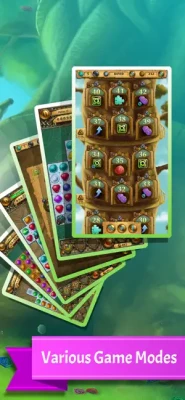
Jewel Tree - Match It! offers five different game modes, helping keep the gameplay from becoming repetitive. The App Store specifically identifies Puzzle and Memory among the available modes.
Puzzle Mode
Puzzle-style challenges reward careful thinking rather than simply making the fastest possible matches.
Look at the entire arrangement before committing to a move. A seemingly simple chain may open a much better opportunity elsewhere on the board.
Memory Mode
Memory introduces a different type of challenge. Instead of relying exclusively on visual matching and immediate reactions, you need to pay attention to patterns and remember useful information.
Take your time and avoid making moves simply because they look attractive.
Other Game Modes
The remaining modes add additional variations to the core chip-linking formula. This variety is useful because it changes how you approach the board and prevents the campaign from feeling like 120 copies of the same puzzle.
35 Achievements to Unlock
The game includes 35 achievements for players who want additional goals beyond simply completing levels.
If you are interested in completing everything, don't focus exclusively on finishing the campaign.
Replay earlier levels, experiment with different chain routes, improve your scores, and learn how the game's different modes reward different styles of play.
Replay Levels for Higher Scores
One of the game's strongest features for puzzle fans is its replayability.
Finishing a level is only part of the challenge. Once you understand its layout and mechanics, you can return and attempt to improve your previous result.
Best Replay Strategy
On your first attempt, concentrate on understanding the level.
On later attempts:
Remember where the strongest chains were located.
Try a different opening move.
Look for longer connections.
Use boosters more efficiently.
Search for combo opportunities.
Avoid unnecessary small matches.
Compare your result with your previous best.
This makes replaying meaningful instead of simply repeating the same solution.
Full Jewel Tree - Match It! Strategy Guide
Tip 1: Don't Make the First Match You See
The most obvious match is not necessarily the best match.
Take a moment to inspect the whole board. Another group may provide a longer chain or create a much better follow-up opportunity.
Tip 2: Prioritize Longer Chains
When two moves are equally safe, favor the one that connects more matching chips.
Longer chains can help increase your score and may create better board positions.
Tip 3: Plan Your Path
Because chips can be connected in different directions, don't limit yourself to straight-line thinking.
Check horizontal, vertical, and diagonal possibilities before committing to a chain.
Tip 4: Look for Backtracking Opportunities
The ability to backtrack while linking chips adds another layer of strategy. When forming a chain, examine whether returning through an available route can increase its length.
Tip 5: Save Boosters for Difficult Moments
Boosters are most valuable when they solve a genuine problem.
Using one simply because it is available can leave you without an important tool later.
Tip 6: Think About Board Position
A good match does more than give you points.
It can also change the board and expose new opportunities.
Before completing a chain, consider what the board could look like afterward.
Tip 7: Use Replay Mode as Practice
Don't treat replaying a completed stage as wasted time.
Repeated attempts are one of the best ways to learn the game's scoring system and discover better chain routes.
Tip 8: Adapt to Each Mode
The best strategy for a Puzzle challenge may not be the best strategy for a Memory challenge.
Pay attention to what each mode is testing and adjust your approach accordingly.
Tip 9: Chase Achievements Naturally
If you're aiming for all 35 achievements, keep track of which challenges you have already completed.
Some goals may be easier to accomplish while replaying earlier levels than during your first campaign run.
Tip 10: Focus on Consistency
You don't need to find the perfect move every time.
A consistent habit of scanning the board, identifying long chains, planning ahead, and using boosters intelligently will make you a much stronger player.
Beginner's Guide to Jewel Tree - Match It!
If you're new to the game, start by learning the basic chain mechanics rather than worrying about maximum scores.
First-Time Player Checklist
Learn how chip chains work.
Experiment with different directions.
Try short and long chains.
Test the available boosters.
Play several different modes.
Replay an early level.
Compare your new score with the old one.
Begin working toward achievements.
Once the core mechanics feel natural, start concentrating on longer chains and combo setups.
Advanced Scoring Strategy
Players chasing high scores should approach every board as a sequence of opportunities.
A strong turn can often be described as:
Long chain → board change → new match → combo → booster opportunity
The exact sequence depends on the board, but the principle remains the same: don't evaluate moves independently.
The strongest players constantly consider how the current move affects the next several possibilities.
Common Mistakes to Avoid
Making Small Matches Too Quickly
Small matches can be useful, but automatically taking them whenever they appear can eliminate better opportunities.
Ignoring Diagonal Connections
The game's flexible linking system rewards players who look beyond traditional straight-line matching.
Using Boosters Without a Plan
A booster should have a purpose. Save it when a stronger opportunity is likely to appear.
Forgetting About Replay Value
A completed level is not necessarily a mastered level.
Returning to previous stages can reveal better routes and improve your scores.
Playing Every Mode the Same Way
Different modes change the type of thinking required. Adapt instead of relying on one routine.
Graphics and Atmosphere
Jewel Tree - Match It! focuses on colorful jewel and chip-based puzzle visuals rather than a large story-driven world.
The presentation is designed around quick recognition of matching pieces, readable puzzle boards, and the satisfying feeling of completing chains.
Its simple structure makes it suitable for short puzzle sessions while the score-chasing and achievement systems provide reasons to keep playing.
Difficulty and Replayability
The basic mechanics are approachable, but the scoring system gives the game more depth than a simple casual matching title.
The combination of 120 levels, five modes, boosters, combos, achievements, and replayable stages provides multiple reasons to return after completing individual puzzles.
For casual players, the game can be enjoyed as a relaxed matching experience. For competitive puzzle fans, the high-score element creates a stronger challenge.
Pros and Cons
Pros
120 Match 3 levels
Five different game modes
Unique directional chip-linking mechanics
Boosters and combos
Replayable levels
35 achievements
Easy-to-understand core concept
Suitable for short or longer puzzle sessions
Available on iPhone and iPad
Cons
Players looking for a traditional swap-based match-3 game may need time to adjust
High-score chasing can become repetitive for players who prefer story-driven games
Some advanced strategies require experimentation and replaying levels
Jewel Tree - Match It! Game Information
| Information | Details |
|---|---|
| Game | Jewel Tree - Match It! |
| Developer | GameHouse LLC |
| Genre | Strategy / Match 3 / Puzzle |
| Levels | 120 |
| Game Modes | 5 |
| Achievements | 35 |
| Platforms | iPhone, iPad |
| Age Rating | 4+ |
| Languages | English + 7 more |
| App Size | 77.3 MB |
| Compatibility | iOS 13.0 or later; iPadOS 13.0 or later |
| Business Model | Free with in-app purchases |
| Main Mechanics | Chip linking, combos, boosters, high scores |
| Developer | GameHouse LLC |
The current App Store listing confirms the platform compatibility, size, rating, category, developer, languages, and in-app purchase options.
Frequently Asked Questions
Is Jewel Tree - Match It! a match-3 game?
Yes. It is a match-3 puzzle game with a distinctive chip-linking system that allows matching chains to be created in different directions.
How many levels are in Jewel Tree - Match It!?
There are 120 Match 3 levels in the current App Store listing.
Does Jewel Tree - Match It! have boosters?
Yes. Boosters and combos are part of the game's scoring and puzzle mechanics.
Can I replay levels?
Yes. The game specifically allows players to replay levels to try to beat their previous scores.
How many achievements are there?
Jewel Tree - Match It! features 35 achievements.
Does the game have different game modes?
Yes. There are five game modes, including Puzzle and Memory.
Can chips be connected diagonally?
The game's chain system allows connections in different directions, making diagonal and unconventional routes an important part of the strategy.
Is Jewel Tree - Match It! available on iPhone and iPad?
Yes. The App Store lists the game for iPhone and iPad. It requires iOS 13.0 or later on iPhone and iPadOS 13.0 or later on iPad.
Is Jewel Tree - Match It! free?
The App Store lists the game as free with in-app purchases. GameHouse also offers subscription options that provide access to its broader game catalog.
Final Verdict
Jewel Tree - Match It! is a refreshing take on the match-3 puzzle formula. Its biggest strength is the freedom to connect matching chips in multiple directions rather than relying entirely on traditional jewel-swapping mechanics.
With 120 levels, five game modes, boosters, combos, replayable stages, and 35 achievements, there is plenty for both casual players and score-focused puzzle fans to explore.
If you enjoy match-3 games but want something that rewards more deliberate planning and creative chain-building, Jewel Tree - Match It! is worth trying.
Rate the Game
User Reviews














Popular Games



















 Android
 iOS
iOS Windows
 Xbox
Xbox