


Latest Version
September 16, 2026
ABI GLOBAL LTD.
Puzzle
iOS
0
Report a Problem
More About :game
The rules are easy to learn, but the puzzles become more challenging as winding lines, overlapping paths, tighter spaces, and different arrow directions appear. One incorrect tap can interfere with another path, while the correct sequence can trigger a satisfying chain reaction that clears several shapes.
Unlike timed puzzle games, Tap Line Out does not require fast reactions. The App Store specifically describes it as a no-timer, no-penalty experience, allowing players to study the board and solve each puzzle at their own pace.
How to Play Tap Line Out
The basic gameplay can be summarized in four steps:
- Study the arrows and their directions.
- Determine where each shape will travel.
- Tap the arrows in the correct order.
- Clear every shape from the map.
The important part is sequence. An arrow may appear ready to tap, but activating it too early can cause another path to become blocked.
The goal is therefore not simply to tap every arrow. You need to understand how the lines interact and find the order that allows the entire board to clear.
Main Features
Simple Tap Controls
Tap Line Out uses an easy control system. Tap a curved arrow and the corresponding shape moves along its path toward the exit.
The controls are simple enough for beginners, while the increasingly complicated layouts provide the strategic challenge.
Curved Arrow Paths
The arrows determine the direction in which shapes move. Learning to read their curves and destinations is one of the most important skills in the game.
Overlapping Lines
As levels become harder, paths can overlap and interact with each other. This means the order of your moves becomes increasingly important.
Chain Reactions
A correctly chosen move can open another path, allowing subsequent shapes to escape in a smooth sequence.
Finding these potential chains is one of the most satisfying parts of Tap Line Out.
Hundreds of Handcrafted Levels
The App Store describes the game as containing hundreds of handcrafted levels with gradually increasing difficulty.
No Timer
There is no countdown forcing you to rush. You can examine the board, predict the movement of each shape, and decide on the safest sequence before tapping.
Clean Visual Style
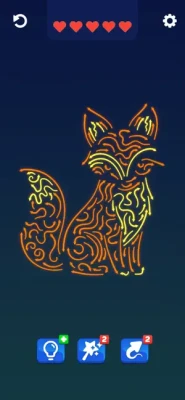
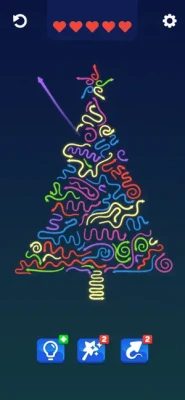
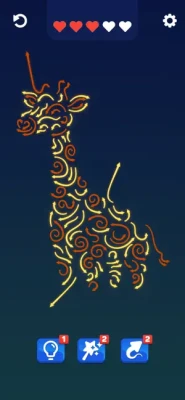
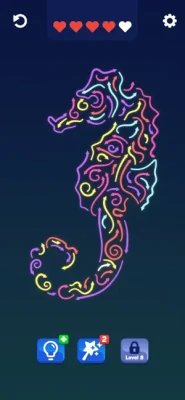
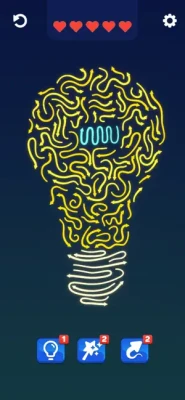
The game uses a dark background with bright, colorful lines and shapes, keeping the paths easy to identify while giving the puzzles a calm visual presentation.
Full Tap Line Out Strategy Guide
1. Don't Tap the First Arrow You See
The most important beginner lesson is simple:
Look before you tap.
An arrow that appears to have a clear route may actually be connected to another path that needs to move first.
Before making your first move, scan the entire puzzle.
Look for:
- Arrows pointing toward open space
- Shapes that are already close to an exit
- Lines crossing other paths
- Arrows blocked by other shapes
- Potential chain reactions
- Paths that become available after another shape moves
2. Find the Safest First Move
A good first move usually has a predictable result.
Look for an arrow where:
- The path is unobstructed.
- The destination is obvious.
- Moving the shape won't interfere with another route.
- The move opens additional possibilities.
If you are uncertain about several arrows, start with the one whose consequences are easiest to predict.
3. Read the Direction of Every Arrow
Don't just look at where an arrow is located.
Look at where it points.
Curved arrows can make a path appear to travel in one direction while actually sending the shape somewhere else. Follow the complete line visually before deciding what to tap.
This becomes particularly important when several paths overlap.
4. Trace the Shape's Route
Before tapping an arrow, mentally follow the shape's route.
Ask:
Where will this shape go?
Then ask:
What will happen to the rest of the board after it leaves?
This simple habit prevents many incorrect moves.
5. Search for the Exit First
Instead of beginning with the most obvious arrow, sometimes it is easier to work backward.
Find a shape that can clearly escape and determine which arrow needs to move it.
Then identify whether another shape is blocking that arrow.
This creates a useful reverse-solving method:
Exit → required arrow → blocker → previous move.
6. Identify Blocking Paths
Some shapes are effectively obstacles.
They may prevent another shape from reaching its exit or stop an important arrow from being activated.
If one shape is blocking several possible moves, it may be the key to solving the puzzle.
Move it first if its path is safe.
7. Look for Chain Reactions
A strong move can create a sequence such as:
Arrow tapped → shape exits → path opens → second arrow becomes available → second shape exits.
When you notice this type of sequence, follow it.
Chain reactions are often more efficient than solving every shape independently.
8. Don't Solve Shapes in Visual Order
The position of a shape on the screen doesn't necessarily indicate when it should be moved.
A shape near the top may need to wait while a shape at the bottom moves first.
Think in terms of dependencies rather than screen position.
9. Use the No-Timer System to Your Advantage
Because Tap Line Out does not use a timer, there is little reason to rush.
Before each tap, take a moment to verify:
- Direction
- Destination
- Possible blockers
- Next available move
Careful observation is more valuable than speed.
10. Recalculate After Every Move
The board changes whenever a shape leaves.
A path that was previously blocked may now be completely open.
Don't automatically follow a plan you created several moves earlier. Re-examine the board after each important movement.
Advanced Tap Line Out Strategy
Work Backward From the Solution
When a puzzle becomes complicated, solving from the beginning can be difficult.
Try working backward.
Find a shape that obviously needs to leave the map.
Then determine:
- Which arrow moves it?
- What is blocking that arrow?
- Which shape must move first?
- Which arrow controls that shape?
Continue backward until you reach a move that can safely be made immediately.
This is especially effective on tightly packed boards.
Identify Dependencies
Think of the puzzle as a series of dependencies.
For example:
Shape C must leave → Arrow C must activate → Shape B must move first → Arrow B must activate → Shape A must leave.
This tells you that the actual solution begins with A even though C may be the most obvious target.
Separate Independent Paths
Not every shape interacts with every other shape.
If you identify two paths that are completely independent, solve the easier one first.
This reduces the number of possibilities you need to consider.
Find the Bottleneck
Many difficult puzzles have one critical location where several paths intersect.
This is the bottleneck.
Identify it and determine which shape needs to move through that area first.
Once the bottleneck is cleared, the rest of the puzzle may become much simpler.
Tap Line Out Tips and Tricks
- Scan the entire board before your first tap.
- Follow each curved arrow to its destination.
- Identify shapes with completely clear exits.
- Look for blockers before moving important paths.
- Work backward when the solution isn't obvious.
- Search for chain reactions.
- Don't assume visual position determines move order.
- Recheck the board after every shape exits.
- Separate independent paths when possible.
- Identify the main bottleneck on complicated boards.
- Take advantage of the lack of a timer.
- Don't tap randomly just to see what happens.
- If you make a poor move, reconsider the sequence rather than repeating it.
- Look for the move that creates the most new options.
Common Mistakes in Tap Line Out
Tapping Random Arrows
Random tapping can make it harder to understand the board.
Since there is no timer, spend a few seconds planning instead.
Ignoring Arrow Direction
The direction of the curved arrow is fundamental. A path that looks visually close to an exit may not actually lead there.
Moving a Shape Too Early
A shape may have a valid path but still need to wait because its movement can interfere with another route.
Focusing on One Shape
The puzzle is about the relationship between all shapes and paths.
Don't solve one shape without considering what its movement does to the rest of the board.
Missing the Chain Reaction
Sometimes the best solution involves setting up one move that automatically makes several later moves easier.
Always ask what becomes available after each successful move.
Overthinking Simple Boards
Not every puzzle requires a complicated sequence.
If one arrow has an obvious, unobstructed path, use it and then reassess.
How to Solve Difficult Tap Line Out Levels
When you're stuck, use this process.
Step 1: Stop Tapping
Take a moment to look at the whole map.
Step 2: Find the Exits
Identify the shapes with the clearest routes out.
Step 3: Trace Their Arrows
Determine which arrows control those shapes.
Step 4: Find the Blockers
Look for shapes preventing those arrows or paths from functioning.
Step 5: Work Backward
Determine what needs to move before the blocker can leave.
Step 6: Find the First Safe Move
Choose the move whose outcome is easiest to predict.
Step 7: Reassess
Once the first shape leaves, examine the new board.
Step 8: Follow the Chain
Continue with the newly available paths.
A Simple Winning Routine
For most levels, use this five-step routine:
Scan → Trace → Prioritize → Tap → Recheck
Scan
Look over every arrow and shape.
Trace
Follow the paths to understand where each shape will travel.
Prioritize
Choose the shape or blocker that should move first.
Tap
Make one deliberate move.
Recheck
Analyze the new board before continuing.
This approach works particularly well because Tap Line Out doesn't require speed.
Tap Line Out Progression
The game starts with straightforward arrangements and gradually introduces tighter spaces, different arrow directions, winding paths, and layered layouts. The App Store describes hundreds of handcrafted levels with smooth difficulty progression.
As the puzzles become more complicated, the main skill changes from simply understanding the controls to recognizing relationships between paths.
The most difficult boards are usually solved through sequencing rather than speed.
Current Updates and Version Information
The App Store version history shows version 1.2, with level updates listed in the recent release history. Earlier version 1.1 also included level updates.
The Google Play listing has also continued to receive level additions, with the listing showing an update on August 3, 2026.
Because additional levels can be added over time, individual puzzle layouts may change as the game receives new content.
Platforms and Requirements
The App Store lists Tap Line Out for iPhone and iPad. It requires iOS 15.0 or later on iPhone and iPadOS 15.0 or later on iPad. Compatible Mac use requires macOS 12.0 or later with an Apple M1 chip or later.
The game is free to download and includes advertising and optional in-app purchases. The App Store currently lists options including removing ads and several gold packages.
Languages
The App Store lists English, French, German, Japanese, Korean, Simplified Chinese, Spanish, and Traditional Chinese.
Age Rating
Tap Line Out has an App Store age rating of 9+.
Frequently Asked Questions
What is Tap Line Out?
Tap Line Out is a logic puzzle game where you tap curved arrows to guide shapes along their paths and out of the map.
How do you play Tap Line Out?
Study the arrows and shapes, determine the correct movement order, then tap the arrows to send each shape out of the puzzle.
Is Tap Line Out a timed game?
No. The App Store specifically describes the game as having no timers or penalties, allowing players to solve puzzles at their own pace.
Does Tap Line Out have many levels?
Yes. The App Store describes the game as featuring hundreds of handcrafted levels with gradually increasing difficulty.
What makes Tap Line Out difficult?
The later puzzles introduce tighter spaces, winding arrows, overlapping paths, different directions, and layered arrangements.
What is the best Tap Line Out strategy?
Study the entire board first, trace each arrow's path, identify blockers, work backward from obvious exits, and look for chain reactions.
Can you play Tap Line Out without rushing?
Yes. There is no timer, so you can take your time to study the paths and determine the correct sequence.
Is Tap Line Out free?
Yes. The App Store lists it as free with advertising and optional in-app purchases.
Can I play Tap Line Out on iPad?
Yes. The App Store lists both iPhone and iPad compatibility.
Final Thoughts
Tap Line Out takes a very simple idea—tap arrows to move shapes—and turns it into a surprisingly thoughtful logic puzzle. The controls are easy, but the correct order becomes increasingly important as paths overlap and boards become more crowded.
The biggest advantage you have is time. There is no countdown, so don't play it like a reaction game. Study the paths, identify blockers, trace where each shape will travel, and look for a sequence that naturally opens the next move.
The most useful formula to remember is:
Scan → Trace → Prioritize → Tap → Recheck.
With hundreds of handcrafted levels, colorful paths, smooth movement, and a relaxed no-timer format, Tap Line Out is designed for players who enjoy satisfying puzzles that reward observation and logical planning.
Rate the Game
User Reviews















Popular Games
















 Android
 iOS
iOS Windows
 Xbox
Xbox