


Latest Version
September 09, 2024
Homa
Card
Android
0
com.free.spider.solitaire.card.game
Report a Problem
More About :game
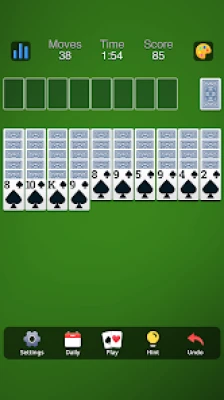
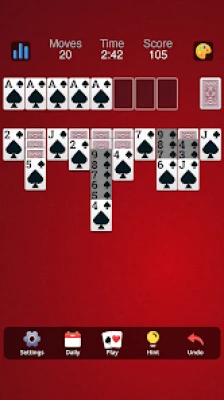
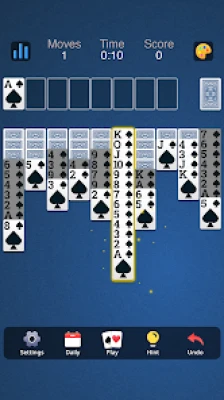
The game features multiple difficulty levels, intuitive tap or drag controls, daily challenges, customization options, statistics and leaderboards, along with an auto-complete option for finishing solved positions. It is designed to be easy to pick up while still rewarding players who think several moves ahead.
What Is Spider Solitaire: Card Game?
Spider Solitaire is a strategic variation of classic solitaire built around arranging cards from King down to Ace. Unlike Klondike, Spider Solitaire focuses heavily on building and reorganizing sequences within the tableau.
The Homa version presents the traditional card-game concept in a mobile-friendly format, with smooth controls, visual customization, different difficulty settings and additional progression features.
The current Android listing reports more than 1 million installs and a 4.8-star rating from more than 27,000 reviews. The current listed version is 1.24.1.
Game Information
Game: Spider Solitaire: Card Game
Developer: Homa
Genre: Card / Solitaire
Platform: Android
Content Rating: Everyone
Current Version: 1.24.1
Latest Listed Update: October 7, 2026
Google Play Installs: 1M+
Google Play Rating: Approximately 4.8 stars
Game Style: Classic Spider Solitaire
Controls: Tap and drag
Difficulty: Easy, Medium and Hard
Features: Daily Challenges, customization, statistics, leaderboards and auto-complete
The Main Objective
The goal is to arrange cards into complete descending sequences:
King → Queen → Jack → 10 → 9 → 8 → 7 → 6 → 5 → 4 → 3 → 2 → Ace
A completed sequence is removed from the tableau, opening additional space for other cards.
Standard Spider Solitaire uses two 52-card decks, giving a total of 104 cards. Ten tableau columns form the main playing area, while the remaining cards are dealt from the stock during the game. A winning game requires clearing eight complete King-to-Ace sequences.
Understanding the Tableau
The tableau is where almost all of your strategic decisions happen.
Cards can be arranged in descending numerical order. For example:
A 9 can be placed on a 10.
An 8 can be placed on a 9.
A 7 can be placed on an 8.
The important distinction is that a complete same-suit sequence is much more valuable than a mixed-suit sequence.
For example:
9♠ – 8♠ – 7♠ – 6♠
is a properly connected same-suit sequence.
A mixed sequence such as:
9♠ – 8♥ – 7♠ – 6♦
may be useful for temporary organization, but it cannot be moved as one complete Spider sequence in the same way as a correctly ordered same-suit run.
How to Play Spider Solitaire
Step 1: Look Before Making the First Move
Do not immediately move the first card that appears useful.
Instead, scan all ten columns and identify:
Face-down cards that can be uncovered
Possible descending moves
Cards that could create an empty column
Existing same-suit sequences
High cards blocking important lower cards
Your first objective should normally be increasing information, not simply making any legal move.
Step 2: Reveal Face-Down Cards
Uncovering hidden cards is one of the strongest early-game objectives.
Whenever you have a choice between:
moving a card that reveals a hidden card, or
making a move that changes nothing underneath,
the move that exposes a new card is often more valuable.
Every newly revealed card gives you another piece of information and can create additional combinations.
Step 3: Build Descending Sequences
Look for opportunities to connect cards into descending runs.
For example:
K → Q → J → 10 → 9
is much more useful than five isolated cards because the connected sequence gives you greater control over the tableau.
Whenever possible, extend existing same-suit sequences rather than constantly creating new mixed stacks.
Step 4: Create Empty Columns
An empty tableau column is one of the most powerful resources in Spider Solitaire.
A vacant column gives you somewhere to temporarily store a card or movable sequence.
This can allow you to:
Break apart blocked arrangements
Move a large same-suit sequence
Reach hidden cards
Reorganize several columns
Build a complete sequence more efficiently
However, do not create an empty column and immediately fill it without considering what you gained.
An empty column is valuable because of the future moves it enables.
The Most Important Spider Solitaire Strategy
Prioritize Mobility Over Immediate Completion
One of the most common mistakes is trying to complete a sequence too quickly.
Suppose you can complete a short sequence but doing so leaves several important cards buried underneath other stacks. Another move may not look as rewarding but could expose multiple hidden cards.
In many positions, the second option is better.
Think about the tableau as a puzzle:
Reveal → reorganize → create space → build same-suit runs → complete sequences.
Same-Suit Runs Are Your Greatest Asset
A same-suit descending sequence is the most flexible structure on the board.
For example:
Q♣ – J♣ – 10♣ – 9♣ – 8♣
can be moved together as a sequence.
If those same values are mixed between suits, you generally lose that ability to move the entire group together.
This is why experienced players constantly try to transform mixed stacks into same-suit runs.
How to Deal With Mixed-Suit Stacks
Mixed stacks are not automatically bad.
They can help you temporarily arrange cards and expose hidden cards.
The problem occurs when you allow too many mixed sequences to accumulate.
A good approach is:
Use mixed stacks when necessary.
Search for matching-suit cards underneath or nearby.
Rebuild the sequence into one suit when possible.
Avoid burying important cards under unnecessary mixed arrangements.
Use empty columns to reorganize complicated stacks.
The goal is not to avoid mixed stacks completely. The goal is to prevent them from controlling the board.
When Should You Deal New Cards?
The stock should not be treated as something to use automatically whenever you have a few spare moves.
Before dealing another row, inspect the tableau.
Ask:
Can I expose another hidden card first?
Can I create an empty column?
Can I improve a same-suit sequence?
Can I move a blocking King or Queen?
Can I separate a troublesome mixed stack?
Is there a useful move that I will lose if I deal now?
Once you deal new cards, the board can become significantly more complicated.
Therefore, maximize the useful moves already available before adding another group of cards.
The King Problem
Kings are powerful but awkward.
A King cannot simply be placed on another card because it is the highest rank. A King can also occupy an empty column for a long time and prevent that space from being used for smaller sequences.
When you have an empty column, consider carefully whether placing a King there will help you reorganize the board or simply consume your valuable space.
A King can be useful as a temporary anchor, but it should not be allowed to become a permanent obstacle.
Queen and Jack Management
Queens and Jacks frequently become important connectors between high and low cards.
If you have:
K – Q – J – 10
you have the beginning of a useful descending chain.
Avoid breaking such sequences unnecessarily unless doing so will:
Reveal a hidden card
Create an empty column
Complete a same-suit sequence
Free a more important card
Good Spider Solitaire play often means knowing when not to move a card.
Use Empty Columns Carefully
An empty column is especially powerful when you already have a movable same-suit sequence ready to occupy it.
For example, if you have:
9♠ – 8♠ – 7♠ – 6♠
and another column is empty, you can use that space to reorganize the board around the sequence.
But if you fill the empty column with a single card without a clear follow-up plan, you may lose much of its strategic value.
A Good Rule
Before filling an empty column, ask:
“What will this move allow me to do next?”
If the answer is clear, the move is probably useful.
Building Toward a Complete Suit
A strong mid-game objective is to work toward a complete same-suit sequence.
For example:
K♠ → Q♠ → J♠ → 10♠ → 9♠ → 8♠ → 7♠ → 6♠ → 5♠ → 4♠ → 3♠ → 2♠ → A♠
Once the entire sequence is assembled, it can be cleared from the tableau.
Every completed sequence reduces the number of active cards and gives you more freedom to solve the remaining board.
Beginner Strategy
If you are new to Spider Solitaire, concentrate on five habits:
Reveal hidden cards early.
Build descending sequences whenever possible.
Prefer same-suit sequences.
Create empty columns when the opportunity is safe.
Think about your next two or three moves before acting.
Do not worry about finishing quickly.
A slower game with better card organization is usually more successful than a fast game filled with unnecessary moves.
Intermediate Strategy
Once you understand the basic rules, start evaluating moves based on their future value.
Before making a move, consider:
What card becomes exposed?
Does the move create or destroy an empty column?
Does it improve a same-suit sequence?
Will the destination column become harder to use?
Does it make the next stock deal safer?
Can another move achieve the same result with less risk?
This turns Spider Solitaire from a simple card-placement game into a genuine planning puzzle.
Advanced Strategy
Advanced play revolves around preserving flexibility.
1. Keep Multiple Options Open
Avoid moves that leave you with only one possible continuation unless they are necessary.
2. Protect Empty Columns
Do not waste empty spaces.
A vacant column is effectively an additional planning tool.
3. Build Same-Suit Runs Gradually
You do not always need to complete a King-to-Ace sequence immediately.
Sometimes building:
10 → 9 → 8 → 7
is enough to create an important movable block.
4. Delay Difficult Stock Deals
If the tableau still offers useful moves, exploit them first.
5. Look for Blocking Cards
Sometimes the most important card is not the card you want to move, but the card preventing you from reaching another card.
Identify those blockers and prioritize removing them.
Easy, Medium and Hard Modes
The game provides multiple difficulty levels, including Easy, Medium and Hard.
Easy
Use the easier mode to learn:
Descending card placement
Same-suit sequences
Empty-column management
Hidden-card exposure
Stock management
Medium
Medium difficulty is a good environment for improving planning.
You should begin paying more attention to the consequences of every move rather than simply looking for legal moves.
Hard
Hard mode demands stronger organization and deeper planning.
At this level, mistakes involving empty columns, mixed-suit sequences and premature stock deals can become much more difficult to recover from.
Daily Challenges
Daily Challenges provide an additional reason to return to the game and test your card-management skills.
Instead of simply playing random games, treat a challenge as a puzzle to study carefully.
If your first attempt fails, analyze the point where your available moves began to disappear.
Ask:
Did I waste an empty column?
Did I break a useful sequence?
Did I deal cards too early?
Did I fail to expose hidden cards?
Did I create too many mixed-suit stacks?
Learning from failed positions can improve your overall Spider Solitaire ability.
Using Hints Wisely
Hints can be useful when you are learning the game or genuinely stuck.
However, do not rely on hints for every decision.
A better learning method is:
Think about the position yourself.
Choose the move you believe is strongest.
Use a hint only if you cannot identify another useful move.
Compare the suggested move with your original idea.
Understand why the move is useful.
This helps develop pattern recognition instead of simply following instructions.
Auto-Complete
The game includes an auto-complete feature that can help finish a position once the remaining play is effectively solved.
Use it as a convenience rather than as a replacement for strategy.
The most satisfying part of Spider Solitaire is solving the difficult middle portion of the board, where decisions about card order and empty spaces matter most.
Customization
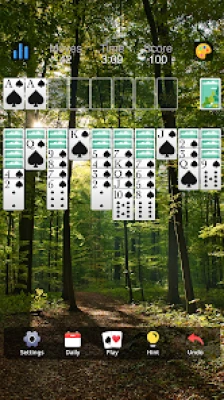
The game offers customization options for card designs and backgrounds, allowing players to personalize the appearance of their solitaire table.
These options do not fundamentally change the rules, but they can make longer sessions more comfortable and visually enjoyable.
Statistics and Leaderboards
Statistics provide a useful way to track your progress over time, while leaderboards add a competitive element for players who enjoy comparing performance.
Instead of focusing only on the number of wins, look at how your decision-making improves.
A strong player should gradually become better at:
Creating empty columns
Revealing hidden cards
Building same-suit runs
Avoiding dead positions
Planning before dealing from the stock
Common Mistakes to Avoid
Filling an Empty Column Too Quickly
An empty space is valuable. Do not use it simply because a card can legally occupy it.
Chasing Short-Term Moves
A legal move is not necessarily a good move.
Always consider what the board will look like afterward.
Building Too Many Mixed Runs
Mixed sequences can become difficult to reorganize later.
Ignoring Hidden Cards
A move that reveals a face-down card can often be more valuable than one that merely rearranges visible cards.
Dealing Too Early
Use available tableau moves before adding more cards from the stock whenever possible.
Breaking a Strong Same-Suit Run
Do not dismantle a flexible same-suit sequence unless there is a clear strategic benefit.
Blocking Your Best Column
A poorly placed high card can make a column difficult to use. Think carefully before committing Kings and other high cards to empty spaces.
A Practical Winning Routine
For a repeatable approach, use this sequence:
1. Scan the entire tableau.
Look for every legal move and every potential blocker.
2. Reveal hidden cards.
Prioritize moves that expose new information.
3. Build descending sequences.
Connect cards whenever doing so improves your structure.
4. Improve same-suit runs.
Whenever possible, transform mixed arrangements into movable same-suit blocks.
5. Create an empty column.
Look for safe opportunities to free a column.
6. Use the empty column strategically.
Move a sequence or temporary card there only when it creates further options.
7. Complete a suit.
Work toward King-to-Ace sequences that can be removed.
8. Reassess before dealing.
Use as many useful tableau moves as possible before taking another stock row.
9. Repeat.
Continue reducing the board until all eight complete sequences have been cleared.
Tips for Improving Your Win Rate
Think at least two moves ahead.
Prioritize hidden-card exposure.
Preserve empty columns.
Build same-suit sequences whenever possible.
Avoid unnecessary rearrangement.
Do not automatically make the first available move.
Use difficult cards as part of a larger plan.
Delay stock deals when useful moves remain.
Study failed games instead of immediately restarting.
Learn to recognize dead-end positions before committing to them.
Difficulty and Learning Curve
Spider Solitaire is easy to understand but considerably deeper than it first appears.
Beginner: Learn descending order and basic movement.
Intermediate: Manage empty columns and start prioritizing same-suit runs.
Advanced: Plan several moves ahead, preserve flexibility and manage stock deals carefully.
The difficulty comes less from complicated controls and more from the consequences of seemingly small decisions.
Controls
The game is designed around simple mobile controls.
Cards can be moved through tap or drag interactions, making the core gameplay accessible on a touchscreen.
The simple controls are useful because Spider Solitaire itself requires most of your attention for planning rather than operating the interface.
Visual Style and Atmosphere
Spider Solitaire: Card Game takes a relaxed, classic-card-game approach rather than trying to turn solitaire into an action experience.
The combination of card animations, customizable backgrounds and traditional solitaire mechanics gives it a casual atmosphere suited to short sessions or longer puzzle-playing sessions.
Player Experience
The game's strong store rating indicates generally positive reception, while the large number of ratings suggests an established player base.
The core appeal is straightforward: it preserves the familiar Spider Solitaire concept while adding mobile conveniences such as challenges, customization, statistics, leaderboards and auto-complete.
Pros
Classic Spider Solitaire gameplay
Multiple difficulty levels
Simple tap and drag controls
Daily Challenges
Card and background customization
Statistics and leaderboards
Auto-complete feature
Suitable for short or long sessions
Easy to learn but strategically challenging
Cons
The hardest games can become difficult to recover from after poor decisions.
Players who prefer completely minimalist solitaire may find the additional features unnecessary.
The game is fundamentally a traditional solitaire experience, so players looking for action or story-driven gameplay will not find that here.
Is Spider Solitaire: Card Game Worth Playing?
Yes, especially if you enjoy traditional solitaire and want a mobile version with additional features.
The strongest part of the experience remains the card puzzle itself. The extra systems—daily challenges, customization, statistics and leaderboards—give regular players additional reasons to keep playing without changing the fundamental character of Spider Solitaire.
For beginners, the easier difficulty provides a comfortable introduction. More experienced players can focus on improving their planning and tackling harder layouts.
Final Verdict
Spider Solitaire: Card Game is a solid modern take on a classic card puzzle. Its appeal comes from the combination of familiar Spider Solitaire rules and convenient mobile features.
The key to mastering it is not speed. It is organization, patience and forward planning.
Reveal hidden cards, protect empty columns, build same-suit sequences, and think carefully before dealing from the stock. Once those habits become natural, the game becomes much more manageable—and considerably more satisfying.
Frequently Asked Questions
What is the goal of Spider Solitaire?
The objective is to arrange cards into complete descending King-to-Ace sequences and clear the tableau. Standard Spider Solitaire requires eight complete sequences.
How many cards are used in Spider Solitaire?
Traditional Spider Solitaire uses two standard 52-card decks, for a total of 104 cards.
How many tableau columns are there?
A standard Spider Solitaire layout uses ten tableau columns.
Can you move a whole sequence?
Yes, when the cards form a properly ordered same-suit sequence, the complete run can be moved together.
What is the easiest Spider Solitaire strategy?
Focus on revealing hidden cards, creating empty columns and building same-suit descending sequences.
Are empty columns important?
Yes. Empty columns provide valuable space for reorganizing the tableau and moving sequences.
Should I always complete a sequence as soon as possible?
Not necessarily. Completing a sequence is useful, but sometimes delaying completion allows you to expose more hidden cards or create better board flexibility.
Is Spider Solitaire harder than Klondike?
Many players find Spider Solitaire more demanding because it requires extensive tableau management and planning. The difficulty also depends heavily on the number of suits being used.
Does the game have daily challenges?
Yes. The current game listing includes Daily Challenges as one of its features.
Does Spider Solitaire: Card Game have customization?
Yes. The game provides different card designs and backgrounds.
Does it have statistics?
Yes. Statistics and leaderboards are listed among the game's features.
Rate the Game
User Reviews









Popular Games



















 Android
 iOS
 Windows
 Xbox